

This thematic thread considers the figure of the anti-hero/anti-heroine and the lens of anti-heroism, and proposes a heuristic reformulation, the anti-hero*ine, to grasp more acutely the complexities and ambiguities in the interplay of power, agency and morality in relation to contemporary struggles for justice, rights, and social change. Pursuing this line of inquiry also allows us to reflect on and celebrate the work and scholarship of our friend, colleague and mentor, Jane Cowan. The thread continues a discussion we initiated on the occasion of her Festschrift workshop, ‘Anti-hero*ines of International Social, Political and Legal Practice: An International Exploratory Workshop’, which took place at the University of Lausanne in June 2024.
In a moment of heightened political and ideological polarisation, how do people invested in the pursuit of justice, rights and/or social change navigate the grey zone (a term we borrow from Primo Levi [1989]) of everyday morality? What are the constraints and possibilities that remain open to contest hegemonic ideologies and policies when the space for constructive democratic debate is gradually vanishing? The lens of the anti-hero*ine allows us to explore this grey zone: to look at ways of acting that are fraught with compromise and analyse them, rather than respond with moral condemnation or shallow relativism.
Bringing together scholars in anthropology, sociology, law and socio-legal studies, this thematic thread has a twofold theoretical and methodological contribution. From a theoretical perspective, we explore new avenues for thinking about the tensions between social structures and individual agency using the figure of the anti-hero*ine as a heuristic device.
The lens of the anti-hero*ine allows us to […] to look at ways of acting that are fraught with compromise and analyse them, rather than respond with moral condemnation or shallow relativism.
In literature and cinema, the anti-hero or anti-heroine, as classically understood, is the protagonist of a narrative or drama ‘who lacks the admirable qualities of fortitude, courage, honesty, and decency’ (Chandler and Munday 2016) but who is nonetheless often complex and compelling. An early 17th century prototype of the anti-heroine, Racine’s character Phèdre is forced to surrender to an oppressive social system but, in submitting to it, disavows her own shortcomings and blames others for her immoral conduct (Kennedy 2014: 165). While the story serves as a vehicle for social critique and for denouncing the abusive authority of an absolutist system, it is Phèdre’s predicament that is particularly poignant. She is aware of her immoral conduct, to which she ultimately confesses, but feels both torn and trapped: she cannot act otherwise. As both victim and offender, Phèdre compels the play’s audience to reflect on the question of responsibility: should she be held responsible for her lies and their consequences, given her structural position of relative powerlessness?
The confounding complexities of the current zeitgeist for women, with its promises of female self-actualisation undermined by male backlash, endemic misogyny and new forms of exploitation and humiliation (such as deepfake pornography), have given rise to a plethora of richly inventive anti-heroine characters created in fiction and for the screen: Lisbeth Salander in The Girl with the Dragon Tattoo, Amy Dunne in Gone Girl, Villanelle in Killing Eve, Queen Anne and her two aspiring, competing companions in The Favourite and Harper Stern in Industry. Real life figures, too, fascinate and horrify in equal measure. Luigi Mangione, who allegedly fatally shot Brian Thompson, the C.E.O of UnitedHealthcare in Manhattan on 4 December 2024, has been hailed as the modern anti-hero. Memes and neo-murder ballads have been swift to appear online. While his (alleged) actions make him, for some, a moral outcast, someone who ‘went too far’, others see him as a folk hero or a social bandit. His actions have opened a space for critique, allowing people to vent their righteous frustration at the corrupt, for-profit US health-insurance system.
In their papers, contributors explore the anti-hero*ic mode of being and action as a lens for a more ordinary predicament in which people operating in complex contexts under constrained conditions, and caught between competing moral and political imperatives, must make difficult choices and assume responsibility for the consequences.
The anti-hero and anti-heroine, fertile and suggestive concepts, continually attract new interpretations. Our anti-hero*ine builds on, yet diverges from, these. Unlike the classic heroes and heroines, anti-heroes and anti-heroines, our anti-hero*ine typically eschews the social and political limelight. Rarely tragic or tragicomic, as in the classic definitions, our anti-hero*ine is often an unexceptional character whose dilemmas, hesitations, struggles and shortcomings illuminate the difficulties of acting morally amidst the vagaries of power. In their papers, contributors explore the anti-hero*ic mode of being and action as a lens for a more ordinary predicament in which people operating in complex contexts under constrained conditions, and caught between competing moral and political imperatives, must make difficult choices and assume responsibility for the consequences.
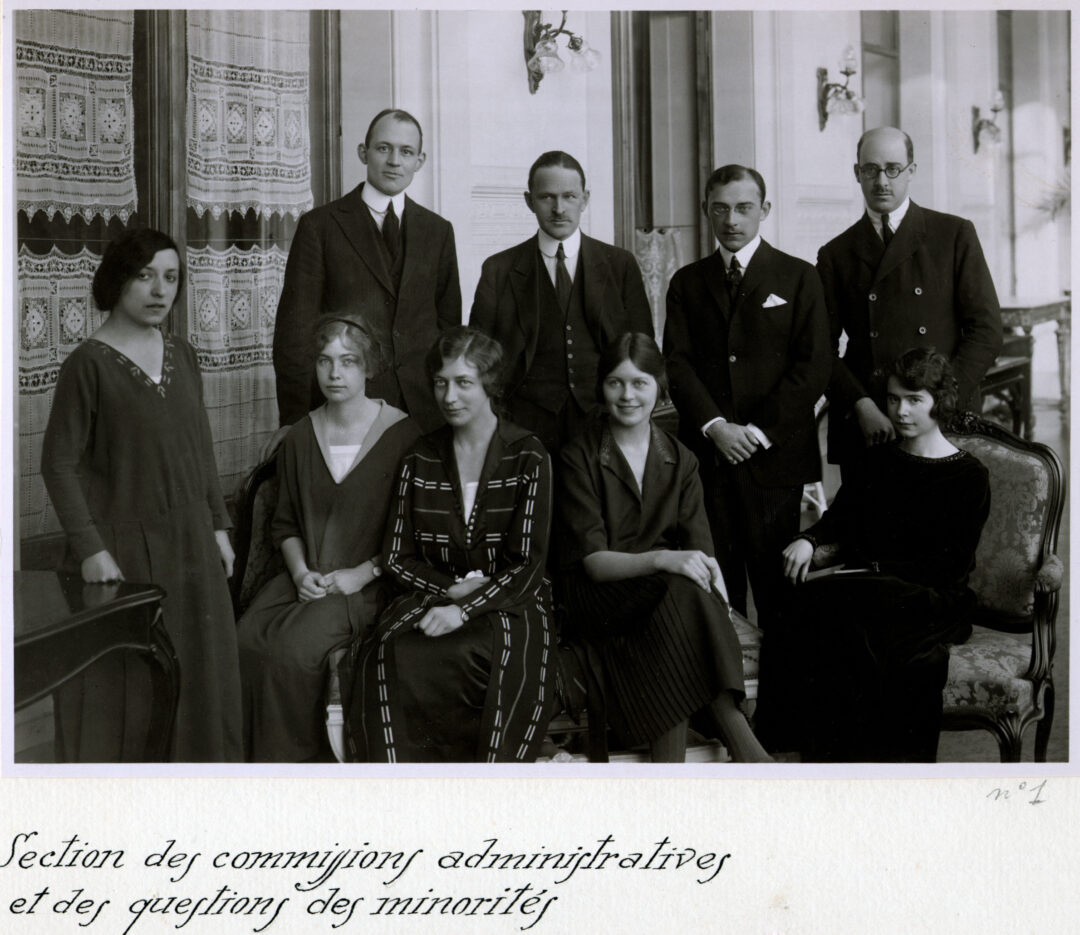
Male officials and female stenographers of the League of Nations Secretariat, Administrative Commissions and Minorities Questions Section, S01. Photo provided by the United Nations Library and Archives, Geneva.
We are especially interested in examining these issues for actors within political, legal and social organisations and movements that aim to transform, or at least, ‘do good’ in the world. We take our cues from Jane Cowan’s work, which explores actors facing different kinds of dilemmas. They have included Greek girls who, in their dancing, must be concomitantly beautiful, seductive and modest (Cowan 1990); League of Nations international civil servants who, as they tried to balance the competing obligations of minority protection, minority rights and conflict prevention, recognised the limits of their space for action, and thus, dutifully (if sometimes reluctantly) tended to sacrifice what minority claimants saw as ‘justice’ (Cowan 2003, 2027, 2020); and diplomats navigating the challenges of acting ‘virtuously’ and solidaristically within the constrained public space of the United Nations’ human rights mechanism, the Universal Periodic Review (Cowan 2021, 2024). Our contributors’ papers investigate the experiences of bureaucrats, humanitarians, lawyers, activists and former revolutionaries who oscillate between disillusionment and hope, cynicism and commitment.
We ask: How might attention to actors’ practices assist us in exploring the distinction between self-righteous moralising, which closes off the political energies essential for meaningful social change, and moral judgement, a contingent and always fraught disposition that may lead to ‘least bad’ rather than ‘black and white’ positioning or solutions? And how can critical social science research contribute to teasing out these ambiguities and crafting analytical narratives that go beyond heroic saviourism or cynical dismissal?
Our plural noun, anti-hero*ines, uses the feminine plural ending (‘ines’), defiantly reversing conventional practice in many European languages where all genders are subsumed in the plural male ending (a nod toward our feminist commitments).
To mark the contrast of our figure with the classic anti-hero and anti-heroine, we have invented a new spelling. Our plural noun, anti-hero*ines, uses the feminine plural ending (‘ines’), defiantly reversing conventional practice in many European languages where all genders are subsumed in the plural male ending (a nod toward our feminist commitments). What about the asterisk? German speakers and writers currently use the asterisk to make gendered nouns gender-neutral, by placing it between the generic masculine form and the feminine ending. We borrow this trick, making our theoretical figure gender inclusive: anti-hero*ine can be used for all genders. The asterisked form works as a capacious category without gender inflection, like a job advertisement open to all regardless of gender. It was in this spirit that we invited our workshop participants to consider any anti-hero*ic figure who might, heuristically, shed light on dilemmas of acting ethically.
Yet the gender neutrality-as-inclusivity so important to the invitation showed itself, once deployed to analyse specific persons in specific contexts, insufficient analytically. The worlds our contributors describe are gendered, though in different ways and to varying degrees. The actors—our anti-hero*ines—operate within them as socially gendered actors, and this is a crucial element of the analysis. A gender-neutral term—teacher, architect, civil servant, anti-hero*ine—does not invite us to explore an individual’s gendered identifications and experiences, and may even obscure them. Consequently, some of our contributors continue to use the terms heroes and heroines, anti-heroes and anti-heroines. Gender matters aside, the asterisk performs another, equally important theoretical task: it distinguishes hero* from hero, marking the word, placing it under scrutiny, ‘troubling’ its conventional meanings. We do not resolve these ambiguities here; our concept, the anti-hero*ine, is heuristic, a concept-in-progress, and for now, we stay with the trouble.
It prompts us to ask: to what extent does this mode of political practice embrace vulnerability, fallibility, and partial knowledge? What are its possibilities and limits in enabling us to confront, collectively, the coming political, economic, social and climatic transitions?
Going beyond individual anti-hero*ines, we also explore anti-hero*ism as practice. Against the individualising focus of the inspirational leader, the folk anti-hero murderer, or the whistle-blower, the anti-hero*ic mode of political practice involves effacement, as seen in leaderless political and social movements (Black Lives Matter, environmental movements, feminist activism) as well as in political, legal and social organisations. It focuses on ‘the work’, collectively carried out, rather than the individual as such. It homes in on a ‘slow’ temporality, helping us to notice the pragmatic ways in which ordinary people, caught in a bind between a dis-satisfying present and an uncertain future, ‘slog through’ disappointments and disillusionments and turn to ‘slow moving political action’ (Greenberg and Muir 2022, 315). It prompts us to ask: to what extent does this mode of political practice embrace vulnerability, fallibility, and partial knowledge? What are its possibilities and limits in enabling us to confront, collectively, the coming political, economic, social and climatic transitions?
At the same time, the anti-hero*ine figure constitutes a challenge to the hegemonic, almost mythical figure of the heroic anthropologist who settles alone in remote and exotic places to study ‘Others’. As Nayanika Mathur and Liana Chua have argued (2018), the ‘anthropological We’ has historically been constituted through exclusionary dynamics between the ‘Global South’ and the ‘Global North’ as well as along racial, gender and class lines that, despite efforts to re-think the politics and ethics of representation, the ‘reflexive turn’ of the 1980s did not fully address. Building on Chua and Mathur’s plea to resist the elitist ‘We’ of the dominant white, male anthropology figures of the 20th century, this thematic thread also deploys the ‘anti-hero*ic scholar’ as an alternative ethos of academic citizenship. The anti-hero*ic scholar, with all their contradictions and flaws, emerges as an appealing counter-model to the ‘academic rockstar’ currently promoted by the neoliberal university: one that is closer to the empirical realities observed in ethnographic fieldwork, that is more plural and more faithful to life, and thus more inspiring.
Methodologically, anti-hero*ism is a characteristically feminist research method. It pluralizes social representations, notably by bringing women and minorities into the picture and paying close attention to the people doing the practical work of justice delivery. Jane’s research style is anti-hero*ic in its concern to complexify historical narratives built upon heroic figures by incorporating characters who work quietly in the background of big political maneuvering without drawing too much attention to themselves, but whose mundane labour reflects their commitment to world improvement. The five contributions to this thread engage with our theme in varied and insightful ways. The first two productively ‘trouble’ classic ideas of the heroine through close attention to specific sociopolitical contexts. Alice Wilson considers the case of former Omani female fighters who, after the crushing of their anti-colonial revolution and the imposition of conservative gender norms, gain a reputation as exceptionally conservative. To the contrary, she discerns evidence that within their extremely constrained and surveilled postwar daily lives, many such women remain committed to and enact the revolution’s emancipatory values. Challenging the Orientalising gaze that prejudges and delimits what a revolutionary ‘heroine’ looks and acts like, Wilson brings to light lasting revolutionary afterlives. Evthymios Papataxiarchis examines a local discourse of heroism that arose within Greece to describe grassroots responses to the European ‘refugee crisis’. With a focus on an elderly ‘granny’ captured in a photo that went round the world, and subsequently dubbed a ‘heroine of solidarity’, he outlines the tensions and distortions created when everyday acts of care (such as bottle feeding a refugee baby) became reimagined as heroic gestures of ‘solidarity’. He considers the social burdens and moral dilemmas that hierarchical, neoliberal forms of humanitarian distinction generated for those singled out for recognition and for their communities, unpacking the ambiguities of the politics of distinction, which both celebrate and discipline those designated as ‘heroic’.
Our third contribution follows actors navigating the bureaucratic structures of a legal institution. Within Greece’s migration management system Christina Miliou-Theocharaki finds strategically maintained ambiguity, uncertainty and withholding of information as techniques of governance that perpetuate precarity for asylum seekers. She considers the practices of two ‘street-level bureaucrats’ who neither resign themselves to the state’s punitive status quo nor challenge it constantly, burn out and give up, but variously, both sustain and subvert institutional practices. The two final contributions think with the anti-hero*ine in order to imagine and theorise new anti-hero*ic modes of political practice. Cognisant of the failures of Euro-modern law and the international human rights system to prevent state abandonment and even annihiliation of racialised subjects, Bal Sokhi-Bulley advocates exploring conceptual alternatives. She proposes radical friendship, drawing inspiration from the Sikh ethics of seva : an ethics of care and service that draws actors, including human rights practitioners, toward a collective goal. Seva, she argues, can inspire a jurisprudence of the future where rights, always open to being collectively imagined and rethought, are grounded in practices of friendship. Seva can also inform making the world otherwise in everyday practices of resistance. Andrew Graan excavates the history of the project form and troubles the heroic narrative of individualised, autonomous world-transforming, as well as self-making, agency at its centre. If today the value and utility of the project is taken as self-evident and imagined as universal, Graan points out the ‘scandal’ and ridicule that initially surrounded such attempts to narrate a conditional future. Provincialising the project, Graan opens up the counter question of what it might mean to give up on projects, with their assumption of an ever improvable future, and inhabit a space of anti-projects. In these, he urges, we could ‘stay with the trouble’ (Haraway 2016), learning to be truly present in a flawed, unfinished world.
Our thread contributions reflect on issues of power and representation in academic writing and experiment with ‘anti-hero*ic’ writing techniques. In different ways, they all critically query the dominant modes of writing and knowledge production in social science that still too often cleave to solitary, heroic ‘trailblazing’ logics of authorship. Inspired by feminist writing techniques, they reflect the constructive collaborations and interdisciplinary exchange among participants that made our Lausanne workshop so exhilarating.
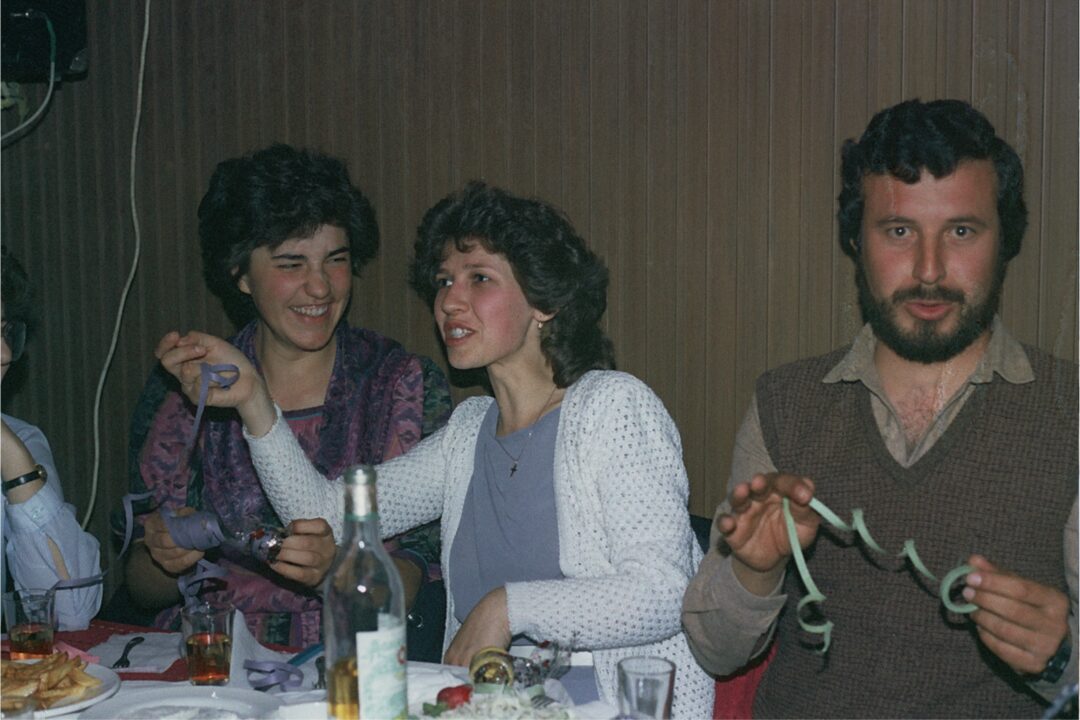
Featured image: Dancing, for girls and women, means pleasure but also danger: exuberant conviviality at a dinner-dance, Sohos, Greece, 1984. Photo by Jane K. Cowan.
References
Chandler, D., & Munday, R. 2016. “Anti-hero”. In: A Dictionary of Media & Communication. Oxford: Oxford University Press.
Chua, L and Mathur, N, eds. 2018. “Who are ‘We’? Reimagining Alterity and Affinity in Anthropology”. Oxford and New York: Berghan.
Cowan, Jane K. 1990. Dance and the Body Politic in Northern Greece. Princeton University Press.
Cowan, Jane K. 2003. “Who’s Afraid of Violent Language? Honour, Sovereignty and Claims-making in the League of Nations”. Special Issue on “Violence and Language”. Anthropological Theory 3(3): 271-291.
Cowan, Jane K. 2007. “The Success of Failure? Minority Supervision at the League of Nations”, in Marie-Bénédicte Dembour and Toby Kelly, eds., Paths to International Justice: Anthropological Perspectives, pp. 29-56. Cambridge: Cambridge University Press.
Cowan, Jane K. 2020. “‘The Feeling of Pursuing an Ideal’: A League of Nations Civil Servant Reflects on His Work”. Social Anthropology/Anthropologie Sociale 28(1): 17-34. Special Section.
Cowan, Jane K. 2021. “Acting Virtuously in the Universal Periodic Review”, in Guilherme Vasconcelos Vilaça and Maria Varaki, eds. Ethical Leadership in International Organizations: Concepts, Narratives, Judgment and Assessment, pp. 176-202. Cambridge: Cambridge University Press.
Cowan, Jane K. 2024. “Recommendations in Words and Numbers: Thinking with Sally Engle Merry at the Universal Periodic Review”, in Philip Alston (ed.), The Complexity of Human Rights: From Vernacularization to Quantification, pp. 203-227. Oxford and New York: Hart Publishing.
Greenberg, Jessica, and Sarah Muir. 2022. “Disappointment.” Annual Review of Anthropology 51(1): 307-323.
Haraway, Donna. 2016. Staying with the Trouble: Making kin in the Chthulucene. Durham, N.C.: Duke University Press.
Kennedy, T. V. 2014. “‘No Exit’ in Racine’s “Phèdre”: The Making of the Anti-Hero”. The French Review, 88(1), 165–178.Levi, Primo. 1989. The Drowned and the Saved. London: Abacus.
Abstract: This thematic thread considers the figure of the anti-hero/anti-heroine and the lens of anti-heroism, and proposes a heuristic reformulation, the anti-hero*ine, to grasp more acutely the complexities and ambiguities in the interplay of power, agency and morality in relation to contemporary struggles for justice, rights, and social change. Pursuing this line of enquiry also allows us to reflect on and celebrate the work and scholarship of our friend, colleague and mentor, Jane Cowan. The thread continues a discussion we initiated on the occasion of her Festschrift workshop, ‘Anti-hero*ines of International Social, Political and Legal Practice: An International Exploratory Workshop’, which took place at the University of Lausanne in June 2024.