Introduction
This essay is an inquiry into projects, the model of agency that projects presuppose, and the limits of that model. Through a project, one describes some vision of the world transformed and then works methodically to bring that vision to fruition (Graan 2022). The project form—the very template of a project as a kind of purposive action—thus provides an especially powerful tool through which social actors imagine and make claims on the future (Graan and Rommel 2024)1 In undertaking projects, organizations, groups, and individuals imbue themselves with a socially valorized style of purpose and momentum. All around the world, projects are now a core part of how people understand themselves and their social environments.2
It wasn’t always that way, though. In what follows, I turn to explore a period before the project form was accepted as commonsense. The long seventeenth century has been called England’s “Age of Projects” (Novak 2008) but it was also a time when projects were fundamentally scandalous. In the first part of this essay, I therefore offer a short survey of early modern projects and their controversies, working to historicize and provincialize the project form and its concomitant formatting of human agency. In its second part, the essay then goes on to explore examples of anti-projects, or modes of action that refuse the heroic, anthropocentric agency and future orientation of projects. Anti-projects “stay with trouble,” to invoke Donna Haraway (2016), and flourish at the fringes of dominant social formations. They turn away from the seductions of technofuturism, with its limitless queue of projects, and instead invoke solidarities and mutualities in the here and now. In the spirit of this collection’s examination of anti-hero*ism, the essay asks: what models of agency do anti-projects produce? And what kind of ethics and politics might they afford?
The project form—the very template of a project as a kind of purposive action—thus provides an especially powerful tool through which social actors imagine and make claims on the future (Graan and Rommel 2024)
A Brief History of the Project Form
Any genealogical exercise can always dig deeper into time or more broadly across geography. My genealogy of projects and project making, however, has come to focus on early modern England as a nodal point in the articulation and dissemination of the modern project form. This period saw the convergence of two technologies that came to define later practices of project making: the written proposal and the patent of monopoly.
Queen Elizabeth introduced patents of monopoly in the 1560s, seeking to incentivize artisans’ relocation to England from continental Europe. These patents would give holders exclusive rights to conduct some newly introduced trade or industry. Applications for patents came to be known as “projects” and patent applicants were called “projectors” (Thirsk 1987). To secure a patent, projectors would make a written petition to the monarch. These petitions functioned as early project proposals. They would describe the trade, industry or endeavor that the projector wished to conduct and also offer arguments on its necessity and benefit. If the petitions were successful, a patent of monopoly would give legitimacy and advantage to a proposal, making it easier for projectors to secure investment. The award of patent was no guarantee of a successful project, though, and a significant number of these early modern projects led projectors to the poorhouse while investors incurred substantial losses.
As a literary technology, the genre of the project proposal did something remarkable. It enabled the narration and artifactualization of a conditional future, of a future reality that did not yet exist but could exist, so projectors argued, with the backing of a patent. The written project proposal was thus a transformative development. When presented in written form, petitions for patents rendered comparable an otherwise heterogenous range of projects. Previously disparate activities, from glass making to crop importation, were thus figured as tokens of the same type: as projects. Moreover, the written proposal also rendered descriptions of a “would be” future monetizable. It was with a written proposal that one could seek a patent and approach investors. Through the technologies of the patent and proposal, the early modern project form presented a template through which to describe, record and commodify a conditional future. This affordance remains a core part of the project form’s enduring value and power.
Nevertheless, the proliferation of “projecting” that began in late sixteenth and continued over the next century was met with recurrent condemnation and ridicule. Some critics saw projects as vehicles of disorder that disrupted well-functioning norms in pursuit of private gain. Others saw projectors as swindlers who, when seeking investment, would promise future benefits and riches that were unlikely to materialize. Then as now, the artful narration of a conditional future did not ensure its realization. One contemporaneous play glossed this problem with projects in the following words: “who sows the clouds shall reap only wind” (reported in Ratcliff 2012). Projects were the terrain of charlatans and fools.
As we know, however, the project form not only endures, but these days its utility and value are considered self-evident. Despite the controversies raised by projects, their promise to deliver (and deliver profit from) a human-designed future proved irresistible. Thus, while the scandal of projects encouraged many 17th century project makers to disavow the tainted label of “projector,” it did not curtail the practice of projecting. Of course, many aspects of project making have changed since the early modern period. For instance, new technologies, from schedules and budgets to Gantt charts and logistics frameworks, now exist to depict and justify the work of projects. Nevertheless, that core affordance, the narration of a conditional future, continues to anchor project making today.
Through the technologies of the patent and proposal, the early modern project form presented a template through which to describe, record and commodify a conditional future. This affordance remains a core part of the project form’s enduring value and power.
Moreover, in providing a template to imagine, narrate, and commodify conditional future realities, the project form also supported the articulation of a particular model of human agency, that of the autological subject. As Elizabeth Povinelli (2006) defined it, the autological subject refers to, “discourses, practices, and fantasies about self-making, self-sovereignty, and the value of individual freedom associated with the Enlightenment project of contractual constitutional democracy and capitalism.” The project form granted the individuals who could inhabit it—usually bourgeois, Protestant, white men—a framework through which to imagine their own world-transforming, heroic agency. They would be the ones to embark on projects to bring forth new future realities. Indeed, the project form allowed projectors to imagine their agency on vast scales, as founders of colonies, as transformers of land, as inventors of technologies, as improvers of society. The opportunity to propose and pursue projects thus contributed to the semblance of an autonomous self. The project form, as a kind of social artifact, spurred on practices that conditioned, amplified and exemplified the autological subject.
Many readers of this essay, I suspect, are also expected to narrate themselves through their projects. After all, “what’s your project?” But here, it is important to point out that, as Carl Rommel and I (2024) argued in a recent essay, “projects are not a neutral vehicle of action.” Rather, the project form expresses a “normative power” that orients and formats action in particular ways. On one level, this is evident in the fact that some kinds of action can be formatted as projects while others cannot. For example, as Tania Murray Li (2007) has argued in regard to economic development, projects prefer “feasible” technological fixes over allegedly “impractical” structural change. On another level, some actors, typically privileged ones, are trained to inhabit project agency and are positioned to do so while others are more likely to be targets of it. The project form can be wielded by anyone but some groups monopolize it to their great advantage. For those committed to autological agency, consciously or unconsciously, the project form will likely continue to seduce. But, if the history of the project form tells any tale, it is a story about its affinity to capitalism, colonialism, governmentality, inequality, and power. It is a story of some people monopolizing project agency over others. Of course, social actors have, and continue to, marshal the project form for activist, subversive, emancipatory, and even revolutionary ends. Nevertheless, perhaps, the time is ripe to reignite the scandal of projects and to consider alternative ways of acting in the world.
Projects and Anti-Projects
The collection of which this essay is part asks us to trouble the heroic figures and heroic narratives that continue to thrive in popular culture and anthropological theory alike. Instead, the collection directs us to the space of the anti-hero*ine, a feminist space populated by oblique subversion, ambivalent contestation, and willful presence. Jane Cowan’s work brings these spaces into relief and offers them to our attention, from the political art of women’s dance in northern Greece (Cowan 1990) to the artful dance of political critique amid the United Nation’s Universal Periodic Review process (Cowan and Billaud 2015, 2017).
The project form, of course, has long enabled claims to and attributions of heroic action. A goal of this short essay has been to historicize and provincialize the project form and the heroic model of autological agency that it conditions. Taking Jane’s work as inspiration, though, I want to end the essay by thinking with the anti-hero*ine. I want to offer a few thoughts on what it might mean to give up on projects and their claims to heroic agency, to inhabit a space of anti-projects, to inhabit a space that resists the assumption of an ever improvable future.
First, we should recognize most forms of agentive action are not formatted as projects. Across time and geography, humans have lived and acted according to different temporalities, historicities, cosmologies, and commitments. Kinship, care and basic social reproduction are first among them (Bear et al 2015).
Taking Jane’s work as inspiration, […] I want to offer a few thoughts on what it might mean to give up on projects and their claims to heroic agency, to inhabit a space of anti-projects, to inhabit a space that resists the assumption of an ever improvable future.
Second, for many people, projects are not something through which you actualize yourself, they are something others subject you to. In these cases, you are a cog in someone else’s idea of what the future should be, and you have to bear the burden of this even if it is not a future you recognized or desired. Such a condition is an aspect of the longue durée of anti-Blackness (Thomas 2019) and the precarious “meantime” (Jansen 2015) of those abjected from modernity’s promises. For those of us who have been so positioned, a suspension of projects is likely not a loss but a relief.
Thirdly, then, in the place of project futurity, there is thus an opportunity for futures formatted outside of project logics to flourish. Such an outcome is not one that can be taken-for-granted but is one that can emerge through what AbdouMaliq Simone and Edgar Pieterse (2017: 29) call “redescription,” the creative of practice of grappling with here-and-now realities in order to “make visible operations and potentials of what might already be taking place.” By redescribing how people survive, refuse and flourish despite layered regimes of violence, precaritization and surveillance, we orient to actually existing presents and the people who live them rather than project-based promises of a new future.
So where does this leave us? What do we do when we refuse projects and refuse the kind of future that projects afford? To let go of projects is to snuff a certain dream of human agency, one that has reigned for four hundred years. But it is not to deny the possibility of action. We might listen to Donna Haraway’s (2016:1) description of “staying with trouble”: “In urgent times, many of us are tempted to address trouble in terms of making an imagined future safe, of stopping something from happening that looms in the future, of clearing away the present and the past in order to make futures for coming generations. Staying with the trouble does not require such a relationship to times called the future. In fact, staying with the trouble requires learning to be truly present, not as a vanishing pivot between awful or edenic pasts and apocalyptic or salvific futures, but as mortal critters entwined in myriad unfinished configurations of places, times, matters, meanings.” When the future collapses, as it has before, life does not stop and to echo Tina Turner, we don’t need another hero. Instead, we stay with trouble and we make trouble; we care and we kin; we dance and criticize; we forge and forage solidarities not knowing where they will lead but knowing that they matter.
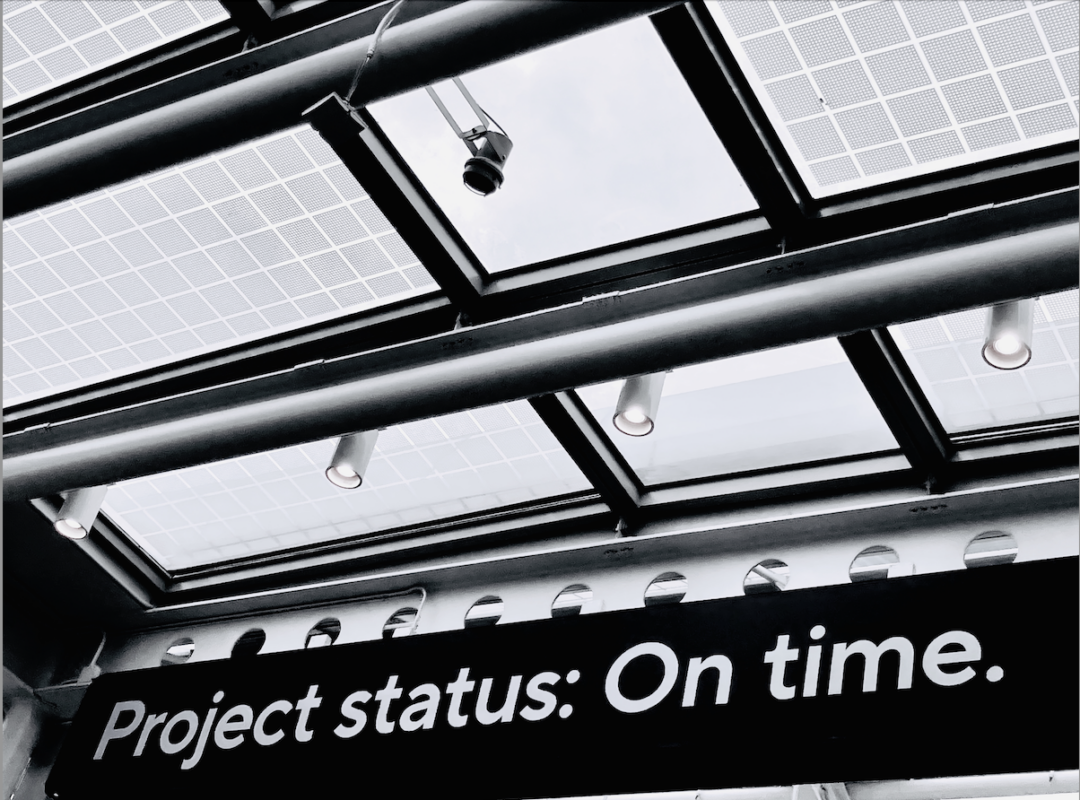
Featured Image: A snapshot from within the Lisbon airport in February 2024. Projects are so ubiquitous that it’s a challenge to go an entire day without encountering examples of and references to projects. Photo by author.
Notes
- It is worth mentioning, however, as a reviewer of this essay pointed out, although projects allow some to narrate their own vision of the future, for others, such as workers in a project-based profession, projects are also a way to satisfy the needs of the present, like getting a paycheck. ↩︎
- For more on the project form, and especially its layered and conflicting temporal dynamics, see the special issue, “Projects and the Temporalities of the Project Form,” that Carl Rommel and I edited for the journal, Social Anthropology, in September 2024. It includes excellent research articles by Deborah Jones (2024), Adam Sargent (2024), Katja Uusihakala (2024), and Car Rommel (2024). ↩︎
References
Bear, L., K. Ho, A. Tsing and S. Yanagisako 2015. ‘Gens: A Feminist Manifesto for the Study of Capitalism’, Theorizing the contemporary, Fieldsights, March 30. https://culanth.org/fieldsights/gens-a-feminist-manifesto-for-the-study-of-capitalism
Cowan, J. 1990. Dance and the Body Politic in Northern Greece. Princeton: Princeton University Press.
Cowan, J. and J. Billaud. 2015. Between Learning and Schooling: The Politics of Human Rights Monitoring at the Universal Periodic Review. Third World Quarterly 36 (6): 175-1190.
Cowan, J. and J. Billaud. 2017. The ‘Public’ Character of the Universal Periodic Review: Contested Concept and Methodological Challenge. Pp.106-126. Palaces of Hope. The Anthropology of Global Organizations, Niezen, Ronald, and Maria Sapignoli, eds. Cambridge: Cambridge University Press.
Graan, A. 2022. What was the Project? Thoughts on Genre and the Project Form. The Journal of Cultural Economy 15: 735–752.
Graan, A. and C. Rommel. 2024. Projects and Project Temporalities: Ethnographic Reflections on the Normative Power of the Project Form. Social Anthropology 32 (3): 1-19.
Haraway, D. 2016. Staying with the Trouble: Making Kin in the Chthulucene. Durham: Duke University Press.
Jansen, S. 2015. Yearnings in the Meantime: ‘Normal Lives’ and the State in a Sarajevo Apartment Complex. Oxford: Berghahn Books.
Jones, D. 2024. Landmine Clearance, or the Promise of a Project without End. Social Anthropology 32(3): 20-36.
Li, T. M. 2007. The Will to Improve: Governmentality, Development, and the Practice of Politics. Durham: Duke University Press.
Novak, M. (ed.) 2008. The Age of Projects. Toronto: University of Toronto Press.
Povinelli, E. 2006. The Empire of Love. Durham: Duke Univeristy Press.
Ratcliff, J. 2012. Art to Cheat the Common-Weale: Inventors, Projectors, and Patentees in English Satire, ca. 1630–70. Technology and Culture 53(2): 337-365.
Rommel, C. (2024). Projects as an Iterative Pursuit: Egyptian Imaginaries of the Social Agency of the Project Form. Social Anthropology. 32(3): 71-88.
Sargent, A. (2024). Becoming Time-Bound: The Temporalities of Construction in New Delhi. Social Anthropology. 32(3): 37-52.
Simone, A., & Pieterse, E. 2018. New Urban Worlds: Inhabiting Dissonant Times. Cambridge: Polity Press.
Thirsk, J. 1987. Economic Policy and Projects: The Development of a Consumer Society in Early Modern England. Oxford: Oxford University Press.
Thomas, D. 2019. Political Life in the Wake of the Plantation: Sovereignty, Witnessing, Repair. Durham: Duke University Press.
Uusihakala, K. (2024). Imperial Infinity, Project Futurity and Clockwork Discipline: Dissonant Temporalities in a British Child Migration Project. Social Anthropology. 32(3): 53-70.
Abstract: Projects are premised on bringing forth something new; they are premised on creation, invention, and improvement. Not surprisingly, then, the project form, with its combination of promissory vision and methodical planning, provides an especially evocative way in which social actors imagine and make claims on the future. So ubiquitous are projects that the project form—that recognizable genre of purposive, managed action—is often taken for granted as universal mode of acting in the world. This essay, however, works to historicize and provincialize the project form and its concomitant formatting of futurity. It first offers a brief genealogy of project making, focused on 17th century England, to analyze the project form and the particular ways in which it formats future thinking. The essay then goes on to explore examples of anti-projects, or modes of action that refuse the heroic, anthropocentric agency and future orientation of projects.