
Introduction: Morality and power in humanitarian honors
The arrival of hundreds of thousands of displaced people in Europe nearly a decade ago triggered a crisis of reception, particularly in frontline Aegean Ιsland communities. This upheaval necessitated a major humanitarian response and led to the encroachment of powerful external actors, notably international NGOs coordinated by UNHCR and state officials, into local societies.
The crisis sparked a massive outpouring of support for ‘travelers of need’, described as ‘solidarity’ – a multisemic term suggesting the recapturing of society in ideologically diverse, ways. Initially ‘refugee solidarity’ emerged at the grassroots through informal, collective, ‘initiatives’. However, as the Syriza-Anel government and media reframed it as a patriotic duty, it became entangled with official politics of honoring particular individuals for their exceptional humanitarian activity. This shift promoted a ‘heroic’ discourse and eventually fueled a demand for ‘heroines’ thus reproducing a long-term fascination with this particular form of distinction.
These recent dilemmas were byproducts of the emergent humanitarian regime.
This paper explores the interplay of morality and power in the conferral of humanitarian honors, focusing on the moral dilemmas and debates that arise when ordinary citizens are elevated to heroic status by powerful actors. I adopt a bottom-up, critical perspective to examine the social and moral complexities involved from the viewpoint of my interlocutors.
The ’refugee crisis’ was saturated with heroic narratives. However, as humanitarian honors were distributed from above they created intense dilemmas in the grey zone of everyday morality facing power. These difficult choices reminded me of the contested terrains of cafeterias and coffeehouses of the 1980s which Jane Cowan and I studied in Sohos and Lesvos respectively. Yet there were significant differences. In contrast to older ‘ambiguities of sociability’ (magnificently unveiled by Cowan’s subtle ethnographic analysis), which adult married men and unmarried young women faced under pressure to conform to the widely shared norms of conjugality and householding in the 1980s, these recent dilemmas were byproducts of the emergent humanitarian regime.
Besides the difficult choices regarding refugee aid, individuals grappled with whether to accept public honors (and the subsequent visibility) that were generously bestowed by state officials and humanitarian agents to those who allegedly made major contributions to the ‘solidarian’ cause or, alternatively, stay on the sidelines. Similarly, informal collectivities had to decide whether to stick to ideological principles such as ‘horizontality’, egalitarianism, generalized reciprocity, and political ‘solidarity’ or to embrace humanitarianism, despite the ideological cost, and thereby risk succumbing to the individualism that accompanied the neoliberal turn of humanitarian governance.
These moral and ideological dilemmas were exacerbated by stark differences in the socio-cultural terms of distinction in local, activist and official humanitarian (and state) frameworks. The conferral of honors sparked painful contestations over the motives behind ‘heroic’ action and the worthiness of the recognized individuals; it enhanced internal social strife and the breakdown of social ties within the community.
I will discuss the above dilemmas and contestations and some of their social and political repercussions in the context of a small fishing community in Northern Lesvos, Skala Sykamnias, my long term ‘anthropological village’, which received more than 250,000 irregular border crossers within a few months. I will particularly approach the making of ‘heroes and heroines’ through the angle of an ethically formative process: the campaign to nominate some locals for the Nobel Peace Prize in 2016.
I am interested in how nominees, whom I know personally, coped with the moral as well as politico-ideological challenges raised by their enmeshment in the grassroots and state politics of distinction. I want particularly to discuss their shifting and often ambiguous stances vis-à-vis the controversial visibility that honorary distinction conferred on them and the ways they dealt with the problematic side effects that transformed distinction into a predicament and a burden.
The Nobel Peace Prize initiative
Humanitarian distinction was produced in multiple ways and through many channels. Among them, the campaign for the Nobel Peace Prize to be awarded to the Aegean islanders for their heroic role in helping refugees had the greatest impact. It started at the grassroots, with a petition on the popular Avaaz platform, and culminated in a second official nomination that was administered by the Syriza government.
The Avaaz petition, rooted in egalitarian ideals, included sixteen, mostly informal, collective initiatives from nine islands under the name ‘Aegean Solidarity Movement’. It emphasized the social nature of ‘solidarity’ among ‘ordinary residents and volunteers’ across ‘front-line’ islands. This marked a key moment in what I have termed ‘refugee solidarity’ patriotism, a period of public discourse on ‘heroes’ -‘heroic fishers’, ‘heroic grannies’, ‘everyday heroes’ – peaking with the official nominations in early 2016 and continuing afterwards.
Due to its strong grassroots connections the Avaaz initiative gained widespread support but also faced challenges, especially as it entered the mainstream political and media landscape. Institutional actors and media prioritized individual humanitarian figures over the ‘movement’ itself, distorting the ideological message of the Avaaz campaign. Compliance with the Nobel Committee’s official protocol rules, which required replacing the petition with a formal letter nominating individuals and signed by academics, added further complications to the ‘solidarian’ project. My involvement in an ad hoc academic committee handling the nomination gave me an inside perspective on these challenges as well as exposed me to dilemmas like those of my interlocutors.
The selection by name of a few individuals raised important political questions: Who decides? Based on what criteria? This process fostered individual recognition at the expense of collective solidarity. ‘Technical’ challenges also arose regarding how to list names – in the main text or in a footnote and in what order. Ultimately, we retained the collective focus, mentioning the sixteen groups (plus the names of ‘contact persons’) while ‘symbolically nominating’ in a sub note three individuals (Thanasis Marmarinos, a fisher from Skala Sykamnias, Nasos Karayannakis, a shepherd from Limnos, and Emilia [Militsa] Kamvysi, a 84 year old pensioner from Skala Sykamnias) to represent the ‘anonymous people’.
Such antinomies in the Nobel campaign intensified when the government, after failing to reach an agreement with the Avaaz campaign, prepared its own nomination. The governmental project, strictly aligned with Nobel protocols, was fashioned on a pragmatic basis and aimed for international visibility. On those grounds it nominated Kamvysi, another fisher from Skala, Stratis Valamios, and actress Susan Sarandon standing for foreign volunteers.
Anonymity was overshadowed by celebrity, collectivity by individuality and horizontal egalitarianism by hierarchical differentiation.
The similarities and differences between the two nominations are equally striking. The government’s version mirrored Avaaz’s. Yet it lacked the emphasis on political ‘solidarity’ and horizontality and was tuned to the rhythms of the media. Its focus on celebrities of ‘solidarity’, and official backing gave it a relative advantage in the public perception. Thus, anonymity was overshadowed by celebrity, collectivity by individuality and horizontal egalitarianism by hierarchical differentiation.
In the following sections, I discuss how the women who stood for ‘ordinary people’, particularly Kamvysi, navigated this honor which was both a privilege and a burden.
‘Grannies teach solidarity’: The making of a ‘heroine’
(a) The photo
Militsa Kamvysi, a pensioner and mother of three, grandmother of eight and great grandmother of four, worked hard all her life to raise her children. The story of her distinction as a ‘heroine of solidarity’ (a title conferred to her by the Minister of Migration Policy) is inextricably tied to the story of a photo through which she achieved global fame.
On 16 October 2015 Militsa Kamvysi, along with her relatives and friends, Maritsa Mavrapidou and Eustratia Mavrapidou, was on her routine walk to a small seaside park where activists from Athens had established Platanos, one of the three camps of first reception. The huge daily traffic of refugees did not prohibit the elderly women from sitting on their favorite bench, watching and commenting upon this incredible situation, offering occasional help while benefiting from the medical services provided by volunteer doctors who ran their ‘clinic’ at the camp’s entrance.
That day, the photo-journalist Levteris Partsalis was capturing scenes of local backstage activity. At Platanos, he photographed the three women at their usual spot. In the now-famous image Militsa is seen holding a baby and feeding it with a milk bottle, while Maritsa and Evstratia watch with a sweet smile. The baby’s Syrian mother stands a short distance away, appearing amused. Partsalis immediately shared the photograph on Facebook, and it was soon picked up by the local news site Lesvosnews.net. As the image went viral, commentators framed it within the universal theme of motherhood. It was praised for celebrating the universal theme of ‘life and love’ and expressing the ‘self-evident’ nature of giving in the ‘authentic world’ of ordinary people that contrasts to the ‘racist reactions’.
The ‘photo of the three grannies’ quickly gained traction in mainstream media, becoming one of the most iconic images of the ‘refugee crisis’. On 20 October, the major newspaper Ethnos, featured it on its first page under the headline ‘The Story Behind the Photograph’. For the first time Militsa recounted the event in public, blending her experience with the journalist’s interpretation. Partsalis was extremely keen to stress her agency and imaginatively described the decisiveness with which she almost grabbed the baby and started singing to it. Later that evening the popular TV programme ‘News at 8’ on Mega Channel reinforced this narrative with the headline: ‘Lesbos: Grannies teach …. Solidarity’.
Invested with this highly agential meaning the photo became an icon of the government’s ‘solidarity’ project. In multiple formal occasions it was used by P.M. Alexis Tsipras to comment on ‘the image of Europe we want’ and ‘the real, good face of Europe’. At the highest levels of government the photo helped shift public opinion in favor of refugees and bolstered national pride in the local people’s hospitable attitude.
The sharing of ‘solidarian’ substance with Militsa had to be visually recorded to be politically effective.
Through this image the allegedly disinterested generosity of the elderly women, coined as ‘solidarity’, was transformed from an inalienable quality of action into an alienable substance which is assumed to be found in the person, a sort of metaphysical property that could be further circulated and shared in various directions. The shift of interest to the actual local protagonists, and particularly to Militsa, who were treated as privileged holders of ‘solidarian’ substance, further inspired a wave of humanitarian pilgrimage to Skala organized around rituals of visual consubstantiality. High profile visitors, including the President of the Hellenic Republic, the President of the Italian parliament, opposition leaders, artists and media personalities, were all after a selfie with Militsa, the archetypal ‘solidarian’. The sharing of ‘solidarian’ substance with Militsa had to be visually recorded to be politically effective.
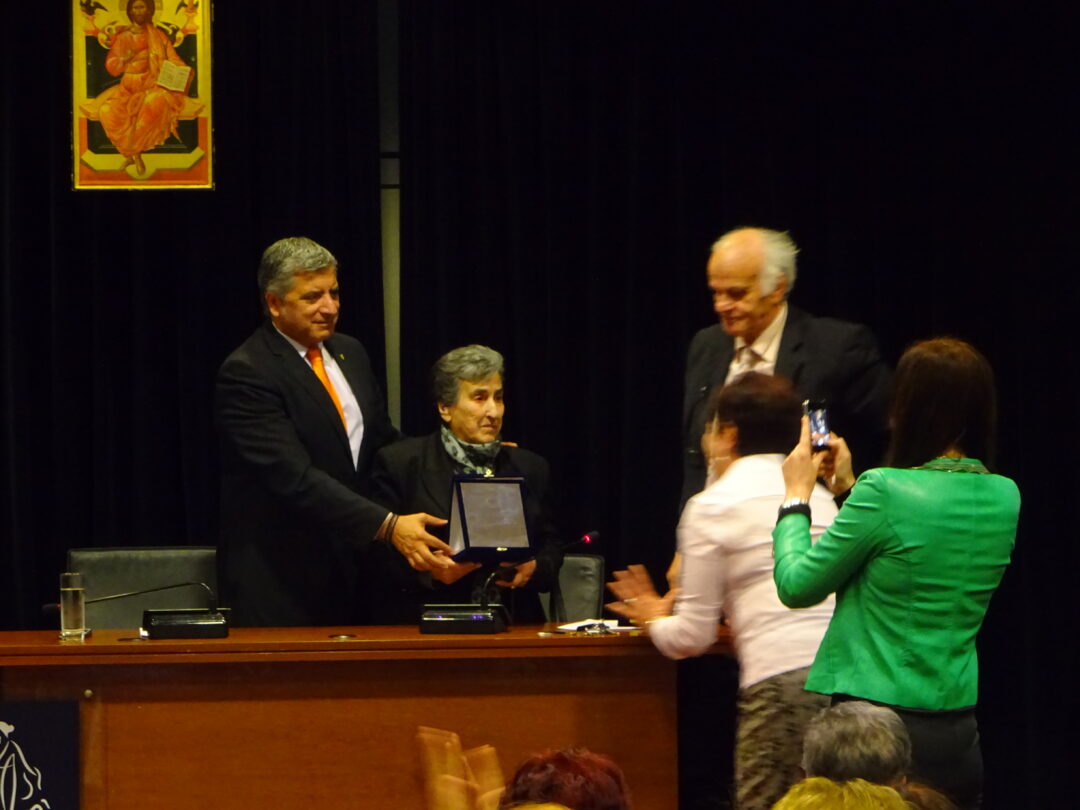
Militsa Kamvysi receives the medal of the ‘Prototype Woman Volunteer’ by the President of Greek Municipalities in Athens, March 8, 2016. Photo by author.
This context explains why Militsa was selected in both nominations for the Nobel Peace Prize and why she received numerous honors. On International Women’s Day, March 8, 2016, she was awarded the medal of the ‘Prototype woman volunteer’ by a women’s organization. The President of the Association of Greek Municipalities, who delivered the medal, described her as the epitome of Greek motherhood’s altruistic potential. Later she was awarded the Athinagoras Human Rights Prize by the Ecumenical Patriarchate.
(b) Backstage: The moral burden of distinction
Militsa and her companions belonged to the backstage, where many local and foreign women and men offered valuable ‘maintenance’ work, in and around the two makeshift, first reception camps (Platanos and Lighthouse) and the Stage 2 camp of UNHCR. The singling out of Militsa because of the photo was quite embarrassing for all those who were aware of the local humanitarian situation. It provided fertile ground for critical reactions ranging from vitriolic gossip to more elaborate reflections on the limitations and contradictions of humanitarian governance. After all, there were other local women whose immense contribution in providing food, clothes and organizational support was widely known (and appreciated by many). They deserved an honorary distinction. Some of them were politically committed to staying at the silent margins offering a ‘mute solidarity’, either for ideological reasons (they gave priority to the collective effort, irrespective of whether they thought of this effort as a ‘movement’ or not) or because they were embarrassed by the violent invasion of an external system of evaluation into their private lives.
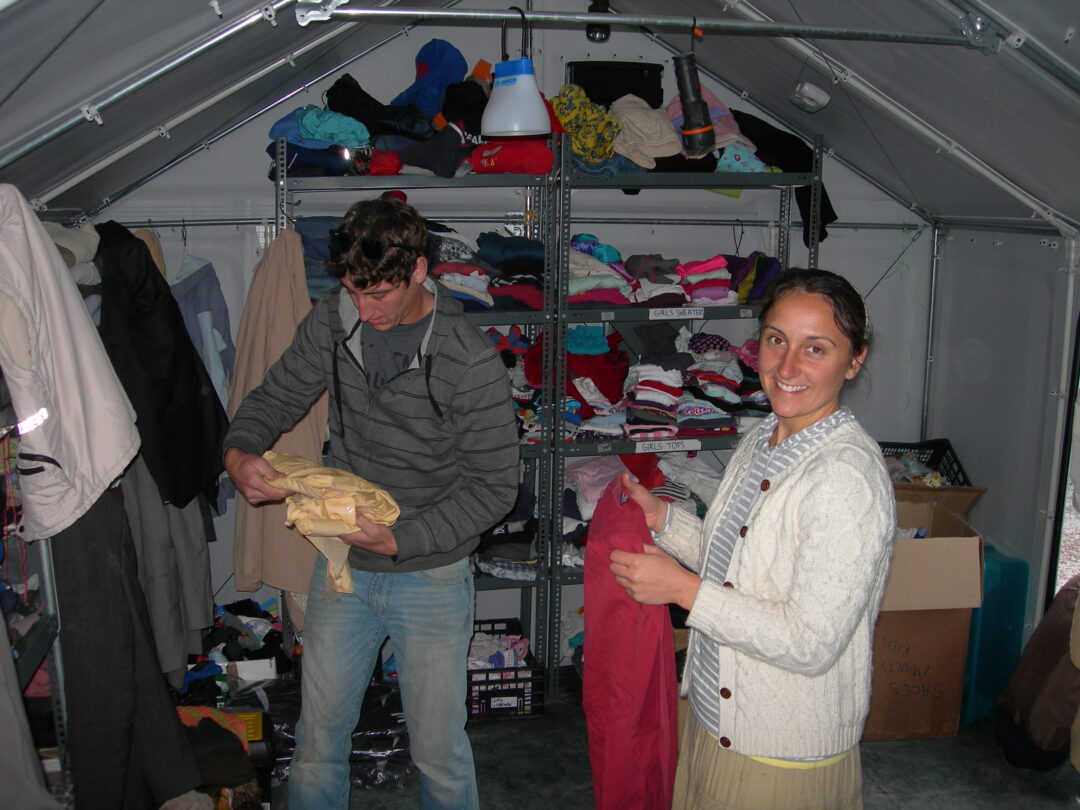
Backstage: Foreign volunteers sorting clothes at the transit UNHCR camp of ‘Stage 2’, Skala Sykamnias, November 2015. Photo by author.
Militsa’s selection for recognition fueled a climate of mutual distrust, suspicion and questioning of motives and exacerbated tensions that undermined the fragile cohesion of the local community since the beginning of the crisis. Her distinction turned into a heavy moral burden. Militsa was aware of the complex dynamics surrounding her sudden fame. She consistently responded to the attention with humility, insisting, ‘I didn’t do anything’ [to deserve all this attention]. This was an honest statement that was simultaneously directed toward those promoting her as the face of ‘solidarity’ and toward her fellow villagers, who questioned the validity of her distinction. Her disarming frankness and her humility only heightened her popularity, to the extent that the New York Times called her ‘the most unassuming candidate in the history of the Nobel Peace Prize’.
Eventually, after discussions with her daughters she agreed to participate in the Nobel campaign. The stakes were high. Being part of a campaign promoting the values of ‘humanness’ and ‘solidarity’ was a worthy cause, but family interests also played a role. However, her account of her decision changed over time. In the many interviews she gave, she gradually adopted the patriotic rhetoric: she accepted the nomination for the sake of Greece, which could benefit from the prize money during its financial crisis.
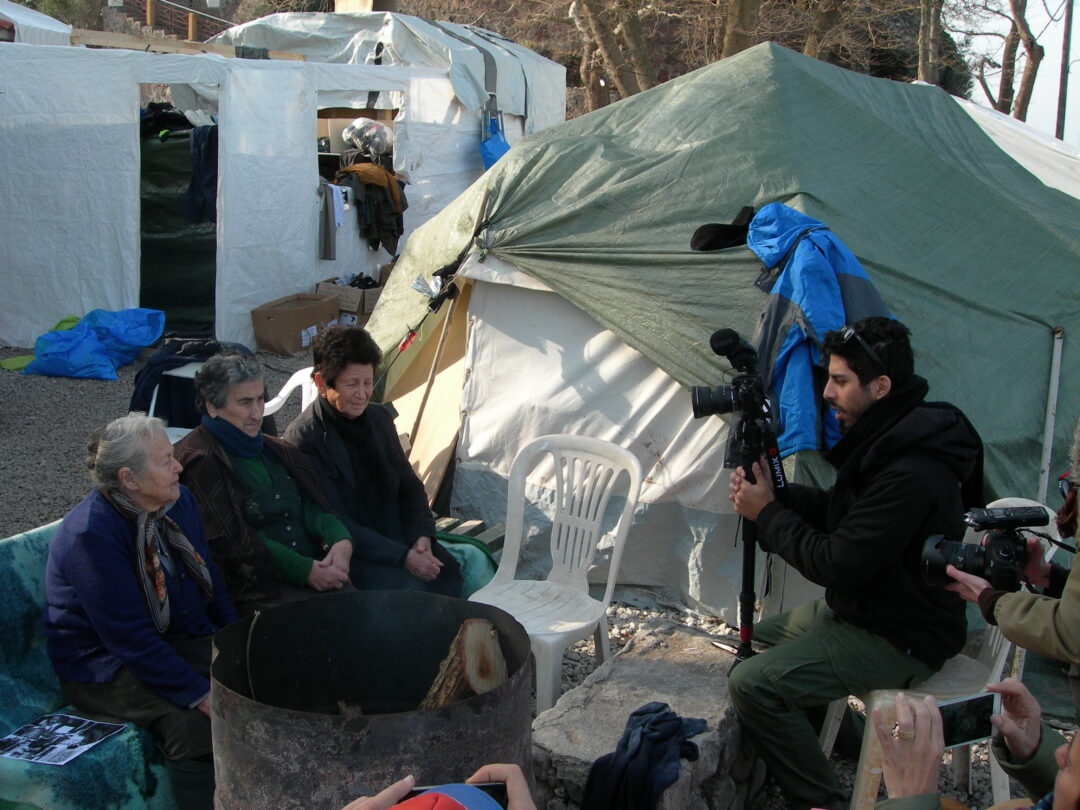
Militsa Kamvysi and Maritsa Mavrapidou give an interview at the entrance of the First Reception Camp of ‘Platanos’, Skala Sykamnias, November 2015. Photo by author.
The photograph ultimately shaped its own reality, creating the role of the ‘solidarian granny’, which Militsa had to embody. Guided by her two daughters, who lived nearby and accompanied her to interviews and public appearances, she navigated her new public persona with remarkable adaptability and ‘professionalism’. Soft-spoken and reserved with journalists but warm with admirers, she responded with grace to her ‘solidarian’ duties. She gradually started enjoying these public occasions and her widespread popularity, only to struggle with its absence once public attention had waned.
Militsa’s differential treatment from the rest of the photographed women threatened long-standing relations, particularly with her cousin Maritsa. Initially Maritsa and her relatives maintained a cautious stance, wary of the prospect that she could ‘be used’ by people with agendas that contradicted their political sensibilities. Yet as ‘solidarian’ sympathy grew, Maritsa became equally vocal and keen to stress her role in the scene depicted in the photograph and her equally admirable record as a mother. Individual distinction was damaging the cohesion of the small neighborhood.
The relational difficulties between the two matrilateral cousins, the tensions and antagonisms that the photo had brought into their lives started making news and headlines in the local media. This became an important source of anxiety and frustration. Humanitarian ‘solidarity’ risked undermining kinship solidarity. Recognizing the danger, Militsa publicly insisted that the honors belonged to all three women, and she pledged to share the prize. Despite these assurances, the nomination continued to generate discord among villagers.
Another source of anxiety was the politics of truth that haunted the knowledge economy of the refugee crisis. Photos simplified a chaotic situation, where it was extremely difficult to find out what had actually happened. Critics scrutinized the famous image, questioning the circumstances it depicted. Yet there was no doubt: local women had taken refugee babies into their arms. That was what the photo showcased.
In the habit of doing good: Paradoxes and contradictions of honorary humanitarian distinction
Individuals like Militsa or Maritsa were in the habit of doing good as an integral part of their daily lives. Their good deeds stemmed from habitual practice, often intertwined with material concerns. Their motherly disposition aligns with my ethnographic understanding of female kinship and child-centeredness in rural Aegean communities. In the matrilocal neighborhoods of Lesvos, where networks of female relatives predominate, caring for children is a life-long ‘career’ for many women. Within this context Militsa’s modest disclaimer – ‘I didn’t do anything’- is entirely understandable. It reflects the continuous performance of motherhood in the child-centered world of the village. After all, feeding a baby other than your own — refugee or not, it made no difference — is more than ‘business as usual’. It is a historical opportunity for an elderly woman to be an energetic agent (and socially alive) in the most prominent – i.e. culturally available – way: through child rearing.
The more honorary distinction was articulated in liberal and neoliberal terms, the more its legitimizing function weakened in the face of critical opposition.
In other words, the protagonists of this paper, apart from activists, were ordinary people performing acts of kindness without perceiving them as ‘activism’, without expressing them in terms of political or ideological principles (such as ‘justice’) or enveloping them in a ‘project’ (such as ‘refugee solidarity’), and without the sense of participation into a ‘movement’. They just insisted on exercising their habits in very difficult and challenging circumstances. Nonetheless, their agency was celebrated. They were imaginatively redefined from sympathetic bystanders to ‘volunteers’, ‘solidarians’ or champions of humanitarian assistance. This transformation was facilitated by the flux prevailing in frontline communities, where blurred boundaries between roles, ideas, and levels of engagement left ample space for humanitarian imagination.
On a broader scale, the emerging humanitarian regime urgently required legitimation, as did the Syriza-Anel government. Facing a society recently affected by xenophobia, Syriza also sought validation from European ‘partners’ and ‘lenders’. Honorary distinction was a valuable tool, yet it was applied from above, with little care, often in dissonance with local understandings and evaluations. It thus became an additional facet of the humanitarian grasp to which local communities were subjected: a burden that provoked both aporia and resistance among locals.
The manner in which the official project of humanitarian distinction was pursued revealed a core contradiction of the ‘solidarian’ project: a project aiming to be an antidote to neoliberalism was becoming a means of neoliberal subject-making. Through the politics of honorary distinction, ‘solidarity’ risked being co-opted into the humanitarian regime. The more honorary distinction was articulated in liberal and neoliberal terms, the more its legitimizing function weakened in the face of critical opposition. This erosion of moral foundations exposed sympathetic bystanders, like Militsa and others, to scrutiny, ultimately making them victims of the ‘armed love’ that humanitarianism frequently imposes.
Featured image: Photo by author.
References
Barnett, M. N. (Ed.). (2016). Paternalism beyond borders. Cambridge: Cambridge University Press.
Cabot, H. (2016). ‘Contagious’ solidarity: Reconfiguring care and citizenship in Greece’s social clinics. Social Anthropology/Anthropologie Sociale, 24(2), 152-166.
Chouliaraki, L. (2022). Post-humanitarianism: Solidarity as lifestyle politics. In Routledge Handbook of Humanitarian Communication (pp. 421-435). London: Routledge.
Cowan, J. K. (1991). Going out for coffee? Contesting the grounds of gendered pleasures in everyday sociability. In Contested identities: Gender and kinship in modern Greece (pp. 180-202). Princeton: Princeton University Press.
Douzina-Bakalaki, F. E. (2017). Volunteering mothers: Engaging the crisis in a soup kitchen of northern Greece. Anthropology matters, 17(1), 1-24.
Fassin D. (2012). Introduction in D. Fassin, (Ed.). A companion to moral anthropology. John Wiley & Sons.
Graan, A. (2022). What was the project? Thoughts on genre and the project form. Journal of Cultural Economy, 15(6), 735-752.
Mitchell, K. (2016). Celebrity humanitarianism, transnational emotion and the rise of neoliberal citizenship. Global Networks, 16(3), 288-306.
Papataxiarchis, E. (1992). The world of the coffeeshop: Male commensality and the symbolism of the drink in Aegean society. In Gender identities in Modern Greece (pp.209-250). Athens: Kastaniotes Publications.
Papataxiarchis, E. (2012). Shaping modern times in Greek family: A comparative view of gender and kinship transformations after 1974. In State, society and economy (pp. 217-244). Athens: Metaichmio Publications.
Papataxiarchis, E. (2016a). Being ‘there’: At the front line of the ‘European refugee crisis’‐parts 1 and 2. Anthropology Today, 32(2), 5-9 and 32(3), 3-7.
Papataxiarchis, E. (2016b). Unwrapping solidarity? Society reborn in austerity. Social Anthropology/Anthropologie sociale, 24(2), 205-210.
Papataxiarchis, E. (2016c). A big reversal? The ‘European refugee crisis’ and the new patriotism of ‘solidarity’. Σύγχρονα Θέματα [Synchrona Themata] 132-133: 7-28.
Papataxiarchis, E. (2022). An ephemeral patriotism: The rise and fall of ‘solidarity to refugees’. In Challenging Mobilities in and to the EU during Times of Crises: The Case of Greece (pp. 163-184). Cham: Springer International Publishing.
Rakopoulos, T. (2016). Solidarity: The egalitarian tensions of a bridge‐concept. Social Anthropology/Anthropologie sociale, 24(2), 142-151.
Rozakou, K. (2016). Socialities of solidarity: Revisiting the gift taboo in times of crises. Social Anthropology/Anthropologie Sociale, 24(2), 185-199.
Rozakou, K. (2017). Solidarity# humanitarianism: The blurred boundaries of humanitarianism in Greece. Etnofoor, 29(2), 99-104.
Theodossopoulos, D. (2016). Philanthropy or solidarity? Ethical dilemmas about humanitarianism in crisis‐afflicted Greece. Social Anthropology/Anthropologie sociale, 24(2), 167-184.
Ticktin, M. I. (2011). Casualties of care: Immigration and the politics of humanitarianism in France. University of California Press.
Abstract: This article explores the interplay between morality and power in the conferral of humanitarian honors during the European “refugee crisis”. Through long-term ethnographic research in the fishing village of Skala Sykamnias (Lesvos), I trace how everyday acts of backstage care by local residents, especially elderly women, became reimagined as heroic gestures of “solidarity” particularly in the course of the 2016 campaign to nominate Aegean islanders for the Nobel Peace Prize. The transformation of Militsa Kamvysi -one of the “three grannies” whose photograph feeding a refugee baby became iconic of Greece’s grassroots’ humanitarian response – into a “heroine of solidarity” showcases tensions between egalitarian, grassroots notions of “solidarity” and hierarchical, neoliberal modes of humanitarian distinction promoted by the Greek state and international actors. It also exposes the paradoxes of moral elevation: the dilemmas, contestations and tensions surrounding the controversial conversion of routine, kin-based, care into symbolic capital, the breakdown of community relations, and the uneasy convergence of grassroots humanitarianism and neoliberal subject-making. By following how honor circulates —from informal recognition to state decoration— I show how humanitarian honors operate as technologies of power that both celebrate and discipline moral subjects. Ultimately the politics of honorary distinction in humanitarianism are full of ambiguity: they produce a “grey zone” where virtue and governance intertwine, blurring the line between compassion, inequality and control.