
“What happened to the women who fought for the revolution?”
This question has frequently come up when I have been in conversation about the legacies of the anti-colonial liberation front that gripped the Dhufar region, today’s southern Oman, from 1965 to 1976. The movement’s female fighters, a striking symbol of revolutionary social emancipation, attracted great international attention – much as images of Kurdish female fighters fascinate audiences today. In Oman, however, a violent counterinsurgency campaign crushed the revolution, condemning its radical vision of social transformation. Thereafter, the postwar Sultanate erased the revolution from its official historical narratives. Despite this repression, during fieldwork in Oman in 2015 I learned from former militants who remained committed to revolutionary social values that the revolution had left legacies or “afterlives” (Wilson 2023). But what were the afterlives of revolution like for the women who had once seemingly embodied radical gender emancipation? Did the postwar imposition of conservative gender norms crush the revolution’s heroines? Or, might those conditions have contributed, albeit unwittingly, to the making of a different kind of subject: not revolutionary heroines, but anti-heroines?
Revolutionary gender liberation
The liberation front that Dhufaris founded in 1965 fought, under changing names, against the rule of the Muscat-based, British-backed al-Busaid dynasty of Sultans. Alongside fellow anti-colonial and anti-imperial liberation struggles in Africa, Asia and Latin America, this movement struggled not only for anti-colonial liberation, in this case of the Arabian Gulf; it also fought, especially in its Marxist-Leninist influenced incarnation from 1968, for radical social liberation. These ambitions included the emancipation of minoritised subjects, such as women, enslaved persons and those of unfree or dependent status.
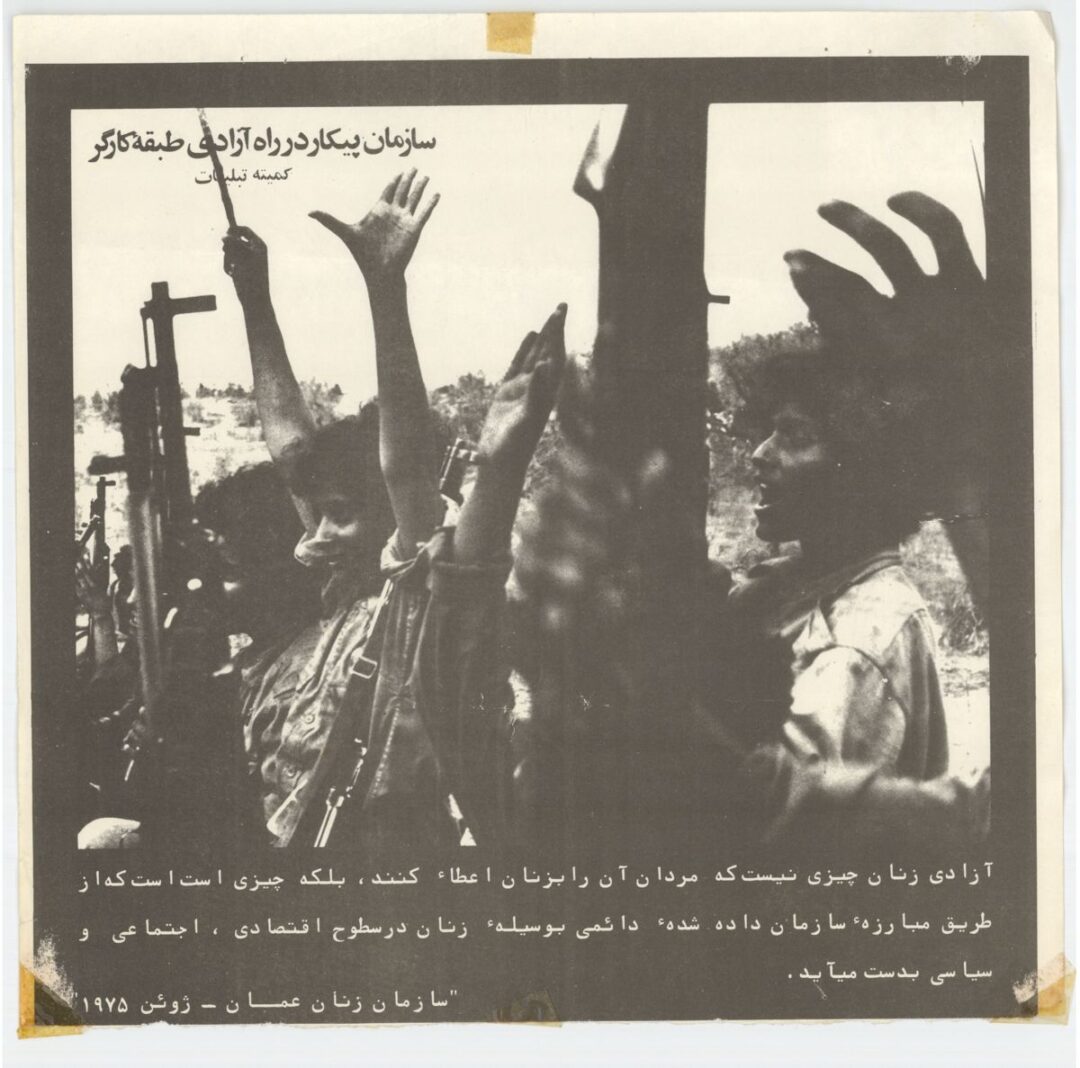
In solidarity pamphlets and other materials sympathetic to the revolution, such as Lebanese director Heiny Srour’s (1974) acclaimed documentary The Hour of Liberation has Arrived, some of the most prominent images of the movement were those of “liberated” women. These depictions ranged from female soldiers in military fatigues, hair uncovered, and armed with a Kalashnikov, to women who advocated the need to overcome “four Sultans” in political, tribal, religious and family life (Halliday 1974, Srour 1974). After the revolution’s military defeat at the hands of the British-backed, increasingly internationalised counterinsurgency forces, depictions of the movement’s female fighters – the revolution’s heroines – continued to circulate among global audiences: in Egyptian novelist Sonallah Ibrahim’s renowned portrayal of a fictionalised female combatant in his novel Warda (translated from Arabic into French and English, Ibrahim 2000, 2002, 2021), in solidarity literature, in online discussions of the revolution’s diverse actors (Sohrabi 2020), and in Srour’s restored film. The ongoing circulation of images of the revolution’s female combatants prompts many to continue to ask: “what happened to these women”?
Problematising revolutionary heroines
The persistent hypervisibility of Dhufar’s female fighters, like that of contemporary female combatants from South-west Asia and North Africa (SWANA), reflects more than activist passion for gender emancipation. Then and now, Orientalist assumptions of the need to “save” Muslim women (Abu Lughod 2002) underpin media and popular fascination with SWANA’s female fighters. Indeed, the popularity of images of fighting women risks reiterating a persistent colonial gaze: one that celebrates the heroines who “liberate” their oppressed peers.
Then and now, Orientalist assumptions of the need to “save” Muslim women underpin media and popular fascination with SWANA’s female fighters.
In broader ways, within and beyond the region, it is also problematic when revolutionary discourses and representations focus on female fighters as the heroic epitome of gender emancipation. The glorification of female combatants risks suggesting that gender liberation involves women taking on traditionally male-gendered behaviours, such as armed resistance. In parallel, the iconisation of female fighters may overlook women’s many other revolutionary contributions (Shamshiri and Thomson 2023), including those arising from traditionally female-gendered roles, such as caring responsibilities in extraordinary and precarious circumstances (Winegar 2012).
Even when a revolution for which women have taken up arms is victorious, former female fighters who have transgressed traditional female roles can still face political and social backlash, for instance when they struggle to find life partners (West 2000) or when governments neglect their contributions compared to those of male counterparts (Vince 2015). After the efforts, sacrifices and struggles of women across many different kinds of revolutionary roles, gender liberation may still prove elusive. Moreover, anti-feminist backlash is a very real possibility.
Counter-revolutionary backlash
Dhufar’s female fighters, and their revolution’s programmes for gender emancipation, certainly faced backlash. The counterinsurgency campaign crushed the revolution militarily – through airstrikes, landmines, free-fire zones, mass forced displacement, cutting off food and water supplies, and destroying the means of survival. In addition, the counterinsurgency operated a psychological campaign that aimed to win “hearts and minds”. Part of those efforts involved delegitimising the revolution and its programmes for radical social change, including gender emancipation.
Accordingly, counterinsurgency propaganda materials questioned the morality of the revolution’s female sympathisers and supporters (Wilson 2023: 86). Counterinsurgency initiatives also (re)introduced forms of gender difference that the revolution had sought to undermine. For instance, although the counterinsurgency offered male guerrillas money to persuade them to join pro-government paramilitaries, there were no such offers for female guerrillas. As a result, women wishing to access resources that the counterinsurgency campaign was distributing needed to do so through their relationships of dependence on a male, such as a husband, brother or father. The gender roles that the counterinsurgency imposed were a far cry from the revolutionary efforts towards gender emancipation in which women and men, girls and boys, had fought, worked and studied alongside one another.
The counterinsurgency’s devastating, indiscriminate violence, and its undermining of revolutionary social emancipation, undoubtedly hit female sympathisers and supporters of the revolution especially hard. In the final months of terrible counterinsurgency violence, an Iranian physician volunteer at the revolution’s medical facilities in exile in the People’s Democratic Republic of Yemen (PDRY) noted the despair of Omani women refugees in exile (Afraz 2018). A few years after the 1976 ceasefire, visitors from the UK’s Labour party to Dhufar in 1982 reported women’s resentment at having lost earlier revolutionary gains in gender equality (Wilson 2023: 129). Those who had stood to gain the most from the revolution’s emancipatory ambitions consequently stood to lose a great deal from counter-revolutionary backlash.
Postwar conservativism
Had the visitors to Dhufar in 1982 contemplated the same question as I would go on to encounter, several decades later: what happened to the women who fought for the revolution? By the time of my research, forty years after the end of the war, the answers concerning Dhufar seemed, for sympathisers of revolutionary social change, all the more perplexing, and even disappointing.
Omanis discussed with me how gender norms prevalent in postwar Dhufar were among the more conservative of the Sultanate. In contrast to the national capital Muscat, in Salalah, the capital of the Dhufar governorate, women (with the exception of some of formerly enslaved heritage) usually covered their faces when circulating in public. Dhufari women of urban backgrounds (again, with the exception of those of formerly enslaved heritage) also encountered stigma if they drove cars. In Dhufar, female genital cutting – which the revolution banned, and which the Sultan’s government also subsequently banned – was still common practice for both urban and rural women.
Perhaps even more perplexing for sympathisers of revolutionary social change are reports that postwar Dhufaris considered women with revolutionary backgrounds to be among the most conservative within their governorate. Dhufari researcher Mona Jabob (2010) reports as much in her study of the revolution’s educational programmes, through which she met many women who had previously been trainee female combatants or pupils at the primary and middle schools that the liberation front operated in exile in PDRY. Had the revolutionary heroines abandoned earlier commitments to gender emancipation?
An authoritarian security state
Initially, it might indeed seem hard to trace legacies of revolutionary feminism in postwar Dhufar. Given the Omani state’s suppression of freedoms of expression and association, perhaps we should not be surprised. In the case of Omanis who contest prevalent social norms, including gender conservatism, “going beyond mainstream culture is quite dangerous not only politically but also socially”, as Omani political scientist Khalid Al-Azri (2013: xiv) cautions.
But if we are willing to adjust our gaze beyond a search for iconic revolutionary heroines, we may come to see something different from their apparent absence in conservative postwar Oman.
Feminist interventions in the apparent spirit of the revolution’s iconic feminist heroines may thus seem to be the exception in postwar times – although such acts are by no means absent, as Dhufari Susan Shahri’s (2013) campaign against female genital cutting demonstrates. But if we are willing to adjust our gaze beyond a search for iconic revolutionary heroines, we may come to see something different from their apparent absence in conservative postwar Oman. And we might find quite different answers to the recurring question of “what happened to the women who fought for the revolution”.
Aisha and the authoritarian state
To understand postwar Dhufar in greater depth, we can follow the prompts of postcolonial and decolonial feminist scholarship to interrogate, rather than assume, the histories, meanings and transformations of gendered norms and practices. Since the 1980s, across South-west Asia and neighbouring regions, there has been a rise in Islamic piety practices, of which women’s conservative dress is one of the most visible markers. In Dhufar, understanding the adoption of such clothing requires engagement with the region’s revolutionary, counterinsurgency and postwar authoritarian histories. In the context of the revolution having promoted radical gender emancipation, and the counterinsurgency having maligned those initiatives as immoral, some of the experiences of women with revolutionary backgrounds who returned to postwar Oman point to the significant role of the authoritarian state in imposing conservative gender norms.
The story of a former pupil of the revolutionary schooling programme drew my attention to the postwar authoritarian state’s interventions in the lives of women of revolutionary backgrounds. In the years after the 1976 military defeat of the liberation movement, and amid the Sultanate’s ongoing efforts to undermine the revolution’s intellectual and political vision, Omani intelligence officers (mukhabarat) travelled abroad to seek out young Omanis who had previously studied at the liberation front’s schools in PDRY. Former pupils were studying in countries, such as Syria and Iraq, that supported anti-colonial movements. The Sultanate’s intelligence officers sought to persuade Omani students to return to Oman as loyal subjects to Sultan Qaboos bin Said. Among the students whom the mukhabarat found was a young woman whom here I call Aisha. A younger relative of hers recounted Aisha’s story to me.
Aisha’s relative recalled: “When they found Aisha, she was wearing a short skirt and her hair was cut short. When she went back to Oman, they took her to a house in Muscat before she went to Dhufar. In the room they had laid out a beautiful ʿabayah [loose outer garment that covers the body from the neck down] for her. It was exactly her size. They told her ‘Dhufar has changed now. This is what you will wear.’” (Wilson 2023: 129).
With Aisha’s return and induction into conservative gender norms, Oman’s postwar authoritarian government seemed to have won a further small victory over the revolution. Aisha transformed from a revolutionary militant into a woman who – at least outwardly – conformed with the very kinds of conservative gender norms that the revolution had once contested. In her new attire, Aisha could hardly have contrasted more with earlier images of “liberated” revolutionary women. Her modest clothing befitted the postwar reputation of the revolution’s female former pupils and former combatants for being among the most conservative women in Dhufar.
It transpires that, at least for some women of revolutionary background, their induction into the very kinds of conservative gender norms that the front had contested occurred under the coercion of the authoritarian security state that would now rule their lives.
But the story of a transformation such as Aisha’s raises other possibilities. It transpires that, at least for some women of revolutionary background, their induction into the very kinds of conservative gender norms that the front had contested occurred under the coercion of the authoritarian security state that would now rule their lives. If Mona Jabob and other Dhufaris identify former revolutionary women as among the most conservative in Dhufar, these women have surely also been particular targets of coercion and pressure from the authoritarian state – and also, in some cases, from family members, as Dhufaris explained to me during my fieldwork.
Yet even in the face of such pressures, these women have continued to disrupt conservative gender norms. In the early postwar period, prevalent norms in Dhufar stigmatised female labour force participation outside the home, except in the case of women of historically stigmatised backgrounds such as the formerly enslaved. It was veteran revolutionary women, drawing on their revolutionary education, as well as on the revolutionary values of a commitment to a “common good”, who pioneered postwar female labour force participation outside the home for women of any social background (Wilson 2023: 188-9).
These women’s adoption of conservative dress, then, marks more than the intervention of the security state in their lives. In addition to its religious significance, this clothing may also be a means for them to claim a legitimacy and moral position recognisable to their peers and to their government. That legitimacy then enables them to continue to challenge prevalent conservative gender norms – as these women did regarding labour force participation.
Despite facing severe constraints of authoritarianism and surveillance, these women have not abandoned their aspirations for greater social justice – as their role in creating persistent revolutionary legacies confirms.
Former revolutionary women’s persistence in challenging gender conservativism in the postwar period is significant. It is one of the ways in which, despite the revolution’s military defeat and the authoritarian state’s ongoing repression of (former) political dissidents, erstwhile militants still reproduced revolutionary values. These women and their peers remained committed in their everyday postwar lives, in small and large ways, to social and gendered egalitarianism. These lasting legacies of ongoing revolutionary values constitute “afterlives of revolution”.
Anti-heroines of revolutionary afterlives
In the light of revolution’s afterlives, it follows that when iconic images of revolutionary heroines help generate the question “what happened to the women who fought for the revolution?”, we must seek answers with great care. We should problematise the extent to which insistence on that very question may accommodate a gaze that assumes that a particular kind of heroine most embodies “liberation”. We must attend to the implications of a postwar authoritarian security state that has imposed conservative gender norms on the very women whom many in Oman and beyond have celebrated as revolutionary heroines. Despite facing severe constraints of authoritarianism and surveillance, these women have not abandoned their aspirations for greater social justice – as their role in creating persistent revolutionary legacies confirms. If it seems that these women could not look more different from their revolutionary past, we can nonetheless hail them as anti-heroines of a revolution’s continuing afterlives.
Featured Image: Political poster by the Organization of Struggle for the Emancipation of the Working Class (Peykar), an Iranian communist organization, depicting female militants of Oman’s liberation front. Permission: photographic work published over 30 years ago in the public domain in Iran, available at wiki commons.
References
Abu-Lughod, Lila. “Do Muslim Women Really Need Saving? Anthropological Reflections on Cultural Relativism and Its Others.” American Anthropologist 104, no. 3 (2002): 783-90.
Afraz, Mahboubeh, and Rafaʿt Afraz. Hamrah Ba Enghelabiyoun-E Omani: Yaddashthay-E Jang-E Zoffar. Frankfurt: Andeesheh va Peykar Publication, 2018.
Al-Azri, Khalid M. Social and Gender Inequality in Oman: The Power of Religious and Political Tradition. London: Routledge, 2013.
Halliday, Fred. Arabia without Sultans. Harmondsworth: Penguin, 1974.
Ibrahim, Sunallah. Warda. Translated by Hosan Aboul-Ela. Yale: Yale University Press, 2021.
Ibrahim, Sunallah. Warda. Translated by Richard Jacquemond. Paris: Actes Sud, 2002.
Ibrahim, Sunallah. Warda. Cairo: Dar al-Mustaqbal al-‘Arabi, 2000.
Jabob, Mona. Qiyadat Al-Mujtamʿah Nahwa Al-Taghayyur: Al-Tajribah Al-Tarbawiyyah Li Thawrat Dhufar, 1969-1992. Beirut: Markaz dirasat al-wihdah al-ʿarabiyyah, 2010.
Shamshiri, Marral, and Sorcha Thomson, eds. She Who Struggles: Revolutionary Women Who Shaped the World. London: Pluto Press, 2023.
Al Shahri, Susan. “The Issue of Fgm in Oman.” Muscat Daily, January 1 2013.
Sohrabi, Naghmeh. “Where the Small Things Are: Thoughts on Writing Revolutions and Their Histories.” Jadaliyya (2020).
Srour, Heiny. Saʿat Al-Thawrah Daqqat. Film. 1 hr., 2 min. 1974.
Vince, Natalya. Our Fighting Sisters: Nation, Memory and Gender in Algeria, 1954-2012. Manchester: Manchester University Press, 2015.
West, Harry G. “Girls with Guns: Narrating the Experience of War of Frelimo’s “Female Detachment”.” Anthropological Quarterly 73, no. 4 (2000): 180-94.
Wilson, Alice. Afterlives of Revolution: Everyday Counterhistories in Southern Oman. Stanford: Stanford University Press, 2023.
Winegar, Jessica. “The Privilege of Revolution: Gender, Class, Space, and Affect in Egypt.” American Ethnologist 39, no. 1 (2012): 67-70.
Abstract: Images of female fighters in liberation movements from the global south have a wide appeal as symbols of radical social emancipation and iconic revolutionary heroines. But what happens to these women when revolution meets with military defeat? In Oman, an anti-colonial revolutionary liberation front, founded in 1965, soon became renowned for its female fighters. By contrast, British-led counterinsurgency forces imposed conservative gender norms – and after the counterinsurgency’s victory in 1976, women of revolutionary backgrounds in postwar Oman acquired a reputation for conservativism. Nevertheless, these women’s postwar lives indicate how they still found ways to challenge restrictive gender norms. Their ongoing commitment to emancipatory values shows how revolutions go on to have lasting afterlives. These revolutionary afterlives problematise a gaze that assumes that a particular kind of heroine most embodies “liberation”, and recast the women who seemingly appear to be the antithesis of that liberation from heroines to anti-heroines.