

What lies ahead?
Reimagining the world. Only that.
– Arundhati Roy, Azadi
On 11 November 2024, I sat in the audience at SOAS London listening to Francesca Albanese speak to her latest report to the United Nations, ‘Genocide as colonial erasure’. She exclaimed that she did not expect in her capacity as the Special Rapporteur on the situation of human rights in the Palestinian Territories occupied since 1967, to be writing a second report only six months after the first (Anatomy of a Genocide) to highlight a worsening horror. In the deft way that she does, she combined meticulous detail, academic rigour and hope. Her report shows genocidal intent and the aim of full Israeli colonization of Palestinian land while removing as many Palestinians as possible. Yet, ‘human rights can still pave the way for freedom and justice’, she shared; rights are the ‘codification of struggle’, ‘the antibody to what is persisting, to imperialism’.
What can we expect from the law in world-making?
In the context of the world we live in, one that is experiencing, and permissive of, global apartheid and abandonment through colonial erasure, the question I was left with following the Anti-Heroines Workshop in June 2024 was, what can we expect from the law in world-making? To even begin to answer this question, we must start from the premise that ‘Euro-modern law’ is ‘a colonial discipline within which bodies and space-time have been revealed and redefined to meet the needs of enclosure, property-making and capital accumulation’ (Adebisi, 2024: 67). And so we need new tools, perhaps those silenced by Euro-modern law, to reveal these presuppositions and to imagine possibilities outside of them. In Lausanne in June, I had been making the argument for radical friendship as a replacement for (human) rights (law). This has been a central theme of my work on radical critiques of rights and its focus on friendship as a way of life and possibilities for re-purposing practices of living better together in refusal of abandonment. I understand state practices of abandonment, through the work of gender studies scholars Elizabeth Povinelli and Jasbir Puar, as an instigation of continuous and dispersed suffering for certain individuals or populations enabled by the state’s right to maim; and, crucially, as an ethical problem that legal rights cannot solve.
Rather than the constant (re)turn to legal rights, I suggest that what we need is to think in a register of ‘human rights after Gaza’. This is not a reimagining that follows a failed pursuit of rights (Petersmann, 2024: 1291). It is not a temporally linear progression (of, say, ‘moving on from rights’) but rather an unmuting of what has come before, exists now and will always be. This work requires a re-tooling of rights by re-purposing concepts that have previously been mutedby Western liberal rights discourse.[1] In a simultaneously world-refusing and world-making move, I unmute concepts from political-spiritual poetic writings in Sikhi (Gurbani, Sikh scriptures) to attempt an ethical praxis of rights that centres the role of spirituality. I argue for an ethics of seva that is radical friendship – ongoing and reflexive anti-hero*ic practices that produce a sort of cosmopolitics, more accurately described as a ‘communal reflexive praxis’. There is an insistence here on ‘conceptual production’, on re-making rights through concepts from, in my case, non-Western spiritualities and to make them ‘matter epistemically, ethically, politically’. As Fanon has said,
For Europe, for ourselves, and for humanity…
we must work out new concepts and try to set afoot a new man.
The particular concepts that I draw on are ‘hukam’ and ‘sarbat da bhalla’ to replace ‘obligation’ and the ‘subject’ of rights within liberal rights language. Hukam implies (divine) command and contains an imperative to act for sarbat da bhala, the welfare of all or a collective well-being in service of the overarching principle of Oneness (Ik O’nkar) that informs the Sikhi way of life. Both concepts fall under an all-embracing ethics of seva – that is, a disciplined and ritualistic way of life informed by ‘selfless service’. Replacing the terms of liberal rights language with these concepts is a move towards decolonising rights and exploring a racially just jurisprudence of the future (Madhok, 2021; Adebisi in Greene et al, 2024).
My argument can be read as posing two problematiques: the first concerns legal futurism and the second, everyday (world-making) practices. In terms of the first, legal futurism, or nomofuturism, like Afrofuturism proposes a different world-making; and it begs the question, what are the limits of invention within the law?
Legal Futurism
The constant (re)turn to law and legal rights is hardly surprising – the appeal of an international court to address the crime of genocide is the promise of ‘global justice’. Yet what we witnessed in January 2024, when the International Court of Justice (ICJ) held public hearings in the proceedings instituted by South Africa against Israel, was a failure of the liberal rights project to address abandonment, and an inability of the legal architecture to see state ‘complicity’ and (state) obligation as an ethical problem.
Thinking in a register of ‘human rights after Gaza’ would thus mean thinking of how to practice friendship as an ethics of seva, in which the response to the ‘stranger’, the abandoned other, is informed by hukam.
The South African legal team emphasised the centrality of rights to the issue at hand, referring specifically to the ‘right not to be killed or seriously harmed’, to the importance of ‘obligation’ and to ‘moral law’. Max du Plessis spoke on the role of rights and/or obligation in international law, saying that the protection of Palestinian rights should be the basis of any ICJ judgment, moreover the international community has a solemn obligation, a common interest, to prevent and punish genocide. Blinne Ni Ghralaigh gave a truly heartbreaking speech, commenting ‘we are witnessing the first genocide in history where its victims are live-streaming their destruction … there is such a thing as moral law and we have morally failed the people of Gaza’. We also heard the South African Justice Minister on 11 January further stress the obligation, or plea, of Ubuntu – I am because you are. Ubuntu is a philosophy of humanity that challenges histories of oppression. Interestingly, disappointingly but most of all unsurprisingly in its order of 26 January – where it ordered Israel to take all measures to prevent acts that could be considered genocidal but did not order suspension of its military campaign in the Gaza strip – the ICJ did not refer to obligation or a moral law. Nor did it refer to obligation or a moral law on 28 March following a second request for additional measures given that the situation had escalated to forced starvation. This was after the ‘flour massacre’ of 29 February, which showed us we are living in a space of the seemingly unthinkable, witnessing ‘a perfectly legal genocide, that is a genocide via a permissive interpretation of IHL’. So we must ask, what if the court privileged a reading of obligation? What if we took our role as critical legal scholars as being to re-make rights and justice through the production of concepts – like Ubuntu, like seva – that are marked by an epistemic difference that has traditionally been relegated to the cultural, local or custom domain. And so in place of obligation I suggest that were the court to apply the concept of hukam – which demands a show of obligation towards the abandoned other – then we might arrive at a relational right not to be abandoned for the Palestinian people. Thinking in a register of ‘human rights after Gaza’ would thus mean thinking of how to practice friendship as an ethics of seva, in which the response to the ‘stranger’, the abandoned other, is informed by hukam.
This is conceptual production as a form of legal futurism. It must incorporate, I suggest, an openness to spirituality. In asking whether radical friendship can replace rights, I seek not only to shift the epistemic centre of rights but to propose a new ethical system at its centre entirely. Starting from political-spiritual practices that already exist within Sikhi, that is before rights, I argue for an ethics of seva to be at the centre of rights – that is, an ethic of care or service that demands sacrifice of the ego-self. Before rights refers to both a sense of linear time, and points to an ontologically richer dimension of time that contains unlimited pasts and unlimited futures (akaal time). This is not asking for ‘us’, as human rights lawyers, advocates, activists, experts, supporters, to be heroes but rather to suspend ourselves – and our temporal existence – as we act towards a collective goal. The tension between the temporal and the spiritual is navigated within Sikhi through practicing sitting in the liminal space between the ‘here and now’ and the ‘then and there’ (known as Sehaj, singh 2024). Through daily rituals that are aimed at unbodiment and unbeing (ibid) we can then move, I argue, towards an idea of collective well-being as a form of ethical praxis. The politics of unbodiment requires, as Black scholars have argued, a disinvestment in our temporal existence such that we already ethically labour against an anti-Black sociality as a form of life that happens before, after and alongside ‘rights’. In exploring non-liberal logics of subjectivity, Marie Petersmann examines how works of critical Black studies refuse the category of the subject as such and instead focus on modes of living that resist racialised, colonial and liberal inscriptions of worlding through ‘rights’. The refusal of the subject comes from the lived experience of Blackness being reduced to the transatlantic slave – a non-human object turned into a legal human subject following the abolition of slavery. The abandoned figure of the Palestinian reveals that rights language continually reproduces a sub-human, if not non-human category of the dispossessed. And so I echo in my reading of Sikhi the ethos of critical Black studies as it ‘foregrounds modes of collective being and becoming in refusal of liberal terms of subjecthood’ (Petersmann). I draw too on traits of Afrofuturism. Afrofuturism is ‘a way of imagining possible futures through a black cultural lens’ (Ytasha L. Womack); a branch of science fiction, it can in its futuristic critique of contemporary lived experiences and cultures also extend into political critique which combines Afrocentricty, fantasy, magic realism and non-Western beliefs (Adebisi, 2024).A radical Sikhi opens us to a political-spiritual concept of ‘futurism’ that can re-make law and rights – this is the concept of chardi kala. Meaning the ascending energy of eternal optimism/ hope) this concept features at the end of the Ardas, repeated three times a day at the end of prayers and as a greeting of good will and well wishing. It was heard often during the Farmers’ Movement in India as encouragement to fight for farmers’ rights and to keep the momentum of struggle going,
May we and our movement stay in chardi kala.
Chardi kala is an eternally optimistic exploration of a jurisprudence of the future which grounds rights in practices of friendship that are collectively imagined, practiced and re-thought. These are the everyday practices that resist imperial capitalism and dispossession, and demonstrate the practice of a right to collective well-being. They are represented in what Albanese called the modern day expression of truth to power: the mass mobilisation of the student encampments.
Everyday Practices
The Sussex Student Encampment for Liberation was set up on 13 May 2024. A group of students turned ‘Library Square’ into ‘Liberation Square’ becoming part of a global student uprising dominated by college students in the United States. I was part of a teach out a few weeks later on the theme of ‘Workers Against Imperialism: Resistance through Sikhi and Yiddish Poetry, Singing and Dance’. It was a rare sunny day in a very soggy month; we sat in a circle on the dry, cool grass in the square. I began by sharing the words of the Ardas,
Nanak naam,
Chardi kala,
Tere bane sarbat da bhalla [2]
I wanted to emphasise the concept of sarbat da bhalla, welfare of all. I was speaking to collective well-being as resistance and the struggle of a particular abandoned workforce: garment factory workers in Britain (specifically in my hometown of Leicester which houses a ‘garment district’). How does the fight against racial capitalism manifest as claiming a right to collective well-being based on the concept of sarbat da bhalla? The teach out was building on an article series that we had posted on Critical Legal Thinking in April, which centred Palestinian workers’ resistance. In his piece for the series, Ihab Maharmeh writes, ‘first, we must recognise, we must say, “there is resistance”’. The hope within this phrase is powerful,
This statement reminds us of the danger of erasing resistance by bringing in an instrumental or institutional lens too quickly. It reminds us of the beauty and hope that resistance carries; that ‘there is resistance’ even in the most violent, imperialist and capitalist circumstances; and, that resistance to imperialism is inherently worthy of our attention (Leigh and Sokhi-Bulley, 2024).
Resistance is the everyday world-making practices of care and refusal: a collective care informed by seva as its ethos, and a refusal of neoliberal capitalism and imperialism which has obscured the complicity of universities in genocide. Workers’ right to collective well-being is realised through ‘actions that solidify trust’ and secure empowerment through collective bargaining and collective refusal – simple, everyday practices like, in the case of local community organisations on the ground in Leicester, providing English language lessons, hosting a factory workers club, holding regular community events like day trips to the beach (a treat when living within a land-locked, industrial city) and showcase events like ‘garment worker stories’ and recitals where whole families are welcome, food is provided and there is no pressure to perform, just share.
Resistance is the everyday world-making practices of care and refusal: a collective care informed by seva as its ethos, and a refusal of neoliberal capitalism and imperialism which has obscured the complicity of universities in genocide.
Our teach out featured Yiddish poetry, singing and bhangra. We were able to share our empathy for loss, joy and physical closeness as a collective. As we ask ourselves what we can do to resist, we must continue the everyday acts of camping out on the grass, sharing and serving food to the campers (itself a form of seva), we must sing and dance. We must normalise, encourage and celebrate this everyday world-making behaviour as expressions of seva, for sarbat da bhalla, as our hukam for the abandoned.
So, what can we expect from the law in world-making? Perhaps this is not the right, or timely, question. Perhaps we should instead ‘confront’ the role of (human rights) law as ‘the keeper of the colonial ever-present’ (Adebisi, 2024: 73) and ask instead, how can we un-make law and the world otherwise. I continue to be struck and inspired by the themes of the Workshop and anti-hero*ism as a critical framework – specifically, other-regardedness; healing; revolts of living and world-refusing practices. I owe much to my discussant, Laurie Hart, for her generous reading of this work and for raising the problem of legal futurism in the first place.
Waheguru Ji ka Khalsa, Waheguru Ji ki Fateh. [3]
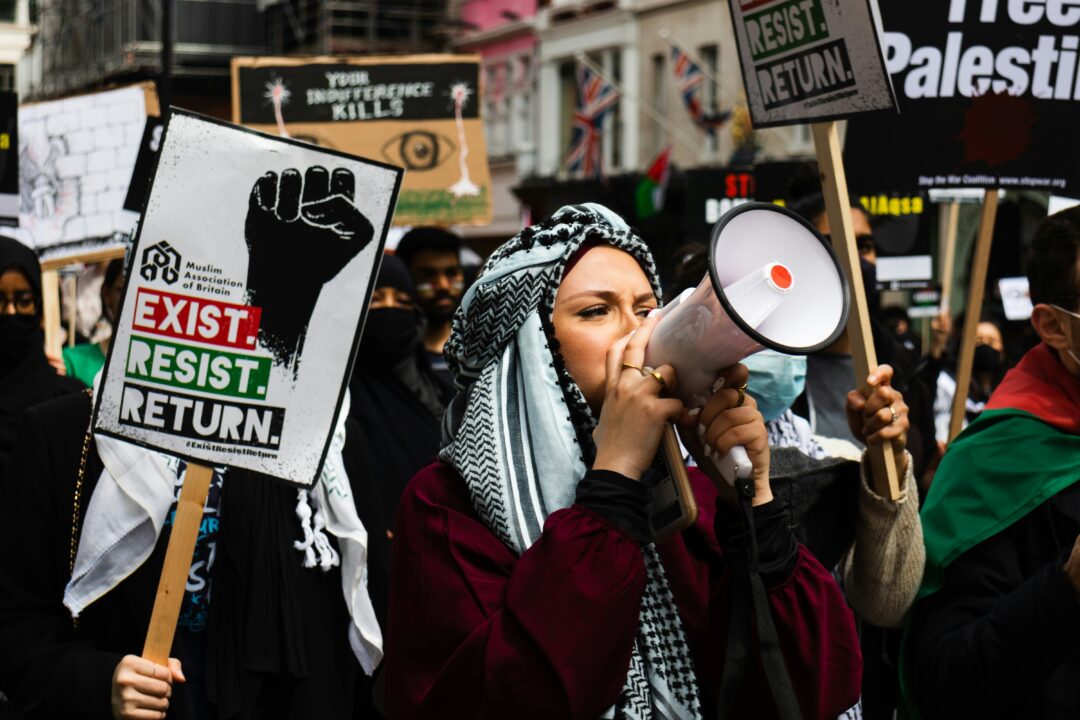
Featured image: Untitled, Yousef Salhamoud. Unsplash.
Notes
[1] I thank Jane Cowan for our swim + coffee sessions in Brighton, out of which the concept of ‘re-purposing’ emerged during discussions on the book I am currently writing, Radical Friendship: Human Rights as Ethical Practice.
[2] ‘May [The] [N]ame, may the human spirit forever triumph, Nanak; and in Your will may peace and prosperity come to one and all’, Central SIkhi Gurdwara Board, ‘Concept of Sarbat Da Bhalla in Gurbani’, Gurbani Series, https://sikhs.org.sg/wp-content/uploads/2022/01/Sarbat-Da-Bhalla.pdf. See also the full Ardas with alternative translation at https://nitnemsahib.com/ardas-english-translation/
[3] ‘The Khalsa is of Waheguru, and to Waheguru belongs Victory’, Nitnem Ardas available at https://nitnemsahib.com/ardas-english-translation/
Abstract: In the context of the world we live in, one that is experiencing global apartheid and is permissive of abandonment through colonial erasure, the question I ask in this piece is, What can we expect from the law in world-making? My focus is human rights language and its foundations as ‘Euro-modern law’, a problematic colonial discipline that continues to produce abandonment of racialised subjects. I suggest we need new tools, perhaps those silenced by Euro-modern law, to reveal these presuppositions and to imagine possibilities outside of them. I make the argument for radical friendship as a replacement for (human) rights (law). Rather than the constant (re)turn to legal rights, I suggest we need to think in a register of ‘human rights after Gaza’ and engage in ‘conceptual production’. My approach is inspired by and advocates practices informed by an all-embracing ethics of seva: that is, a disciplined and ritualistic way of life informed by ‘selfless service’. I show how replacing the terms of liberal rights language with concepts from the political-spiritual doctrine of radical Sikhi is a move towards decolonising rights and exploring a ‘racially just jurisprudence’ of the future. My argument can be read as posing, and exploring, two problematiques: the first concerns legal futurism and the second, everyday (world-making) practices.