


Positioning the “anti-hero*ine” framework
In this short piece, I explore Chrysanthi and Elektra, two street-level bureaucrats I encountered during my fieldwork, who used their discretionary powers to provide access to services and information for asylum claimants and those supporting them. Chrysanthi is an asylum officer working on the organisation and scheduling of meetings between appellants and government-assigned lawyers. Eleκtra is a judge at the Independent Appeal Courts, judging 2nd instance asylum applications (applications appealing negative asylum decisions). Both women work either for or alongside the state by either implementing its policies or enacting its laws. With the goal of critically analysing their role in the management of migration, I begin by offering a brief overview of the literature around state bureaucrats and how irregularity, ambiguity, and secrecy have been employed as a technique in the governance of border crossers in Greece (Rozakou, 2017; Stel, 2020; Wilding, 2022). I then examine the different categories of state bureaucrats with whom I interacted: those who enjoy their discretionary powers, those who burn out and leave, and those who occupy the in-between, the-antihero*ines: the category under which Chrysanthi and Electra fall. This approach enables a more holistic and nuanced understanding of street-level bureaucrats, the challenges they face, and the responses they formulate in their efforts to manoeuvre around the conditions imposed upon them by the state, and those they are meant to protect or care for. Throughout my eight-month ethnographic fieldwork in Athens conducted in 2021-2022, I observed that the (in)actions of street-level bureaucrats significantly influenced the (re)production and/or countering of uncertainty. In attempting to understand their role in either perpetuating or challenging these ambiguities, the antihero*ine framework proved invaluable in identifying everyday resistance against different responses to the migration management from within, without heroising or villainising the street-level bureaucrats, but by simply acknowledging the everyday resistance they may produce.
Heath Cabot (2014) has highlighted how asylum seekers experience a state of limbo and uncertainty when navigating asylum procedures, often unsure of the meaning of their documents and struggling with inadequate legal aid and understanding of the legal framework. Similarly, Rozakou (2017) has demonstrated how bureaucratic irregularities, particularly the non-recording of data at the outset of the crisis, became a form of statecraft that enabled the Greek state to avoid liability and responsibility for asylum claimants. Wilding (2022), though within the UK context, similarly highlights how strategic ignorance by the state regarding gaps and inconsistencies in legal provisions (re)produces asylum seekers’ misinformation, precarity, and, ultimately, deportability. Stel (2020, 2021; Natter, Norman and Stel, 2023) further argues that the accumulation of ambiguity and uncertainty within asylum processes functions as a strategic tool that allows states to both evade responsibility of care and (re)produce governable individuals whose lives are consistently debilitated. Given the structural conditions asylum seekers face, it is crucial to interrogate the mechanisms through which these conditions are sustained and reproduced. According to Stel (2020), the persistence of institutional ambiguities is closely linked to agential reasonings and behaviours (p.7). In this context, the discretionary practices of street-level bureaucrats within asylum services are critical in either reinforcing or mitigating the uncertainty inherent in asylum procedures.
The antihero*ine framework proved invaluable in identifying everyday resistance against different responses to the migration management from within, without heroising or villainising the street-level bureaucrats, but by simply acknowledging the everyday resistance they may produce.
Street-level bureaucrats are individuals who work in established bureaucracies and who, in an effort to uphold the administrative mechanisms, “interact directly with citizens in the course of their jobs and who have substantial discretion in the execution of their work” (Lipsky 1980; 2010, p.3). Such individuals affect the public’s access to resources and their actions can be understood as the collectively chosen policy of a given agency (p.13). There has been extensive research on street-level bureaucrats within the migration management regime and the (in)justices that arise due to their discretionary powers, showing how their personal beliefs, prejudices and perceptions of ‘truths’ become a barrier to asylum (Aschenbrenner, 2012; Cabot, 2013; Fassin, 2013; Rozakou, 2017; Affolter, Miaz and Poertner, 2019; Iliadou, 2019a, 2019b; Bhatia, 2020; Liodden, 2020; Gill et al., 2021; Karastergiou, 2023).
The questions asked here, however, are: How should we conceptualise the actions of street-level bureaucrats that operate in an ever-evolving legal framework, where uncertainty of access and misinformation are continuously (re)produced? Specifically, how should we understand the role of street-level bureaucrats, who exercise discretion while also attempting to clarify uncertainties and misinformation? The antihero*ine framework provides a critical lens to examine individuals engaging with a system marked by ambiguities. On the one hand, by engaging with the system, those street-level bureaucrats, whether intentionally or inadvertently, reinforce the existing system. Yet they can simultaneously subvert these practices by advocating for transparency and clarity, counteracting the techniques that sustain uncertainty. This perspective provides a nuanced understanding of everyday resistance, which can take place from within an oppressive or authoritarian system.
Antihero*ines working with and against strategic ambiguity in Greece
From summer 2015 until March 2016 about a million refugees arrived in Greece, precipitating the country’s reception crisis. With the numbers now much diminished, the Greek state has asserted that the crisis is over, claiming that Greece has ‘left the difficult days of the refugee crisis behind [her]’ (Mitsotakis, 2023).1 However, the reception system continues to be plagued by institutional irregularities, dire detention conditions (Refugee Support Aegean, 2024a) and delays in services due to unpaid government officials (The Press Project, 2024). According to Stel, factors such as a state’s financial difficulties or other bureaucratic conditions may contribute to the severe situations of state abandonment, yet the persistence of these conditions can be understood as a form of deliberate inaction in the management of migration, designed to perpetuate narratives of debilitation, deportability, and deterrence (Stel 2020). As a result, she says, this form of governmentality can be understood as strategically ambiguous (ibid). In the case of Greece, Stel’s concept of strategic ambiguity intersects with that of strategic ignorance (Wilding, 2022), where state officials not only allow such conditions to persist but also deny their very existence. As Karastergiou (2023) describes, the asylum system contains structural features that impede the asylum officers’ functionalities, thus hindering claimants’ access to a fair hearing. The supposed trainings not with standing, managing and potentially working through the system-created difficulties are rarely discussed. As she claims:
Little or no reference is being made to everyday practical difficulties that impact the implementation of the guidelines and regulations, the strict and unrealistic organizational quantitative targets, the pressure, the unpredictable challenges, the ambiguities and uncertainties of the decision-making process, the constant policy and administrative changes, and the emotional and ethical dilemmas that caseworkers experience in the field (p. 31).
Throughout my fieldwork, I observed the continuation of institutional ambiguities and ignorance, mirroring the findings of various scholars researching migration in Greece (Cabot, 2014; Papataxiarchis, 2016; Iliadou, 2019a, 2019b; Rozakou, 2020; Pallister-Wilkins, 2021; Spathopoulou and Tazzioli, 2021). These dynamics placed asylum claimants in precarious situations, trapped in a state of limbo and subjected to misinformation or a lack of information. Initially, I witnessed these mechanisms of governance through my work with two NGOs providing legal aid, where claimants and lawyers described persistent barriers to accessing asylum offices and obtaining accurate information. Later, I encountered further perpetuation of uncertainties in the field, with interviews being unexpectedly postponed, scarce interpretation services, and, when available, services of questionable quality, leaving many claimants unaware of the system they were attempting to navigate.
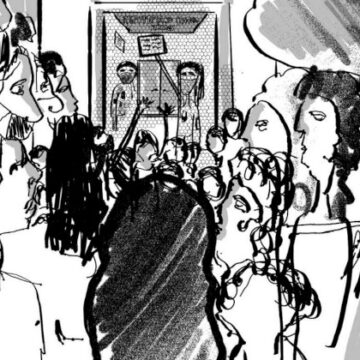
Figure 1: Author’s drawing from fieldwork observation outside an Asylum Office in Athens in 2021. The security guards are shouting the names of the asylum claimants who can pass the gates behind a fence.
While perpetuating the (re)production of ambiguity by working within a system which uses strategic ambiguities and ignorance, this third group simultaneously endeavoured to facilitate access to services and information to the best of their abilities and within the constraints of their roles.
Consistent with existing literature, my fieldwork revealed that alongside institutional ambiguities, the agentic role of street-level bureaucrats played a significant part in the (re)production of uncertainty, both for asylum claimants and those assisting them (Stel, 2020, p. 7). Two categories of state bureaucrats became clear from the beginning. The first group were those who reaffirmed the negative stereotypes of a “Greek state official”: they were comfortable in their positions of security and used their discretionary powers to reproduce uncertainty, illegalisation and deportability. The second group was composed of state officers who quickly burned out and left the migration management field: they were exhausted by their constant efforts to advocate and counteract the ambiguities imposed by the system.
Through my interactions with state bureaucrats who grappled with unrealistic time constraints, cross-agency coordination challenges, and institutional efforts to limit transparency, it became evident that a third category existed: the antihero*ines. While perpetuating the (re)production of ambiguity by working within a system which uses strategic ambiguities and ignorance, this third group simultaneously endeavoured to facilitate access to services and information to the best of their abilities and within the constraints of their roles.
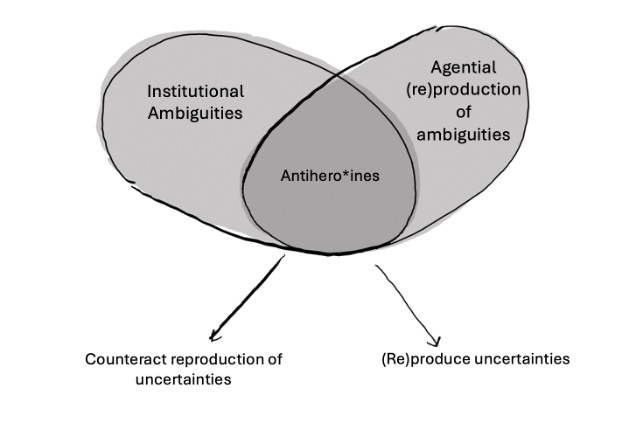
Figure 2: Positioning the Anti-hero*ine perspective in ambiguous spaces. Author’s drawing.
Their actions and stances provide a complex picture of migration management, structural difficulties they experience, and a possible subtle form of resistance from within. The antihero*ine framework allows me to analyse these individuals without heroising or villainising them, instead focusing on their (in)actions within the strategically ambiguous environment they navigate. To further illustrate the framework’s utility, I will discuss two actors I encountered: Chrysanthi and Elektra.
Chrysanthi: An antihero*ine in Legal Aid
Chrysanthi, a woman in her early forties, worked in one of the main asylum offices in Athens. One of her responsibilities was organising meetings between government-appointed lawyers, interpreters, and appellants. She was one of the few asylum workers who helped me gain access to these meetings. My initial access was facilitated by a gatekeeper higher up in the Ministry of Migration’s administration, who had asked Chrysanthi’s manager and others in similar positions whether they could accommodate my request. Although the gatekeeper had cc’d staff from other asylum offices in Athens, only Chrysanthi and a colleague from her office agreed to grant access. This request was not an official order but rather a voluntary action, indicating Chrysanthi’s willingness to allow me to observe and critically assess the operation of these governmental processes.
She was an anti-hero*ine. […] Yet, Chrysanthi also perpetuated these very ambiguities within the asylum system.
Chrysanthi made sure to call the lawyers ahead of each of their meetings to get their consent for my observations and then coordinate with me to ensure that I became available when consent was given. In our conversations before and after meetings, she would subtly mention institutional ambiguities she had to face on a daily basis, trying to justify why she had to speed-walk back and forth from her office to find the appellants or the interpreters, or even to find last minute solutions to telecommunication issues for implementing legal aid meetings. Clearly, she was not one of the street-level bureaucrats who remained unaffected by institutional ambiguities. She was an anti-hero*ine. She tried her best to provide a space for lawyers and appellants to meet, and when meetings were cut short or interpretation became unavailable, her agitation was subtly expressed. Yet, Chrysanthi also perpetuated these very ambiguities within the asylum system.
As the person responsible for signing off on meetings as ‘successfully completed,’ she oversaw situations where privacy was not ensured, telecommunication interpretation caused significant communication breakdowns, and claimants were given insufficient time to discuss their cases in depth with their lawyers. Chrysanthi, thus, was culpable for reproducing the uncertain conditions in which the asylum applicants were placed.
Elektra and Kalliope: (Un)making space for knowledge
The asylum appeal process in Greece is entirely written-based, with appellants submitting their written appeals through either their government-appointed or private lawyer to the Appeals Committees, which may consist of one or three judges. Hearings are not conducted unless explicitly requested by the judge(s) for further questioning of the appellant. This raises concerns about whether the impersonal nature of the process truly ensures access to effective remedies (Gill et al., 2022). Out of the 12,626 decisions taken in 2023, only 409 cases were examined through an additional oral examination (Refugee Support Aegean, 2024b). When those hearings occur, they are automatically “open to the public” unless the claimants, or their lawyers, specifically request to opt out to protect the claimant’s privacy, something which rarely happens (L. 4939/2022, Art. 102).
Neither should [her actions] be overlooked, as they challenge and critique the prevailing system of obfuscation and concealment.
The first asylum appeal hearing I managed to attend was chaired by Electra, a judge who, I later realised, was one of the anti-hero*ines of my fieldwork. Word of my presence quickly spread within the appeals office. Having already received permission from Electra, I was waiting outside the room for the next session when an appeals officer, Kalliope, approached. In an aggressive tone, she informed me that my observation would not be allowed to continue, as I had not followed the proper bureaucratic procedures. When I explained that the hearings were intended to be open to the public, she entered the courtroom and interrupted the ongoing hearing to address the issue directly with the judge. Although I was outside the hearing room, the voices of both women were loud enough for me to hear. Kalliope strongly insisted that the meetings should remain private, while Electra, adhering to the law, asserted her authority, declaring, ‘I am the judge; let her in my courtroom,’ as she pounded her fist on the table. After some time, despite Kalliope’s continued attempts to prevent my entry, she relented and allowed me access. Throughout my fieldwork, I encountered numerous judges who exercised their discretionary powers to refuse my presence, citing various excuses. In contrast, Electra’s decision to allow me entry challenges the secrecy and ambiguity that typically govern such processes. She not only resisted internal pressures to uphold secrecy over procedures but also advocated for what should be a fundamental right. At that moment, Electra became the antihero*ine. Electra, as a judge responsible for deciding a person’s claim under the strict state-driven laws, which have been increasingly more constraining on who is allowed or not access to seek asylum in Greece or not, is still responsible for (re)producing the state’s efforts to manage and deter migration. Yet, while her position within the state inevitably contributes toward the state’s efforts of migration control, Electra’s efforts to promote transparency and facilitate the production of knowledge, partly by granting me access and opening the process to academic scrutiny, served as a form of resistance to governing via ambiguity and secrecy. Electra’s actions should not be idealised, as the hearing is, in principle, public and my access to it, a right. Nevertheless, neither should they be overlooked, as they challenge and critique the prevailing system of obfuscation and concealment.
Conclusion
The antihero*ine perspective enables me to identify and analyse how street-level bureaucrats both counteract and (re)produce uncertainties within bureaucracies governed by ambiguity. This framework acknowledges the coexistence of these dynamics, creating space to examine and understand the nuances of their actions without resorting to heroisation or vilification. By applying the antihero*ine framework, we can uncover the subtle power dynamics of those whose behaviours significantly affect others, allowing for a holistic analysis of their (in)actions. The cases of Chrysanthi and Electra illustrate two street-level bureaucrats who, while helping the state (re)produce an exclusionary politics via their approval of meetings or their negative judgments, still create space for inadequate information or misinformation to be revealed, documented, and critiqued. The antihero*ine framework is particularly valuable for exploring the grey areas between ‘good’ and ‘bad,’ highlighting the struggles behind decisions, beliefs, and behaviours. It challenges binary categorisations, opening up space for the complexities to emerge and questioning preconceived assumptions and expectations. This article calls on researchers studying state actors in strategically ambiguous environments to recognize moments both of resistance and of the (re)production of discretion and to analyse them in a more comprehensive manner.
Featured image: Author’s drawing, 2021.
Note
- It is important to note that in July 2025, the Ministry issued a three-month ban on all asylum applications from people coming from North Africa, leading to their arrests and subjecting them to deportations under the auspices of a forthcoming ‘refugee crisis’ in Crete (UNHCR, 2025).
↩︎
References
Affolter, L., Miaz, J. and Poertner, E. (2019) ‘Taking the “Just” Decision: Caseworkers and Their Communities of Interpretation in the Swiss Asylum Office’, in N. Gill and A. Good (eds) Asylum Determination in Europe. Cham: Springer International Publishing (Palgrave Socio-Legal Studies), pp. 263–284.
Aschenbrenner, K. (2012) ‘Discretionary (In)Justice: The Exercise of Discretion in Claims for Asylum’, University of Michigan Journal of Law Reform, (45.3), p. 595.
Bhatia, M. (2020) ‘The Permission to be Cruel: Street-Level Bureaucrats and Harms Against People Seeking Asylum’, Critical Criminology, 28(2), pp. 277–292.
Cabot, H. (2013) ‘The social aesthetics of eligibility: NGO aid and indeterminacy in the Greek asylum process: The social aesthetics of eligibility’, American Ethnologist, 40(3), pp. 452–466.
Cabot, H. (2014) On the doorstep of Europe: asylum and citizenship in Greece. 1st ed. Philadelphia: University of Pennsylvania Press.
Fassin, D. (2013) ‘The Precarious Truth of Asylum’, Public Culture, 25(1), pp. 39–63.
Gill, N. et al.(2021) ‘The tribunal atmosphere: On qualitative barriers to access to justice’, Geoforum, 119, pp. 61–71.
Gill, N. et al.(2022) ‘Rethinking commonality in refugee status determination in Europe: Legalgeographies of asylum appeals’, Political Geography, 98, p. 102686.
Iliadou, E. (2019a) ‘Border Harms and Everyday Violence. The Lived Experiences of Border Crossers in Lesvos Island, Greece’.
Iliadou, E. (2019b) ‘Safe Havens and Prison Islands: The Politics of Protection and Deterrence of Border Crossers on Lesvos Island’, Graduate Journal of Social Science, 15, pp. 62–88.
Liodden, T.M. (2020) ‘Who Is a Refugee? Uncertainty and Discretion in Asylum Decisions’, International Journal of Refugee Law, 32(4), pp. 645–667.
Karastergiou, M.N. (2023) Becoming a street-level bureaucrat: aspects of discretion in asylum decision-making. An autoethnography of a caseworker in the Greek Asylum Service.University of Macedonia.
Lipsky, M. (2010) ‘Steet-level Burreaucracy: 30th Anniversary Edition: Thedialmmas of the individual in public services’, New York: The Russell Sage Foundation[Preprint].
MitsotakisKΜητσοτάκης: Αφήσαμε πίσω μας τις δύσκολες μέρες του προσφυγικού -Η Λέσβος ατενίζει το μέλλον με αισιοδοξία. Available at: https://www.real.gr/politiki/arthro/mitsotakis_afisame_piso_mas_tis_dyskoles_meres_tou_prosfygikou_h_lesbos_atenizei_to_mellon_me_aisiodoksia-919336/.
Natter, K., Norman, K. and Stel, N. (2023) ‘Strategic non-regulation as migration governance’, Migration Politics, 2(1), p. 004.
Pallister-Wilkins, P. (2021) ‘Hot spots, debilitating life’, Environment and Planning C: Politics and Space, p. 239965442098138.
Papataxiarchis, E. (2016) ‘Being “there”: At the front line of the “European refugee crisis” -part 1’, Anthropology Today, 32(2), pp. 5–9.
Refugee Support Aegean (2024a) ‘Refugee facilities onthe Aegean islands’. Available at: https://rsaegean.org/el/prosfygikes-domes-sta-nisia-tou-aigaiou/.
Refugee Support Aegean (2024b) The Greek asylum procedure in 2023: Clear need of international protection for most asylum seekers in Greece. Available at:https://rsaegean.org/en/greek-asylum-stats-2023/.
Rozakou, K. (2017) ‘Nonrecording the “European refugee crisis” in Greece’, Focaal, 2017(77), pp. 36–49.
Rozakou, K. (2020) ‘The violence of accelerated time Waiting and hasting during “the long summer of migration” in Greece’, in C.M. Jacobsen, M.-A. Karlsen, and S. Khosravi (eds) Waiting and the temporalities of irregular migration. London; New York: Routledge, Taylor & Francis Group.
Spathopoulou, A.and Tazzioli, M. (2021) ‘Turning Refugees into Migrants: Transit, Dependency and Technological Disruptions in the Greek Asylum System’, Parallax, 27(3), pp. 282–299.
Stel, N. (2020) Hybrid political order and the politics of uncertainty: refugee governance in Lebanon. Abingdon, Oxon; New York, NY: Routledge.
Stel, N. (2021) ‘Uncertainty, exhaustion, and abandonment beyond South/North divides: Governing forced migration through strategic ambiguity’, Political Geography, 88, p. 102391.
The Press Project (2024) ‘Lawyers at the Asylum Services on strike until 29/11 -Unpaid while European funds are disbursed’, 11 November. Available at: https://thepressproject.gr/se-apochi-oi-dikigoroi-stis-ypiresies-asylou-eos-29-11-aplirotoi-eno-ta-evropaika-kondylia-ektiamefthikan/.
Wilding, J. (2022) ‘Beyond Advice Deserts: Strategic Ignorance and the Lack of Access to Asylum Legal Advice’, Amicus Curiae, 3(3), pp. 472–489.
Abstract: This article explores the role of street-level bureaucrats within the migration management system in Greece, examining their discretionary powers and their involvement in either perpetuating or challenging structural ambiguities which prevent access and information. Acknowledging the dire conditions under which asylum applications take place, I argue that the state, by reinforcing ambiguity over procedures and rights, and withholding information over the conditions under which such services take place, maintains conditions of precarity for asylum seekers and their supporters. Following research on governance through uncertainty, I explore several moments in migration governance where street-level bureaucrats become essential actors, exposing the effects that agential behaviours can have in either (re)producing or countering such institutional ambiguities. The article engages with the antihero*ine framework as an analytical lens, providing a nuanced understanding of individuals who both validate and subvert the system’s practices. Focusing on the experiences of two street-level bureaucrats who must operate within a system marked by bureaucratic irregularities, I suggest that their work either executes the state’s policies or abides by its strict exclusionary legal frameworks, even in instances where they disagree with the system’s status quo. At the same time, by creating spaces for transparency and knowledge, these state bureaucrats contribute to exposing and critiquing the state’s failings and thus try to counteract the current governance from within.
Proudly powered by WordPress