Political Crisis: Two Years of Protest, Two Years of Authoritarian Consolidation
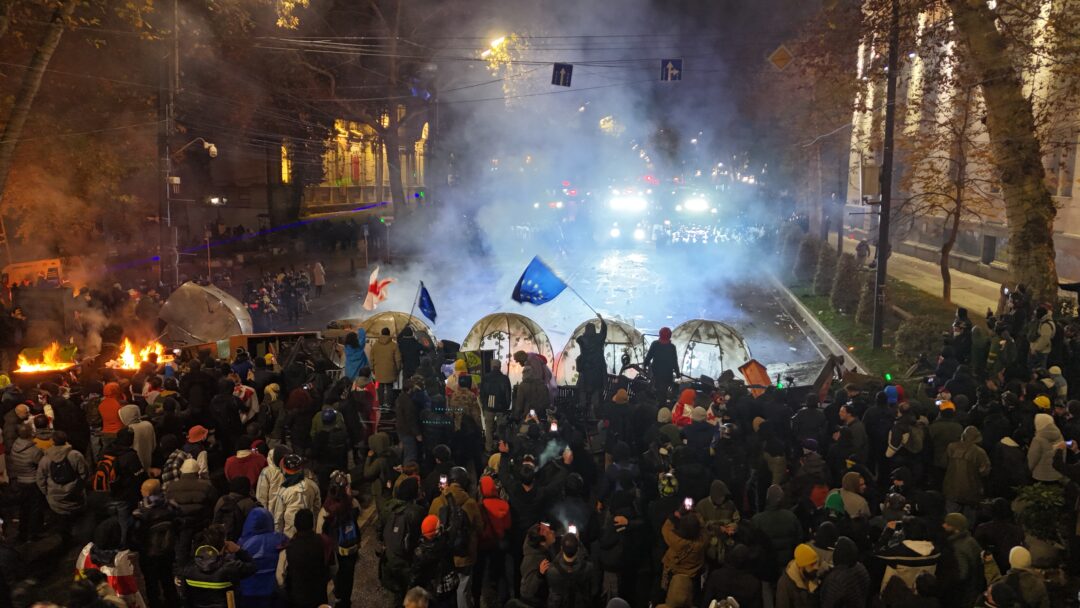
It has been almost two years since Georgia’s protests began on November 28, 2024. For weeks, an unprecedented number of people flowed ceaselessly down Tbilisi’s central Rustaveli Avenue, with daily protests in front of Parliament that continue to this day. Georgia has since undergone rapid authoritarian consolidation under the ruling “Georgian Dream” party and the oligarch Bidzina Ivanishvili. Although we never had the kind of democracy we are now mourning and fighting for, the current authoritarian shift has been overwhelming and shocking.
The converging events triggered the current protests: the shift in the Georgian government’s foreign policy, including the suspension of EU accession negotiations until 2028; the adoption of the Law on Transparency of Foreign Influence, which labels any civil society or media organization receiving at least 20% of its funding from abroad as “an organization carrying out the interests of a foreign power;” and, finally, the manipulation of the October 2024 parliamentary elections. Since then, the one-party parliament has significantly undermined civil rights and the rule of law: dispersing street protests by force, dismissing hundreds of civil servants, and introducing restrictive legislative changes, including a crackdown on public assembly and the criminalization of dissent.
Authoritarian consolidation in Georgia has produced multiple mechanisms of control over the university: legal, institutional and financial, and ideological, the last enforced through political loyalty, and delegitimizing rhetoric branding specific institutions and scholars as “politically biased,” “unqualified,” or “pseudo-liberal”. Prime-minister Irakli Kobakhidze’s 2024 threat to “cut out” the education system’s “pseudo-liberal roots,” read alongside the reform that followed, is a declaration of intent: to silence critics and replace them with loyalty through restructuring. This ideological project was preceded and reinforced by legal changes.
The ruling Georgian Dream party’s anti-gender amendments removed the terms “gender” and “gender identity” from Georgian legislation, replacing “gender” with “woman and men” or “sex.” In September, a repressive anti-LGBT law passed under the cover of the “Law on the Protection of Family Values and Minors.” It restricts freedom of expression and assembly for queer people, bans gender-reassignment surgeries, and introduces censorship in media and education, specifically the “popularization” of gender nonconformity and same-sex relationships at all levels of education, including universities. Popularization is defined as any action that, “from the perspective of an objective observer,” portrays LGBT issues in a “positive or exemplary” manner. The state thus enters the university as a controller of knowledge, imposing self-censorship.
University autonomy has always been a contested issue in Georgia, but this reform deepens state control considerably: it expands the government’s leverage to reorganize universities, centralizes their management, including the power to suspend governing bodies, weakens interdisciplinary research, further restricts entry into the academic field.
Alisse Waterston notes that the AAUP’s 1940 statement cautioned against teaching the “controversial matter, which has no relation to their subject.” Georgia’s law goes further criminalizing a specific category of such material as “popularization.”
Given how scarce domestic research funding already was, foreign funding had become essential for Georgian researchers. The 2024 Law on Transparency of Foreign Influence, which equates receiving funding from abroad with serving “foreign interests,” compounded by Foreign Agents Registration Act (FARA) in May 2025, struck directly at that lifeline. Georgian lawyers describe its provisions as deliberately vague, warning that common academic activities abroad – a grant, a research trip – could trigger prosecution, when combined with public political critique, broadly interpreted.
Institutional and Financial Control: Restructuring the University
The sweeping educational reform announced by the ruling Georgian Dream government in October 2025 established the principle of “one city, one department,” reorganizing Georgia’s multidisciplinary universities into narrower, market-driven institutions and tightening state control over admissions, governance, and academic programming. Following the February 2026 decree, the disciplines associated with critical inquiry were hit hardest: social science admissions fell by 74%, humanities by approximately 49%, and natural sciences by 45% (Chakhaia and Tsotniashvili 2026). Framed by the government as improvement, the reform in practice deepens political control over the university at the very moment when democracy itself is most fiercely contested in the country.
The universities in Georgia carried deep-rooted problems well before this reform: a lack of research infrastructure and funding, poor accessibility for less privileged students, and a chronic absence of dormitories and affordable housing. Salaries vary starkly: at Tbilisi State University invited lecturers earn around $45 a month, against associate professors roughly $1,000, which is itself unstable, since some universities tie associate professor’s pay to courses taught and cut it if hourly teaching loads aren’t met. Given the favoritism, nepotism, and cronyism in hiring, the invited-lecturer position, precarious and absurdly compensated as it was, functioned as one of the only entry points into academic teaching for those outside the “club.” I speak as someone who taught as an invited lecturer at Tbilisi State University for nearly ten years, work that was close to voluntary.
University autonomy has always been a contested issue in Georgia, but this reform deepens state control considerably: it expands the government’s leverage to reorganize universities, centralizes their management, including the power to suspend governing bodies, weakens interdisciplinary research, further restricts entry into the academic field. University programs have been reshuffled to target specific labor-market niches, with institutions like Ilia State University now restricted primarily to pedagogy and STEM. The severity of intervention was uneven: Ilia State University, long framed by the ruling party as a bastion of opposition, saw its enrolment quotas cut by 91 per cent and 86 per cent of its programmes eliminated (Chakhaia and Tsotniashvili 2026).
Yet the reform’s logic cannot be reduced to punishing dissent alone. Sokhumi State University, Georgia’s university in exile from Abkhazia, was never framed as oppositional, and its rector was a reported ruling-party donor (Chakhaia and Tsotniashvili 2026). When part of its faculty drafted a collective statement of protest, the rector opposed it and hence, the leadership’s loyalty to the party left the university vulnerable to severe restructuring of its academic programmes.
The legal, institutional, financial and the ideological mechanisms do not operate as separate assaults but a single, converging pressure, narrowing what the university in Georgia is permitted to be. This crisis can be treated not as a dead end but as a site of profound political labor, one that requires diagnosing the present with unfiltered pessimism, which allows us to grieve what has been lost while simultaneously refusing to surrender the university as a space worth fighting for.
References
Chakhaia, Lela and Keti Tsotniashvili. 2026. “Between Complicity and Resistance: Higher Education Reform and Academic Community Responses in Georgia amid Authoritarian Resurgence.” European Education. 58 (3).
Featured image: Protests on Rustaveli Avenue, Tbilisi (photo credit: Mautskebeli reproduced with permission)