The purpose of this essay is to open a conversation with scholars from around the world on the topic of academic freedom from their perspectives and structural locations. I offer a view of the topic from my standpoint in the United States as professor of anthropology emerita at the City University of New York, the City’s major, non-elite public university serving working class and working poor, historically marginalized students.
From my perspective, academics today are struggling in a turbulent world to live, to work, to contend with assaults on higher education and to stand up on behalf of those who are being threatened and silenced. The threats and assaults are unrelenting; each day brings reports that lead to growing recognition that academic freedom and its sister principle—free speech—are at grave risk.
To say we are in a turbulent world is not to express an opinion but a statement of fact. The turbulence is not new but has now escalated to full-out chaos. There is the turmoil of a world on fire from ubiquitous war and ongoing genocide. There is climate change instability and the denial of it by powerful political actors, the results of which engulf all forms of life in multiple ways. There is the terrible quaking from extreme wealth inequality alongside the politics of “fear and loathing,” leading to a world fired up by suspicion, hatred, tribalism, and ever more local and global violence. There are the confusions and obfuscations that result from the burning of knowledge in favor of ignorance, from the incineration of honesty in favor of deception, from the destruction of trust in favor of suspicion.
The local and global turbulence produced by the Trump administration is hitting the world with full force: the cataclysmic wars, the support of genocide in Gaza and settler colonial expansion and ethnic cleansing in the West Bank and East Jerusalem; the slashing of national and international health and welfare programs; the state terror campaign on immigrants. There are overt attacks, threats, bribes and other actions against students, professors and academic institutions that have led to dangerous censorship, loss of individual academic freedom, and a surge in self-censorship that has spread to colleges and universities across the country.
If the United States were but one country equal in its power to many others, the turbulence it produces may not have worldwide implications. But it is not. The United States remains the world’s most powerful country, given its military and economic dominance. And so, what happens there has enormous impact elsewhere.
There are the confusions and obfuscations that result from the burning of knowledge in favor of ignorance, from the incineration of honesty in favor of deception, from the destruction of trust in favor of suspicion.
At the broadest level, the sorry state of the world is rooted in the logics of the global capitalist political economy that maintains conditions of scarcity and insecurity while protecting private, concentrated wealth—the driving force behind the turbulence, the assaults, the attacks. In the interest of resource extraction and nationalist land expansion, particular groups—categorized, dehumanized, and transformed into something less than human—are contained, controlled and even eradicated by means of genocide, war, and malign neglect.
Knowledge is attacked because it threatens to expose this. Scholars are positioned to provide the stories and struggles of people striving to live out their lives, offering understanding of the ways differential access to power and resources shapes the local scenes of action. These scholars come up against influential political actors who have long tried to suppress such knowledge. It is no wonder that critical anthropology is often singled out for special condemnation by the most powerful, rightist, reactionary forces attacking higher education (Boghossian et al 2026; cf. Bérubé 2026; Fuentes 2026).
The Need for a Gathering of Contexts
This essay is a call for those who have been thinking, writing or living through academic freedoms and unfreedoms in different contexts. Academic freedom must be understood amid shifts in political-economic and social conditions that shape the academy and higher education (please see a living bibliography on academic freedom here). Over many decades, key shifts have included but are not limited to the marketization, commercialization, financialization, and bureaucratization of the university, and attendant ideas and ideologies about the purpose of higher education. Academia is facing the consequences of the turbulence and the shifts because it is significantly complicit in certain ways and significantly oppositional in other ways.
There is a vast literature that documents a range of these issues from military-university relationships over time and ways educational institutions stifle critical scholarship and repress student dissent—from that—to the great value and social benefits of reliable knowledge production and dissemination that is centered in such institutions.
It is useful to understand how ideas and definitions of academic freedom have changed over time and differ across geo-political place, an endeavor that may facilitate a global conception of academic freedom. Positions to be considered include but are not limited to: institutions (their prestige status; whether they are public or private), where they are located, who they serve, how they are structured, administered and funded, who and what are their internal and external partners and collaborators, what their stated and unstated missions are, the academic disciplines they support, the composition of their faculty and students, the composition of their Boards of Trustees or equivalent, the influence of these powerful decision makers and the interests they serve, how academic freedom is defined, and whose voices are heard and whose are silenced.
This essay of an open Thread serves as a call for a series of “Notes” on academic freedom from across the globe.
Conceptualizing and Defining Academic Freedom: The Case of the United States
In the US, the American Association of University Professors (AAUP) has played a key role in conceptualizing academic freedom “as a professional standard and legal right of individual professors.” Formed in 1915, the AAUP is a membership association and union, the main mission of which is to advance academic freedom and shared governance. Its first Declaration of Principles defines academic freedom as follows: freedom of inquiry and research; freedom of teaching within the university or college; and freedom of extramural utterance and action. Noteworthy is that the AAUP itself failed to defend its own principles of academic freedom during two important periods: The first during World War I when it issued a report on “Academic Freedom in Wartime” that stated, “We have to recognize that some things are just at present vastly more important than is academic freedom,” a jingoistic stand the organization later regretted considering the dismissals of “insufficiently patriotic professors.” They also regretted having urged German and Austrian professors to self-censor in all spaces—academic and public.
In today’s world of “alternative facts,” “facts” become controversial themselves, enabling the most cynical of political actors to distort the meaning of academic freedom.
The second period was during the height of the McCarthy era (1949-1956) when it neglected to publish a single report of an alleged violation of academic freedom despite the firing, blacklisting and exiling of faculty for their so-called “un-American views and affiliations.” Since then, the AAUP, learning from its past failures, has been the most important organization for defending academic freedom in the US, defining its principles, and standing up for threatened faculty.
On principles of academic freedom, Ben Heineman wrote in 1965, “In abstract terms, academic freedom guards the liberties of a professor in two broad areas: the right within the academic community to pursue and promulgate truth without restrictions or censorship, and the right, in the public sphere, to enjoy the freedoms of association and expression which any citizen possesses,” a free speech right guaranteed by the first amendment of the US Constitution. In more concrete terms, Heineman describes certain specific cases to examine what he calls matters of “political independence.”
Matters of “political independence” have to do with “controversial issues” that are discussed in the classroom and outside of it. It is in these very aspects—political independence and controversial issues—that lines can get blurred, that matters get subject to interpretation, that powerful actors exploit the grey areas, and that larger politics come into play.
In the AAUPs 1940 statement of principles, it is written that “Teachers are entitled to freedom in the classroom in discussing their subject, but they should be careful not to introduce into their teaching controversial matter which has no relation to their subject.” The caveat left professors vulnerable to charges of bringing to their classroom discussions of certain topics deemed “controversial,” subjecting them to sanction and/or firing. In its 1970 update, the AAUP added a caveat to its statement, “The intent of this statement is not to discourage what is ‘controversial.’ Controversy is at the heart of the free academic inquiry which the entire statement is designed to foster. The passage serves to underscore the need for teachers to avoid persistently intruding material which has no relation to their subject.”
Specious Accusations and Real Threats
How this plays out in real time is fully dependent upon politics. Threats to academic freedom and free speech have escalated since 9/11 and the passage of the Patriot Act in 2001 under the Bush administration that ushered in the rise of surveillance—including of what books people take out of public libraries. It also heightened the so-called “culture wars,” and intensified focus on and institutionalized characterizations of “terrorism” and “terrorists.”
In the post-9/11 era, attacks on individual professors and collective academic freedom have escalated. Politically motivated accusations by a growing number of influential right-wing organizations were leveled at professors without evidence of any wrongdoing and for making statements of fact. One example is the story documented by Matthew Streb about NYU Professor Todd Gitlin who in 2001 “was taken to task by ACTA for saying, ‘There is a lot of skepticism about the [Bush] administration’s policy of going to war’” (2006). Note that ACTA is the American Council of Trustees and Alumni, an organization that Nancy MacLean characterizes as “a little known driver of the attacks on academic freedom,” and that is today a member of the advisory board of Project 2025, the Heritage Foundation’s plan for the Trump administration’s draconian actions we are now witnessing and experiencing (2025).
the speaker and their utterances must be protected against those who would distort the meaning of their words and level false or specious accusations against them, violating the speaker’s academic freedom and free speech rights.
In today’s world of “alternative facts,” “facts” become controversial themselves, enabling the most cynical of political actors to distort the meaning of academic freedom. While Heinemen insisted on the right within the academic community to pursue and promulgate truth without restrictions or censorship, the US president today and his administration’s powerful decision makers promulgate falsehoods. At the same time, they are actively suppressing speech and demanding fealty to the administration’s political agenda, thus disabling scholars from pursuing and promulgating truth.
In this context, it is difficult to grapple with the subtleties involved in specific cases. For example, how are we to square the guaranteed right to free speech with keeping falsehoods and unsubstantiated claims out of the classroom? How do we preserve academic freedom in cases where—whether promulgated inside or outside the classroom—an educator professes what Michael Bérubé describes as “beliefs with no legitimate intellectual foundation whatsoever,” such as eugenics or denial of climate change or the Holocaust or the ongoing annihilation of Gaza? (see also Bérubé and Ruth 2022)
What is happening today is the exploitation of the grey areas, the ambiguities, the inconsistencies when principles sometimes come up against specific cases, turning everything upside down. The sheer number of cases is overwhelming and growing exponentially; it is almost impossible to monitor and assess each one for the details. And the devil is in the details of specific cases. There may be a case where the speaker’s utterances as a citizen may be deemed utterly reprehensible and based on no legitimate intellectual foundation. The AAUP’s principles of academic freedom protect that speech unless “it can clearly demonstrate the faculty member’s unfitness for his or her position [that can only be determined by] “taking into account the faculty member’s entire record as a teacher and a scholar.”
In other cases, the speaker and their utterances must be protected against those who would distort the meaning of their words and level false or specious accusations against them, violating the speaker’s academic freedom and free speech rights. Today, there is an ever growing number of examples of exactly this, many of them centered on discussion of Palestine, long in the sightline of censors.
The situation of Dr. Maura Finkelstein offers a case in point. Professor Finkelstein was fired from her tenured position as professor and chair of the Department of Anthropology at Muhlenberg College in Pennsylvania in May of 2024. The details of her case are provided in a comprehensive report published by the AAUP that is well worth reading in full because it reveals various insidious forces at work in violating the academic freedom rights of the professor and the chilling consequences of it.
The chronology of events in her case shows that the trigger for the investigation were complaints about the professor’s efforts to legitimately discuss—inside and outside the classroom—the condition of Palestinians before and after the events of 7 October 2023, conditions, including scholasticide, that have long been silenced in the US and elsewhere. Ultimately, the College dismissed the Jewish professor for reposting a post, without her making any commentary on it, of an anti-Zionist statement by a Palestinian American poet.
The AAUP considers the attacks on Professor Finkelstein for her criticism of Israel as themselves antisemitic because such attacks suggest that it is not acceptable to be Jewish and pro-Palestine or anti-Zionist, thereby justifying (and in some cases encouraging) vitriol and hostility directed at Jewish persons who hold these views. They also reveal what is behind the surveillance and suppression of Finkelstein and of other faculty at other universities who critique the conditions of life for Palestinians under occupation, apartheid and genocide. In the aftermath of October 7:
…powerful outsiders—including donors, legislators, and well-funded political organizations—escalated demands that college and university administrations crack down on what could be expressed on campus…[University presidents] were called to the US House Committee on Education and the Workforce, a low point for academic freedom… new state legislation and institutional policies were swiftly enacted, [policies] that chilled the climate for academic freedom… [and] several college and university administrations hastily enacted overly restrictive policies dealing with the right to assemble and protest on campus…
We are witness today to a growing number of professors ousted for what they present in the classroom and for their online posts about an ever-expanding list of subjects from Palestine to race, gender, colonialism, and for critiquing right wing activist Charlie Kirk whose organization established the Professor Watchlist ten years ago that names and surveils professors that the organization deems “[to engage in] radical behavior…[that] advances leftist propaganda in the classroom…[and] discriminates against conservative students.” Individual professors are listed within labels created by the watchlist that include: “climate alarmists,” “terror supporter,” “racial ideology,” “socialism,” “abortion,” “anti-law enforcement,” “protests,” and “antisemitism.” Among the professors listed under “antisemitism” are the scholarly notables Richard Falk, Robin D.G. Kelly, Rashid Khalidi, Peter Beinart, Noura Erakat, Katherine Franke, Cornell West and of course Maura Finkelstein. Faculty on the Professor Watchlist have been subject to verbal and physical threats of harm, harassment, and malicious doxxing since 2016. In the wake of Mr. Kirk’s murder in September 2025, over two dozen professors were fired (some later reinstated) without any due process for comments construed as negative about the founder of Turning Point USA, an organization with the mission “to educate young people about the importance of limited government, free markets, and freedom.”
So what we are talking about when we talk about academic freedom today in the United States is attack from multiple sources all at once: openly hostile organizations; secretive organizations; beholden, corporatized universities;, the president of the United States and his administration; the Republican-dominated US Congress; individual states such as Florida and Texas; and those political leaders (Democrats and Republicans) with allegiance to Israel and/or paid for by AIPAC, the Israel lobby.
An Invitation and Concluding Remark
The series of notes gathered in this open Thread will document the state of academic freedom from a number of different perspectives and contexts.
The attacks on faculty and assaults on academic freedom may seem overwhelming. Nevertheless these and the fear that it instills resulting in self-censoring, the withdrawal of government funding for research and education, the cynical weaponization of antisemitism, the censoring of what can be researched, what can be studied, what can be written, what can be said, and what can be read—despite all this, there are spaces in the interstices for refusals, initiatives, resistance, and solidarity as these last five links illustrate.
It is not too late.
For those interested in contributing a note to the open Thread, please email Alisse at: AcademicFreedom.AllegraLab.Notes@gmail.com
References
Bérubé, Michael and Jennifer Ruth. 2022. It’s Not Free Speech: Race, Democracy, and the Future of Academic Freedom. Baltimore: Johns Hopkins University Press.
Boghossian, Paul, Kwame Anthony Appiah, Kit Fine, Joseph Henrich, Katherine E. Fleming, Jason Merchant, Gary Saul Morson, Gideon Rosen, Ashley Rubin and Sean Wilentz. 2026. “Report on the State of Scholarship in the Humanities and the Humanistic Social Sciences” (April 5): https://cdn.vanderbilt.edu/vu-wpfsx/wp-content/uploads/sites/51/2026/06/State-of-Scholarship-Report-final.pdf
Fuentes, Agustin. 2026. “McCarthyism Dressed Up as an Academic Report: Are Leftist Professors Really Destroying the Academy’s Credibility? No, despite what a recent report argues.” Chronicle of Higher Education. June 12. https://www.chronicle.com/article/are-leftist-professors-really-destroying-the-academys-credibility
Heineman, Ben W., Jr. 1965. “The University in the McCarthy Era.” The Harvard Crimson. June 17. Accessed 13 October 2025. https://www.thecrimson.com/article/1965/6/17/the-university-in-the-mccarthy-era/
MacLean, Nancy. 2025. “The American Council of Trustees and Alumni: A Little-Known Driver of the Attacks on Academic Freedom and Shared Governance.” Action Report #4. Center for the Defense of Academic Freedom. February 25. Accessed 13 October 2025. https://www.aaup.org/sites/default/files/ActionReport4_ACTA.pdf
Streb, Matthew J. 2006. “The Reemergence of the Academic Freedom Debate.” In Freedom at the Dawn of a New Century: How Terrorism, Governments, and Culture Wars Impact Free Speech, Evan Gerstmann and Matthew J. Streb, eds. Redwood City, CA: Stanford University Press.
Abstract: In this essay, I offer a perspective from the United States on the ever-growing assaults on academic freedom and its sister principle, free speech. The assaults are situated amid the turbulent world within which we struggle to live, to study, to write, and to stand up on behalf of those who are being threatened, silenced, erased. The essay begins with a description of the turbulence, synthesizing the broad context for the state of academic freedom today. There are histories, definitions, debates, conflations, interpretations and misinterpretations to unpack in any effort to wrap our heads around what academic freedom means and does not mean. The essay is designed to stimulate conversation on how we might move forward to confront real threats—wherever these or we—are located in academia and in the world.
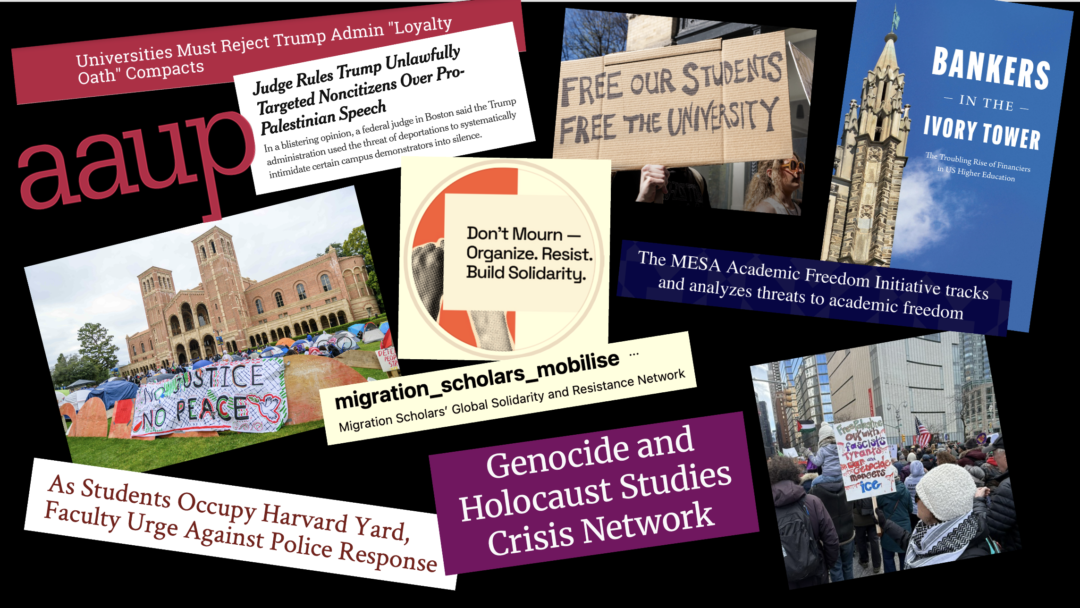
Featured Image: A View from the United States by Alisse Waterston