Academic freedom is, along with democratic freedoms, in dramatic decline worldwide, what with the latest V-DEM report indicating a decline in academic freedom in fifty countries worldwide over the past ten years. The reasons for this decline are complex and manifold, but can reliably be linked to the rise of an authoritarian populism that has long regarded academics as forming part of a “cosmopolitan elite of frequent travellers” and universities as havens of “liberal,” “radical,” or “woke” worldviews, as well as the rise of neoliberal managerialism in universities. As Joan Scott notes, a paradox of academic freedom is that it appears as if “democracy depends on the university even if the university itself is not a perfect democracy” because “critical thinking is the lifeblood of democratic societies” and “depends on informed and disciplined knowledge” – of the kind that universities do offer at its best (Scott 2019: 104).
Part of the challenge we face, as Akheel Bilgrami and Jonathan Cole point out, is that what academics understand by academic freedom, and how it relates to the much wider concept of freedom of speech, is not always clear or transparent to academics themselves (2015)1. In general, we may define academic freedom as the freedom to teach, research and disseminate freely and without the fear of sanctions from the state, university administrators or funders. But like other forms of freedom, academic freedom is never entirely free nor individual, and entails both rights and responsibilities: academic freedom depends on the academic’s willingness and ability to adhere to scientific norms and standards, and on validation by the relevant disciplinary research community (Rabban 2025). Academic freedom does not provide a licence to use the university classroom as a space for activism or advocacy of particular political views (Reichman 2025): your hunger strike for Gaza must take place elsewhere. But what at any given time and in any given place counts as “activism” may be contested. There are certainly those in our present dark times who count support of human rights or the equal rights to life and dignity for all people as forms of “activism.” The area in which this gets most problematic and contested is in so-called extramural speech, where the lines between the professional scholar and the democratic citizen often tend to blur (Butler 2025).
The Case of Norway
In the present context, I would perhaps have wished that I had a dramatic personal story about the state of academic freedom in Norway to tell. But I don’t. Having first voiced serious concerns about the state of public discourse about Islam and Muslims in 2011, I went on to publish on hate speech, racism, and Islamophobia in Norway in the decade which followed. That was not universally popular, and it was in hindsight not the best career move in a country where the parrhesiast is not necessarily and always welcome. I have seen more than my fair share of hate mail, deliberate targeting via social media, and academics contacting my superiors with a view to getting me fired over things I have said in public, but I have also had the fortune of having had an employer and a board willing to defend both my academic freedom and freedom of speech if and when the situation required it. Having the required institutional understanding of and support for one’s exercise of academic freedom has in my own experience been crucial, and saved me from many sleepless nights.
Anthropologists have historically been relatively good at deconstructing abstract universalisms. If truth be told, we have been less good at making the case for the value of retaining and defending some universalisms. But there is a time for everything, and if the time for defending academic freedom is not now, then when will it ever be?
Freedoms are differentially and unevenly distributed, and so too in the case of academic freedom. For not only does it crucially depend on requisite material circumstances and educational infrastructure (a reason that the Israeli scholasticide in Gaza has been so effective), there is also a hierarchy in which the tenured have much more of it than the untenured, and academics more than students.
One of the greatest threats to academic freedom is the rise of the non-tenured academic precariat across the world. For this also breeds a culture of self-censorship that is most apparent recently in the refusal of many academics – including in our own discipline – to say anything at all about the serious affront to any idea about the right to human life and dignity of all people that the ongoing Israeli genocide in Gaza presents us with, lest it damage their own career, prospects and opportunities for conference travel.
Norway has never constitutionalized academic freedom, but nevertheless ranks highly on international rankings of academic and democratic freedom. One may take issue with such rankings that are premised on a positivistic political science approach, which takes for granted that academic freedom is a universal value; that we all understand what is meant by the term; and that it can be measured by the cross-cultural application of the same social science methodology. But what scholars have referred to as “substantive democracy” is in fact more tangible and real in Norway than in most other places.2
Sapere aude! or Dare to know! was the motto of Kant’s classic What is Enlightenment? , but unlike Kant, we need not see academic freedom as exclusively “Western.”
What Role for anthropologists?
Anthropologists have historically been relatively good at deconstructing abstract universalisms. If truth be told, we have been less good at making the case for the value of retaining and defending some universalisms. But there is a time for everything, and if the time for defending academic freedom is not now, then when will it ever be? If academic freedom is to be globalized, as both Waterston (this thread) and Butler (2022) call for, then anthropologists could do worse than try to map vernacular conceptions of academic freedom in variegated contexts with a view to identifying potential overlapping understandings cross-culturally.
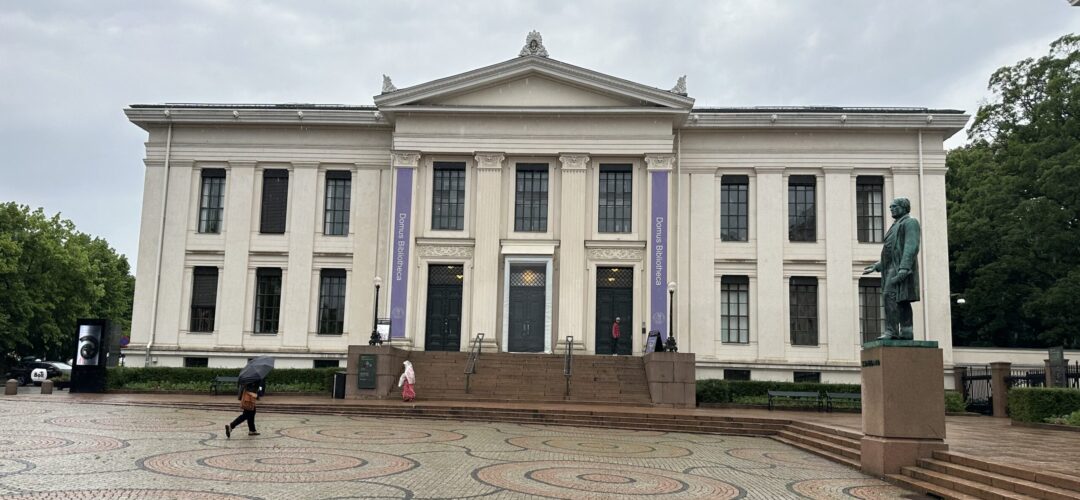
Featured image: A Classic Building of the University of Oslo by Sindre Bangstad
References
Bangstad, Sindre (2011). “Fighting Words That Are Not Fought,” The Immanent Frame 14.07.11. https://tif.ssrc.org/2011/06/14/fighting-words/
Bilgrami, Akheel and Cole, Jonathan (2015). Introduction. In Bilgrami, Akheel and Cole, Jonathan (eds.) Who’s Afraid of Academic Freedom? New York: Columbia University Press: ix-xvii.
Butler, Judith (2022). “Endangered Scholarship, Academic Freedom, and the Life of Critique,” Critical Times 5 (2): 399-425.
Butler, Judith (2025). “Academic Freedom in a Time of Destruction: Reconsidering Extramural Speech,” Social Science Quarterly 92 (2): 407-446.
Rabban, David M. (2025). Academic freedom: From Professional Norm to First Amendment Right. Cambridge, Mass: Harvard University Press.
Reichman, Henry (2025). Understanding Academic Freedom. 2nd edition. Baltimore, ML: Johs Hopkins University Press.
Scott, Joan W. (2019). Knowledge, Power and Academic Freedom. New York: Columbia University Press.
Footnotes:
- A 2022 Norwegian government commission led more than a few Norwegian academics to confuse academic freedom and freedom of speech by popularizing the conflationary and contradictory government-mandated term “academic freedom of speech.” ↩︎
- Even so, Norway, too, is blessed with a right-wing populist party with aspirations to power whose parliamentarians regularly castigate gender studies, for example, as a “waste of taxpayers’ money.” ↩︎