

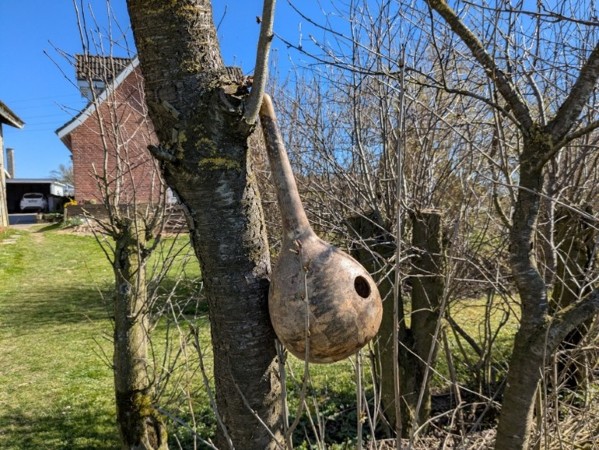
On a sunny spring afternoon, a colleague and I visited Pia’s private garden, where she introduced us to her plants. Withered leaves and branches crunched beneath our feet as we walked, while dreams and plans about the upcoming season were on Pia’s mind as plants slowly awakened from their winter slumber beneath the soil.
In between the branches of some naked trees, a weird-looking gourd caught my eye. It seemed alien to me as I had never encountered one before, and it stood out in between the slim branches. I couldn’t resist asking Pia about it, and it turned out to be a dried and hollowed gourd made into a birdhouse. As Pia talked about this gourd, the energy of the conversation shifted to a new level of excitement as she was reminded why these plants brought her so much joy. As Pia went on describing her experience with the gourd, it resonated with me as memories, affections, imagination, and multiple temporalities flooded in and through me – hence why I chose it as my object of analysis in the poetic resonance workshop (see the introduction to this thematic thread).
There were two points in Pia’s answer that I experienced as affective triggers, as the poetic resonance protocol puts it, or Affinities as sociologist Jennifer Mason calls it – potent connections arising from sensations that flow through our encounters, which can make sensorial happenings blossom rather than flattening (Mason, 2018). The two points of interest were:
- Her description of harvesting the gourd:
“It’s one of those things that come into the living room, because it needs to mature, then you drill and hollow it, and then those seeds need to be fiddled [originally in Danish: nulre] out, then it needs to dry again, and now it’s a bird house.” - Her description of the gourd plant when it was in the hot house:
“…in the hot house, it’s really a plant you can get lost in. Suddenly, it says POOF [Pia waves her arms, briefly losing balance on her legs], and then it’s everywhere.” Pia goes on reflecting on her excitement: “The cool thing is also that you can go outside, and then you just meet another organism that just seems so HAPPY.”
In my fieldwork, I am interested in the existential being of the gourd and Pia’s relation to it, particularly in relation to my broader work on designing technologies that strengthen human–plant relations. I draw on posthumanist philosophies (Braidotti, 2013; Ferrando, 2013; Haraway, 2016; Smith et al., 2017), which decenter the human and understand the world as constituted through a nonhierarchical, agential network (Barad, 2007). Using the multispecies ethnography method (Kirksey & Helmreich, 2010), I attend not only to Pia as a human interlocutor, but equally to the plants and other beings in her garden, focusing on their intertwined entanglements rather than isolated entities.
My own bodily experience became the starting point for my insights, rather than being a passive onlooker extracting knowledge from others.
While doing fieldwork, I have not considered myself as part of this entanglement and have not been interested in my own situated relation to the entities studied. But upon analyzing them using poetic resonance, my own bodily experience became the starting point for my insights, rather than being a passive onlooker extracting knowledge from others. The poetic resonance protocol heightens attention to multisensory forces and flows (Ingold, 2012; Pink, 2009), allowing slippery experiences—amalgamations of emotions, atmospheres, materials, bodies, and memories—to come into focus.
It was clear from the start that this ethnographic object had many interesting sensory and affective modalities at play. For example, the gourd’s growth and timescale in seasons and Pia’s time-consuming prepping of the gourd; the gourd’s changing shape and movement between outside and inside the house; how the gourd takes up space in the hot house, then in the living room, and then becomes birdhouse; the gourd’s expressive, happy and energetic being as something experienced through Pia’s body.
Me as Tuning Fork
The protocol helped me further analyze these modalities by being explicit about what the resonated experience was, and how it was felt in my own body. Using myself as a “tuning fork” – feeling out vibrations of others to find resonance – and by following the protocol guidelines, these were the insights I had from revisiting Pia’s conversation:
Upon revisiting the first point, I couldn’t stop smiling and chuckle at Pia’s description of her harvesting process, because it sounded like very tedious work that takes a whole year before completion, but she went swiftly over the steps as if it took no effort or time, and she ends it comically with “and now it’s a birdhouse”, as if it was the most natural thing in the world. I experienced a sense of admiration for how she does things so lightheartedly. This was further amplified in the contrast between a very mundane activity of fiddling with free and removing the seeds inside her house and the extraordinary birdhouse as an outcome. Nature seems to seep into and out of her home with ease. This admiration and ease were felt as a poetic resonance in my heart, shoulders, and in my smile.
It was refreshing to experience someone mirroring a plant like that, since plants are normally perceived as slow and static beings.
On the second point about the gourd plant in the hot house, I felt a shock when Pia burst out “POOF”, emphasized through her body by waving her arms and briefly losing her balance. It was a surprise because her body language had been subtle up until this point, but also because it was refreshing to experience someone mirroring a plant like that, since plants are normally perceived as slow and static beings (Sanders, 2019). It triggered a memory in me of being inside my grandpa’s plant-packed hot house with the smell of moist soil and condensed air that is almost suffocating. I felt this as a squeeze on my arms as if being suddenly surrounded by a plant in a tight space. Then Pia continues to reflect on how she met the gourd plant as a happy, content, and energetic organism. She stuttered in excitement as she suddenly thought about this and had the urge to convey it. Her happiness was contagious and warm, and I envy her ability to be so happy just by meeting a plant. I felt her excitement in my lungs and my stomach – like being on a rollercoaster.
Now that my encounter with the analytical object has been expanded upon – or “blossomed”, as Mason says – the next step of the protocol was to make a list-poem from my insights, meeting Pia and the gourd. I saw this exercise as a way to condense the affective findings back down to a tangible list of things, but still without oversimplification since the poetic format allowed for abstractions, interpretation, and emotions to emerge.
I started out by making a list, but felt it was not encompassing the multiplicity of this object, as I had been on a journey with it by engaging with it affectively, which in turn has made me become part of its multiplicity. So, I decided to go one step further and incorporate temporality and storytelling in my poem, while still following the repetitive flow of a list-poem. Here are the two poems side by side:
The gourd is…
The gourd is a huge explosion
The gourd is fast and slow unfolding
The gourd is a plant you get lost in
The gourd is a happy and content organism
The gourd is contagiously warm
The gourd is a tight squeeze on my arms
The gourd is an embrace or suffocation
The gourd is from a room of hot moist air
The gourd is drying in the living room
The gourd is a living room for birds
The gourd is lighthearted hygge labor
Getting lost in a gourd
When you were tucked in the warm soil;
when you stuck your head out arms out and climbed out;
when your leaves munched on sunlight roots on water;
so slow so patient.
Then you POOF exploded unfolded stretched filled out and embraced;
when she met you so full so happy so content so exciting so envious;
when you gave fruit in that hot house then dry house and now birdhouse;
so energetic so thankful.
Researcher as Situated Subjects
In the active listening exercise that followed the list poems, I chose the second poem to be read out loud, and my listening partner responded that it gave a very personal understanding of the gourd since it was written in second person, as if I had an intimate relationship with it. This came as a surprise, since the poem was written as a “secondary experience” where I was reiterating what Pia had experienced by imagining the growth of the gourd. This is not my gourd, I have not cared for it when it was a plant nor interacted with it, I am “just” a researcher who noticed it and listened to someone talk about it – the gourd is my object of study, so how could there be an intimate relationship between me and the gourd? When and how did this relationship occur, and is it good or bad? And as with the cautiousness around “triggering false memories” mentioned in the protocol, I question whether this relationship was authentic or synthetic, and how to go about this question.
In trying to understand the relationship between subjectivity and research, I turn to my Posthumanist approach to research that is itself an ethico-onto-epistemological entanglement, where a researcher’s ethical sentiment (in my case, towards plants), ontological worldview, and epistemological knowledge-making process is inseparable (Barad, 2007) – I am thus inseparable from my study. I do not question whether there is space for subjectivity in research, as embodied knowledge – especially in sensory anthropology and related qualitative traditions – has been advocated as the condition of, rather than a threat to, ethnographic knowledge (Ingold, 2011; Pink, 2009; Stoller, 1989). My question is to what extent subjectivity is allowed to color and shape research: when do we account for our situated knowledge (Haraway, 1988), and how do we stay critically reflexive about the way knowledge is produced? The next section analyzes the knowledge-making process I went through with the protocol, in order to better understand where subjectivity was intensified and what this means for my ethnographic work and the agency of the protocol itself.
Drawing as Sense Making Tool
To further understand how the intimate relationship emerged and to pinpoint my own situatedness, I map out my process with the protocol by drawing, and use it as a form of meta-analysis:
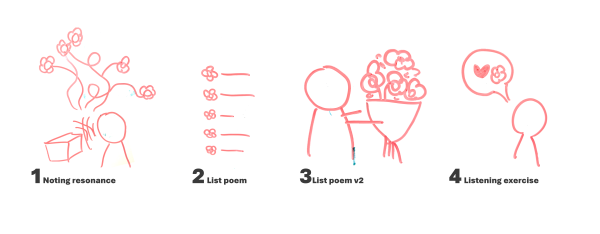
Figure 1: Drawings that visualise the process with the protocol, using flowers as metaphors
Inspired by Mason’s phrasing of blooming and flattening, and my own design research with plants, I illustrate the process using flowers. Here is a more elaborate description of each step in the process:
- In the encounter between me and the object, resonance happened. Furthermore, out of my heightened noticing and analysis from protocol steps 1-2, sensorial happenings bloom, grow, and become tangled like a wildflower meadow.
- I picked the flowers and compressed these tangled happenings into a list as suggested by the protocol step 3.
- I made a bouquet out of the flowers, which entails adding a few new elements and tying them together. This is where I diverged from the protocol and made my own list poem, “Getting lost in a gourd”.
- I showed my bouquet to someone and listened to their reaction, as instructed by the active listening exercise.
The map helps me make sense of my process by translating and concretizing the slippery micro-relations between me and the ethnographic object. By analyzing it, it is clearer that the process has been one of repeated complication and distillation, which can be illustrated with opening and closing gaps like this:
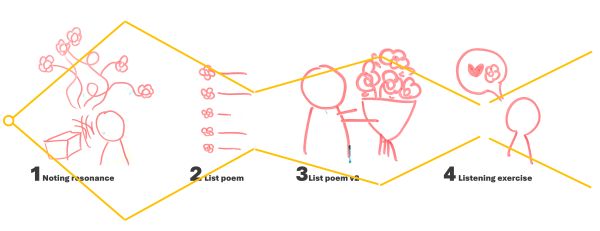
Figure 2: Visualisation of where the complication (divergence) and distillation (convergence) happened in the process.
On further inspection, it becomes clearer that the intimate relation might have emerged in the third step, where the list-poem was complicated by subjective memories and emotions. If the protocol had not diverged from this the intimate relation might not have emerged. And if the poem had remained a simple list, it would perhaps have left more room for open interpretation for my listening partner or resulted in a sharper distillation of insights.
On the other hand, it is also possible to believe that the intimate relationship was already existent from the moment I engaged with the gourd, and that the protocol has helped bring those relations forth and put them into words. Maybe this relationship refused to be simplified into a list and demanded more subjective contextualization in order to be conveyed more clearly. This way of thinking about relations as emerging from the moment object and subject meet can be further understood and supplemented by posthumanistic ways of understanding relations. Haraway’s term ‘becoming-with’ (2008) suggests that relations emerge through ongoing entanglements, meaning that relations are constituted rather than pre-existent; they emerge through encounters, but always within a pre-existing web of entanglements that condition them. In this case, an intimate relation emerged through the encounter between me, Pia, and the gourd, but the specific relation emerged only because of the pre-existing entanglements – such as memories, sensorial experiences, history, and feelings – that had conditioned us into that specific assemblage.
Relations are constituted rather than pre-existent; they emerge through encounters, but always within a pre-existing web of entanglements that condition them.
Return to the question: was the intimate relation synthetic or authentic? If relations only emerge through encounters, they can be argued as synthetic, as in something was “composed” through the orchestrated encounter of multiple entities. However, following that logic, “authentic” relations cannot exist as relations only emerge rather than being pre-existent, pure, and distinct. As Haraway puts it, “The world is a knot in motion” (2003, p. 6), illustrating relations as a construct that is ongoingly becoming, rendering the question of “synthetic or authentic relations?” as a false binary.
The intimate relation could also be understood as synthetic in the sense that something helped set it up to emerge—namely, the poetic resonance protocol itself, which we need to acknowledge as a tool to bring forth and concretize slippery relations. Without the protocol, the relations might exist, but they would be hidden and hard to grapple with. So in a way, the intimate relation emerged thanks to the protocol, albeit we need to remember that the protocol – just like everything else – also has its own pre-existing web of entanglements that has conditioned it to become what it is. The relation was not forced upon me by the protocol, but it needs to be recognized as an equal agent in the surfacing of the intimate relation, just as the pre-existing entanglements within me, Pia, and the gourd before our encounter.
Featured image: The gourd, photograph by the author.
References
Barad, K. (2007). Meeting the Universe Halfway: Quantum Physics and the Entanglement of Matter and Meaning. Duke University Press.
Braidotti, R. (2013). The posthuman. Polity Press.
Ferrando, F. (2013). Posthumanism, Transhumanism, Antihumanism, Metahumanism, and New Materialisms: Differences and Relations. Existenz, 8, No 2, 26–32.
Haraway, D. (1988). Situated Knowledges: The Science Question in Feminism and the Privilege of Partial Perspective. Feminist Studies, 14(3), 575–599.
Haraway, D. (2003). The companion species manifesto: Dogs, people, and significant otherness. Prickly Paradigm.
Haraway, D. (2008). When species meet (8th reprint 2020). University of Minnesota Press.
Haraway, D. (2016). Staying with the Trouble: Making Kin in the Chthulucene. Duke University Press.
Ingold, T. (2011). Being Alive: Essays on Movement, Knowledge and Description. Routledge.
Ingold, T. (2012). Toward an Ecology of Materials. Annual Review of Anthropology, 41(Volume 41, 2012), 427–442.
Kirksey, S. E., & Helmreich, S. (2010). THE EMERGENCE OF MULTISPECIES ETHNOGRAPHY. Cultural Anthropology, 25(4), 545–576.
Mason, J. (2018). Affinities: Potent connections in personal life. Polity Press.
Pink, S. (2009). Doing Sensory Ethnography. SAGE Publications Ltd.
Sanders, D. L. (2019). Standing in the shadows of plants. PLANTS, PEOPLE, PLANET, 1(3), 130–138.
Smith, N., Bardzell, S., & Bardzell, J. (2017). Designing for Cohabitation: Naturecultures, Hybrids, and Decentering the Human in Design. Proceedings of the 2017 CHI Conference on Human Factors in Computing Systems, Denver, Colorado, USA.
Stoller, P. (1989). The taste of ethnographic things: The senses in anthropology (1st ed., p. xv). University of Pennsylvania Press.
Abstract: During a multispecies ethnographic fieldwork in a Danish private garden, I encountered a weird-looking gourd (Calabash) that was turned into a birdhouse. By using the poetic resonance protocol proposed in this thematic thread, which turns myself into a “tuning fork” and heightens my attention towards multimodal sensorial experiences, I examine two points from the interview that were “affective triggers” and further analyze the intimate relationship that emerged from using the protocol. I use drawings and blooming flowers as metaphors to make sense of the intimate relation and reflect on subjectivity in relation to being a situated researcher. Lastly, I discuss the authenticity of such an intimate relation and use posthumanism to understand the nature of relations as emergent entanglements.