
Academic freedom in Germany is marked by a growing paradox. Constitutionally, universities enjoy strong protections for research and teaching. Yet, in practice, these freedoms are becoming increasingly conditional, particularly when scholarship or activism concerns Israel and Palestine. The current crisis is driven less by explicit censorship than by administrative governance, reputational pressures, and political norms that define the boundaries of legitimate academic expression (Abu El-Haj 2023; Al-Taher and Younes 2024, 2024).
This Note explores how regimes of Holocaust memory and ethical responsibility are translated into administrative and legislative mechanisms that condition the practice of academic freedom in contemporary Germany. It argues that these developments are best understood through a memory–morality–power framework. Germany’s commitment to Holocaust remembrance and the protection of Jewish life remains an indispensable ethical foundation of its democratic order. However, when these moral commitments are translated into university governance, legislative initiatives, and institutional policies, they also become mechanisms that regulate academic life. In this context, academic freedom is increasingly governed through anticipatory compliance, bureaucratic discretion, and concerns over institutional reputation. The intersection of historical memory, moral obligation, and institutional governance produces a form of conditional academic freedom, in which scholars and students increasingly adjust their research, teaching, and public engagement to avoid professional or institutional risk (Al-Khatib 2026).
Rather than isolated incidents, these developments reveal a broader transformation in which universities increasingly regulate political expression through administrative authority, producing a chilling effect on teaching, learning, and public debate about Palestine.
This dynamic can be observed across three interconnected arenas: the securitization of pro-Palestinian student activism on university campuses, the disciplinary governance of scholars within leading research institutions, and the incorporation of Staatsräson—the principle of Germany’s historical responsibility for Israel’s security and the protection of Jewish life—alongside the IHRA framework into academic governance. Together, these developments reveal a broader restructuring of the university as a space where historical memory, moral responsibility, and state priorities intersect to shape what can be researched, taught, and publicly debated (Bundestag 2024; Levy and Sznaider 2006).
Yet this trajectory has not gone uncontested. Students, academics, professional associations, and transnational scholarly networks have increasingly challenged these restrictions through public statements, legal action, independent initiatives, and campaigns defending academic freedom. Their efforts demonstrate that the struggle over academic freedom in Germany is ultimately a struggle over the purpose of the university itself: whether it remains a space for critical inquiry or is increasingly redefined by political conformity.
How Academic Freedom Became Conditional
The most visible transformation has occurred on German university campuses, where pro-Palestinian student activism has increasingly been treated as a matter of security rather than academic debate. Recent scholarship describes this process as the securitization of higher education, in which political dissent is reframed as a threat to institutional order rather than an expression of democratic participation (Della Porta 2024; Ullrich 2025).
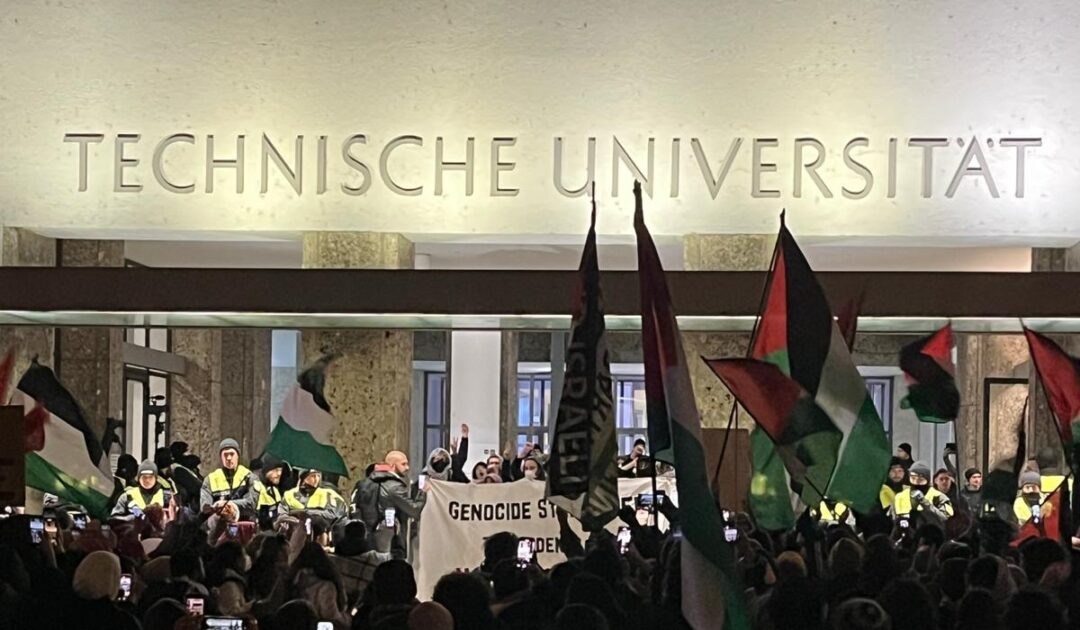
Berlin became the clearest example of this shift in 2024. At Freie Universität Berlin, a student encampment in solidarity with Gaza was dismantled by police following a request from the university administration, resulting in dozens of temporary arrests and criminal investigations. Similar restrictions affected Palestine-related events and student initiatives at other Berlin universities, including Humboldt University. These developments coincided with legislative proposals allowing universities to deny matriculation on political grounds, thereby expanding administrative discretion over student participation.
The future of academic freedom in Germany therefore depends not only on constitutional guarantees, but also on the willingness of students, scholars, universities, and professional associations to defend the university as a space for critica
The consequences extended well beyond the protests themselves. More than 200 academics publicly condemned the police intervention and defended students’ constitutional rights, while student unions, legal organizations, and the education union GEW challenged both the proposed legislation and the growing use of disciplinary measures on campus. Rather than isolated incidents, these developments reveal a broader transformation in which universities increasingly regulate political expression through administrative authority, producing a chilling effect on teaching, learning, and public debate about Palestine.
Scholars: Reputational Governance and Institutional Discipline
The pressures experienced by students are mirrored at the level of academic staff, particularly within Germany’s elite research institutions. Rather than relying on direct censorship, universities and research organizations increasingly regulate controversial scholarship through reputational risk, funding dependency, and administrative discretion, contributing to a shrinking space for critical scholarship on Palestine (Schuetze 2024). This increasingly restrictive environment became especially visible during 2023–2024, when a series of high-profile cases revealed the consequences faced by academics perceived as too supportive of Palestine or too critical of Israeli government policies. The anthropologist Ghassan Hage was dismissed from a visiting position at the Max Planck Institute following social media posts criticizing Israel, which were subsequently targeted by attacks in right-wing media outlets. Laurie Anderson withdrew from a professorship at the Folkwang University of the Arts after facing criticism for endorsing an open letter by Palestinian artists. Likewise, the University of Cologne rescinded a visiting professorship offered to the Jewish-American political philosopher Nancy Fraser after she signed a public statement condemning Israel’s military campaign in Gaza. Perhaps the most troubling development was the revelation that Germany’s Federal Ministry of Education and Research, under Minister Bettina Stark-Watzinger, explored the possibility of withdrawing public funding from academics who had signed an open letter criticizing police violence against pro-Palestinian student protesters (Matthews 2024; Ramani & Jensen 2024).
From Moral Responsibility to State Governance
These developments cannot be understood apart from Germany’s distinctive politics of memory. Since 1945, Holocaust remembrance and the protection of Jewish life have become foundational principles of the German democratic order. While these commitments remain ethically indispensable, they have increasingly been translated into mechanisms of academic governance that shape the boundaries of legitimate political expression
The clearest example is the Bundestag’s 2024 resolution, Never Again Is Now, which reinforces the IHRA working definition of antisemitism and encourages its incorporation into public institutions, including universities. Critics argue that, in practice, this framework has increasingly blurred the distinction between combating antisemitism and restricting legitimate criticism of Israeli state policies (Gould 2022; Abu El-Haj 2023). As a result, university administrations, funding bodies, and public institutions have become more cautious in regulating research, teaching, and public events related to Palestine.
Instead of directly prohibiting critical scholarship outright, these developments institutionalize Staatsräson—the principle that Germany’s historical responsibility entails a particular commitment to Israel’s security and existence—as a governing principle of academic life (Levy & Sznaider 2006; Amir-Moazami 2024). Historical memory thus becomes embedded in administrative practice, transforming academic freedom into a conditional space in which political legitimacy and scholarly legitimacy are increasingly intertwine.
The future of academic freedom in Germany therefore depends not only on constitutional guarantees, but also on the willingness of students, scholars, universities, and professional associations to defend the university as a space for critical inquiry. The recent mobilizations across campuses and academic networks suggest that this struggle is well underway.
References
Abu El-Haj, Nadia. 2023. “Surviving Colonialism? A Response to Neither Settler nor Native.” Anthropological Theory 23 (4): 373–385. https://doi.org/10.1177/14634996231209105.
Al-Khatib, Taqadum. 2026. “Academic Freedom Under Pressure: Holocaust Memory, Institutional Control, and the Discourse of Genocide Regarding Palestine in Germany.” Middle East Critique, June, 1–21, 1–21. https://doi.org/10.1080/19436149.2026.2673596
Al-Taher, Hanna, and Anna-Esther Younes. 2024. “Erasing Palestine in Germany’s Educational System: The Racial Frontiers of Liberal Freedom.” Middle East Critique 33 (3): 335–351. https://doi.org/10.1080/19436149.2024.2383444.
Amir-Moazami, Schirin. 2024. “The German Consensus and Its Critics: Postcolonial Interventions and the Limits of Academic Freedom.” Journal of Critical Studies on Antisemitism 2 (1): 15–38.
Berliner Senat. 2024. “Änderung des Berliner Hochschulgesetzes beschlossen.” https://www.berlin.de/rbmskzl/aktuelles/pressemitteilungen/2024/pressemitteilung.1431516.php
Bundestag. 2024. “Bundestag stimmt mit breiter Mehrheit für Antrag gegen Judenhass.” Deutscher Bundestag, November 7, 2024. https://www.bundestag.de/dokumente/textarchiv/2024/kw45-de-juedisches-leben-1027708
Della Porta, Donatella. 2024. “Moral Panic and Repression: The Contentious Politics of Anti-Semitism in Germany.” Partecipazione e Conflitto 17 (2): 276–349.
GEW Bayern. 2024. “Stellungnahme der GEW Bayern im Rahmen der Verbändeanhörung Zum Gesetzentwurf zur Förderung der Bundeswehr.” GEW Bayern, Munich. https://www.gewbayern.de/aktuelles/detailseite/zum-gesetzentwurf-zur-foerderung-der-bundeswehr-in-bayern
Hochschulrektorenkonferenz. 2023. “Israel.” Accessed October 10, 2023. https://www.hrk.de/fileadmin/redaktion/hrk/02-Dokumente/02-02-PM/2023-10-10_P_Israel.pdf
Levy, Daniel, and Natan Sznaider. 2006. The Holocaust and Memory in the Global Age. Philadelphia: Temple University Press.
Ullrich, Peter. 2024a. “Nahostkonflikt an Deutschen Unis.” Blätter für deutsche und internationale Politik.
Featured Image: Student Protests in Munich (photo credit: Academics for Justice)