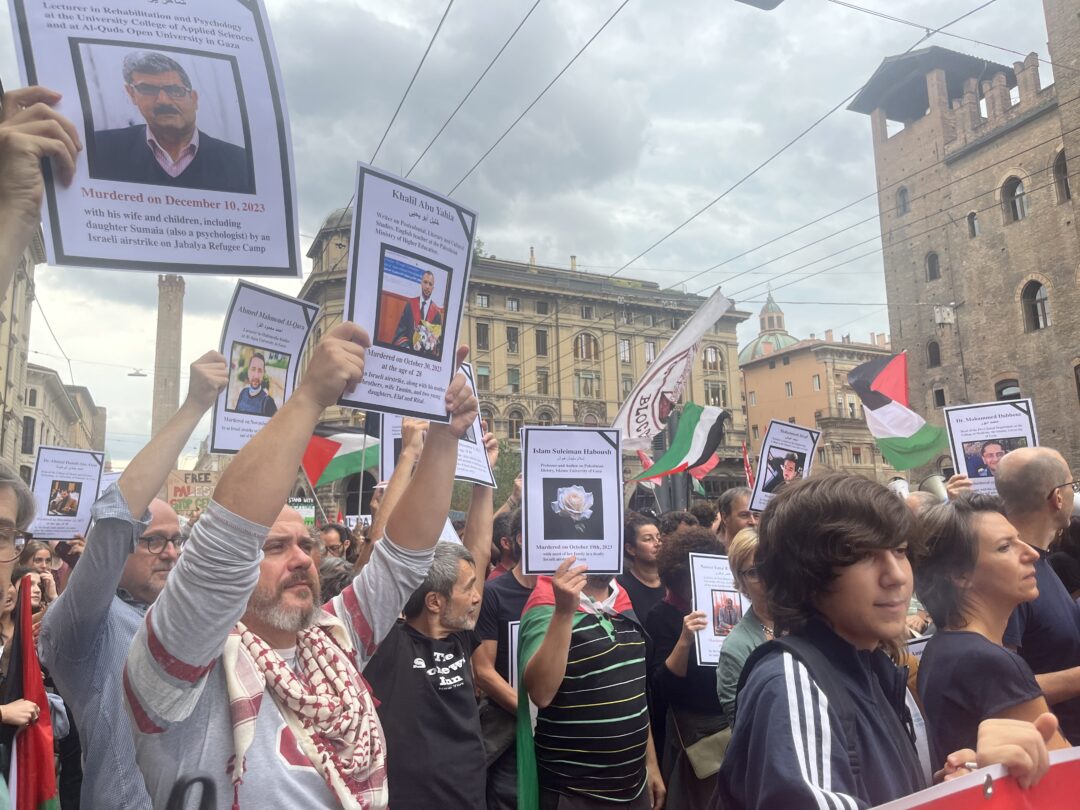
Calls and legal tools to ensure “freedom of speech” in universities proliferate across European countries. As I argued elsewhere in relation to the presumed neutrality of higher education institutions and knowledge production in the context of the genocide in Gaza, what we see at work is a process of extreme abstraction and decontextualisation, intentionally leading to a reversal of reality. In psychoanalysis this is considered a part of narcissistic personality disorders and known as DARVO Deny, Attack, and Reverse Victim and Offender.
Far from expanding democratic debate, many of these calls also invert relations of power: individuals and movements committed to maintaining racial, gendered, or class-based hierarchies increasingly portray themselves as victims of discrimination when their views are challenged. In this discursive framework, victim and perpetrator, racist and racialised, colonial domination and anti-colonial struggle are turned upside down. Racist and supremacist positions and actors are reframed, at best, as “controversial” or “anti-conformist,” while demands for justice and accountability are recast as censorship. Such reversals not only obscure relations of power but also reshape the very terms through which violence, injustice, and resistance must be publicly understood. As Sara Ahmed notably argued what counts as speech or as harassment is political.
In Europe, university campuses have transformed into an active zone of surveillance, where the bounds of permissible thought are tightly policed by administrative bodies yielding to external political and economic pressures.
Disquieting is the way those striving to readdress the reproduction of inequalities in neo-liberal institutions are framed as “political” and cast as mobilising outside legitimate academic boundaries. This strategic concealment operates quite consistently across various institutional battlegrounds. It functions when actors actively engage in exclusionary projects targeting Black and brown scholars and their scholarship or roles. It manifests when gatekeepers attempt to restrict the discipline of anthropology to an epistemic framework where scholars experiencing structural racism, colonial violence, or genocide in Gaza are deemed the threat rather than the threatened.
Over this hot 2026 summer, we witnessed Professor Jason Arday, a young life, a father, and a Black academic hounded to death. This was the epilogue of an intense, merciless and ruthless campaign by right-wing forces and outlets in alliance with liberal media. The hunt followed a campaign orchestrated by a former postdoc at Cambridge, Nathan Cofnas, connected to a wide network of race pseudoscientists, backed by multimillionaire supporters of eugenicist ideas with overlapping wings in the UK and the US that for years have been engaged in wars against diversity equality and inclusion in Higher Education.
Cofnas was fired by Emmanuel College at Cambridge University for views expressed in a Substack blog advocating for “racial distinction” and for suggesting that in a true meritocracy, Black scholars would “disappear from almost all high-profile positions outside of sports and entertainment” because intelligence and talent are not equal across groups. He defines these views as “race realism,” and calls for a “hereditarian revolution” against the “DEI devil.”
This was followed by Free Speech Union, an organisation championing Islamophobic, transphobic and conservative views framed as “free speech,” assisting Cofnas in suing the college. A University of Cambridge’s investigation concluded that the ideas presented in the blog were “lawful free speech.” Ghent University, which had suspended Cofnas, later reinstated him thanks to heavy intervention by no less than the US embassy. A campaign that collected hundreds of signatures was also organized in support of Cofnas’s “academic freedom.”Notions of academic freedom and free speech are conflated and weaponized in defence of a “view” that, when situated within its broader networks of white supremacist billionaires and race-realist actors, reveals a social and political reactionary project which extends far beyond equality and diversity initiatives in academia. Universities end up reproducing an entrenched hierarchy that considers some sensibilities worthy of protection and freedom while others are to be managed, contained, repressed or discarded.
Similar dynamics are at work in struggles within professional academic associations. An emblematic case is that of the European Association of Social Anthropologists (EASA) Working Group on Human Rights and `Academic Freedom, which some firmly entrenched, members of EASA were heard naming the initiative as a kind of “Spanish Inquisition” during its launch in 2024. This hyperbole reveals a deep-seated defensive mechanism within dominant scholarly structures: when an institution tries to support academic victims of freedom violations who speak out against colonialism, genocide, and repression, opposing actors reframe the accountability mechanism as violent persecution. Through this deep process of structural inversion, the political projects of dominant figures are rendered invisible or recast as innocent subject-positions pursuing “true anthropology” focused on theory. Alisse Waterston’s essay highlights these similar attacks to the AAA in the recent Vanderbilt report on humanities and social sciences scholarship.
The backlash against calls for severing academic ties with Israeli institutions reveals the machinery most clearly and violently at work. While academics, professional associations, and teachers’ unions advocate boycotts or the suspension of institutional ties given Israeli universities’ complicity in the systematic targeting of Palestinian scholars, students, and educational institutions and the existential threats they face, these acts of solidarity are often portrayed as breaches of academic freedom and attacks on democracy. The result is a striking paradox: calls to confront the destruction of academic life are themselves cast as the greater danger to it.
We must ask: whose academic freedom and which democratic processes are at stake here?
Far from respecting academic freedom, Israeli universities exercise systematic repression against the expression of dissent. Already in 2024 Adalah, the largest human-rights organization for Palestinian citizens of Israel, had carefully documented 124 cases of punitive and retaliatory proceedings specifically targeted against Palestinian students across 36 Israeli universities and colleges. These severe disciplinary actions were triggered by simple expressions of opinion: posts published on the students’ private social-media accounts. This policing of private thought extends into the physical space of higher learning. Major academic centres -Tel Aviv University, Bar-Ilan University, Haifa University, Ben-Gurion University, and the Technion – have gone as far as reporting their own students directly to the Israeli police, endangering their lives.
the increasing repression of Palestinian advocacy on campuses has exposed the deep contradictions at the heart of many Western liberal academic institutions and the violence afforded and obscured by universal notions of the pursuit of “freedom.”
By contrast, Palestinian universities are constantly and physically under attack. In Gaza, under ongoing genocidal violence, universities have been destroyed and the academic body in some instances decimated, with the Palestinian Ministry of Education reporting nearly 50.000 students either killed or injured and more than 200 academics murdered in targeted killings , with other thousands injured. In the West Bank -where Palestinians are facing a violent occupation and barbaric attacks by settlers and the army – about 150 students of Birzeit University are held in Israeli prisons, a figure that does not even account for the continuous raids, arbitrary arrests, and systemic property seizures occurring across other West Bank universities. This is not a new or temporary predicament; Birzeit University alone has been violently attacked and looted by the Israeli army at least 22 times since 2002.
In Europe, university campuses have transformed into an active zone of surveillance, where the bounds of permissible thought are tightly policed by administrative bodies yielding to external political and economic pressures. This intensified after the adoption of the IHRA definition of anti-semitism across Western universities and organizations, including the UK, Germany, France and soon Italy, which might soon be the first country to make IHRA a national law. The ELSC (European Legal Support Centre) issued a report detailing how the IHRA definition, that conflates criticisms of Israel with antisemitism, has been weaponised on UK campuses, leading to severe limitations of freedom of expressions of staff and students. The report shows the definition to be an instrument of institutional control that actively undermines freedom of expression and is used to discriminate against Palestinians and others on campuses who are invested in teaching, studying and discussing the oppression of Palestinians.
Moreover, ELSC’s transnational index of repression documents, for Germany and the UK alone, more than 2000 incidents targeting students and academics as well as workers, journalists, artists, and organisers who stand in solidarity with Palestine (2019 -2025). This staggering number does not include those who choose silence over the risk of professional retaliations. The forms of repression are varied, systemic, and designed to induce compliance. They include pervasive harassment, malicious legal actions, formal disciplinary investigations, suspensions from academic work, abrupt de-platforming from scheduled conferences, physical interference with campus events, and even structural threats of the revocation of residency or citizenship.
In conclusion, the increasing repression of Palestinian advocacy on campuses has exposed the deep contradictions at the heart of many Western liberal academic institutions and the violence afforded and obscured by universal notions of the pursuit of “freedom.” There is a red thread that connects these diverse instances of reality reversal and blaming the victim, where those demanding justice or attempting to readdress systemic inequalities, violations of academic freedom and racism are cast as threats to the freedom provided to those who want to shatter dissent in order to perpetuate discrimination.
Behind declarations of humanism, universalism, and free speech often lies a persistent willingness to accommodate racism, political expediency, and external pressure. The stark statistics mentioned above documenting the repression of Palestinian scholars, students, and their supporters demonstrate that the notion of “freedom,” invoked in many academic spaces, is becoming a tool of control and repression.
Such developments remind us that academic freedom cannot stand as an abstract principle detached from social and political realities. Decontextualization serves the purpose of obscuring and denying the systemic inequalities and the oppressive forces in which scholars, as living and embodied subjects and people, struggle for their own existence, never mind their scholarship. If academic freedom is to have any meaningful substance, it cannot be divorced from the broader struggle for liberation from colonial, racial and class oppression or from the pursuit of collective justice.
Featured image: Name Them: Murdered Palestinian Academics, Bologna, Italy 2023 (photo credit: Ruba Salih)