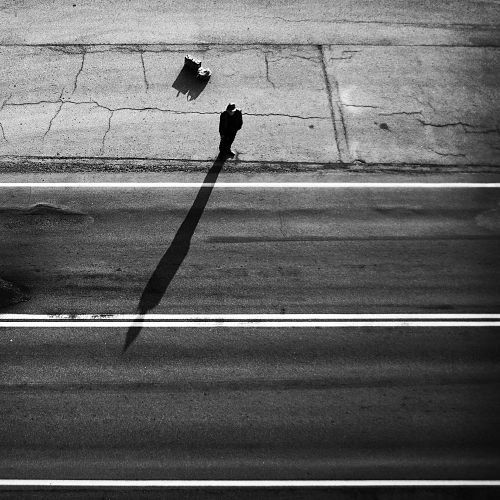
We live in a world organised along BORDERS – walls, lines, marks that we cannot cross, do not dare to cross, prefer not to cross. Borders between states prescribe position in time and space to humans and non-humans alike. But beyond mere geographic lines defining states’ territories, ‘border consciousness’ creates new categories related to border-crossings. People move and become migrants; objects move and become exported or smuggled goods. Borders within states are walls between people constructed by their origin, gender, age, class, profession, and habits. But borders are not just an element of our social imagination. Reinforced by bureaucratic routines, they materialise in the everyday through passports, residence permits, customs that establish distinctions between citizens and ‘alien others’.
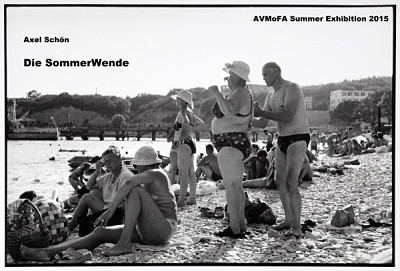
This series begins with AVMoFA’s first personal exhibition Die SommerWende, which displays 22 photographs by Axel Schön, an artist from Kiel (Germany), who traveled extensively across the former Soviet Union during the 1990-s and created a unique collection of images, deeply imprinted in the social imagination of the epoch that followed the Perestroika / die Wende in German / in the former Soviet Union. Allegra #interviews Axel Schön as he explores walls, summer, and how the social transformation in socialist countries has affected his artistic works. This interview enables us to discuss the relationship between photography as an art form and photography as an ethnographic document.
The series continues with Judith Beyer‘s text Simulacrum Crimea in which she suggests to look at the Crimea events as performances – legal and political. Together with Judith we revisit the current positions on Crimea while examining Axel’s works that documented the Black Sea as a popular Soviet resort, a sentiment that has played a crucial role in positioning the Crimean annexation in the Russian media.
In a second essay entitled Russian and Polar Bears Unite! A follow up , Judith Beyer offers a textual and visual exploration of the bear in Russian folklore – both traditional, like fairytales, and current political, like internet memes. This essay can be seen as mirroring a sort of ‘A Midsummer Night’s Dream’, a phantasmagoric mixture of imagined and existing, when awakening, and thus realization and attribution of images and artifacts, delimit the border between a dream and a real experience.
Magnus Marsden, who pursued intensive ethnographic fieldwork in three ex-Soviet Union countries: Tajikistan, Ukraine, and Russia, explores the activities of Afghan traders in the post-socialist space. His text draws attention to the intertwined nature of cross-border mobilities as a combination of economic and political ‘push and pull’ factors, resulting in blurring the boundary between refugee and trader/economic migrant.
Our reflections on borders and post-socialism are enhanced by a review of Border Work: Spatial Lives of the State in Rural Central Asia by Madeleine Reeves (2014) prepared by Mateusz Laszczkowski. This reading of Reeves’ work stresses the exploration of borders as ‘works in progress’. Borders are constantly made and unmade. They appear and disappear with distinct rhythms for specific groups of people.
Likewise, Constanza Curro’s review of the chapters on post-Soviet Russia and Lithuania from Ethical Eating in the Postsocialist and Socialist World edited by Yung, Klein, and Caldwell points out how different attitudes in the socialist past have affected people’s perception and dispositions towards food practices and shaped peculiar constellations of state-market-citizen relations in the present.