“Checkpoint A is closed, gate B is closed, settlers are on the road, be careful……” In Palestine, you do not listen to the radio for traffic updates in the usual sense. Instead, you listen to be informed on which roads are open, which are blocked, which may cost you your life, and whether settlers are gathered along the way. I have been commuting all my life, moving back and forth between towns and cities, and it is difficult to put into words the intensity of what builds up after spending hours and hours on the road.
In Palestine, time is now understood through the rupture of the recent genocide: before the genocide, or after the genocide.
Before 1993, checkpoints were not a permanent feature of Palestinian life. Then Israel imposed closure on the West Bank and Gaza Strip and began installing what were described as temporary military checkpoints along the Green Line and around East Jerusalem. They were never temporary. Over time they multiplied and hardened into a vast, interlocking system, permit regimes, bypass roads, the Oslo boundaries, the Separation Wall, designed not merely to restrict movement but to fragment Palestinian space and time entirely.
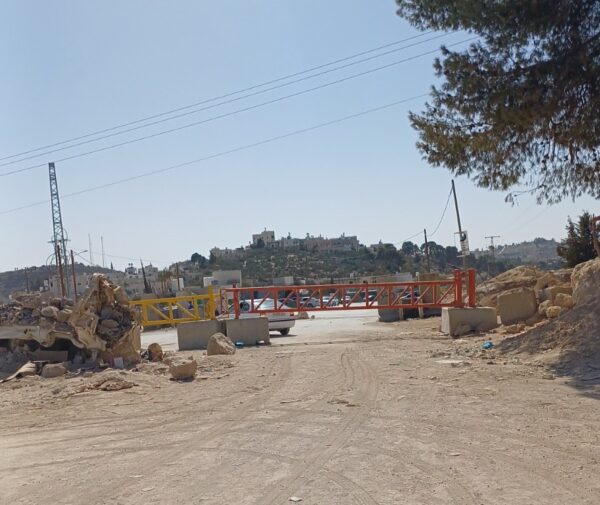
In Palestine, time is now understood through the rupture of the recent genocide: before the genocide, or after the genocide. Since the beginning of genocide in October 2023, movement restrictions have intensified even further. Israel has installed nearly 1,000 new gates, separation walls, and concrete barriers across the West Bank. Palestinians are no longer allowed to access the main roads, and instead must take long, unpaved detours just to reach their destinations before the army finds out and blocks those too. For example, a one-hour trip may extend to four or five hours or even longer. Drivers spend more time and fuel to move around, and transportation costs have increased compared to before the genocide.
A taxi driver explained that his vehicle has been destroyed from using long unpaved roads, yet he has no choice but to keep working. Driving is his sole source of income, and he continues so as not to disrupt people’s work and daily obligations. I was traveling from Hebron to Ramallah, a distance of about 60–63 km, when a passenger asked the driver how long the journey would take. The driver replied: “Two hours, three hours. It depends. You never know”. In another story, another taxi driver who works between al-Mughayer village and Ramallah city was returning home when he found the gate to his village closed. This elderly man had to leave his car on the road and climb a mountain, taking a rough path to reach his village.
Crossing this border can take an entire day, sometimes even several days.
These iron gates isolate cities from one another and fragment villages and communities internally, severely restricting Palestinian movement. They permanently or intermittently restrict the mobility of 3.3 million Palestinians across the West Bank, including East Jerusalem, reinforcing Israeli domination and cutting people off from education, healthcare, workplaces, and farmland, while also wasting hours of our life on the roads.
Traveling while Palestinian
For Palestinians holding West Bank IDs, travelling outside Palestine requires passing through the Allenby Crossing, also known as the King Hussein Bridge. This is the main border crossing between the West Bank and Jordan, and it serves as the primary gateway for Palestinians. The distance between Palestine and Jordan, measured as a straight line between their geographical centers, is approximately 179.53 kilometers (111.55 miles). At an average commercial flight speed, this distance would take roughly 12 minutes to cover by air, and approximately 4 hours by land.
Palestinians measure distance less in kilometers and more in equivalent times.
In practice, however, crossing this border can take an entire day, sometimes even several days. Palestinians may wait for hours only to be denied entry, sent back, or allowed to pass after prolonged physical and mental exhaustion and humiliation. Travelers have been reporting waiting up to eight hours and still being denied entry despite paying 150 USD for the so-called VIP service. A humiliating experience at a premium price. Palestinians are allowed to pass only after paying additional bribes to officials up to 100 USD. Movement is deliberately complicated and controlled, even when the destination is geographically close. For Palestinians, not only is this emotionally exhausting, but also financially draining.
This bridge, also known as al-Karama Bridge, meaning “dignity” in English, is one Palestinians often joke about, calling it a place that strips every last bit of dignity away.
My lived tragedy is reduced to a spectacle for the world to consume.
How Palestinians understand distance is shaped by both space and time. Distance is not only about how far something is, but also about how long it takes and what layer of waiting, delay, or control is involved. Palestinians measure distance less in kilometers and more in equivalent times. Traveling from Ramallah to Hebron is a short distance that can take up to five hours. In that same time, one could fly halfway across the world. Distance is calculated by the number of obstacles that will be encountered and the temporal rhythms they impose.
Colonizing the Body
I was explaining to a Westerner what it takes to travel from Palestine to Europe, and he said, “You must be very angry”. How to convey what oppression does to the soul to those who never experienced it? What I feel goes beyond anger and lingers heavily. It is a slow, crushing form of oppression that builds over time, as frustration, injustice, and helplessness accumulate. It is systemic oppression mixed with emotional suffocation. Palestinians are no strangers to injustice; it is woven into their daily life. Yet we stand powerless on our own, because fighting this oppression is not ours to carry alone, it is humanity’s responsibility to bear. The result is not rage directed outward, but anger turned inward, exhaustion, and a constant sense of entrapment. Another Westerner responded: “Very interesting and pretty intense,” the way someone responds to a film they enjoyed but would not watch again. Like that, my lived tragedy is reduced to a spectacle for the world to consume.
“The limits of my language mean the limits of my world,” as Ludwig Wittgenstein famously wrote. When others translate what I feel into anger, they reveal more about their world and the boundaries of their imagination. They had never stood at a checkpoint, waited for permission to move, or carried the uncertainty that shadows every journey when the right to pass is never guaranteed. They reach for a word that contains an unfamiliar experience, a word shaped by assumptions of freedom of movement and the expectation that mobility is a given rather than a privilege. Their language emerged from a different reality, and so it could only offer me a word that fit the Westerner’s world. His world has no words for mine.
What colonial violence carves into a person does not lift away, even under ordinary circumstances. It settles somewhere beneath words. Franz Fanon (1963) argues that colonial domination does not stop at the political. It reaches into the emotions, behavior, and sense of self of the colonized, shaping not only how they are ruled but who they become.
Movement restrictions are traumatic not only because of moments of clear, direct violence, but because they slowly wear people down.
I recall falling asleep on a bus on my way to the airport in Europe. When I woke up, for a second, I did not know where I was. My mind went blank, the world unrecognized, time suspended. It took me a minute to make sense of the world. Although I had arrived, I could not just get off the bus and continue on my way to the airport. I froze, and felt as if I was back in Palestine, waiting for the Israeli border officer/soldier to allow passengers to leave their seats. That waiting, that oppression, is what travel from and to Palestine feels like, and it hovers over me always, even when I am free to move; or rather permitted to.
Veena Das (2007) calls this experience the descent into the ordinary: the way violence does not stay inside the moment of its happening but folds itself into the textures of everyday life, into gesture, into habit, into the body’s automatic responses. The checkpoint had descended into my ordinary. It was there in the bus arriving at a European airport, in the simple act of waking up and not knowing, for a moment, whether I was permitted to move.
Violence embeds itself into the body as a temporality of anticipation
Movement restrictions are traumatic not only because of moments of clear, direct violence, but because they slowly wear people down. When you are repeatedly stopped, delayed, or prevented from moving freely, you lose control over your own time and decisions. Daily life becomes unpredictable. Over time, this constant uncertainty and lack of agency cause deep psychological and physical harm, a quieter form of violence, a slow death that seeps under the skin. Nadera Shalhoub-Kevorkian (2015), a Palestinian scholar, names what such conditions produce in the body the politics of fear. She writes that “the constant fear associated with the ever-shifting dynamics of the checkpoint and the emotional residue of that fear seeps into the very mind and body of the subject,” so that “the material reality of the checkpoint and the induced fear that results become a psychic reality as well”.
Time becomes fragmented, unownable,
permanently provisional.
Checkpoints, permit denials, and sudden closures force Palestinians to wait, be watched, and risk being turned back at any moment. This constant uncertainty disrupts daily life and makes it hard to plan or feel in control of one’s time. They cause exhaustion, shame, and a gradual loss of dignity and sense of self. Because these practices are framed as routine security measures, the trauma they generate is often rendered invisible or misrecognized. Achille Mbembe (2016) argues the wounds inflicted by colonial violence are “painful blows that are difficult to forget because inflicted on the body and its materiality, but also, above all, on intangible elements such as dignity and self-esteem”. Their traces, he writes, are “mostly invisible” and their “scars difficult to heal”. In this sense, mobility restriction functions as a form of ongoing traumatic violence, embedding fear, anticipation, and loss into the fabric of daily life rather than appearing as an exceptional event. Das emphasizes that this is not violence that happens and then ends. It embeds itself into the body as a temporality of anticipation, fear that is real but not necessarily actualized in events, restructuring how one moves through time long after the checkpoint has been left behind.
Temporal violence
Movement restrictions do not just stop people in space, they steal time. Hours are lost at checkpoints, and there is constant uncertainty about whether a trip will take 10 minutes or 5 hours, and life organized around permits that may expire or be revoked overnight. Time becomes fragmented, unownable, permanently provisional. It becomes a medium of control and subjugation. When I was applying for a study visa, I went through what many Palestinians experience as a ritual of humiliation. The embassy was located in Jerusalem, only about fifteen minutes by car, roughly 13 km from Ramallah. Yet, as a Palestinian given a West Bank ID, I am barred from entering Jerusalem. Instead, I was forced to travel to Jordan to submit my application, crossing into another country simply to spend less than five minutes inside an embassy.
Life is deliberately held in abeyance.
The settler colonial project in Palestine weaponizes time through checkpoints, permit regime, court bureaucracy, and different colonial actors (Khalid 2025). Palestinian life is scattered, discontinuous, marked by the artificial and imposed arrangements of interrupted or confined space, by the dislocations and unsynchronized rhythms of disturbed time (Said and Mohr 1998). As noted by Rema Hammami (2015), the logic of power materialized through the checkpoint regime aims to create a constant state of uncertainty.
Waiting, and being forced to wait, is how temporal violence is lived in everyday life. Waiting at the airport to board a delayed flight, waiting for an appointment with a medical specialist or waiting on the highway for a mechanic to come and fix our car all involve a high degree of passivity: things are beyond our control, out of our hands, and we can only wait for what we wish to happen, rather than actively doing something to make it happen (Hage 2009). In settler colonial contexts such as Palestine, waiting is not just doing nothing for a while. It is a forced, suspended form of time where nothing is allowed to move forward. Life is deliberately held in abeyance. Spatial confinement and constrained mobility are central features of settler colonial projects (Peteet 2017).
The writer Leila el-Haddad writes about the Palestinian experience of time: “Always waiting. For this is what the Palestinian does: we wait. For an answer to be given, for a question to be asked; for a marriage proposal to be made, for a divorce to be finalized, for a border to open, for a permit to be issued; for a war to end; for a war to begin; for a child to be born, for one to die a martyr; for retirement or a new job; for exile to a better place and for return to the only place that knows us; for our prisoners to come home; for a time when we no longer have to wait”. However, waiting in Palestine is hardly equivalent to the mundane waiting of ordinary life, whether in a post office queue, at airport security, in the grocery store, or a bus stop. Rather, waiting in Palestine fundamentally disrupts everyday life (Meneley 2008).
For Palestinians, time itself becomes a weapon for the occupation to use against them.
Palestinians often describe closure as living in an open-air prison. Israel has effectively imposed at least five forms of confinement on Palestinians: the 1948 areas, Jerusalem, the West Bank, the Gaza Strip, and the diaspora. Each operates under a distinct legal, political, spatial, and temporal regime. What were initially framed as temporary arrangements have, over time, hardened into near-permanent structures.
For Palestinians, time itself becomes a weapon for the occupation to use against them. Once a Palestinian crosses the border outside Palestine, they enter a parallel world governed by different temporal rules. As my sister puts it, “we borrow life”. Commuting cannot be measured in distance, but in waiting, delay, and uncertainty. Minutes stretch into hours, medical appointments are missed, children cannot reach schools, work is interrupted, and basic necessities remain out of reach. To be stopped in motion is to be stopped from life itself.
Featured image: Figure 1. An iron gate imposed by the Israeli army at the entrance to a Palestinian town.
References
Dader, Khalid. “Temporal Ruination: Scarcity, Entrapment, and the Affective Intensities of Time in Gaza.” Environment and Planning D: Society and Space, OnlineFirst (2025). https://doi.org/10.1177/02637758251407082.
Das, Veena. Life and Words: Violence and the Descent into the Ordinary. Berkeley: University of California Press, 2007.
Fanon, Frantz. The Wretched of the Earth. New York: Grove Press, 1963.
Hage, Ghassan, ed. Waiting. Melbourne: Melbourne University Press, 2009.
Hammami, Rema. “On (Not) Suffering at the Checkpoint: Palestinian Narrative Strategies of Surviving Israel’s Carceral Geography.” Borderlands 14, no. 1 (2015): 1–17.
Mbembe, Achille. “The Society of Enmity.” Radical Philosophy 200 (2016): 23–35.
Meneley, Anne. 2008. “Time in a Bottle: The Uneasy Circulation of Palestinian Olive Oil.” Middle East Report 248 (Fall): 18–23.
Peteet, Julie. Space and Mobility in Palestine (Bloomington: Indiana University Press, 2017).
Said, Edward W., and Jean Mohr. After the Last Sky: Palestinian Lives. New York: Columbia University Press, 1998.
Shalhoub-Kevorkian, Nadera. Security Theology, Surveillance and the Politics of Fear. Cambridge: Cambridge University Press, 2015.
Abstract: In this article, I describe restrictions on Palestinian movement in the occupied West Bank and their intensification since October 7, amid the genocide in Gaza. I focus on how gates, separation walls, and concrete barriers transform everyday journeys into hours of waiting, and how time is used as a weapon against Palestinians. Rather than treating these delays as interruptions to ordinary life, I explore how waiting becomes one of the conditions through which that life is lived, and in which colonial violence seeps into the ordinary and settles in the body, remaining with us even when we are far from the places where we experienced it.