There is a persistent myth that too often obstructs discussion about how to hold Israeli academic institutions accountable for their complicity in genocide. That myth is that Israeli academia is a center of progressiveness.
I write as a Dutch-Israeli academic working at a Dutch university, but who is very much connected to critical voices within and outside of academia in Israel/Palestine. I have witnessed firsthand the ways in which Dutch universities, such as my own, claim that cutting ties with Israeli academic institutions will do harm to the progressive and critical academics within those institutions, limiting academic freedom. This position is often accompanied by the claim that Israeli institutions are strong defenders of academic freedom, and that academics within them enjoy a large degree of autonomy, enabling scholars and students to adopt a critical stance towards the actions of the Israeli government. As one member of the board of directors of my university put it, “I have a colleague who goes out every Saturday night in Tel Aviv with her children to demonstrate against the government. These progressives in Israeli academia are the people we need to protect.”
Closer to the truth is that these so-called progressives have been attending rallies primarily against Netanyahu and his accomplices. For the most part, these protesters are not objecting to the genocide in Gaza, are not opposing the killing of Palestinian children, or the starvation, or the destruction of Palestinian universities, or the slaughter of Gazan scholars and students, as I have witnessed myself and as has been documented by others. The very small minority of protestors that does protest these atrocities is attacked for it by police and other protestors. The majority of Israeli academics stay quiet even when their colleagues and students at their own institutions lose their jobs or are otherwise silenced for speaking out against the genocide. My observations suggest that they speak up only when their own reality becomes uncomfortable.
Their silence is resounding, matched by Israeli academic institutions that have direct connections with the Israeli military and secret services, that offer courses to military officers on campus, and provide exemptions and other special treatment to veterans, as documented by scholars and in a recent report published by New Profile, an Israeli NGO working against the militarization of Israeli civil society (see also also Wind 2024: Landy, Lentin and McCarthy 2020).
Who is Under Threat. Whose Academic Freedom Needs Protecting
I am co-author with a dozen Dutch university affiliated colleagues as members of an Expert Committee that in 2025 issued the “Report on Israeli-Dutch Academic Ties.” The matter of academic freedom is one of nine topics covered in the report that also includes scholasticide and educide. Here, I will note the ways in which Israeli academic institutions suppress the academic freedom of Palestinian faculty and students and of Israeli Jewish faculty and students who speak up against the genocide in Gaza and their own institutions’ complicity in it—practices and policies that demolish the myth of progressive academia in Israel.
Among the ways academic freedom is curtailed by Israeli institutions is through discriminatory rules used to exclude students. Some institutions, for example, require proof of military service in their admission process, and that extra credit for admission to dormitories are given to those who have served in the military and/or are active as reservists. Such rules structurally exclude Palestinian students.
As our Expert Committee report documents, it is those scholars whose work focuses on the dispossession, marginalization, and forced displacement of the Palestinian population who have had their academic freedom violated.
Israeli academic institutions have silenced and suspended critical scholars when they voice concerns about Palestinian victims of Israeli (military) violence or criticize the Israeli Defense Forces (IDF). Most are Israeli Jews who speak out; some critical Jewish-Israeli scholars, such as Ilan Pappe, Neve Gordon, and Ariella Azoulay, have felt the need to leave the country. In contrast, Palestinian scholars and students most often do not dare to speak up for fear of repercussions, as documented in the report, “Silencing, Censorship, and Free Speech Violations in Israeli Academia,” issued by Academia for Equality (2025).
Israeli academic institutions have silenced and suspended critical scholars when they voice concerns about Palestinian victims of Israeli (military) violence or criticize the Israeli Defence Forces
Such silencing is structural and comes in many forms. As detailed in the report, among the main practices are: a form of McCarthyism, whereby right-wing students “rat out” Palestinian classmates on social media, actions supported by the universities; the Israeli government, and intimidation and disavowal where disciplinary action is taken by academic institutions against faculty members who have been critical of the genocide in Gaza (The case of Prof. Nadera Shalhoub-Kevorkian is one of the most well-known in this regard, but not the only one); and the depoliticization of the campus whereby campus political activities are severely restricted or banned, activities that range from events, ceremonies, workshops, and protests organized by students and faculty that are deemed political. There is, moreover, no evidence that Israeli universities have taken up a critical position towards the Israeli government.
Nevertheless, right-wing NGOs, such as Im Tirzu, are given leeway to act out silencing campaigns against any students or staff members who speak out against the genocide. Also given free rein are student groups such as the National Union of Israeli Students that campaigned in 2024 for legislation requiring universities to fire all academics who express dissent and objection to the war, including tenured professors.
Academic freedom is thus certainly under threat in Israeli academic institutions. But not in the way suggested by those Dutch university boards and politicians who urge “dialogue” with such institutions. The argument about the “liberal” nature of the Israeli universities still holds in the discourses and actions of many boards and academics, even as there is increasing recognition that continuing cooperation means that Dutch universities are themselves complicit in atrocity crimes.
University boards, academics and politicians have been asked and pressured to end their complicity in atrocity crimes, occurring due to their continued institutional cooperation with Israeli universities. As a counterargument, university boards and politicians put forward that Israeli universities are among “the few remaining liberal institutions in Israel,” and thus remaining “in dialogue” is needed. While there is increasing recognition that continuing cooperation means that Dutch universities are themselves complicit in atrocity crimes, the argument of the ‘liberal’ nature of the Israeli universities still holds in the discourses and actions of many boards and academics.
In consideration of the social responsibility of universities, the seriousness and urgency of stopping the genocide in Gaza, the structural dependence of Israeli universities on the Israeli government and militarism, the lack of academic freedom at Israeli universities, and the necessity of a structural and coordinated action to achieve the strongest and fastest possible result, the “Report on Israeli-Dutch Academic Ties” concludes that all Dutch universities must suspend institutional collaborations in projects and programs with all Israeli universities, which does not mean interrupting individual collaborations by and with individual scholars from those universities.
If academic freedom matters to Dutch universities, it is imperative that they stand in solidarity with those who are truly silenced by holding Israeli institutions accountable.
References
Landy, David, Ronit Lentin, and Conor McCarthy. 2020. Enforcing Silence: Academic Freedom, Palestine and the Criticism of Israel. Bloomsbury Publishing.
Wind, Maya. 2024. Towers of Ivory and Steel: How Israeli Universities Deny Palestinian Freedom Verso Books.
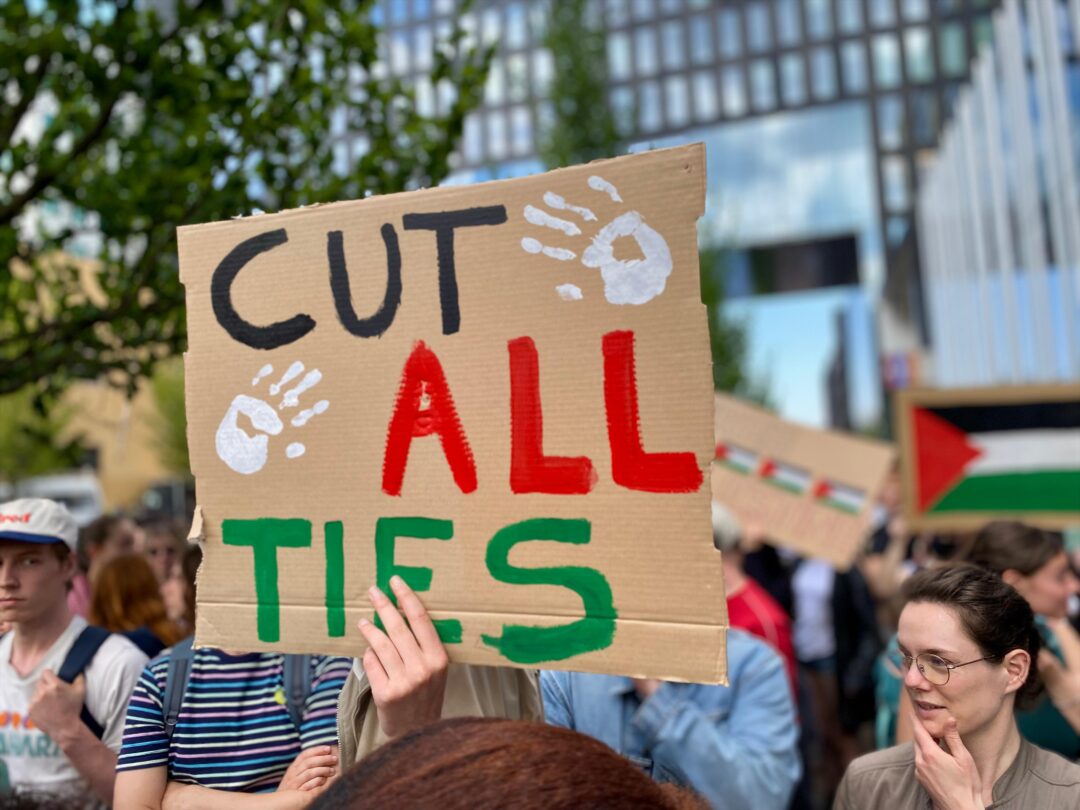
Featured Image: At the May 2024 protest at the University of Amsterdam by Jonathan Massey