
My mother died in the month of May, lying in a hospital bed of crisp white sheets, while I sat beside her and held her hand. The once warm and soft hand that had held me my entire life. As she brought me into this world, I brought her into eternity—or whatever death is. As she was there when I took my first breath, I was there when she took her last.
With the death of my mother, I experienced a rupture in time as I usually perceive it in my everyday life. Time did not exactly become slow motion, but slower. The days grew longer, and the density of every second, every minute, every hour was intensified. My senses were heightened; every detail around me more vivid. I existed in my own time and space—a distant place from the world that continued around me. This time, which I consider existential (Fuchs, 2020), this liminal place (Jackson, 2005; Mattingly, 2018), I have only experienced twice before. That was when I gave birth to my daughters.
Time did not exactly become slow motion, but slower. The days grew longer, and the density of every second, every minute, every hour was intensified.
What might this have to do with my initial professional encounter with the concept of “poetic resonance”? Anything and everything. Resonance is about tuning in with your empirical data and enabling the reader to do the same—about bridging experience in all its sensorial multiplicity. And ethnographic poetry, as Adrie Kusserow points out regarding her own ethnographic work:
“(…) is not just about accurately describing an experience but using the insight of its acutely nuanced language and artistic aesthetic to bring a wider array of meaning(s) to these facts than conventional wisdom offered (…) Far from being a kind of epiphenomenal icing on the cake, poetry encouraged a more rigorous analysis and theoretical understanding of what I observed. In this way, poetry embodied and emboldened my ethnographic research, requiring me to probe behaviors with all my senses (…)” (Kusserow 2020, 430).
When my mother passed, I was in the first year of my PhD research. Similar to Kusserow, I found that the concept of poetic resonance, invoked through my participation in a collaborative, practice-led workshop, helped me approach excerpts from the empirical data of my PhD research in a more multifaceted and embodied way. Actually, using my state of being in existential time as an analytical tool. This I will unfold and elaborate on in this essay. But first, let me take a step back and position myself as a researcher.
I am a trained anthropologist and currently a PhD student at Copenhagen University Hospital (Rigshospitalet) and the National Institute of Public Health, University of Southern Denmark. I have been involved in health research for several years prior to starting my PhD journey. And though I have never really let go of my anthropological roots, I can sense how I have gradually adapted to the rather square box that health research sometimes tends to be. However, with my current project – an ethnography of induced abortion in Denmark – I find myself in the process of rediscovering my scientific and anthropological creativity.
In my earlier research, I have circled around themes such as uncertainty, loss, death, existential dilemmas, and stories—or, more analytically speaking, narratives. Together with my longstanding interest in end-of-life issues, I have always been drawn to reproduction and the continuums between life and death. A somewhat dual interest that now converges in my PhD research on induced abortion.
At present, alongside my fieldwork at a Danish hospital, I am working on a document analysis of dominant abortion narratives at the macro level in Denmark, focusing on themes such as life and death, women and their (pregnant) bodies, and the aborted phenomenon. I deliberately avoid the clinical terms “embryo” and “fetus” to leave space for what I find in the empirical material (cf. Boltanski, 2013), which includes policy documents, media excerpts, and autofictional literature.
In the workshop on poetic resonance that I participated in only a couple of weeks after my mother’s passing, we were asked to share an excerpt from our data that puzzled us. In relation to my document analysis and my personal and professional interest in abortion, I had recently read the autofictional book Afterpains by the Danish author Ingeborg Topsøe (2025), and I felt an immediate urge to choose the last page of her book as my contribution to the data pool:
Feminists will probably never make a sticker
With the text
‘It’s a choice and a child’
But of course, that’s how it is, and we know that.
[…]
Sometimes we choose death.
I chose death, and I understood intellectually that it was a child. That the number of weeks in the womb is, to some extent, arbitrary. But I didn’t know that it would also feel like a child, long after it had been expelled and destroyed. I didn’t know that I would have to live through death and this intense sense of loss and grief. But now I do.
The abortion is. The child is not. It was my choice, and I chose death. But now it’s summer, and for the first time in a long while, I don’t feel like crying (Topsøe, 2025, [My English translation]).
I chose these written words because I hoped they would stir something in the other participants – perhaps resonance, or some might even find the words provocative. The words had at least stirred something in me. When I first read them, I recall lying in bed, struck by a sense of “self-righteousness” from the author and, at the same time, a sense of relatedness and compassion toward her. I felt her words. When I revisited the text before the workshop, the loss of my mother was still so fresh in my body, and I felt anger. Anger toward the author for using the words “death” and “grief”. In my existential time vacuum, colored by my own grief (and shock at that stage), how could her experience of loss possibly be as “real” and devastating as mine? Losing my mother—my young daughters’ grandmother—far too early to an all-consuming illness. My apologies to the reader for this brutal honesty. With the benefit of time, these feelings now seem almost childish, but feelings are not always, if ever, rational or scripted, and my honesty serves an analytical purpose. I promise.
During the workshop, we were assigned an exercise on poetic repetition, and I experienced an analytical breakthrough. We were invited to reflect on resonance within our chosen data excerpt and to write a repetitive text that explored a concept arising from these reflections. Based on the quote from Topsøe’s book, I chose “death” and wrote:
Death is emptiness
Death is heaviness
Death is fulfilment
Death is fear
Death is relief
Death is surprising
Death is the color red dripping from somewhere inside
Death is the taste of salty tears running from swollen eyes
Death is being soothed by alcohol, by anaesthesia, by paracetamol
Death is darkness
Death is light
Death is a rainbow
Death is a hospital bed with white sheets
Death is the safe space of home
Death is pain
Death is silence
Death is shouting
Death is conflict
Death is peace
For the next exercise, we were divided into pairs and sent to virtual breakout rooms. Not knowing who would appear on my screen made me nervous. My repetition text was about death in relation to Topsøe’s words about abortion, but it was also deeply personal. Could I detach from my own loss and existential state of being? Should I even try? Another female face appeared on the screen, from the other side of the world, and as we immersed ourselves in the exercise—reading our texts aloud, listening with body and senses, resonating with one another—the digital breakout room became a safe space where physical distance was replaced by intimacy.
It felt as though we vibrated with and through each other around the analytical concepts we had chosen.
At one point, I felt compelled to share that I had just lost a family member to explain my text better (I could not say “my mother,” as I knew I would then fall apart). No further explanation was needed. My fellow participant was kind and caring and had experienced a similar loss some years earlier, which instantly established a mutual understanding. By listening actively and reflecting aloud on how we resonated with each other’s texts, we created a mirroring—not only of text, but of feelings, bodies, and thoughts. It felt as though we vibrated with and through each other around the analytical concepts we had chosen. I know this experience was mutual, as we discussed it afterward. It was powerful and intersubjectively intense – despite that our encounter was virtual. I felt seen in a way that transcends professional or personal labels. It was both. It was human.
After my recitation, my fellow participant shared her reflections on my repetitive text. I took notes and then read her words aloud. In this mirroring, her insights took root in me. Let me share some examples:
“A realization of how big concepts can be interpreted and reflected in our own experience”
“The first feeling is the first two lines. A hollow feeling, but at the same time it’s really heavy”
“Reflection goes back to the experience. There are so many facets to it”
“We are trying to fill the emptiness with words. Sometimes the filling makes the emptiness lighter. A paradox”
The poetic repetition and collective mirroring deepened my analytical reflections. Afterward, I reread Topsøe’s words more openly, with my whole body and state of being, and realized that we might have more in common than I initially assumed. Perhaps her experience of loss was not so different from mine. One of us lost her mother; the other, her budding motherhood. I sensed that her abortion also disrupted time as she knew it, thrusting her into an existential, liminal space and creating distance from the surrounding world. Her words were not objectively self-righteous; they were hers—her experiences, her feelings, her embodied and sensorial impressions of her abortion.
In addition to enriching my analytical understanding, the poetic repetition exercise prompted a personal process of self-reflectivity, which is so central in ethnographic inquiry. The ethnographer always interprets from somewhere—a specific position and context. During the workshop on poetic resonance, my context was death and loss; my position, not only that of an anthropologist and health researcher, but also that of a woman of reproductive age, a mother, and a motherless. The poetic repetition exercise created an intersubjective space in which I could see this more clearly and use my own experiences as an analytical tool. I am sure I could not have done this alone, as my reflections grew richer by the mirroring with and through my fellow participant.
Thus, I consider poetic resonance – especially poetic repetition – an innovative and valuable analytical and methodological practice in ethnography, whose scientific potential has yet to be fully uncovered. I further believe that this practice is not limited to being applicable among researchers but could also be applied between researchers and research participants – something I am curious to explore further in my ongoing research on abortion.
I am writing this essay months after the death of my mother. My initial anger has turned into gentleness and compassion for others’ experiences of loss. I am no longer only in my own existential time; I am also part of the surrounding world again (with a deeper understanding for other’s existential time spaces as well). These states of being now intertwine and entangle. Sometimes they merge and coexist; sometimes one is dominant. But from where I stand now, I understand that my mother tale – a tale not only of loss and grief, but also of nurturing, compassion, and love – has deepened my multifaceted and multisensorial understanding of other people’s mother tales, whether these tales center around being a (potential) mother, having a mother, or both.
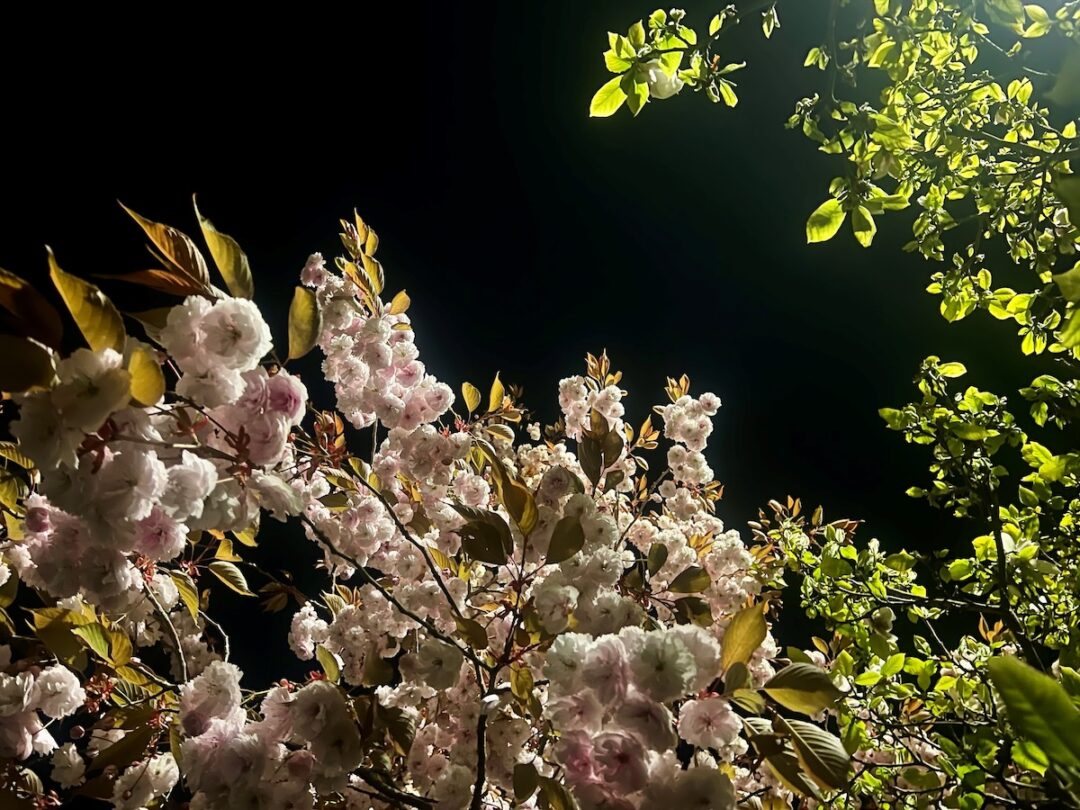
Featured image: Spring blossoms at night, photo by Mia Jess, 8. May 2025.
References
Fuchs, T. (2020). Time, the body, and the other: Phenomenology and psychopathology. In C. Tewes & G. Stanghellini (Eds.), Time and body: Phenomenological and psychopathological approaches (pp. 15–44). Cambridge University Press.
Boltanski L. (2013). The foetal condition: a sociology of engendering and abortion. English edition. Cambridge: Polity Press.
Jackson, M. D. (2005). Existential anthropology: Events, exigencies, and effects. Berghahn Books.
Kusserow, A. (2020). Opening up fieldwork with ethnographic poetry. Anthropologica, 62(1), pp. 430–436. https://doi.org/10.3138/anth-2019-0068
Mattingly, C. (2018). Ordinary possibility, transcendent immanence, and responsive ethics: A philosophical anthropology of the small event. HAU: Journal of Ethnographic Theory, 8(1–2), pp. 31–52.
Topsøe, I. (2025). Efterveer [Afterpains, trans. by the author]. Gutkind.
Abstract: This essay explores how poetic resonance can deepen ethnographic analysis by attuning to sensorial, embodied, and existential dimensions of experience. Written in the aftermath of my mother’s death—an event that ruptured my perception of time and drew me into what I term “existential time”—I reflect on how my altered state of being intersected with a collaborative, practice-led workshop on poetic resonance. Engaging with a text from Ingeborg Topsøe’s autofictional book Afterpains (2025) and an exercise in poetic repetition, I examine how poetic resonance can create a mirroring space, leading to a shared affective and analytical terrain. These reflections are situated within my ethnographic doctoral research on induced abortion in Denmark, where narratives of life, death, and loss, but also freedom and choice, converge. I argue that poetic repetition not only fosters intersubjective intensity and analysis among researchers but also holds promise for deepening analytical engagements with research participants.