
Till Mostowlansky and Elmira Muratova. 2026. Humanitarianism From Below? Universalism and the Politics of Inhumanity. London: UCL Press.
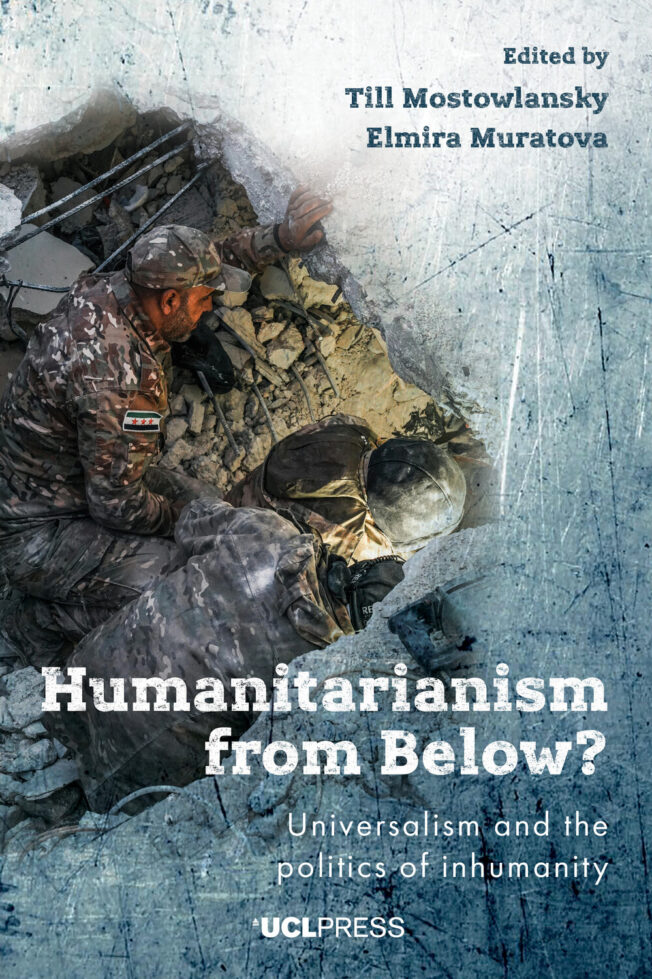
All good books are an invitation to a conversation. For me as a researcher who sits sometimes precariously between history and anthropology, humanitarianism and its relatives, Humanitarianism From Below? Universalism and the Politics of Inhumanity is one such book. Edited by Till Mostowlansky and Elmira Muratova, the volume is provocative and conceptually challenging from the title page, while bringing rich and contrasting ethnographies to the table.
Its value is in its complexity and scope: the selection of ethnographic cases ranges from diasporic mobilizations in support of Ebola relief in 2014, to Indigenous organizing in the face of settler colonial violence in Canada in the 1970s, and the entanglement of solidarity and military aid in Ukraine today. The juxtaposition of such diverse examples of humanitarian pluralism brings into sharp relief the questions Kloos poses in his afterword: “what do we gain, analytically and theoretically, by framing our subjects and their practices as humanitarian, and ‘from below’, in the first place?” (191).
This is a question that does not haunt just this book, but many projects questioning where we draw the boundaries, and why, between humanitarianism and human rights, social movements, or development; or between what Benton refers to as the “qualified humanitarianisms” (21) – such as everyday (Richey 2018), vernacular (Brković 2023), grassroots (Fechter and Schwittay 2019), diasporic (Olliff 2018), and ‘from below’ (Kloos 2020) – which seem to sprout like Tsing’s mushrooms at the end of the world (2015). What does the label of humanitarianism do in this book and others like it? Would we not rather reject the humanitarian label in search of a better term for the relational ethics of care, solidarity, and mutual aid that these ethnographies document? In my own work, as in the chapters which make up this book, the answer relates to legibility and politics. Humanitarianism makes a universalist claim which lifts the argument outside of the local and the particular and makes ethnographic specificity a microcosm of social structures and social change. The rhetoric and framing of ‘being humanitarian’ also, as shown in these multiscalar ethnographies, make possible political and material claims for support and legitimacy. This book has an ambivalent relationship to the humanitarian, examining the operation of “situated universalisms” (5, citing Brković 2023, 5) in particular political and social contexts within “dynamic conceptualisations of scale” (3) focusing on movement and adaptation of both actors and frames. Its strength in the ethnographic grounding of diverse cases can also be a drawback when making a conceptual intervention beyond the messiness and complexity of what is justified in the name of humanity. As such, it may not be the best entry point for someone arriving in search of an anthropology of humanitarianism, or indeed looking for humanitarianism at all. But by highlighting the pluralisms, tensions, and uneasiness which accompany these diverse projects and the challenge they pose to humanitarianism ‘from above’, the editors have woven together a fascinating tapestry.
The rhetoric and framing of ‘being humanitarian’ also, as shown in these multiscalar ethnographies, make possible political and material claims for support and legitimacy.
The book is structured in three sections which roughly engage with the four concepts framing the text (scale, universality, (in)humanity, and alter-politics). Each of the sections (Geospatial Orders, Shifting Ground and Tactical Universalism) seeks to destabilize in key ways hegemonic understandings of “big-H” (Benton 20, citing Ross 2017), leaving open the question of what can be meant by ‘humanitarianism from below’. The debate is developed through seven ethnographic chapters, with case examples from West Africa (and its diaspora, Benton), Ukraine (Fedirko) and Crimea (Muratova), Kyrgyzstan (Mostowlansky and Toktogulova), Thailand (Bolotta), Turkey (Ephrussi), and Canada (Maxwell), as well as a conceptual introduction by the editors and an afterward by Kloos, who first coined the term “humanitarianism from below” in 2015 (Kloos 2020, 189).
The first section raises questions of scale, categorization, and “geospatial orders”’ (9). It questions the who, what, and where of humanitarianism: both the US and UK diasporic groups raising funds, collecting supplies, and mobilizing medical interventions for Sierra Leone and the Ukrainian mobilizers who collect funds and aid primarily for troops on the front lines intervene in material ways to support those in need and to ‘save lives’ while challenging hegemonic conceptions of what constitutes humanitarianism and how it operates. In both cases, the chapters move from the intimate and small scale of individuals raising funds and providing supplies through their immediate family and social networks, to the collective power of organizing in which crowdfunding drives clinical trials and medical intervention in Ebola contexts or, in the case of Ukraine, supplies a major percentage of domestic and military supplies to frontline troops. While Benton’s chapter argues that framing these practices as “qualified humanitarianisms” (21) reifies the power dynamics of “big H humanitarianism” (20, citing Ross 2017) as ‘from above’, normative, and dominant, her analysis of the ineffectiveness and exploitation of interventions led by diasporic medical teams remind us that the hierarchies of power, privilege, and extraction can shape humanitarianisms both from ‘above’ and ‘below’. Fedriko’s chapter on aid to the front line in Ukraine illustrates how the aid also reshapes these hierarchies through performances of political belonging in moments of crisis and flux – as picked up by Ephrussi in the second section.
Taking up Dubal’s call to decentre a universal humanity, the second section turns to the concepts of humanity and belonging in “Shifting Ground” (10), framed in the introduction by Dubal’s ethnographic engagement with fighters from the Lord’s Resistance Army (LRA) in Northern Uganda and the argument “against humanity” (Dubal 2018). Dubal, to whom the book is dedicated, in many ways haunts these pages, having passed away in 2020. In his work on the LRA, he develops the concept of inhumanity to argue that ‘humanity’, as an organizing principle of solidarity and aid, limits and constrains social and political projects and ways of living. His research engages with LRA conceptions of being in the bush (lum), in juxtaposition to both Acholi and universal humanitarian framings. Inhumanity, as named in this book’s subtitle, calls for a reconceptualization which does not centre the universal human, but rather the specific, situated, and relational ways of living which make an alterpolitics possible (Hage 2015). In “Goat Humanity”, Mostowlansky and Toktogulova discuss competing Muslim humanitarian universalisms in Gülchö, Kyrgyzstan. The chapter focuses on a locally organized game (ulak) as a manifestation of local and transnational solidarities. The event becomes a tool of solidarity and social support for community members “in need” (74) through the embedded networks of generations which are grounded in the town’s high school and diasporic networks, while directly raising moral and political challenges to the disembodied aid of Gulf NGOs operating in the same space. “Acting Out the Citizen’”(109), the chapter by Ephrussi, offers in many ways a parallel and counter-point to Benton and Fedirko in the first section, taking the performative (in Butler’s sense) fundraising of illicit Afghan migrants in Turkey to support victims of the 2023 earthquakes. In a context in which aid and fundraising is constructed as a national project while migrants are rendered illegal, abject, and subject to deportation, the deliberately visible Afghan aid project stakes a claim to citizenship and belonging. As with Fedirko’s chapter on Ukraine, participating in fundraising and aid provision in times of crisis enables a reconfiguring of the national community which legitimizes some forms of performative citizenship and, in the case of Ukraine, renders others as less-than.
In the third section, focusing on the alterpolitics of “tactical universalism” (12), the authors address humanitarianism – both as rhetoric and mode of action – as a tactical adaptation to shifting social and political circumstances. In Maxwell’s historical research on Indigenous activism among the Anashinaabe, she situates the tribe’s contemporary struggle within the long history of imperial and “settler” humanitarianism in the British empire and colonies, and in dialogue with the anti-imperial strategies of the Black Power movement (139). Developing on de Certeau’s analysis of ‘tactics’ in the face of structural violence (142), she argues that the group’s adoption of tactical performance of ‘humanitarian’ approaches and discourses in their collective and political action created space for alternative ways of being. The tactical humanitarian frame enabled the community to ‘save life’ not only in the biopolitical sense, but also through values of social, collective, and relational life which had meaning to the tribe outside of the settler colonial project (146-147). Muratova’s study of the shifting universalisms of the Islamist group Hizb ut-Tahrir, from anti-Western, Islamic universalism prior to the Russian occupation of Crimea to a deliberately humanist universalism through language of persecution and participation in Western human rights and humanitarian fora afterward, shows a different perspective on the tactics of humanitarian discourse. Whereas, prior to 2014, the group undertook a politics of protest, after the occupation they shifted to a politics of aid in response to persecution, appealing to the Western humanitarian sentiments they had previously scorned. These chapters, like that of Ephrussi, emphasize the legitimacy of claiming to be humanitarian and claiming political agency, recognition, or power through acts of care and life saving aid. Maxwell’s chapter in particular shows that tactical performances of humanitarianism can, in some times and contexts, create space for alternative ways of being.
Bolotta’s chapter “Starving for Humanity”, which also features in section two, was the most challenging for me to locate within the framework of humanitarianism, and is worth dwelling on for what it illustrates about the book’s effectiveness as a conceptual intervention. The chapter focuses on two young activists who engaged in a hunger strike in response to imprisonment under Thailand’s lese-majesty law. The first, a young man who has since become a Buddhist monk, mobilizes a discourse of humanity which is explicitly Buddhist and resonates with hierarchies of humanity and citizenship which are specific to Thailand, rejecting the royalist ontologies which place the king above the human. Nevertheless, by going on a hunger strike, he makes himself a subject of humanitarian and human rights concern. The second activist, a young woman who is his friend, goes on a hunger strike herself in solidarity. She purposefully uses her position as young, female, and from a privileged social class to draw attention to her political position from both Thai and global audiences, and in turn generates another wave of solidarity hunger strikes. Bolotta argues that both of these political actions are humanitarian, in the sense that they mobilize an idea and ethics of humanity which is meaningful both within local Thai moral contexts and global discourses and universalisms, and because they “encapsulate[s] an imaginary of selfless devotion to the commons – an altruistic sacrifice undertaken on behalf of those unable to defend themselves” (86). This is especially true of the young woman, who goes on a hunger strike explicitly as an act of solidarity with her comrade (97) in an attempt to use her suffering to draw attention to, and bring to an end, his own suffering (98). Where other chapters in this book examine forms of solidarity, politics, and charity (advocacy, resource mobilization, mutual aid) that are legible as humanitarian action, the humanitarian claim of Bolotta’s emphasis on hunger strikes, as a political act which harms the self, is less clear. The author acknowledges this and argues for a broad definition of humanitarianism that encapsulates the hunger strike’s goal of mobilizing humanitarian sentiments and attention through sacrifice of the self and the body (88-90). Like Fedirko’s chapter on citizen aid in Ukraine, Balotta’s analysis incorporates action (hunger strikes) which are harder to identify in frames defined by big-H humanitarianism. These chapters, more starkly than some of the others, raise the ghost of Kloos’s question: why does it matter to label these political act as ‘humanitarianism’?
Are they humanitarianisms ‘from below’? They are, in the sense that they challenge the claim to knowledge of ‘big H humanitarianism’.
Overall, what the book shows is the lingering and diverse power of what Fassin famously called “humanitarian reason” (2012). Each of these chapters exemplifies diverse actors and political projects which nonetheless seek to make themselves legible and gain legitimacy through a discourse and performance of humanitarianism, responding to need and saving life. In that sense, the answer to Kloos’s question is that the humanitarian frame matters because it has meaning to these actors and to the academics who analyze them. The book succeeds at demonstrating the diversity of these humanitarianisms and aspirations, the pluralism of their forms and the breadth of their political claims and projects. Are they humanitarianisms ‘from below’? They are, in the sense that they challenge the claim to knowledge of ‘big H humanitarianism’. My colleagues in humanitarian studies would perhaps struggle to recognize or accept the cases of Fedriko or Bolotta as ‘humanitarianism’, and in that sense the inclusion of these diverse case studies successfully broadens the frame and challenges the power dynamics of the research field, if not the industrial complex it studies.
Where the book falls short, in my mind, is in challenging a universalist frame of humanity. The editors suggest this is a goal, emphasizing ‘inhumanity’ in the title and in the introduction, in dialogue with Dubal. However, this theme – ‘inhumanity’ as a challenge rather than pluralization of universalisms – is less effectively developed in the contributions than the themes of scale, universality, and alter-politics, despite perhaps sitting at the centre of a book project interrogating ‘humanitarianism’. Dubal’s work on the LRA was successful because it engaged with the concept of humanity through its rejection and the construction of an alternative way of conceiving life which was specific to the LRA and the context of Acholi society in Northern Uganda. Of the chapters in this book, in my reading only Maxwell’s really makes the claim to such a rejection and reorientation – through centring the ontological frame of the Anashinaabe nation – rather than a reframing or broadening of the term. Returning to Bolotta’s chapter, the argument challenges the frame of ‘humanitarianism’ while providing a Buddhist reading and conception of ‘humanity’. While broadening the conception of humanitarian, it doesn’t challenge the hegemony of ‘humanity’ as a moral frame and categorization. The other chapters similarly propose alternative universalisms (and like Dubal for humanity, Li’s The Universal Enemy (2020) offers an underpinning conceptual frame), but nevertheless seemingly return to the conceptual terrain of ‘humanity’. Perhaps, like the alter-political projects analyzed here, the authors and editors also recognize the tactical value of a claim to humanity when seeking to challenge prevailing socio-political conditions.
Featured Image: Photo by Rashid Khreiss. Source: blogsmedia.lse.ac.uk.
References
Dubal, S. (2018) Against Humanity: Lessons from the Lord’s Resistance Army. 1st edn. University of California Press.
Fassin, D. (2012) Humanitarian reason: a moral history of the present times. Translated by R. Gomme. Berkeley, California: University of California Press.
Fechter, A.-M. and Schwittay, A. (2019) ‘Citizen aid: grassroots interventions in development and humanitarianism’, Third World Quarterly, 40(10), pp. 1769–1780.
Hage, G. (2015) Alter-politics. Critical anthropology and the radical imagination. Melbourne: Melbourne University Press.
Kloos, S. (2020) ‘Humanitarianism from Below: Sowa Rigpa, the Traditional Pharmaceutical Industry, and Global Health’, Medical Anthropology, 39(2), pp. 167–181.
Li, D. 2019. The Universal Enemy: Jihad, Empire, and the Challenge of Solidarity. Redwood City: Stanford University Press.
Olliff, L. (2018) ‘From Resettled Refugees to Humanitarian Actors: Refugee Diaspora Organizations and Everyday Humanitarianism’, New Political Science, 40(4), pp. 658–674.
Richey, L.A. (2018) ‘Conceptualizing “Everyday Humanitarianism”: Ethics, Affects, and Practices of Contemporary Global Helping’, New Political Science, 40(4), pp. 625–639.
Tsing, A.L. (2015) The mushroom at the end of the world: on the possibility of life in capitalist ruins. Princeton: University Press.