

Rituparna Patgiri and Gurpinder Singh Lalli. 2026. Food, Culture and Society in India: Social, Political, Economic and Cultural Perspectives. London: Berghahn Books.
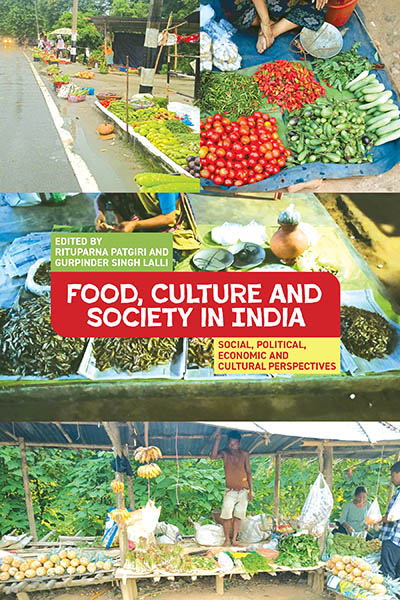
In 1986, the publication of Food, Society and Culture: Aspects In South Asian Foods Systems, a collection of essays edited by R.S. Khare and M.S.A. Rao, synthesised the extant social-anthropological enquiries on South Asian food and food systems. Four decades later, Rituparna Patgiri and Gurpinder Singh Lalli have compiled essays on food by scholars from an even wider range of disciplines. This edited volume, bearing a similar name to its predecessor, explores the questions of tradition, identities, and emotions that the acts of cooking, consumption, and their representations elicit.
The volume upholds three tenets put forth by the food studies scholars, either tacitly or overtly, to sustain and strengthen the field’s relevance. First, food, as a conceptual and material entity, traverses a wide range of domains, such as farmland, factory, family, the human body, and social organisation. Consequently, an academic account on food should visualise it as a comprehensive system, mindful of the web of meanings and uses it may encompass (Douglas 2003). This does not mean that every account on food should lay bare all the social, cultural and biological processes linked to the phenomenon under focus. Nevertheless, it should acknowledge the various realms that constitute the material and discursive world of food. This volume as a whole, with essays traversing disciplinary domains, comfortably succeeds in presenting such a comprehensive account. What is more commendable is that, while almost all the chapters take a holistic approach to food, some skilfully interweave the aforementioned domains, yielding ingenious insights into seemingly familiar phenomena like hunger, nutrition, and culinary memory.
Second, for a comprehensive analysis of food, one should “study the food system by itself” (Khare and Rao 1986, p. 5), rather than being subsumed as a peripheral aspect of an analysis of a larger system. This is not to say that the food system is autonomous and the investigation of it should sequester it from the institutional structures of caste, kinship, and politics. Rather, a work on food studies should have food and food system as its central foci, both in the analyses of the wider socio-economic and cultural processes that affect the meanings, movements, and uses of food and in the explications of the role of food in the constitution of solidarity and hierarchy within social organisations. While many of the chapters in the volume take up either of the said approaches, a few of them exquisitely present the constitutive dialectics of the food system and social organisation.
Consequently, an academic account on food should visualise it as a comprehensive system, mindful of the web of meanings and uses it may encompass (Douglas 2003).
Finally, as discerned from the works of scholars such as Arjun Appadurai (1981) and Krishnendu Ray (2004), an inquiry into food should also have a spatio-temporal consciousness. Such a consciousness could be achieved either by tracing the metamorphosis of the object of study as it passes through time and space or by conceptualising it at a level of abstraction that makes it withstand the spatio-temporal variations. The essays in the volume mostly adopt the former strategy. And they do so with such finesse that they not only record the movements of people and food across borders and epochs, but sketch the ebb and flow of the gastronomical meanings through those peregrinations.
Containing eighteen chapters, this book is divided into four thematic parts. The six essays in the first part, titled ‘Food, Culture, and Identity’, study the relationship between food practices and socio-cultural processes. Three of the essays examine the changes in dietary habits and in the meanings attributed to food. The remaining three explain how food items that are overlooked in the representations of national and regional mainstream food cultures gain visibility, at times through culinary notes in cookbooks and at times by mere acts of consumption. The second section, titled ‘Food, Memory and Migration’, continues the arguments from the previous part, but in the context of migrant and diasporic communities. The essays emphasise how the recreation of culinary memories, which may also entail the reenactment of culinary practices in a different context, accentuates the bonds and fissures that may exist between communities. The third, titled ‘Food, Livelihood and Nutrition’, features a couple of essays on how public policies and technological interventions fail to account for the ecological, cultural, and gustatory factors that shape people’s dietary systems. And the final section, titled ‘Food, Consumption and Media’, elucidates how the digital representation of food and farm outputs, while creating new cultural affinities and trust, also has an effect on the established social hierarchies, either through reinforcements or ruptures.
The volume begins with the chapter by Aniket Nandan, ‘You Are What You Eat’: An Assessment of Evolving Identity of Caste and Changing Food Preferences. It traces the shifting food norms of Bhumihars in Bihar, as deliberated by their caste associations with respect to the changing political discourse. The author points out that Bhumihars, who renounced meat during the colonial period to claim a higher social status in accordance with Brahminical values, later refashioned themselves as meat-eating warrior Brahmins when confronted with the backward caste politics and Maoist movements in the 1970s. The recent rise in religious nationalism and the reinvigoration of the discourse on cultural purity have now led them to adopt a compartmentalised food norm in which meat is allowed on some days of the week, and the rest are strictly meant for a vegetarian diet. While this chapter offers an exemplary historicisation of the varied conformity of Bhumihars to food norms, the subsequent chapter, Cast(e)ing Curries: Creating the Culinary ‘Other’ by Neha Arora, outlines the resistance by the Dalits to the hierarchies in the country’s gustatory cultures. The author mentions that Dalits have moved beyond the political and literary domains to register the presence of Dalit food in other socio-cultural spaces, such as hostel mess menus, food festivals, and social media content. Both these chapters underscore the non-linearity in both adherence and resistance to the dominant dietary norms.
Food and food habits change with time. But what happens when the people themselves move? Do they take their food culture with them? How are those cultures received by the hosts of the new territory?
The next two chapters, Littoral Gastronomies and Border Eating: Dismantling the Narratives of ‘Disgusting Food Habits’ through Culinary Practices of Coastal Communities in West Bengal by Kashyapi Ghosh and Sayan Dey and Eating Away (from) the National Consciousness: The Post-NationalProspect of Street-Food in Muslim Localities of Bihar by Md Asif Uzzaman extend this discussion to illustrate how selling and consuming food items that are neglected and misrepresented in the dominant imagination could, in itself, offer a counter-narrative. The fifth essay of the segment, Indian Masalas in Kosher Kitchens: Mapping Cultural History through Cookbooks of Jewish-Indian Women by Barsha Nayak, lays out the varied roles of cookbooks written by women, particularly of those who form part of a micro-minority emigrating community like the Indian-Jewish population under consideration here. Videkhono Yhokha, in the section’s sixth and final chapter, Changing Patterns of Modern Food Habits in Nagaland: A Cake Narrative, looks at the emerging practices of baking and consuming cakes in Nagaland. It makes a perceptive observation that the cake culture in Nagaland, though symbolising the ‘western transference’, does not involve the practice of assessing health impacts, which has become a constitutive aspect of contemporary dietary modernity.
Food and food habits change with time. But what happens when the people themselves move? Do they take their food culture with them? How are those cultures received by the hosts of the new territory? Two of the five chapters in the next section, Kashmiri Cuisine as Collective Memory: How Kashmiri Muslims and Pandits Bond over Food by Sehar Iqbal, Farah Qayoom and Fayaz Ahmad Bhat and Eating Shutki in Postcolonial Bengal by Rituparna Roy, one on the recipes shared by the Muslims and Pandits of Kashmir and another dealing with the incongruent attitudes between the Ghotis and Bangals on shutki (dried fish) consumption, explain how food can nurture or inhibit intra-ethnic relationships in post-conflict and post-migration contexts. The remaining three chapters of this section, Food, Memory and Materiality in East African Asian Women’s Narratives: A Reading of Parita Mukta’s Shards of Memory by Sruthi Ranjani Vinjamuri, In Search of a Recipe: ‘When I Cook Our Food, I Belong – My Food Centres Me’ by Preetha Thomas, and More Than Just Kababs: Food Memories and Identities in Delhi’s Afghan Refugee Areas by Shirin Mehrotra, discuss how migrant communities call forth their ethnic identities not only through cooking and consumption, but also by recreating the ethical, emotional, and material landscapes that they believe represent their places of origin. Preetha Thomas’s chapter further argues against generalisations when it comes to migrant food cultures, as they are contingent upon an individual’s disposition, their relationships with the host culture and the negotiations they carry out with the changes in food cultures of their origin countries.
The third part, the shortest of the volume, begins with one of the most intriguing essays that moves away from the themes discussed thus far. Titled Sprinkling Fortification: Gendering Food, Nutrition and Knowledge in Mid-Day Meals, this chapter by Shreeja Banerjee points out the insufficiencies in the fortification efforts of the mid-day meal programme in Delhi government schools, which rely solely on quantified measurements of nutritional requirements. This results in excessive salt and uneven distribution of food portions in the meal. The author suggests that the policy should rather take into account the children’s gustatory preferences, local dietary wisdom, and other everyday practicalities while serving food. The other chapter in this section, A Note on High-Yielding Variety Rice and Inequality in the Floodplains of Assam, India by Sampurna Das, makes a similar argument, but in the context of the introduction of high-yielding rice varieties (HYVs) in Assam Chars. There is widespread adoption of HYVs in the region, given their yield and year-round cultivability. The consumption of thin and shiny HYVs has also begun to be associated with higher socio-economic status. Nevertheless, the author describes how HYVs affect the dietary, cropping and livelihood options of the villagers, particularly those of agricultural labourers and small farmers, apart from making them vulnerable to health hazards.
The performative acts of organic farmers, showcasing their farms, farm outputs, and agrarian practices on online platforms, are particularly significant in contexts where there is an absence of well-legitimised organic certification regimes, which is coupled with a lack of physical proximity between producers and consumers.
The final segment of the volume illustrates what happens when food enters the arena of digital representation and circulation. The first three chapters here build on the discussion from the previous parts. These essays, Consuming Nippon: Food, Anime and Japanese Soft Power in India’s Northeast by Moureen Kalita and Aashirwad Chakravarty, Are Food Advertisements Gendered? A Content Analysis of Post-Pandemic Bengali Print Advertisements on Food by Amrita Basu Roy Chowdhury, and The Digitization of Uttarakhand’s Cuisine: A Case Study on eUttaranchal by Priyakshi Pandey and Disha Bisht, explain how representations of food both mediate and are mediated by prevailing socio-cultural affinities and hierarchies. Sohini Bhattacharjee, in their chapter Virtually Mediated Farms: Social Media, Digitalization and Organic Farms in India makes an insightful point on how such digital representations are used to build trust among consumers. The performative acts of organic farmers, showcasing their farms, farm outputs, and agrarian practices on online platforms, are particularly significant in contexts where there is an absence of well-legitimised organic certification regimes, which is coupled with a lack of physical proximity between producers and consumers. The final essay of the compilation, Food, Social Media, Representation: An Emergent Syntax of Homogenizing Indian Heterogeneity by Diganta Bhattacharya, discusses the implications of mass-marketed images of food upon the concomitant imaginations of ethnicity and nationhood they invoke almost incessantly in a mediatised world.
The volume is a valuable addition to the field of food studies, which is attempting to make itself more attentive to the multiplicities and stratifications of South Asian cultures that mediate the food practices of the region. The essays also demonstrate how a systemic analysis of food can be done without presuming the singularity of the cultural system with which the food practices interact. Nevertheless, a few more analytical efforts would have made the exercise more meaningful. To begin with, most of the essays do not sufficiently spell out the relevance of the arguments they put forth to the theorisations on food and food systems. An explicit positioning of the essays within such broader frameworks would have provided readers with an added narrative layer through which to navigate them. This has also resulted in convoluted structures in some essays, making it difficult for readers to identify the overarching questions. Moreover, the quotations cited in the essays, such as those of Arjun Appadurai and Benedict Anderson that recur throughout the volume, do not situate the essays within the larger discursive world in which the cited works lie. This is despite the fact that some of the essays have remarkable potential to develop well-founded critiques of the works they cited. For instance, the chapter by Md Asif Uzzaman does rebut Appadurai’s (1993) idea of postnational imaginaries fueled by electronic media and emigration, using Partha Chatterjee’s (1998) proposition to examine the nation-state’s crisis from within before turning to transnational spaces. Nevertheless, Chatterjee situates the crisis, not merely in contestations to nationalistic imaginations, but in the opposition between “civil society/ modernity and political society/ democracy” (ibid., p. 68). The framing of this opposition could be used, in both the above-mentioned essay and many others in the volume, to offer a more fundamental critique of Appadurai’s (1988) idea of national cuisine constituted largely through English cookbooks of the Indian middle classes. Many chapters might have benefited from adopting a more critical approach when they combine Appadurai’s (1988) discussion on national cuisine with Anderson’s (2005) theory on imagined communities. In fact, some of the frequent conceptualisations in the volume, particularly those of national imagination, media representation, and culinary standardisation, require, in certain instances, better explications when applied to Indian contexts.
Overall, the volume is an extraordinary and timely output as a repository of details on varied cuisines and practices that were hitherto overlooked and neglected. It is particularly topical because food studies is seeing a revived enthusiasm among scholars across disciplines in India. The book will be a refreshing read not only for researchers who engage with food and nutrition but also for those interested in probing how these topics speak to the questions of caste, ethnicity, and memory.
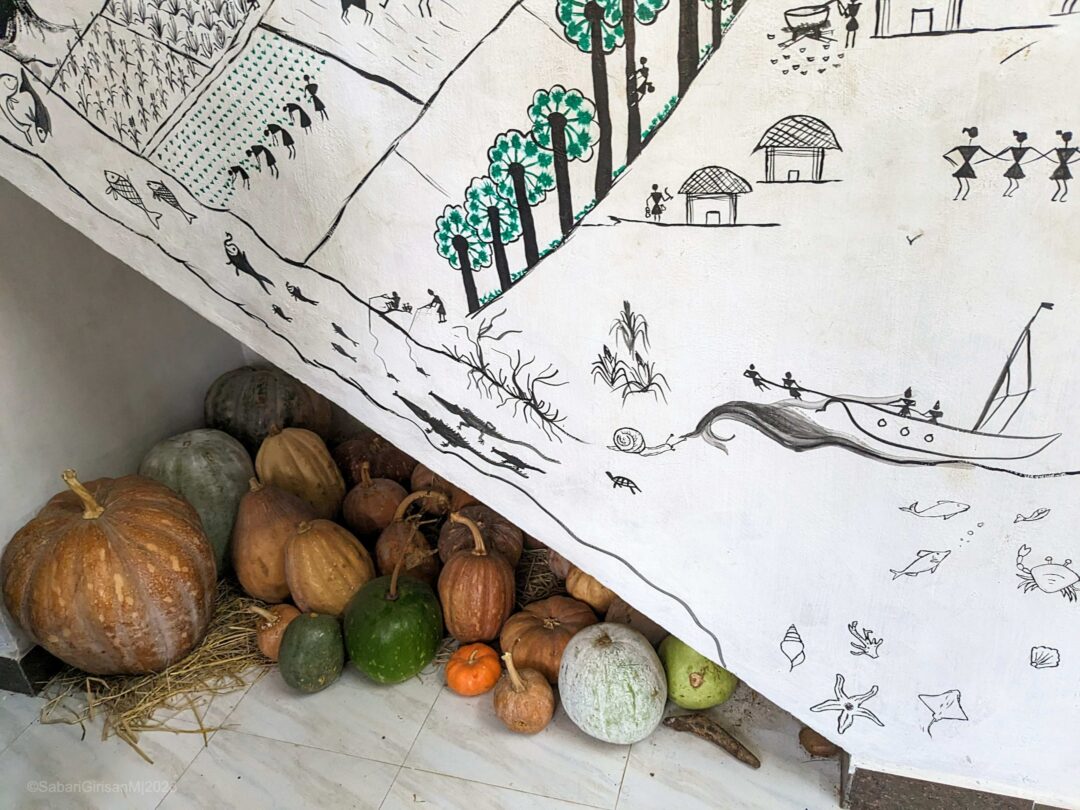
Featured Image: Preparations at a community seed bank’s opening ceremony at Vellore, India.. Source: M Sabari Girisan.
References
Anderson, Benedict. 2005. “Imagined Communities: Reflections on the Origin and Spread of Nationalism.” In Nations and Nationalism: A Reader, edited by Philip Spencer and Howard Wollman. The Cromwell Press.
Appadurai, Arjun. 1981. gastro-politics in Hindu South Asia. American Ethnologist 8 (3): 494-511.
Appadurai, Arjun. 1988. How to Make a National Cuisine: Cookbooks in Contemporary India. Comparative Studies in Society and History 30 (1): 3–24. http://www.jstor.org/stable/179020.
Appadurai, Arjun. 1993. Patriotism and Its Futures. Public Culture 5 (3): 411–29. https://doi.org/10.1215/08992363-5-3-411.
Chatterjee, Partha. 1998. Beyond the Nation? Or Within? Social Text, no. 56: 57-69. https://doi.org/10.2307/466770.
Douglas, Mary. (1993) 2003. Food in the Social Order: Studies of Food and Festivities in Three American Communities. Vol. 9. Mary Douglas Collected Works. Routledge. Reprint, Routledge.
Khare, R. S., and M. S. A. Rao. 1986. Food, Society and Culture: Aspects in South Asian Food Systems. Vol. 22. Carolina Academic Press. https://doi.org/10.2307/2802884.
Ray, Krishnendu. 2004. The Migrant’s Table: Meals and Memories in Bengali-American Households. Temple University Press.