Molybdomancy is the practice of reading the shapes of molten metal poured into cold water, and it belongs to a tradition older and wider than any single name for it. In Bosnia and Herzegovina it is called salivanje strahe (the casting/pouring of fear), and is performed to relieve psychic distress, nervousness, and fright; in Ashkenazi Jewish tradition it is known as bley-gisn, recited over with psalms to dispel the evil eye in children and pregnant women; in Norway it moved through the folk-magical complex of trolldom; in German-speaking Europe it persists as Bleigießen, now a New Year’s ritual. The practice travels across these geographies to divine the future, to attract fortune, or to cleanse the body of affliction, and thereby changes what it takes the body to be: a receptacle, a surface, or a site of accumulated harm.
In the Turkish context, specifically within vernacular religion, kurşun dökme is a diagnostic technology used to identify invisible harm already lodged in the body. Biomedical knowledge requires visible and measurable symptoms, and Islamic practice often addresses named sins or named spiritual states. As a harm without a visible origin, the “evil eye” is neither of these, without a locatable cause and without a name that any official diagnostic system can work with. Kurşun dökme thus exists because no other available diagnostic register can see what it sees.
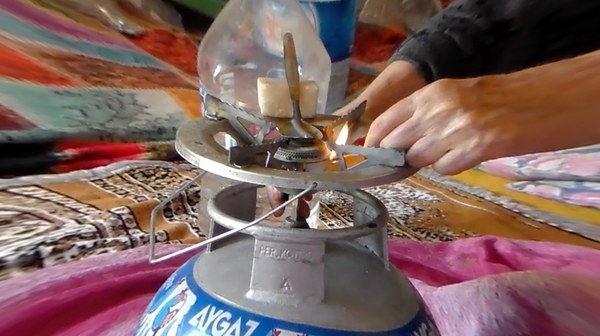
Practically, it is the act of pouring molten lead into water to diagnose the “evil eye”, performed in domestic space, by elder women, often transmitted matrilineally, and operates alongside (and sometimes in friction with) both institutional practice and biomedical knowledge. Unlike tasseography, which is divinatory and future-facing, kurşun dökme is therapeutic. It works on a body already affected, already carrying something. It is intimate and domestic, with a ‘grandmother’, a spoon, a bowl of water, a body that is known. In its conventional form, the ritual brackets the story. The biography of the person being read recedes; what matters is the lead, the shape it makes, the cleansing.
In my film, I let the biographies, namely geographies and languages, stay. Istanbul, the city I was born into, and Berlin, the city I arrived at, are the two poles of an interpretive field alongside biographical coordinates. Istanbul appears as a space where kurşun dökme remains socially and affectively embedded, and Berlin becomes a site where such practices are translated, reinterpreted, or rendered legible through the vocabularies of migration and religion. The body being read in Istanbul is a body that Berlin has also read, that moves between two cities where different silences are available to it. In my research I ask what it means to attend to a body that is perpetually being diagnosed by the family, by the clinic, by the ritual, by the border; the latter reading the body not for what it carries spiritually or medically but for where it belongs and whether it may pass. Each system arrives with its vocabulary, and each system claims to know what the body carries. I am interested in what exceeds all of them. What remains unread by each system accumulates and becomes the texture of a life lived across interpretive regimes that do not fully overlap.
Every diagnostic act has its instruments, and knowledge, like lead, takes the shape of what it is poured into.
As such, in this experimental documentary I study ritual embodiment through the proposition that sensory, sonic, and material practices carry knowledge that cannot be fully recuperated into text. This is also why the research takes the form of a film, as what the ritual does to and through the body are harder to textualize than to be shown, heard, or sat with. Taking the body as a site of knowing, I inhabit kurşun dökme as a mode of inquiry in which the ritual is moved through, but not explained. I understand the ritual, the body, and the self that attends to both as mutually generative. Identity is produced in and as the practice, recursively, without a located or fixed origin point. The film holds what the ritual holds, which I take to be the unresolved or the untranslated remainder that no single interpretive system can fully account for. What the ritual sets aside, I ask to remain present. The lead carries everything with it, and the film does not let that go.
Every diagnostic act has its instruments, and knowledge, like lead, takes the shape of what it is poured into. The conceptual vessels here are three.
In sensory and multimodal anthropology, Sarah Pink’s (2009) framework of sensory ethnography, positing the body as a site of knowing, as the very medium through which knowledge is produced, provides the ground for treating kurşun dökme as a method rather than an object. Her argument that sensory ethnography is a reorientation of what research itself is, namely a doing rather than an observing, opens for me the possibility of treating the ritual as a mode of inquiry to be inhabited instead of a site to be studied. Brian Massumi’s (2002) work on affect and research-creation further helps me understand the way in which knowledge that is produced through participation in a practice operates below the threshold of representation and cannot be fully recovered into language afterward, pointing to participatory knowledge as a different register of the real that precedes and exceeds representation. In this film, I submitted my own body to the ritual’s reading. I was the one for which the spoon was held, the lead poured, the shape interpreted. The knowing happens in the being-read, and the film reflects this through its fragmentary, non-linear, and open to interpretation structure in the way the ritual itself is. The ritual’s own logic, which works in bits and pieces and resists resolution, also becomes the organizing principle of the filmmaking. By treating the ritual as a method, I mean that the research moves through the practice instead of standing outside and describing it, and the film is the process itself, not a record; still unresolved, still in motion. To treat kurşun dökme as a method rather than an object, in a way, is to ask what the ritual participation makes thinkable that observation alone cannot, to let the ritual’s own logic structure the conditions of inquiry, and to submit to its epistemology.
Silence here is what the body holds when no register is adequate.
The autopoietic framework of Humberto Maturana and Francisco J. Varela (1987), which indexes the self-producing, self-maintaining logic of living systems, enters here as a structural claim about the ways in which the ritual, the body, and the attending self co-constitute one another without fixed origin. The practice has a history, the loop does not. I cannot identify the moment when the ritual began to produce me or I began to produce it, as each iteration generates both simultaneously, and each iteration is itself a claim about recursion. Through the ethnographic framing of the project I therefore ask how ritual travels, transforms, and survives across migration, modernity, and competing regimes of interpretation. In visual anthropology and the study of ritual, I draw on a tradition that includes David MacDougall’s (2006) work on the corporeal image and Nadia Seremetakis’ (1994) theorization of the senses, memory, and the still moment that highlight how certain practices preserve what modernity tends to displace. McDougall’s notion of the corporeal image, specifically the idea that film thinks through the bodies rather than merely interpreting them, and that the camera itself is a corporeal instrument capable of knowledge that the written word cannot access, grounds my understanding of what the film is doing when it lingers on the body being read rather than cutting away to explanation. Seremetakis’ figure of the still moment, the pause, the suspension, and the instance in which the senses collect around something that has not yet been named, inspires me to let the ritual’s moments of waiting (such as the cooling lead or the held breath before interpretation) function as epistemological positions and not as gaps in the data. Kurşun dökme, in this light, is a technology of attention that this film attempts to extend bodily, which is to make the screen a surface through which the viewer’s own sensory knowledge is activated. In other words, the film does not ask the viewer to ‘understand’ kurşun dökme. However, it asks you to be in it long enough for something to be felt before it is named.
I locate the ritual’s significance in its texture, namely the weight of the spoon, the smell of molten metal, the sound of lead striking water, and the slow cooling that precedes interpretation accompanied by the fear that molten lead would splash onto the body. Sound is treated here as a primary ethnographic material, which I take, through Steven Feld’s acoustemology, as a way of knowing place, self, and relation. I thereby treat sound and silence as epistemological gestures. For Feld, sound is how a place and a self come to know themselves, and to listen carefully is already to know differently. In this film, that means the sonic choices are constitutive, as I use the sound to reach what the image cannot, not to accompany what it already shows. Sound, in this framework, is the argument itself. In the film, I extend the hush around the ritual cinematically, as large silences open when the lead is melting, when the interpretation is being formed, and when the practitioner’s murmured prayer sits at the edge of comprehension. Silence in this film is therefore material, and where the film’s knowledge is located. What the ritual is doing at those moments cannot be said, because it operates in a register that language does not reach. Similarly, scenes shot in nature carry German voices in the background, and the call to prayer appears reversed, unrecognizable as itself. I take these disjunctions between sonic and visual registers as ways of registering how knowledge arrives in this film partially, out of sequence, and sometimes before it can be named. As such, the gaps between voiceover and image, between what the ritual names and what it cannot, are where the translation runs out and something else begins. To explain these silences would be to domesticate them. The film asks instead that they be sat with. Silence here is what the body holds when no register is adequate.
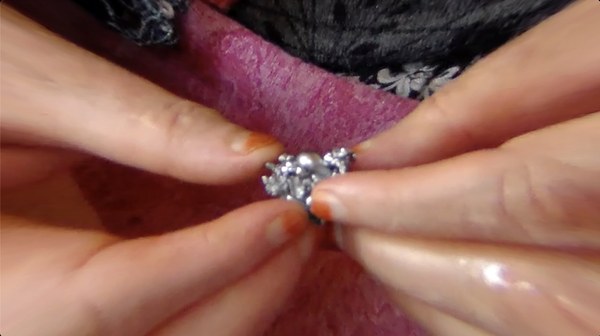
Film still from (dis)gnostic overlap
The system produces itself, the ritual produces its own coherence, and I produce myself in the act of attending to it.
Water holds form long enough to be seen and not long enough to be trusted. The call to prayer un-calls itself. The body unhears what it knows.
The voice no longer belongs securely to the body on screen.
I remain with uncertainty because resolution would require me to stop being multiple. The body sensed as several. The ritual as a living thing that changes in the telling, that changes me in the attending, that pours itself into the shape of whatever vessel is near.
İstanbul is the place where the ritual already knows my name. Berlin is the place where I learned to name the ritual. I remain between them the untranslated remainder.
The figure of the evil eye renders itself instructive by positing harm as relational and invisible. Something that passes between bodies. Something that accumulates in the space of regard. Something that the body registers before consciousness does. Something the body carries as heightened attention, as anticipation of misrecognition.
You are invited to watch kurşun dökme without knowing in advance what you are looking for, and noticing what your own body does in the watching. What accumulates in the silences? What does the reversed call to prayer do to the ear before the mind catches up? What does it mean to sit with a shape in water and not yet know what it means? Noticing is itself a diagnostic act. Your body, like the body being read on screen, knows something before it can be named.
Diagnosis, then, is not something that happens to the body from outside. The diagnosis is what the body does; perpetually, in relation, and across registers that never fully converge.
Featured image: Film still from (dis)gnostic overlap. Photo by author.
Cited Works
Feld, Steven. “Acoustemology.” In Keywords in Sound, edited by David Novak and Matt Sakakeeny, 12–21. Durham: Duke University Press, 2015.
MacDougall, David. The Corporeal Image: Film, Ethnography, and the Senses. Princeton: Princeton University Press, 2006.
Massumi, Brian. Parables for the Virtual: Movement, Affect, Sensation. Durham: Duke University Press, 2002.
Maturana, Humberto R., and Francisco J. Varela. The Tree of Knowledge: The Biological Roots of Human Understanding. Boston: Shambhala, 1987.
Pink, Sarah. Doing Sensory Ethnography. London: Sage, 2009.
Seremetakis, C. Nadia, ed. The Senses Still: Perception and Memory as Material Culture in Modernity. Chicago: University of Chicago Press, 1994.
Abstract: This experimental documentary essay traces the practice of pouring molten lead into water to diagnose the evil eye, which is called kurşun dökme, as a method of inquiry. In the film, sound and silence are the primary materials. The reversed call to prayer, the hush around cooling lead, and the murmured prayer at the edge of comprehension become arguments. Moving between Istanbul and Berlin, the film attends to a body perpetually being read by the family, the clinic, the ritual, and the border. The essay draws on sensory ethnography, acoustemology, and autopoietic theory to ask what the ritual makes thinkable that observation alone cannot. The work then asks that kurşun dökme be sat with long enough for something to be felt before it is named. Diagnosis, in the end, is not something that happens to the body from outside. It is what the body does.