


Cindy Barukh Milstein. 2024. Constellations of Care: Anarcha-Feminism in Practice. London: Pluto Press.
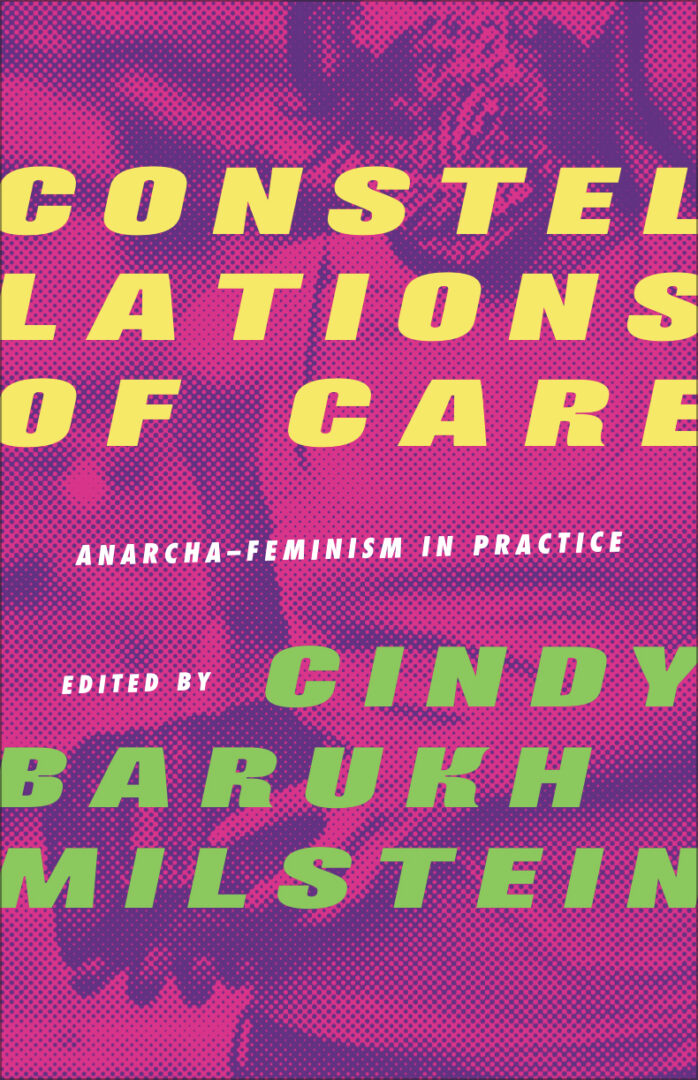
Constellations of Care is an anthology of answers to a fundamental question: what do people do to survive and thrive from the margins of society? According to the volume’s editor, Cindy Barukh Milstein, the goal of state-based systems is not to provide prosperity and security for all. Rather, they strategically reserve material and political protections for those who conform to a masculine and heteronormative model of the ‘good citizen’. The various authors of this anthology, all members of various anarcha-feminist collectives, employ the praxis of anarcha-feminism to suggest that resistance to state-based exclusion depends first and foremost on the practice of care, sustaining and building relationships that give life to those without political and economic power or opportunities, who unwittingly or willingly do not conform to the standards desired by the state. Empowerment and social transformation are not driven by massive state projects, but by interpersonal and highly specific interventions managed by those who share the ontological experience of exclusion through inhabiting queer or feminine bodies.
What follows is a collection of histories, reflections, conversations, and artwork that reflect collective, anti-hierarchical, and locally organized efforts to care for a global network of the excluded. Whether written by underground abortion care providers in Poland, communal kitchen collectives that sustained anti-government protests in Colombia, or unhoused and precarious sex workers in Philadelphia who hold weekly needle exchanges, each of its thirty-seven entries offers an approach to creating communities by and for the marginalized.
In some ways, Milstein’s work sits at odds with a strictly academic style of writing. One of the first entries in the book, written by members of the Nightshade collective in Philadelphia, actively denounces the ability of formal academia to understand and advance anarchist theory, suggesting that academia is inherently hierarchical, focuses on creating grand universalist theory rather than accepting theoretical plurality, and gatekeeps legitimacy through economically restricting access to academic credentials (p. 24). Constellations of Care is based on the idea that theory is created, interpreted, and used not by researchers, but by the everyday stakeholders in the political processes that it analyzes. The book emphasizes alternatives to academic style in some of its editorial choices. For example, each section’s author biography veers away from listing degrees or institutional affiliations, and rather briefly chronicles the author’s skill sets and political positions, as well as their close relationships to both communities and geographies, often defined by a city or an Indigenous land designation, rather than a nationality. However, the main contribution of the book is to showcase/underscore/reveal both the vastness of anarcha-feminism’s theoretical considerations and approaches, as well as highlight the difficulties of living out radical politics on a day-to-day basis. The reader is constantly invited not only to explore the deep-seated reasonings that drive the book’s storytellers, but are also challenged to forget clean, academic theory and engage with the messy process of extending a hand to the people around them.
Queer/Feminist Alternatives to Both Historical Anarchism and State Systems
Anarchist organizing has often struggled with how to oppose hierarchical structures without simply reproducing their harms or coercive authority in less formalized ways. These anarcha-feminists often characterize state power with masculinized values and phenomena, including violence, individualism, and the influence of charismatic and ambitious political leaders who are willing or able to take public risks in the name of a cause. Two members of Food Not Bombs, a collective that gives away free meals to unhoused people and at protests, write that “emphasizing only the most visible, frontline, or confrontational forms of activism fails to acknowledge the massive amounts of labor carried out every day that…are part of the glue that holds us all together” (p. 348). This invisibilized labor is often only understood from the standpoint of those who are either doing the work of caring for the marginalized, a disproportionately feminine group, or who are outside of normative economic, familial, and domestic structures, a key part of the ontological experience of queerness.
This understanding offers a corrective course to both official marginalization and trends within social movements that prioritize direct action against a hostile authority over the daily needs of vulnerable people. What it doesn’t offer is a clear idea of where masculinity as a concept or masculine bodies reside in a framework of care. The book, like many of the collectives featured within it, is entirely the work of women and queer contributors, with a range of opinions from wanting to work in tandem with more ‘masculine’ political groups, to advocating for full autonomy of feminine and queer anarchists from cisgendered and heterosexual men as a strategy towards harm reduction. The argument is clear-cut that a theory of masculinity in line with the values of horizontal, communitarian care politics is the responsibility of men themselves, not women or gender queer people. At the same time, anarchism as inherently pluralist, inclusive, and non-hierarchical cannot simply condemn or disregard masculinities and move on. In presenting a gendered understanding of the division of roles in alternative and social movement spaces, Constellations of Care highlights the unclosed gap between a queer feminist politics of care and both institutional and radical politics that are understood to be masculine.
Maximum Care, Minimal Harm
“Safety, however, is itself a problematic concept. First off, there is no way to ensure 100 percent safety. It’s all just harm reduction. Presenting a space as “safe” might actually make it less safe because if people walk in expecting to be shielded from any and all harm, they are defenseless.” – Corinne, Aurore, Éris and Tom, members of the Bibliothèque Anarcha-Féministe of Toulouse, France in their chapter Tea, Books and Thresholds (p. 63)
The question of whether or not to constantly reassert the validity of care work against a harmful masculinist anarchism raises another dilemma. How much care work is based around providing material or affective support, and how much is based on shielding marginalized people from harm? As the above quote from a self-managed library in Toulouse notes, the idea of total safety can be deceiving and utopian, as different individuals’ needs and expectations for safety come into conflict with each other. Furthermore, a collective that believes itself to be ‘safe’ based on its standpoint or on the identities represented in its membership may be less likely to take accountability or accept criticism when real damage occurs. Thus, several entries emphasize the importance of both anticipating and pre-empting both the external harm that their members openly face, as well as harms that may be committed within movement spaces. Collectives thus recount dedicating large amounts of time to understanding any instances or allegations of harm and determining what accountability and reparation measures are appropriate. More traditional forms of anarchist organizing have objected to the amount of dedication anarcha-feminists hold to addressing harm, arguing that it takes time and energy away from more ‘positive’ activities. However, as Benji Hart of the Chicago youth anti-war collective Dissenters explains, “Anarchist feminist politics do not teach us to reject all structure, they invite us to imagine structures that are shaped by and intended to protect the autonomy of the most vulnerable versus the interests of the most powerful” (p. 360). Redressing harm forms the basis for building new structures that address the needs of the most vulnerable and sheds light on the ways in which anarchists unwittingly reproduce coercive or authoritarian systems.
Ultimately, many of the authors conclude that some amount of plurality is necessary to be able to provide the care and protection that is required by diverse populations with divergent needs for safety. This calls up the metaphor of the constellation in the title, casting care networks as being widespread and just as diverse and loosely organized as the communities they serve.
Unproductive Temporalities
“We ended it while we still appreciated each other, we ended it without being in debt, and in fact… and we ended by each of us moving toward other horizons.” – Cindy Barukh Milstein Stitching Together our Worlds (p. 228)
Anarchic collectives, Milstein notes, have several points of departure from more institutionalized organizations, even if both appear on the surface to do similar work. One key difference comes in the way that the temporality and impact of work are linked. For a state or non-profit organization, productivity is linked to temporality through quarterly goals, annual reports, and funding cycles, all of which carry the urgency of proving both effectiveness and efficiency. The longevity of such organizations is tied to their ability to consistently meet a standard of efficacy that is defined by funders.
Self-organized and funded groups are under no such obligation, thus tend to consider the best measure of whether their work is needed and should continue through relational and affective lenses. If the care provided is nurturing relationships, and the members of the collective maintain an intuitive sense that the work is sustainable and ‘worth it’, collectives carry on. Temporalities of anarchic care thus ebb and flow with the broader energy and demands of social movements, direct communication with communities, and the needs and limitations of caregivers. This places decisions about effectiveness and temporality out of the hands of funders, and into the hands of those directly doing the work. As a result, many of the authors actively celebrate the fact that they are not bound to an outside standard of productivity, and all the flexibility or joy of simply doing nothing once in a while that comes with it. The Bibliothèque Anarcha-Féministe of Toulouse, or the Pink Peacock, a “queer, Yiddish, anarchist feminist, anticapitalist cafe” in Glasgow (p. 151) relish in offering their services for free or on a pay-what you can basis, using community space and volunteer labor to make themselves available. Philadelphia’s Nightshade collective and OccupyICE, Colombian Community Kitchens, or members of the Mačjak squat in Ljubljana pointed out the importance of simply claiming public space for their use or enjoyment without asking permission.
Benevolent State Control vs. Community Care
“In Prison, we referred to health care as ‘health scare.’ It was such a dehumanizing process to submit a written application to see a doctor, wait for weeks, and then just be dismissed, patronized or put down during the two-minute consultation…my friend nearly died of cancer in prison after the authorities failed on nine separate occasions to take her to hospital appointments for lifesaving surgery.” – Nicole Rose/Solidarity Apothecary in the Chapter Solidarity Apothecary: Reclaiming Life (p. 179)
The other major distinction between institutional and anarchic forms of care comes in whether there are certain forms of control or coercion built into receiving care. This quote comes from Nicole Rose, an apothecary and herbal medicinalist who works with incarcerated people. While she makes no claim that herbal cures, especially ones that can be accessed from inside prison, are a match for conditions like cancer, she emphasizes her interventions are meant to humanize patients and come with no strings attached. The options offered by the state can be quite effective, but severe limitations in access communicate that institutional providers in this context do not prioritize the health or quality of life of specific individuals, leading to more dehumanization rather than its alleviation.
Other contributors, especially those working with unhoused communities, sex workers, drug users, and undocumented immigrants consistently noted the trade-off between receiving state-sponsored care and being subject to policing and surveillance. Anarchic care is focused on continuing to allow people to live outside of systems, such as housing markets, immigration laws, and minimum wage labor, without using access to care to guide vulnerable people into specific economic and social modalities. While this does not lead to a condemnation of many programs that vulnerable people are able to access through state care, anarchists such as Bayla (Bay) Ostrich of the Network for Reproductive Options, a grassroots abortion referral and funding network (p. 375) or the Philadelphia Nightshade Collective’s Raani Begum (p. 100), are critical both of the ways that healthcare housing, food distribution, and rehabilitation programs impose a mold of the ‘good’ and thus masculinized citizen, and also how failure to meet that standard can result in a loss of care or even criminalization.
Political Pleasure
“Creating spaces of joy has literally always been how Black and Brown people have sustained ourselves throughout history and fluctuating degrees of violence or being targeted” Claire Barrera of Brown Girl Rise in Brown Girl Rise: How We Take Care of Our Own (p. 119)
Perhaps the most consistent theme throughout the book is summed up by a sense of political pleasure, a certain form of happiness that comes with being in a trusted community, united by common ideals and sense of purpose. Over and over, the authors emphasize that the most important aspect of care is providing a space where people can simply enjoy themselves, be happy, and find community with people who might understand them. In reading Constellations of Care, one can sometimes tangibly feel the affection that the contributors hold for their respective collectives.
Thus, the next time you find yourself asking what is to be done in situations of hopelessness and marginalization, the answer might be to pick up this book, read an entry or two, and hopefully be inspired to show care to someone around you.
Featured Image: Matryoshka dolls. Source: PickPik.