During an interview broadcast in early August 2026, Argentine President Javier Milei again explicitly attacked the university and scientific community, a sector that has been largely critical of his administration since he took office two and a half years ago. Amid ongoing conflicts and tensions stemming from austerity measures in higher education and scientific research, Milei labeled students, professors, researchers, and journalists “terrorists,” accusing them of what he called a “Gramscian strategy” to gain control over education, the media, and the state. I am one among Milei’s “terrorists” who publicly speaks out against the government’s university and scientific policies, and against the criminalizing, racist, and repressive immigration policies it has pursued and continues to pursue. For more than twenty years, I have worked within Argentina’s university and scientific system, teaching and researching on migration and borders.
Milei’s recent official statement is part of a long history of attacks on academic freedom within a context of severe restrictions on individual and collective rights and freedoms. His is a far-right government that has sought to appropriate the idea of freedom as primarily a free-market principle, while its policies have subjected broad sectors of the population to deeply precarious living and working conditions. The government’s authoritarian drift is becoming increasingly explicit: there is less and less room for dissent. In recent years, there has been a notable concentration and expansion of executive power, accompanied by an expansion of control and surveillance mechanisms designed to restrict and discipline social protest as well as of systematic practices of harassment and stigmatization of individuals considered “adversaries” or “enemies.”
“Scienticide” is a concrete form of attack on the institutional and material conditions that make the effective exercise of academic freedom possible
Since taking office in 2023, Milei’s administration put limits on academic freedom by imposing threats and sanctions, and casting suspicion on professors’ conduct in university classrooms. In 2024, the Secretariat of University Policies, under the neoliberal Ministry of Human Capital, established an institutional email address to receive complaints from university students against professors for so-called “ideological persecution, indoctrination, or harassment in the classroom.” The government’s maneuver, carried out by a government that presents itself as a defender of freedom, restricts academic freedom under the pretext of protecting students from ideological imposition. In Argentina, both “academic freedom,” which aims to guarantee diversity of opinion and promote critical thinking in universities, and “university autonomy” have been formally recognized since the 1918 Reform. The 1995 Higher Education Act stipulates that universities must ensure “academic freedom” and the “pluralistic coexistence of schools of thought, theories, and lines of research.” The reporting mechanism that the Secretariat for University Policies implemented was among the government’s first attempts at social disciplining in the name of “freedom,” which the national government claims to defend.
The draconian policies were met with condemnation by a collective of academic institutions because of the way the measures foster undemocratic and repressive practices. Nevertheless, the government continues to attack and discredit those engaged in teaching and scientific research. For example, in September 2024, Milei spoke at an international event of the Madrid Forum, an organization of right and far right political leaders. In his opening remarks, Milei discredited scientists and intellectuals in a two-pronged attack: first, he cast doubt on whether scholars and scientists are legitimate representatives of knowledge, and then questioned the usefulness of the scientific knowledge and the value providing public funding for science. Aimed at delegitimizing those who practice science, the provocation served as justification for dismantling the infrastructure of public funding and thus the institutional and material conditions for knowledge production.
As a research program director, I have experienced the gradual deterioration of the scientific system in very specific ways: among other issues, young researchers have seen their academic and professional trajectories interrupted as a result of the discontinuity of scientific training and career programs; fellows and researchers with established professional careers have found it difficult to sustain material living conditions on our salaries alone; scientific research projects that had been evaluated and approved did not receive the corresponding grants (with available funds seemingly vanishing into thin air); and research topics and approaches have been compromised due to the reorientation and increased restriction of thematic prioritization criteria. Despite this situation, we have continued to envision and pursue alternative ways of carrying out our scientific and intellectual work even as this far-right government has undoubtedly caused great harm.
In my view, the president’s fury and the systematic attacks against researchers and university professors reveal the fear and insecurity of a government that feels threatened by the exercise of academic freedom and the production of critical knowledge. The Milei administration is waging a battle it will ultimately lose: when the government delegitimizes scientists and questions the legitimacy of the institutions that produce knowledge, it may be weakening the social authority of the scientific community but it certainly erodes the foundations of its legitimacy by its public actions.
Academic freedom is a practice that we engage on a daily basis, doing so collectively
The government’s actions have been met with strong opposition. Over these past three years, the defunding and dismantling of the scientific and technological system has been denounced and condemned by numerous figures in the academic community, including researchers based outside Argentina. The most recent open letter addressed to President Milei was signed by 24 Nobel laureates, prominent figures in science and technology, and more than 3,500 doctoral and postdoctoral fellows and scientists (July 2026). The letter serves as warning of the consequences of the collapse of the Argentina’s scientific system by means of budget cuts, the erosion of employment and career structures, the weakening or dissolution of scientific institutions, the interruption of research programs and infrastructure, the loss of “accumulated capacities,” and, increasingly, the coercive treatment of scientific workers and institutions.
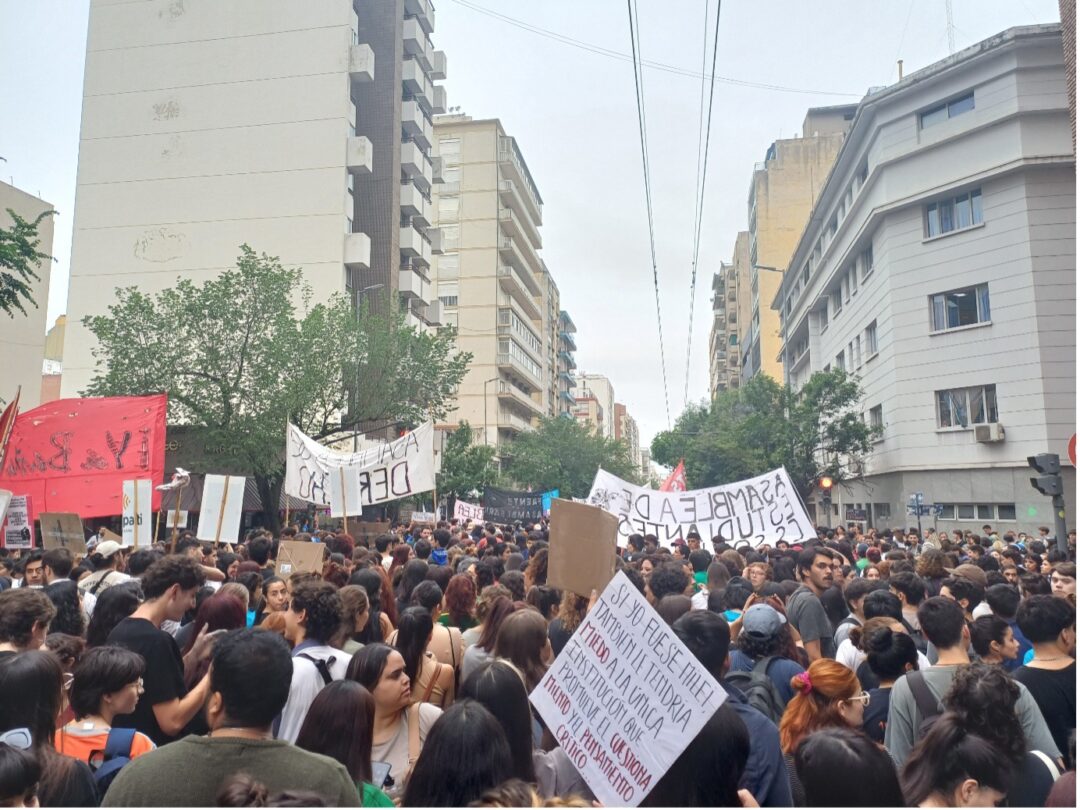
Moreover, scholars, professors, and students have been protesting in the streets once the government’s actions began to take shape. For example, those affiliated with the National Scientific and Technical Research Council (CONICET) have organized numerous and ongoing protests and demonstrations against “scienticide.” “Scienticide” is a concrete form of attack on the institutional and material conditions that make the effective exercise of academic freedom possible; invoking the term has been highly effective in raising awareness and mobilizing society. In today’s Argentina, “scienticide” carried out by the national government directly undermines academic freedom by suffocating the institutional and material conditions that sustain academic and scientific work.
In the face of defunding, delegitimization, and attempts to impose discipline, a community of workers in scientific and university institutions have deployed various collective and creative forms of organization, protest, and defense of public education and science: taking science to the streets; transforming scientific slogans into political ones; turning scientific protest into a cultural intervention; reclaiming symbols of popular culture to build new languages of protest. Beyond these interventions in the public sphere, we engage in numerous everyday practices of resistance that may not be highly visible but have us actively engaged in the struggle to keep alive knowledge production. Thus, academic freedom is a practice that we engage on a daily basis, doing so collectively.
Featured image: The Federal University March in Defence of Public Education in Córdoba, October 22, 2024 by Eduardo Domenech