I am a Palestinian who carried out their PhD in Europe. I have a Palestinian passport, and hence have more issues with state authorities than most people. Having planned to start my thesis writing year in Palestine, I received a position as an exchange lecturer in a local West Bank university and moved back home in September 2023.
After October 7, Israel’s ruthless policies and practices escalated. The checkpoints would close for undetermined periods. Gates were erected, disconnecting communities from their neighbors. The transit from my home to my place of teaching changed from 35-45 minutes to 2-2.5 hours each way. Soldiers, mainly younger unexperienced ones sent to West Bank checkpoints, would randomly pick people to exit their vehicles, selecting them for harassment and worse. Some were blindfolded and zip-tied, beaten up, or used as a decoy for percussion-grenade launcher practice. Students arrived late to classes and arrived brutalized.
Upon hearing their leaders call for ethnic cleansing, soldiers on the checkpoints enthusiastically embraced sexual harassment of Palestinian female students. I heard of several cases that first year I was teaching. Soldiers would take the students’ phones, then add themselves to the women’s social media accounts. Male soldiers would force the female students to strip in front of them and in sight of the thousands waiting for their turns to pass the checkpoint. In one particularly sadistic case, one of my students was forced by soldiers to video record as they beat up another student. These soldiers would encourage students to film these brutalities to “show others what awaits them.” These soldiers had no fear of being held accountable for these crimes.
As I was on my way to the conference, Israeli border control forced me to turn back. No reason or explanation was given. No paper nor order submitted. Only a paper stamp on the back of my passport with a date for when I could reclaim my luggage.
Palestinian university administrations were put in a difficult position. Faculty and students who raised the issues were hushed. The university administration did not want news of the bullying at the checkpoints to impact their already dwindling enrollments from the checkpoint-crossing segments of the student population. Several administrators and even some faculty supported “not making a fuss.” Some suggested the university use “discreet” methods, such as connecting with international and Jewish activists and international and Israeli human rights organizations, and informing foreign consulates. But the university dallied. Other than setting up a system so students could report violations, the only action they considered was the mumbled option to inform US ambassador Mike Huckabee, a stalwart Zionist, at such time “the opportunity presents itself.” It is not clear if the opportunity ever presented itself.
Through it all, I managed to submit my thesis. Between that time and my defense, I had been accepted to present at a European conference. Happy to be getting a break from the situation at home, and excited that I had income from the fellowship and a valid student residency for travel to Europe, I was optimistic.
And then, as I was on my way to the conference, Israeli border control forced me to turn back. No reason or explanation was given. No paper nor order submitted. Only a paper stamp on the back of my passport with a date for when I could reclaim my luggage.
I was faced with a travel ban.
I sought legal assistance. Once, there were reliable Palestinian human rights organizations able to assist. No longer. Some of them, such as Addameer and Al-Haq had been criminalized by Israel as terrorist organizations prior to October 7. Others had their funding cut by the EU after October 7, a European knee-jerk reaction that limited funding to Palestinian civil society, subjected organizations to humiliating “Patriot Act”-like restrictions, and crushed institutional stability. I finally found a still functioning organization to provide some assistance: the Society of Saint Yves, the human rights arm of the Catholic church in Palestine.
I was not alone. I soon learned that over fifty other academics and intellectuals from Palestinian universities and cultural institutions were banned from traveling during this period. No one knew why we were banned, or even if we constituted a “we.” Word was that the bans were due to the student encampments in the US and Europe, and “we” were considered influencers and organizers, a ridiculous assumption. I, for one was never a Palestine activist on my European campus but a PhD labor union organizer.
I became unemployed and immobilized. My attorneys had advised me to keep a low profile, halting my career development. I were not to publish my thesis, I could not attend conferences, I would not submit three ready-to-be-submitted articles for fear they would be published (as opposed to fearing a journal rejection).
The emergency laws enacted by the Israeli government complicated and limited the ability of lawyers to assist. An early challenge was to “prove” there was a ban on me. Saint Yves could not take my case to court without such proof. They advised me to go to the border where I would be turned back again, showing I had been denied exit twice. After a year, occupation authorities confirmed that I had was officially banned from travel, claiming I was “in a terrorist organization,” yet another claim wrapped in vagueness and illogic: why, if I were a known “terrorist” wasn’t I arrested? There are no shortage of jails or Palestinians imprisoned on that charge and even on lesser grounds.
During the ban period, I defended my thesis. Before the ban, I had plans to catch up with colleagues, have dinner and drinks with my supervisor and committee, and visit nearby European capitals. In the end, my defense was held via zoom. My defense was successful but there was no celebration with my professors and fellow doctoral-strugglers/survivors.
My fellowship came to an end, and I found myself a new graduate launched into a collapsing labor market. Palestinian universities reduced their faculty because of the domino effect of the war-time economy; Palestinian workers in Israeli construction and agriculture were not given permits to work; the NGO sector was rocked with funding cuts or re-calibration to strictly humanitarian programs; and the Palestinian Authority had its revenues cut by the Israeli government leading to months of employee wages being due. Parents lost their income, which meant students did not have tuition. In turn, this led to a financial crisis in Palestinian universities.
I became unemployed and immobilized. My attorneys had advised me to keep a low profile, halting my career development. I were not to publish my thesis, I could not attend conferences, I would not submit three ready-to-be-submitted articles for fear they would be published (as opposed to fearing a journal rejection).
Eventually, the lawyers had a breakthrough that enabled my application for a court hearing; after two years, the travel ban was finally lifted. This summer I attended my first conference, having received a travel grant to be able to attend and present, a small personal victory. I count my blessings because it could be worse, and I can now try to continue my career.
To practice sumūd (steadfastness) is the basis Palestinian survival; in the greater scheme of other Palestinian struggles, I am privileged. Still, mine is one of thousands of stories about how people endure settler colonialism and its draconian measures, not least academic unfreedom.
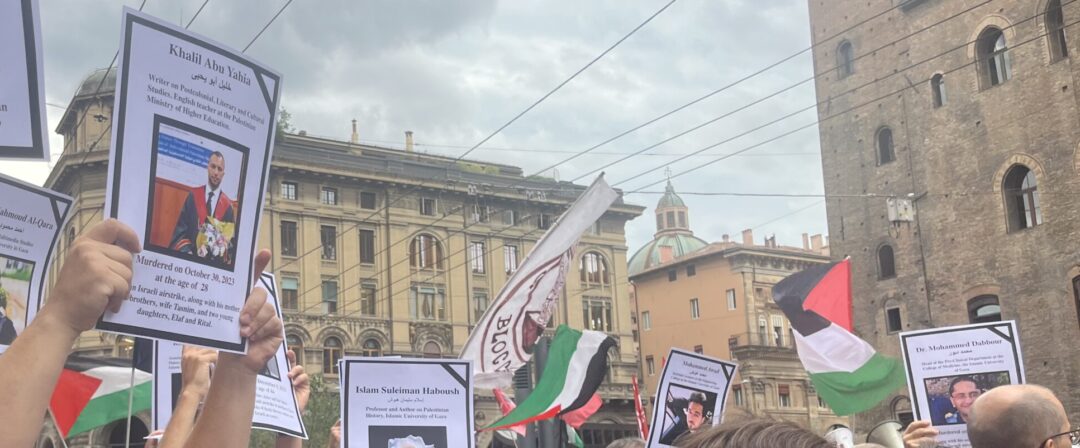
Featured Image: Standing in Solidarity with Palestinians and Palestine (photo credit: Ruba Salih, Bologna 2023)