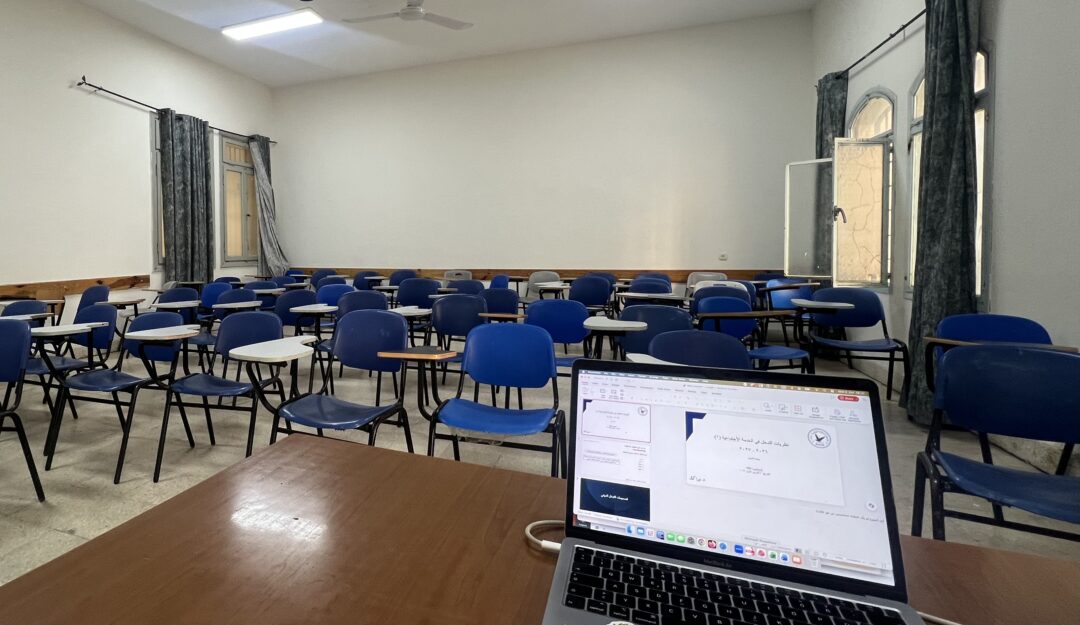
At An-Najah National University in Nablus this year, it was another day in the life of an educator under occupation. I stood in front of only a handful of students, with another 20 minutes before I would bring the lecture to a close. Earlier, there had been an announcement: the Israeli military would be closing all gates and checkpoints around Palestinian villages and cities.
Two students looked up at me, clearly nervous and unfocused. Their bodies were present, but their minds were elsewhere.
I stopped the lecture and looked at them, wondering how many worries they were carrying. Changing from the academic topic at hand, I instead began sharing an experience from when I was a student at Birzeit University during the Second Intifada. I thought that perhaps sharing my own experience would help ease some of their worries. This is what I said:
There are things in life we can’t change, but we can change how we react to them. I was a student once, and, like you, I experienced the struggle of living under military occupation and settler colonialism. Birzeit, Ramallah and Nablus were on my route. It was a journey through hell. One Thursday, at the start of the weekend, I wanted to visit my family in Nablus. At Hawara military checkpoint, every Palestinian had to cross on foot and undergo a search just to enter or leave Nablus. I waited and waited. It was summer, the sun was intense, and many people were waiting for their turn to be searched.
I saw some Palestinians take another route, where the soldiers did not notice them. A friend and I decided to follow them. We were unlucky: suddenly, a soldier stopped me and pointed his rifle at my face. I laughed inwardly and gave a sarcastic smile: “What bad luck!”
They threw us into what we call a hofra (a hole) in Arabic, a depression in the ground next to the military checkpoint. They put us there with other men, who were being punished for reasons unknown to me, and one woman, who was also being punished for trying to take this route.
At that time, there was no social media or 3G internet. I chose not to dwell on negative thoughts that would increase my stress and worries. I asked myself, “What can I do in such a situation?” The answer I gave myself was this: observe how people pass through the military checkpoint and how they interact with the soldiers. Learn how people react and interact in the face of such harsh reality.
After around five hours in the sun and heat, they released us all.
Looking straight at the two anxious students, I offered advice: “Life keeps moving. Worrying too much will not solve any problem or mitigate our anxiety. We need to embrace our reality in a way that helps us to move forward.”
The students listened carefully, but their worries didn’t vanish. Instead, they asked, “May we leave early to get home?” Without hesitation, I said, “Yes, of course.”
Twenty-four years separate my experience as a student from theirs, yet the suffering Palestinians face has never left our daily lives. Regardless of who is in power, every political party within the occupying state agree on one thing, and that is to uproot Palestinians from their everyday lives.
That very same week, I sat in the classroom, waiting for the students to arrive for our 8 a.m. class. Two arrived an hour late. Why? They looked exhausted.
One explained: “We left home at 5:30 a.m., but the military checkpoints slowed us down.”
What could I say? I had a flashback to when the occupation forced us to walk and walk and walk as we tried to reach our universities. I remembered the siege of 2002 when Israel unleashed a large-scale military offensive in the West Bank. To be a student was not an option. We were prisoners inside our homes, without access to education for months at a time until life returned to “normal” occupation.
These two moments, among many others, shows what it means to be a student or an academic in Palestine. There’s struggle simply to get from home to the university and back. There’s the instructor from Al-Quds University forced to wait for hours to reach her morning lecture, only to find herself stuck for more than four hours on her way home. There’s another, forced to resign from a university position because restrictions on freedom of movement made it impossible to continue working. Each teacher, every professor and all students carry stories of the same struggle, trying in their own way to cope with a harsh reality that robs them of a dignified way of life and makes them prisoners under occupation.
Academic freedom has long been constrained by the occupation’s apparatuses of control, with military closures intensifying the suppression.
Living under such uncertainty and continuous atrocities, Palestinians find themselves creating meaning out of the nonsense that engulfs them. Being an academic or a student does not exempt us from suffering. On the contrary, academic spaces have been subject to endless closures for decades and have never been considered safe or sacred ground in the eyes of the colonizers. Students and teachers have been killed, kidnapped and imprisoned, and have never been able to pursue their education or teaching in peace. The occupiers want the occupied to be isolated and uneducated, which helps explain the obstacles constantly put in front of us.
Palestinians have had to forge a path of hope, even when making sense of reality falters, making hope difficult to sustain. Yet, existence is resistance, and continuing our education is part of the Palestinian struggle to exist. Finding new ways to navigate harsh reality has become part of our everyday lives, as we seek possibilities beyond closed physical spaces through the virtual world, include online teaching. Our ability to cope never ceases to amaze me.
Education is a weapon of hope that transcends the boundaries imposed on Palestinians. Creating meaning and sustaining hope enables ability to confront the pain inflicted on us. This inspiration manifests itself in every academic and student who builds bridges to the rest of the world through their knowledge, bringing people together in the face of inhumanity. Our commitment to learning and sharing knowledge challenges the isolation imposed on us.
Hope remains deeply rooted within each Palestinian, sustained by the belief that, no matter what, the power of knowledge will never fade.
Featured image: Military checkpoints mean empty classrooms with students either late or unable to come at all, 5 October 2025 by Noura Kamal