
Look around you,” the taxi driver said as we left Maiduguri airport and drove toward Wulari.
“Do you see dead people on the streets?”
He did not wait for my answer.
“These NGO people,” he added, waving his hands dismissively, “they just like to make money from lies. There is nothing to see.”
It was late afternoon. Dust and diesel hung in the air, the sun angling low across the road as tricycles wove between cars inching forward. Engines idled and then surged, settling into a steady hum. Sweat gathered beneath the fabric. The city carried on with practiced ease. Yet beneath that motion lay something tighter, an alertness that showed itself less in words than in the way bodies held themselves. You sensed it at checkpoints where soldiers stood behind sandbags and in the brief, assessing glances that met yours before sliding away.
There is nothing to see.
On a decrepit wall near the edge of town, someone had written in uneven paint: Boko Haram is evil. There was no signature, no addressee, no call for response—only a statement left to stand at a distance from those it named. The words lingered without reply.
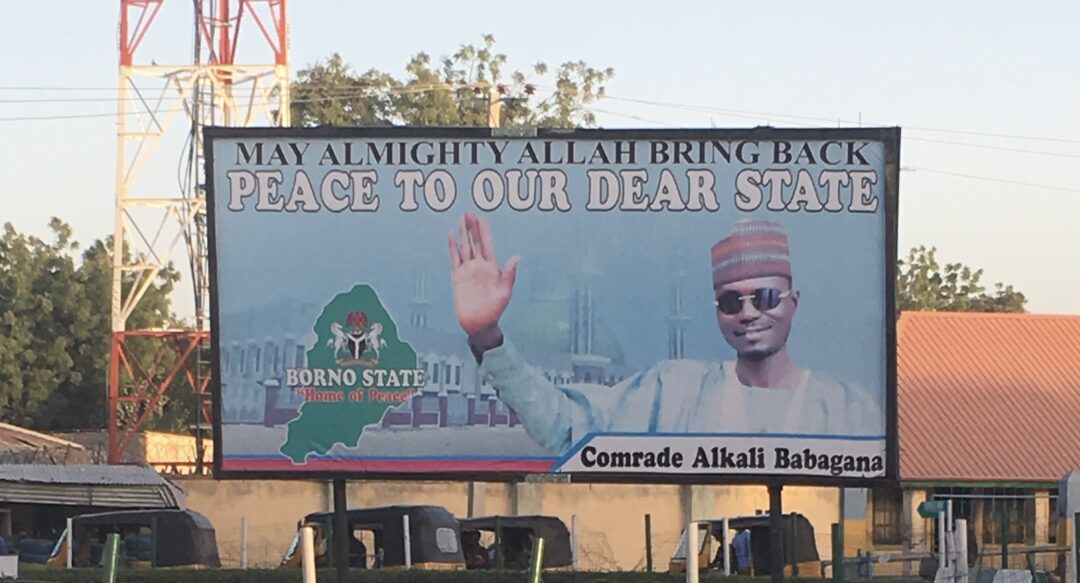
Along the roadside stood the charred frames of vehicles burned in earlier attacks, their metal ribs twisted and blackened. Campaign billboards implored “Almighty Allah” to “Bring Back Peace to our Dear State” (Fig. 1). Posters of wanted Boko Haram commanders stared out over the traffic. Young civilian vigilantes gripped wooden sticks and scanned passing cars.
I saw no bodies in the street. Still, the city carried war in its surfaces and routines, in what people had learned to see without seeming to.
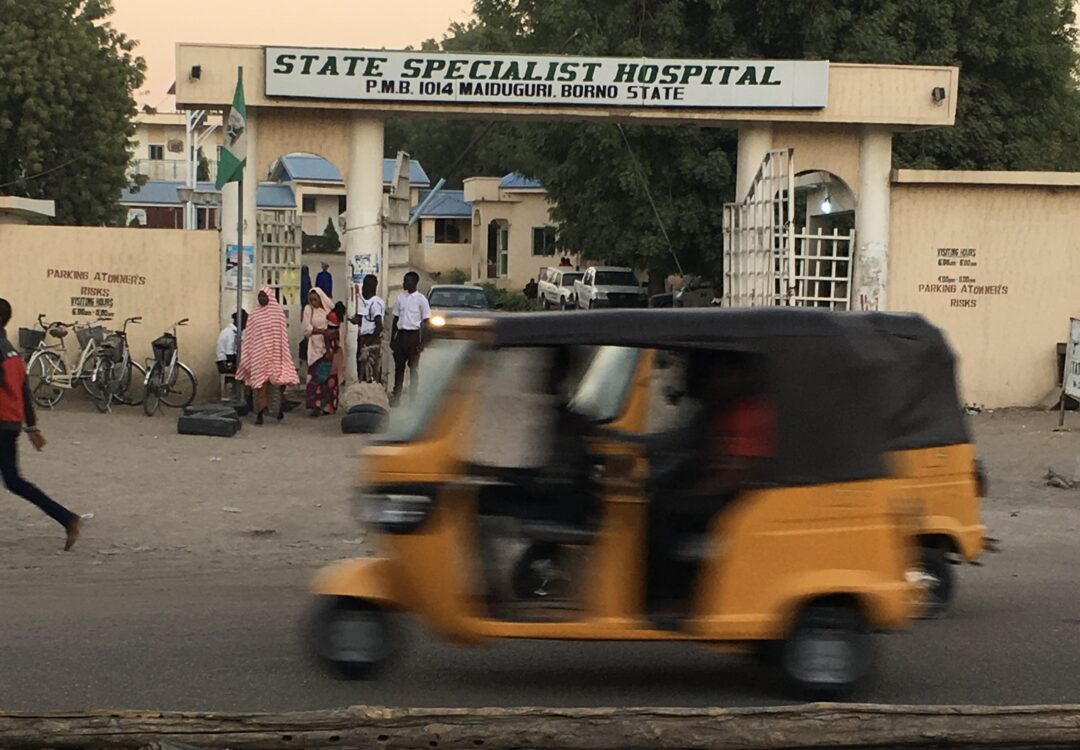
Fig. 2 Photo provided by author
Later that afternoon, outside the State Specialist Hospital (Fig. 2), ambulances arrived in quiet succession. No sirens screamed. Stretchers moved briskly through the gates. Bystanders did not gather. They glanced briefly and continued walking.
The taxi driver was right in one sense. There was nothing spectacular to witness. But there was silence.
Not a lack of sound. The city was loud enough. What I encountered was a trained quiet: a refusal to narrate what lingered beneath the ordinary, a calibrated insistence that things were fine, a turning away that functioned as a way of living. In the Lake Chad Basin, silence is the medium through which unfinished war becomes livable.
Acoustic Terror
The silence I encountered during fieldwork belonged to a different order than the quiet that gripped Maiduguri at the height of the insurgency. Between 2013 and 2015, when Boko Haram was widely described as the world’s deadliest terror group, silence was immediate and bodily. One woman described those years with striking precision:
Silence is the medium through which unfinished war becomes livable.
“We faced a terrible absence of peace where one never trusts anybody. There were incessant attacks. One cannot even talk aloud inside his room. People were injured while some lost their lives. It was like hell. People were running when the name of Boko Haram was mentioned. One could not eat. People were killed anyhow. Our brothers were scaling walls to escape. It reached an extent that no one dared drop any household utensil to make a sound that would attract the insurgents.”
In those years, silence was survival. Sound could betray you. A dropped spoon could draw attention. A raised voice could mark a house. Kitchens became acoustic traps. Bedrooms became listening posts.
Territorial control later fractured, insurgent factions splintered, and large-scale attacks became less frequent, particularly after the Nigerian military reasserted control over Maiduguri in 2015. In their place, checkpoints multiplied and rehabilitation centers expanded.
Silence did not disappear. It changed form. Where it once meant avoiding detection by insurgents, it now meant navigating suspicion among what I came to think of as recognized strangers, people bound by shared history yet divided by what could not safely be named. Where it once meant not making noise, it now meant saying less than one knew.
One Eye Open
A religious leader in Maiduguri described the present this way: “We live with one eye closed and one eye open. One ear closed. One ear open.”
Gunshots lingered in the body, he said, even when no shooting occurred. A car backfiring could jolt him awake. A rumor could travel faster than confirmation. Calm did not eliminate vigilance. It reorganized it.
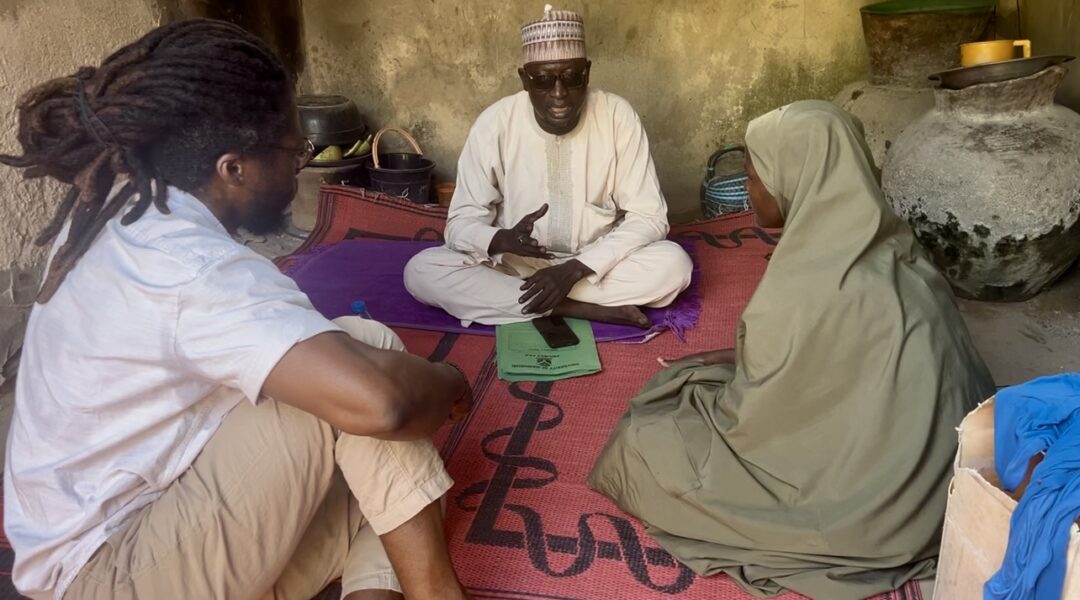
Fig. 3 Photo provided by author
Michael Taussig writes of societies shaped by terror as operating within a “nervous system.” Violence no longer announced itself in explosions or headlines. It moved through posture, anticipation, and scanning. In interviews, I began to notice hands before I heard words. Fingers folded and unfolded. Knees bounced. Heads turned toward the doorway before an answer came (Fig. 3).
War had not vanished. It had thinned into atmosphere.
Avery Gordon calls this haunting: when something that should be over continues to structure the present and leaves its traces on the body. In Maiduguri, war had not vanished. It had thinned into atmosphere. Silence carried that atmosphere.
Silence and Denial
“There is nothing to see,” the taxi driver had said.
His denial functioned as defense.
Maiduguri, often called the “home of peace,” has long been narrated as epicenter and battlefield. To insist that nothing is happening is to refuse reduction to spectacle. It is to reclaim ordinariness from a global gaze. Silence in this register can function as dignity.
It also draws boundaries. The dismissal of “NGO people” marked a line between those who inhabit the city’s rhythms and those who narrate it from outside. That line has sharpened as humanitarian presence has thinned in recent years, a shift visible in the growing number of under-occupied hotels that once housed expatriate staff. To speak too loudly of danger risks fixing a place in permanent crisis. Denial can be a way of asserting authority over how the city is known.
Silence here is knowledge under management.
Denial and vigilance coexist. People move through checkpoints with practiced familiarity. They know which roads to avoid at night. They know how quickly rumor can ignite fear. Silence here is knowledge under management.
Silence as Strategy
If silence in Maiduguri operated as denial and boundary, it took on a different inflection in sites of reintegration.
In a rehabilitation center in Meri, northern Cameroon, a facilitator told me bluntly, “Many of them are not fully open.” He was referring to returnees—men and women who had left Boko Haram–controlled territories and entered state-managed reintegration programs. They often narrate themselves as victims, he explained. They emphasize coercion. They minimize agency. They foreground suffering.
The observation could easily become accusation. But under what conditions does one speak freely? Support is conditional. Classification matters. Being labeled “low risk” rather than “high risk” shapes reintegration. Speech can alter classification. Narration becomes calculation.
Terrence Des Pres observed that survivors “select and arrange, point up and slide over” in recounting extreme situations. In the Lake Chad Basin, this selection is protective. Speech is scrutinized. Communities remember who left, who stayed, who suffered. State actors monitor behavior. Vigilantes listen. NGOs assess. To speak fully is to risk exposure.
To speak fully is to risk exposure.
Édouard Glissant names a “right to opacity”: the refusal to make oneself fully legible to systems that demand transparency as the condition of belonging. In landscapes saturated with suspicion, legibility is not safety. It is exposure. Silence becomes a shield.
Gendered Silences
These strategic calibrations of speech are not evenly distributed; they are shaped by gendered forms of discipline and experience. They are learned, enforced, and carried differently across bodies.
Many women who returned from insurgent camps carried multiple layers of enforced restraint. Some had been married several times. Some had lost children. Some had given birth under conditions of scarcity and threat. Their speech was measured.
Inside the camps, discipline extended to sound. One woman recalled that when she made a mistake during Qur’anic instruction, she was beaten. “I cried often,” she told me, “but quietly, so that no one would hear.” Even grief required vigilance. “Everything you do, you look around first.” Speech could signal dissent. Sound could invite scrutiny.
Years later, that attentiveness lingered. After a particularly sparse interview, a community leader cautioned me: “You must remember who they are carrying inside.” The phrase unsettled me. Silence here was compression.
Part of it was grief. Part of it was social training. Part of it was calculation. Husbands might still be alive. Networks might persist. Words travel.
Toni Morrison writes that “unspeakable things” remain structured by language even when they are not voiced. Silence, in these encounters, marked where articulation would rupture more than it would repair. It sustained forms of proximity that speech might have undone.
Silence as Governance
Silence is not only personal. It is administrative.
Access to rehabilitation centers was tightly managed. Permissions were delayed. Interviews often occurred in the presence of security personnel and local vigilantes. Information about returnees’ pasts was unevenly distributed.
The state governed through partial disclosure as much as proclamation. Lists are withheld. Classifications remain opaque. Communities are asked to trust decisions they did not witness.
The result is organized uncertainty.
Taussig describes “violent silencing” as structuring the conditions under which speech becomes costly. Silence becomes infrastructural. Knowledge concentrates within administrative enclaves while suspicion disperses outward into the ordinary spaces where coexistence is negotiated.
Coexistence Without Resolution
These layered forms of silence—defensive, strategic, and administrative—converge most visibly in the fragile arrangements of everyday coexistence.
They would tell me they had forgiven. Then, without lowering their voices or altering their tone, they would add, “If he comes back here, we will kill him.”
The sentence was not whispered. It carried no drama, no menace. I heard it while sharing kola nuts in shaded courtyards after Friday prayers, sandals scattered outside the mosque. I heard it in late afternoons when men reclined on woven mats beneath trees, huts of dried grass and millet stalks behind them. It was delivered as practical knowledge.
Across towns in northeastern Nigeria and northern Cameroon, the formulation recurred with quiet regularity. No one treated it as contradiction. It described a condition.
People lived beside one another without narrating an ending.
Forgiveness operated at a distance. It permitted reintegration elsewhere. It required anonymity. Proximity reactivated fear.
The arrangement was maintained without spectacle. Neighbors did not openly accuse; returnees did not openly defend. Traditional authorities brokered accommodations in subdued tones. Silence stabilized cohabitation without demanding reconciliation. People lived beside one another without narrating an ending.
Method and Listening
Anthropology often privileges voice, the making audible of what has been suppressed. In these settings, insisting on full articulation would have been extractive.
Some interviews ended in shared quiet. I learned not to fill every pause. Not every evasion required pursuit. Not every silence demanded translation.
Silence was not a failure of data; it demanded a different mode of listening.
Meaning traveled in tone, hesitation, posture, and glance. It appeared in scrambled recordings where generators swallowed words. To study the afterlives of insurgency is to learn to hear differently.
What Silence Holds
“There is nothing to see,” the taxi driver had said.
He was not entirely wrong. There was something real in what he said.
There were no bodies on the streets that afternoon. The city functioned. Markets opened. Checkpoints operated. Life moved. What he resisted was spectacle.
Beneath that functioning city ran an undercurrent of vigilance, grief, and unfinished time.
Silence in the Lake Chad Basin takes many forms. It can be acoustic survival. It can be strategic opacity. It can be gendered discipline and political calculation. It can express dignity, or boundary, or fear.
War here did not end. It shifted registers.
In that altered register, silence remains one of its principal media, dense with what persists and what cannot safely be said.
Featured image: campaign billboard, photo by author.
Acknowledgments
This research was supported by the Cross-Border Conflict Evidence, Policy and Trends (XCEPT) research programme, funded by UK International Development from the UK government. The views expressed do not necessarily reflect the UK government’s official policies.
References
Des Pres, Terence. 1976. The Survivor: An Anatomy of Life in the Death Camps. New York: Oxford University Press.
Glissant, Édouard. 1997. Poetics of Relation. Translated by Betsy Wing. Ann Arbor: University of Michigan Press.
Gordon, Avery F. 2008. Ghostly Matters: Haunting and the Sociological Imagination. Minneapolis: University of Minnesota Press.
Morrison, Toni. 1988. “Unspeakable Things Unspoken: The Afro-American Presence in American Literature.” Tanner Lectures on Human Values.
Taussig, Michael. 1992. The Nervous System. London: Routledge.
Abstract: This essay examines the social life of silence in the Lake Chad Basin after years of insurgent violence. Beginning with a taxi driver’s insistence that there is “nothing to see” in Maiduguri, I argue that silence operates not as absence but as social infrastructure in the aftermath of war. Drawing on ethnographic fieldwork in northeastern Nigeria and northern Cameroon, I trace how quiet shifts register: from acoustic survival under Boko Haram’s territorial control to strategic opacity and calibrated coexistence in its wake. Silence functions as protection, denial, discipline, and governance. Rather than signaling war’s end, it marks its transformation into atmosphere. In contexts of deferred justice and persistent insecurity, silence becomes the medium through which proximity is sustained without requiring moral closure.