
Listening, looking, reading, reading aloud, touching, then looking once more, letting the words and images settle in, drift and stir again. Some resonate more than others. Yet I feel no urge to linger on why. I believe this captures what it means to stay close to the protocol of poetic resonance, which lies at the heart of this thematic thread. In its place, something in the pieces on my screen folds time back onto itself. They do not return me to October 2009 because their themes and tunes mirror mine; they don’t. Wildfires and healing forests, the Palestinian diaspora, climatic-affective atmospheres, Danish construction industry, induced abortions, calabash gourds; these worlds are not my worlds. My mother is still alive, an everyday grace I register with a quiet, growing tenderness while time passes by. For this reason, what is called for is an orientation grounded in humility and an openness to curiosity as it emerges from the encounter itself.
What is called for is an orientation grounded in humility and an openness to curiosity as it emerges from the encounter itself.
And yet, each poetic contribution, each assemblage of words and images, in its own cadence, nudges awake that same ethnographic awe, that same slow-burning frustration with language that gripped me for weeks, months, and eventually years after leaving my fieldwork in Argentina. It still does.
It was a Friday morning. Austral Spring trembled in the air. I remember the hum of bodies pressed close in the Buenos Aires courtroom, the slight tremor of anticipation moving through the room around us. After months of hearings, five retired military officers were minutes away from receiving their sentences for crimes against humanity. For weeks, the space had been thick with words: torture, assassination, disappearance, rape, stolen children. But it was the silences and gestures that wedged deepest. The downward gazes, the tightening jaws, the tremor of a hand, the suspended breath. These carried a density no legal transcript could hold. Yet even these were only traces of something larger. It felt sometimes as if the atmosphere itself spoke: a thick, almost granular presence that exceeded gesture. It surpassed the visual and the sonic, extending beyond movement itself. Pooled in the space between direct perception, this thick presence often pressed our bodies down into our chairs, unable to rise even when a break was announced. It was as if the room itself exhaled a painful history, and we were folded into a wordless, overwhelming tide.
It was the silences and gestures that wedged deepest. The downward gazes, the tightening jaws, the tremor of a hand, the suspended breath.
And then the Judge President spoke the final words. In an instant, everything broke open. A swell of cries, shouts, sobbing, bodies rising, collapsing, and recoiling. A torrent of emotion, raw and unmediated, crashed through the courtroom. It moved through me too: confusion, vertigo, a bodily uncertainty so sudden it left no time for interpretation. Only later did I understand that this moment, this visceral rupture, would become the axis of my PhD. It was the emotions, those affective currents spiraling through the courtroom, that insisted on becoming the heart of my ethnography, the place from which I thought all thinking about justice had to begin. But how to record emotion?
For a time, the image of the sponge offered a way forward. How that squishy image held me in the field, day after day, absorbing everything around me. Every sound, every glance, every fleeting feeling, letting it soak into me, and then squeezing it out into words that could never quite contain it. And yet, those words in my notebook and on the laptop screen were just enough to let me refill myself the next day. It became a form. A system. A ritual, perhaps? But this absorption, this squeezing and refilling, wondrously never touched analysis. I moved through the processes of thesis writing with little awareness of resonance. No sense of autoethnography whatsoever. Suddenly, the sponge metaphor was no longer there. As though the act of analyzing were separate from the act of living. Similar methodical documentation of new ineffable experiences during the act of ‘writing up’ had not occurred to me. Bad anthropology? Perhaps. And yet, there was a life in it too. Of course. Something felt, something irreducible, something that resonated that could not be measured or contained.
I mistook the vibrations running through me for personal failure.
If only I had known then that my body could be understood as a tuning fork, an instrument that does not merely witness or absorb but resonates, something Minke Nouwens and Amalie Scheel articulate so strikingly in their protocol for grasping what poetic resonance entails. “[A protocol] to explore sensorial and affective experiences in the field, in interviewing, and in analysis. Using your own body as a tuning fork, the protocol is employed to pick up on vibrations and resonances in spaces, places, and data to understand how, by, and for whom, and in what ways affective experiences shape relational dynamics and situated practices in people’s everyday lives (Scheel and Nouwens, 2026). Instead, I mistook the vibrations running through me for personal failure. Sleepless nights and restless legs that drove me away from the screen, preventing me from attuning to those pulsations. Only later did I understand that these sensations were not noise but knowledge as well, knowledge one must learn to perceive, to follow, and to attune to.
Such engaging and ‘thinking with’ the material, sonic, and sensory qualities of sound waves, the anthropologist as tuning fork “is activated as an analytical tool to aid in the alchemist process of analysis to find what is not automatically apparent when bumping into and pulsing with multimodal relational worlds and people’s situated experiences” (Scheel and Nouwens, 2026). In more practical terms, the poetic resonance protocol invites one to begin with a single word, image, line of transcript, drawing, or video clip that troubles, and to listen with all the senses to how these fragments reverberate through the body. In doing so, it invites readers to join in staying close to discomfort and uncertainty. Re-reading this advice, I now understand the protocol above all as a concrete invitation to staying with the trouble (Haraway 2016), and to working through the difficult, messy, and unresolved realities of ethnographic practice.
To recognize oneself as a tuning fork would mean granting legitimacy to these embodied oscillations.
The approach offers a way for ethnographers to stay with the vibrations of their works and lives, also when they finally sit back down at their desks. To recognize oneself as a tuning fork would mean granting legitimacy to these embodied oscillations: the tightness of a jaw while typing, the sudden warmth of shame and guilt, the sinking feeling in the gut. It would mean trusting that parts of anthropology happen in the body first, long before it becomes language. Perhaps then the writing becomes less painful. Less a struggle against the inadequacy of words and more a continuation of the body’s reckoning. Without the need for closure or resolution, simply by resonating within, in the experience itself.
I feel a mixture of reverence and a wholesome envy as I witness my colleagues poised at the threshold of their young careers, and already so fluent in the art of moving through life and work in this reflective, attentive way. It took me more than a decade to reach even a semblance of their quiet understanding: to realize that embodied ethnography is not about gathering data alone, about being that sponge, so to speak. But about letting the body itself register, resonate with, and articulate the rhythms and undulations of lived experience at any given moment of ethnographic practice. Re-reading each piece, each small pulse of poetic resonance, I also realize how words keep calling. Calling to me as they call to all companions in this poetic resonance collection. Words pull us together and pull us apart, and in this restless oscillation, we continue shaping our endless effort to inhabit and understand our experiences and those of others. Always incomplete and always hungry for more. Here too, I hope, our words become a form of poetic resonance, vibrating between self and world, carrying us forward into what we have yet to feel, yet to know.
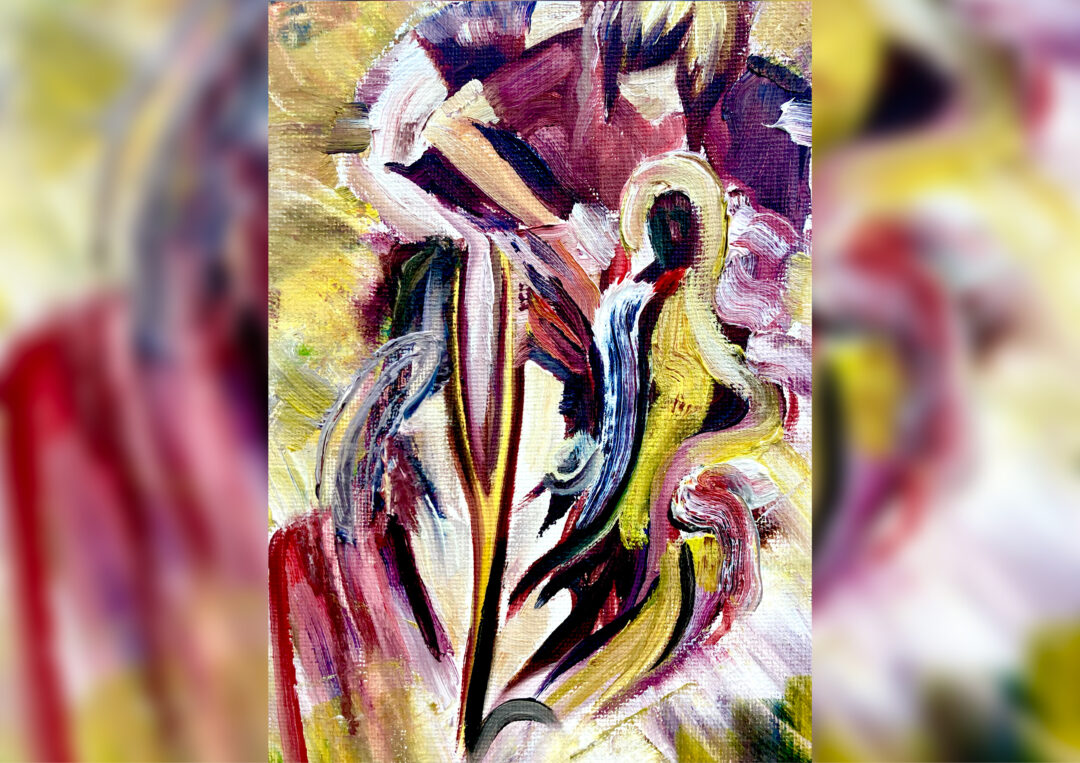
Featured image: ANTHROPOLOGIST AS TUNING FORK (Rich Thornton, 2026, Oil on Canvas), presented against a blurred fragment of the painting.
References
Haraway, Donna. 2016. Staying with the Trouble. Making Kin in the Chthulucene. Durham: Duke University Press.
Scheel, Amalie and Minke Nouwens. 2026. Poetic Resonance: Dwelling in the Affective Ripples of Ethnography. Allegra Lab.
Abstract: This afterword reflects on the practice of ethnography through the metaphor of the anthropologist as a tuning fork—an embodied instrument attuned to the subtle or violent vibrations of lived experience whilst working through ethnographic materials. Drawing on personal recollections from fieldwork in an Argentinian courtroom and on the poetic resonance protocol, it explores how sensorial and affective impressions often exceed what language, documentation or analysis can capture. Moments of dense atmosphere, visceral rupture and bodily unsettlement emerge as forms of knowledge in their own right, challenging the distinction between feeling and thinking. The afterword traces a personal movement from earlier understandings of fieldwork as a sponge-like process of soaking and squeezing experience into words, toward a recognition of resonance as an ongoing, embodied mode of knowing. By engaging with such fragments (in words, images, sounds, gestures) that trouble and reverberate, the anthropologist learns to stay with uncertainty, discomfort and the unfinished. The afterword highlights how poetic resonance offers a concrete method for honoring these embodied oscillations, inviting ethnographers to listen beyond the immediately legible and to trust the knowledge moving first through the body. Ultimately, it suggests that writing and thinking become extensions of these resonances, continually shaping how we inhabit and understand our own and others’ worlds.