
This writing is about cleaning rooms that are never meant to remember your presence. It is about thousands of towels folded the same way, fingerprints polished off mirrors, and bodies trained to smile and disappear as quickly as they arrive. It is about working in luxury spaces while being rendered surplus, interchangeable, unskilled – despite degrees, languages, and histories carried into every shift.
The room must look as though no one has ever been there. That is not a metaphor – it is the job description. Sheets pulled tight, surfaces returned to blankness, the air itself neutralized. What the guest encounters upon opening the door is not cleanliness so much as a performance of absence: the careful erasure of every sign that a human body, tired and often underpaid, has just moved through this space at speed.
The smile was not mine to give; it had been purchased along with the shift.
I know this because I was that body erased from space. As a former cleaner in a luxury hotel in Amsterdam, I pushed a cart through corridors where guests floated past without eye contact. My university diploma had not protected me from being reduced to a pair of hands. On an early Sunday morning, my manager cupped my chin and said: “All I want to see is smiling faces. No sad faces on the corridors.” I learned to compress my thoughts into a checklist. Fourteen minutes for a small room. Seventeen for a large one. Two minutes per bed. No minutes, officially, for walking between rooms, or for being human.
What was being managed, in that corridor, was not just my time or my body. It was my face. Arlie Hochschild, writing about flight attendants and bill collectors in The Managed Heart, called this emotional labor: the work of inducing or suppressing feelings in order to produce the appropriate emotional state in another person. In the hotel, emotional labor was not a perk of the job or even an expectation, but a condition of employment, monitored and corrected in real time. The smile was not mine to give; it had been purchased along with the shift. What the manager enforced that Sunday morning was not a dress code. It was a claim on the interior. And unlike a sore back, which recovers overnight, the cost of chronic emotional management (of performing warmth while feeling nothing or feeling everything while showing nothing) accumulates in ways that are harder to name and easier to ignore.
We were not merely working in a non-place. We were required to become one.
But the back alley told a different story. During the lunch break, I stepped outside for a cigarette and found three colleagues already there: a social worker, a historian, and a dance artist, all of us in the same grey uniform. The social worker was mid-story about a village in Romania, and the historian, a young man with a small Star of David on his chest, started to laugh: “What a coincidence, this is where I spent my childhood, at my grandparents’ house, it is the same village”. Someone brought cookies from home. For a few minutes, we were not cleaners. We were our full selves: credentialed, curious, multilingual, tired. Then someone checked the time. Cigarettes were crushed underfoot. Shoulders reset to the posture the uniform required. We went back in through the service entrance.
That threshold between the alley and the corridor is where I want to linger. The anthropologist Marc Augé (2009) used the term non-place to describe spaces designed for transit rather than habitation: airports, motorways, hotel lobbies. Nobody is meant to dwell there, the architecture refuses intimacy. But Augé was writing about guests. What he did not fully account for is what happens to the people who maintain these spaces. We were not merely working in a non-place. We were required to become one. Our interiority (our histories, emotions, qualifications) had to be made invisible so that the guest’s experience of smooth, weightless service could remain intact. The non-place is not only an architectural condition. It is a labor relation.
This is the detail that anthropology must not let pass: we were all overqualified. Not by accident, but by design. The Amsterdam hospitality industry is structurally dependent on a particular kind of worker: educated, multilingual, flexible, desperate enough to accept precarious contracts, and socially trained to be polite under pressure. Migrants, international students, artists between gigs, caregivers supporting families across borders. The industry does not simply tolerate this overqualification; it feeds on it. It extracts the soft skills – the emotional literacy, language competencies, the professional discipline – while paying for none of them. A social worker’s capacity to manage distress becomes, in the hotel, a resource for absorbing guest complaints without escalating. A historian’s precision becomes speed and accuracy in room turnover. These are not coincidences. They are quiet appropriations.
What makes this form of exploitation particularly worth naming is that it operates not through force but through a kind of enforced simplification. To recognize a cleaner as a skilled professional with an inner life would be to introduce a kind of friction the hospitality machine cannot accommodate. The room must appear effortless. Effort has a face, and a face has a name, and a name implies a person who might be tired, who might refuse, who might ask for something. The industry’s solution is to render the worker structurally illegible: be present enough to do the work, invisible enough not to complicate the experience. This is not simply a matter of low wages. It is an active, institutional refusal to see.
The industry calls this unskilled labor. Anthropology should know better – and say so.
And yet. The back alley keeps producing what the hotel cannot. Homemade cookies are brought on Monday mornings. Stories are shared in five languages across the trolley. A colleague’s name is remembered, used, and insisted upon. These are not grand gestures; they barely register against the scale of what the system extracts. But they are, in anthropological sense, significant. They are evidence that subjectivity cannot be fully administered away. Workers recognize each other, fully, as people, precisely in the spaces the industry forgot to surveil.
Tourism sells Amsterdam as a city of welcome. The welcome is real enough for those who can afford to receive it. For those who produce it, the city offers something else: the experience of being essential and expendable at once, of being everywhere and nowhere, of working in a place that is professionally obliged not to remember you were there. The room is reset. The next guest arrives. Somewhere in the service corridor, a historian is pushing a cart and thinking about Romania. The industry calls this unskilled labor. Anthropology should know better – and say so.
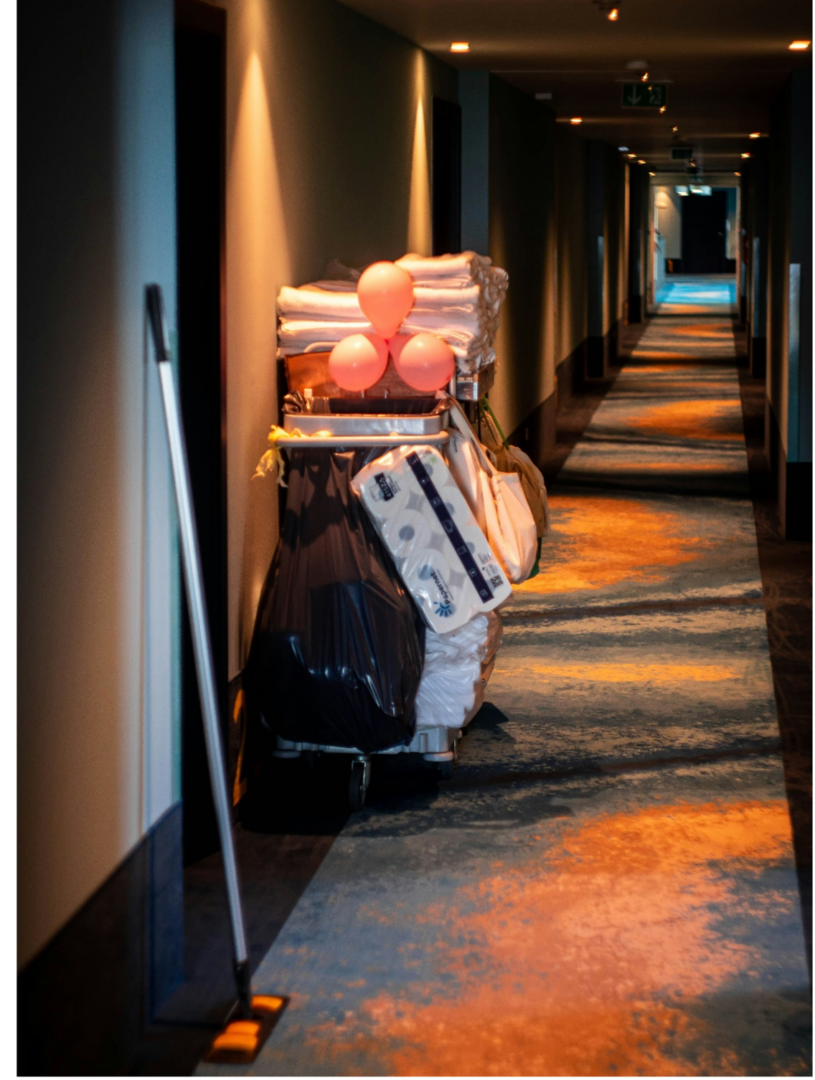
Featured image: Picture by Michal Balog.
Further reading
Augé, M. (2009). Non-Places: Introduction to Supermodernity. Verso.
Bourdieu, P. (1977). Outline of a Theory of Practice. Cambridge University Press.
Ehrenreich, B. (2001). Nickel and Dimed: On (Not) Getting By in America. Metropolitan Books.
Hochschild, A. R. (1983). The Managed Heart: Commercialization of Human Feeling. University of California Press.
Abstract: Drawing on autoethnographic experience as a hotel cleaner in Amsterdam, this essay examines how the hospitality industry renders its workers structurally invisible. Through the concept of the non-place (Augé), emotional labor (Hochschild), and overqualification-as-extraction, it argues that the erasure of workers’ skills, qualifications, and inner lives is not incidental to the tourism economy but constitutive of it. Against this, it traces the small, persistent acts of mutual recognition that workers forge in the spaces the industry forgot to surveil.