
“You look into a mirror and see a fire” (Whitehead 2016: 129).
Introduction: The Field on Fire
A wreath of light is glowing along the fringes of a forest in north-eastern Germany. Neon-yellow canola flowers, waist-high, and vivid violet meadow sage. The mid-summer sun has been pouring over the hot ground for hours already, and everything smells of pine needles and soil. Long, rustling grasses, dry to the touch, are covering a strangely orange ground. Within them, offering no shade, are the shimmering black trunks of conifer trees, towering up toward the sky, all of them burnt and mostly dead from a forest fire that happened here in 2022.
Here, in Brandenburg’s slowly recovering forests, only a few months earlier, five hundred firefighters were risking their lives in a fire that burned through one thousand hectares of ground and led to the evacuation of hundreds of residents. These people, all of them locals, faced the consequences of climate change first-hand. Lifelong forest owners lost their source of income; hundreds of animals on farms died; invisibility and sensory overwhelm injured and traumatized the firefighters; and the residents—many of whom moved here because they wanted to live close to a forest—are waking up now each day to a very different kind of home.
What does it mean to become attuned to this new brightness at a place where, before, there were overgrown forest paths in the shade? What worlds are forming after a fire, during the slow re-attachment of a body with the sweet smell of pine wood or wet soil or a barbecue in the garden with friends? What does it sound like when, after a long silence, the birds and the deer are coming back? Can the sensation of feeling safe and at home on these shifting grounds return as well? How does the heat of an early spring day feel when there is an uncanny sense in the air that “something” (Stewart 2007: 2) about this weather is off?
The Ethnographic Object: A Pyropoetic Workshop with Wildfire-Affected Residents
Nothing about a fire is obvious; its meanings and significances are never fully knowable, always suspended in states of alluring, confusing, flickering intensities. As Gaston Bachelard wrote in his Psychoanalysis of Fire, “the animistic and the substantialistic conceptions are mingled in an inextricable fashion” (Bachelard 1964: 61). In fire, the boundaries between inside and outside quiver and dissolve. This hazy and ambiguous tonality of fire and climate change, with all its sensory and affective patterns, is challenging to describe through traditional, linear means of articulation.
This turned out to be an interesting challenge for my PhD research, a sensory ethnography of wildfires. How could I truly grasp, in my encounters with affected persons, the textures and densities of living in a world increasingly shaped by fire? Recent developments in human geography and anthropology encourage a move away from conventional approaches to fieldwork and analysis (e.g., Lathem 2003; Saari & Mullen 2018; Vannini 2015). Instead, artistic practices could embrace these ambiguous intensities through more sensuous, embodied, and creative methods—such as music, dance, drawing, or poetry (e.g., Magrane 2021; Faulkner 2019; Zani 2023).
Equipped with these ideas, I reached out to my contacts in Brandenburg, those whose lives were profoundly impacted by the 2022 fire. Weeks later, we convened a poetry workshop in a beautifully restored parish hall. The group was larger than anticipated, comprising firefighters, military personnel, priests, evacuated residents, farmers, foresters, high school teachers, children, and a dog. Over the course of this afternoon, gestures and stories emerged that gave expression to the sensory and affective relationships between these people and their environments in ways more raw and vivid than I could have ever hoped for.
The poetic resonance protocol
A few months later, after this “Pyropoetic” endeavor had time to sink in, I participated in a course focused on the development of the poetic resonance protocol (Scheel and Nouwens, 2026). The protocol outlines iterative steps for engaging with ethnographic material, using the researcher’s “own body as a tuning fork” (ibid.). Initially, I anticipated a methodological tool to pick up the currents—the “poetic resonances”—pulsating between the workshop participants in Brandenburg and their changing environments. However, the application of the poetic resonance protocol to my poetry workshop material unfolded differently than I expected. Slowly, step by step, and frustratingly at first, yet inevitably, the protocol directed my sensibilities toward the resonances felt on my own skin, pushing me into a necessary, yet undeniably uneasy, form of self-reflection and self-attunement toward my own presence in the field.
There was a room filled with people who understood fire in ways I never could, people who trusted me to guide them through an afternoon of poetry.
The protocol slowed me down. I tuned into my material. I listened back in time to that day in Brandenburg, and memories began to flicker to the foreground:
A cinnamon-covered plate of plum cake that the local high school teacher baked and brought for us.
A shy man in a military uniform washing up dishes in the small kitchen during the break.
The utter creativity of the participants.
The gratitude I felt for being allowed to listen to these people’s words.
My tears in the car on the way back to the city.
The silence in the room after a firefighter declared his loss for words when he remembered the smell of hundreds of burnt pigs.
A shared feeling of a shifting home.
Autumn light and the bright cold air environing the parish hall.
The poetic resonance protocol asked me to find one single word or concept that somehow grouped these resonances as they resurfaced in my reflections. There was a room filled with people who understood fire in ways I never could, people who trusted me to guide them through an afternoon of poetry. The most powerful impressions left by this workshop were full-body sensations of experiencing the deep love and knowledge these people held for the forest, and their incredible courage and creativity in sharing their intimate, often traumatic, experiences with the group. And the stories these people shared—their gestures, their words, their worlds—they moved me, moved through me, through us, and changed us. But how could I possibly find a name for this elusive and powerful movement?
The Composition of Humility
At first, when I tuned into my material, I thought that these shifting energies that I felt in the room during the poetry workshop in Germany could be named as something like “awe”—awe as a shared sensation of being in the presence of something vast: the incomprehensibly vast web of life that is a forest; the elemental beauty, necessity, and destructiveness of fire; the fragility and resilience of all the people in the room. Awe is a complicated and appropriately ambiguous word. People typically feel awe when they admire something larger than themselves, something magnificent, something that might even frighten them (e.g., Allen 2018; Keltner & Haidt 2003). But in addition to this feeling, there was also a more subdued sense of gratitude—gratitude for coming together and listening to each other, for talking about the trees growing back, for moments of silence and kindness.
Humility was resonating back and forth between the past and the present, between the forest and the people, between a sense of control over the elements, and suddenly losing it.
But if there is one word that gets closest to the affective atmosphere of this workshop, I think it is neither awe nor gratitude. The word that crystallized has more to do with humility (e.g., Biehl & Locke 2017; Lorimer 2007). Humility was resonating back and forth between the past and the present, between the forest and the people, between a sense of control over the elements, and suddenly losing it. Humility was in the cake the local art teacher brought, the smiles exchanged, the worries shared. Humility was in every single word of the final poem that we composed together and read out loud as a whole in front of the parish hall. Humility was in the intricate things that come together to make, or unmake, a home. The word humility itself is a fascinating one. At its etymological roots, we literally find humus, which is Latin for “soil”—and also the origin of the words “humor,” “humiliation,” and “humanity” itself. It is an open word for world in formation.
This, I think, is what humility did that day in Brandenburg: it was not avoiding the gaze. It stayed present. It brought to light a tangle of questions and fragile connections without seeking to untie them. It held the room for both the losses that were encountered and for the joys of seeing how much was growing back already. This kind of humility is not possible without intimacy, without being very close to each other and the living world. I felt, in every moment, how much courage it took, and trust, to open up like this, to allow oneself to be exposed to the neighbor, the stranger, the forces of nature, and not to withdraw. Humility is a quieting force, maybe exactly because there’s an element of risk in it: the risk of being wounded or overwhelmed. With our words and our hands so close to the soil, to the people, to the thick humus of our lives, we were humbled, not only by the resilient fragility of these human and nonhuman relations themselves, but also by our responsibility to care for them—a responsibility that is, as Alphonso Lingis wrote, “coextensive with our sensibility; in our sensibility we are exposed to the outside, to the world’s being, in such a way that we are bound to answer for it” (Lingis 2018: 20).
Conclusion
The poetic resonance protocol is a tool that can become part of a movement toward a more embodied form of fieldwork and analysis. I spoke with many people about their lived, embodied, affective experiences with fire. But the application of the protocol reoriented my engagement with the material and pushed me beyond my role as an observer and toward a form of self-attunement and self-reflection. Only now, by noticing particular resonances between myself and the places and the people that I encounter, could I notice these energies elsewhere as well.
This openness and immersion, on the other hand, should not narrow my critical self-awareness—after all, my interlocutors trusted me with their stories exactly because of my role as a researcher. By offering a comprehensible step-by-step guide that leads me not further away but ever more deeply into the affective movements in my research material, the poetic resonance protocol illuminates a middle way: an embodied attention to the vibrant and ambiguous nature of lived reality while simultaneously acknowledging my disciplinary origins and committing to my responsibilities as a researcher.
Humility—to be humbled by a fire, by a gesture, by a poem—means to make oneself vulnerable to the world, to open up to it fully.
Guided by the protocol, I attuned to my field notes and moved through my memories of the poetry workshop with wildfire-affected people in Brandenburg. Soon, I became aware of a polyphony of shifting moods, of a vibrant composition of sensations and affects. Among the stories and poems that were shared that day, in the gestures and movements between the participants, in the material environment, and as a sensation that I felt almost viscerally myself, there was, I think, one key affective tonality: a subtle yet unmistakable sense of humility. This feeling, as well as the name of it, is inherently ambiguous. Its meanings and affective vibrations sway between an active, muscular modesty on the one hand, and a sense of inadequacy on the other. Either way, humility—to be humbled by a fire, by a gesture, by a poem—means to make oneself vulnerable to the world, to open up to it fully, no matter what. It emerges and thickens as a complicated, yet deep and powerful force that extends well beyond the individual, connecting people with each other and with the broader environmental changes they experience.
Postscript
For two years, I’ve been listening closely, and slowly I’m learning to be affected by stories of a landscape on fire. And what I’m hearing humbles me. Not only during this poetry workshop, but throughout my whole research on wildfires, people from all over the world shared with me their stories of joy and growth, fear and loss—and more often than not these stories left me awed, grateful, and speechless. It is one thing to describe and theorize “poetic resonances” in the fieldwork material, and something quite different to live them, to be overcome and penetrated by them. It was probably because of this friction that writing this essay became an unexpectedly complicated experience. Humility renders us vulnerable, and at the same time, it makes us fully receptive. Maybe this is what the anthropologist (and magician!) Paul Stoller meant when he wrote that the “most important and difficult lesson that a sensuous scholarship provides is that of humility. No matter how learned we may become, no matter how deeply we have mastered a subject, the world, for the sensuous scholar, remains a wondrous place that stirs the imagination and sparks creativity. (…) If we allow humility to work its wonders, it can bring sensuousness to our practices and expression. It can enable us to live well in the world” (Stoller 1997: 136). This is a difficult lesson indeed, but I will try as best as I can to act in accordance with these words.
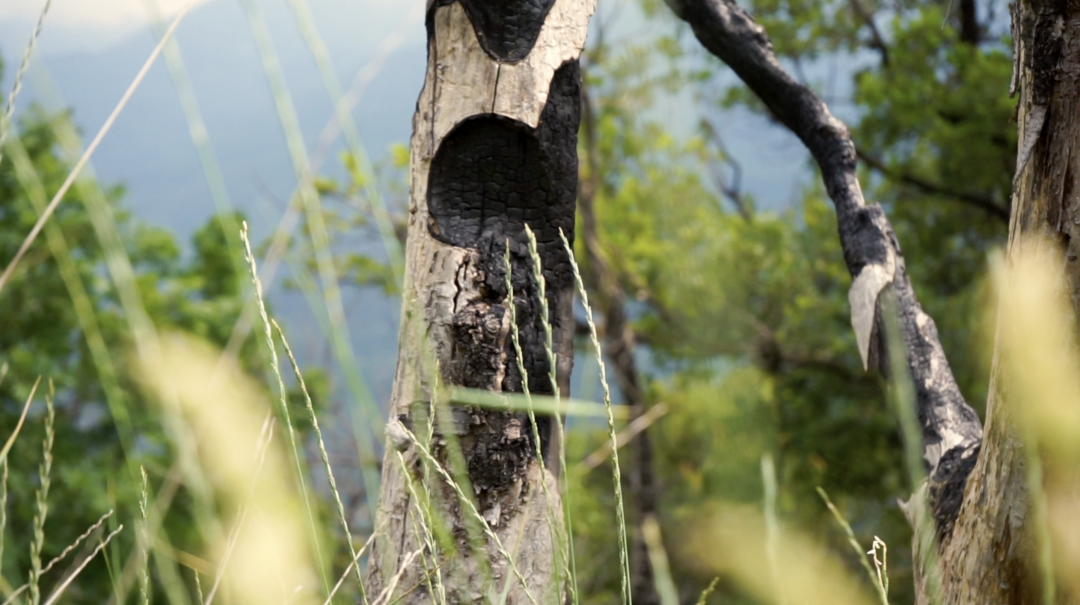
Featured image: Half-burned birch tree in the Piedmont region, Italy. Photograph by Marvin Heine, 2024.
References
Allen, Summer. 2018. The Science of Awe: A White Paper Prepared for the John Templeton Foundation. Berkeley, CA: University of California, Berkeley, Greater Good Science Center.
Bachelard, Gaston. 1964. The Psychoanalysis of Fire. Boston, MA: Beacon Press.
Biehl, João, and Peter Locke, eds. 2017. Unfinished: The Anthropology of Becoming. Durham, NC: Duke University Press.
Faulkner, Sandra L. 2019. “Poetry as Method.” In Poetic Inquiry: Craft, Method and Practice, 2nd ed., 38–99. New York: Routledge. https://doi.org/10.4324/9781351044233-2.
Keltner, Dacher, and Jonathan Haidt. 2003. “Approaching Awe, a Moral, Spiritual, and Aesthetic Emotion.” Cognition and Emotion 17 (2): 297–314. https://doi.org/10.1080/02699930302297.
Latham, Alan. 2003. “Research, Performance, and Doing Human Geography: Some Reflections on the Diary-Photograph Diary-Interview Method.” Environment and Planning A 35: 1993–2017.
Lingis, Alphonso. 2018. The Alphonso Lingis Reader. Edited by Tom Sparrow. Minneapolis: University of Minnesota Press.
Lorimer, Jamie. 2007. “Nonhuman Charisma.” Environment and Planning D: Society and Space 25: 911–932.
Magrane, Eric. 2021. “Climate Geopoetics (the Earth Is a Composted Poem).” Dialogues in Human Geography 11 (1): 8–22. https://doi.org/10.1177/2043820620908390.
Saari, Antti, and Jeffrey Mullen. 2018. “Dark Places: Environmental Education Research in a World of Hyperobjects.” Environmental Education Research 26 (9–10): 1466–78. https://doi.org/10.1080/13504622.2018.1522618.
Scheel, Amalie, and Minke Nouwens. 2026. “Poetic Resonance: Dwelling in the Affective Ripples of Ethnography”. Allegra Lab.
Stewart, Kathleen. 2007. Ordinary Affects. Durham, NC: Duke University Press.
Stoller, Paul. 1997. Sensuous Scholarship. Philadelphia: University of Pennsylvania Press.
Vannini, Phillip. 2015. “Non-Representational Research Methodologies: An Introduction.” In Non-Representational Methodologies: Re-Envisioning Research, edited by Phillip Vannini, 1–18. New York: Routledge.
Whitehead, Alfred North. The Concept of Nature. North Charleston, SC: CreateSpace Independent Publishing Platform, 2016.
Zani, Leah. 2023. “How to Write Fieldpoetry.” In An Ethnographic Inventory: Field Devices for Anthropological Inquiry, edited by Tomás Sánchez Criado and Adolfo Estalella, 83–91. New York: Routledge.
Abstract: This essay explores how the poetic resonance protocol enabled a deeper, embodied engagement with my ethnographic object: a poetry workshop conducted with wildfire-affected residents in northern Germany. Iterative steps of sensorial attunement toward my field notes and my memories destabilized my affective relationship with the material and revealed my own body as a resonant site of knowledge. Guided by the protocol, I followed the fuzzy contours of a feeling that extends well beyond the individual: humility. To be humbled by a fire, by a gesture, by a poem means to make oneself vulnerable to the world, to open up to it fully. Humility here connects people with each other and with the shifting environments they inhabit. Rather than further separating the intelligible from the sensible, the poetic resonance protocol illuminates a middle way: an embodied attention to the ambiguous nature of lived reality while simultaneously acknowledging disciplinary origins and one’s responsibilities as a researcher.