Prologue
Uncertainty pretends to be certain. Uncertainty is hands behind the head. Uncertainty is wringing hands. Uncertainty is tension in the body. Uncertainty is looking toward your partner. Uncertainty is twisting and turning for the right angle.
This article began in the poetic resonance protocol’s writing vibrations and follows their rhythms into what Marilyn Strathern calls “awkward relations and partial connections” (Tsing, 2019: 239), asking what becomes perceptible when uncertainty is approached through movement rather than through words alone. I am writing from the edges of anthropology, academia, and clinical research, shaped by more than twenty-five years as a dance, Pilates, and movement teacher. Across these settings, form matters, but bodies and situations rarely line up neatly with it. I follow what happens in that gap, and how rhythm becomes one way to understand, share, and sometimes make uncertainty bearable. Recent work on clinical uncertainty argues that the problem is not simply that we lack answers, but the tendency to treat not-knowing as failure, rather than as a capacity worth cultivating — an orientation and an openness to ambiguity that can broaden attention and loosen tunnel vision (Jackson, 2023). In clinical medicine training and practice, Arabella Simpkin names this as our “unhealthy reaction to uncertainty” and the reaction to suppress ambiguity rather than work with it (Simpkin & Schwartzstein, 2016; Jackson, 2021).
In considering ways to perceive clinical uncertainty, my anchor is the body in action and its habits of sensing, adjusting, and connecting. My background shapes how I notice. I look for where attention goes, how people meet one another, and what changes when a body is invited to move instead of explain (Ellison, 2024). I came to the poetic resonance protocol looking for a tool that could support this kind of embodied noticing as ethnographic method.
The piece draws on fragments from the poetic resonance protocol alongside fieldwork and narrative vignettes. What follows is organized into four short movements, with an epilogue and coda. Each movement opens with a simple prompt as method. The prompts make patterns of sensing and interaction perceptible in your body, because the concepts should land beyond the words on the page, and because this is how I negotiate uncertainty as a movement teacher. The essay is written to be experienced in both small and large vibrations, echoing the protocol’s rhythms, but the connections are yours to make. You will not get one sustained case. You will get scenes, stories, and notes, because that is often how uncertainty arrives and shifts.
Movement 1/Rhythm
Take 30 seconds to notice your body rhythms. Your breath, heartbeat, hands as you read, feet as you sit. Where is there tension and ease? However you perceive them, what do they tell you? Write down three to five words.
Where words failed, the world was constantly perceived and translated through movement, environment, and sensory experience.
At sixteen, I left home and everything I knew, trading rural Southern Illinois for rural Japan for a year-long immersion program. I was the only foreigner and non-native speaker at my high school. Without family or familiar rhythms, that year brought more than a new language; it gave me a deeply embodied sensitivity to different rhythms of communication. Where words failed, the world was constantly perceived and translated through movement, environment, and sensory experience. In retrospect, those sensory experiences, alongside a lifetime of dancing and teaching movement, shaped what I notice and how I communicate and make sense of the world. I became fascinated with bodily orientation and how perception and interaction with ourselves, others, and space can change that orientation. I have explored this with movement mentors, including Hubert Godard, whose formative concept holds that a change in perception evokes a shift in tonic response, the body’s orientation in gravity, and potentially a shift in one’s relationship to the world (Newton, 1995; McHose, 2006).
That draws me to rhythm as a way of thinking about uncertainty and communication. Before words or thoughts, there is the moving, sensing body. Movement and sensation anchor our being in the world (Sheets-Johnstone, 2011). Even when we think we are dealing with ideas, the ground of experience remains sensory and situated. A room has a smell. A door handle has a motion. A person stands too close or has a “vibe”. Long before we name any of this, our bodies are already organizing it. Rhythm names that organization as the patterned way perception unfolds through attention. Rhythm is not only heard but also felt (Judge, 2019), as different sensations gather into regularity and variation, shaping expectation and surprise. It is not simply a beat at intervals, but a grouping of elements and how phenomena hang together across different scales of experience (Langer, 1967).
Henri Lefebvre’s Rhythmanalysis offers an entry point for rhythm in anthropology, grounding it in ordinary life: wherever place, time, and an expenditure of energy meet, there is rhythm (Lefebvre, 2013). From an epistemological dance frame, rhythm extends into human bodies as ongoing patterns of movement and relation. “Humans are nothing more or less than an impulse to connect…to create and become patterns of sensing and responding that relate them to their environment in human-sustaining ways” (LaMothe, in Fraleigh, 2018, p. 127; see also LaMothe, 2011; LaMothe, 2015). These approaches situate rhythm as relational and perceptible in the organization of attention and orientation across self, other, and space. For anthropology, attending to embodied rhythm supports an approach to uncertainty and communication that tracks coordination in action (Ellison, 2024), including my year in Japan, when understanding depended less on verbal precision than on movement, spacing, and the shifting organization of attention.
Movement 2 / Resonance
Connect two parts of your body, like bringing your hands together. Take 15 seconds, allowing the right hand to touch the left, letting the left receive the touch. Then switch, letting the left hand touch the right. Move between these two states. What changes in the sensing and receiving? Note three words.
How do we translate embodied rhythms into words, and for whom?
If rhythm is how perception and communication unfold, then ethnography faces a familiar problem. How do we translate embodied rhythms into words, and for whom? The poetic resonance protocol became one means of working with this problem. I returned to my fieldnotes and rewrote a scene through verbal repetition, using rhythmic naming to test what my body still held and what language could carry. Revisiting fieldnotes through the protocol was an exercise in shifting attention (Ingold, 2023) and in exploring possible resonance between discourse and experience.
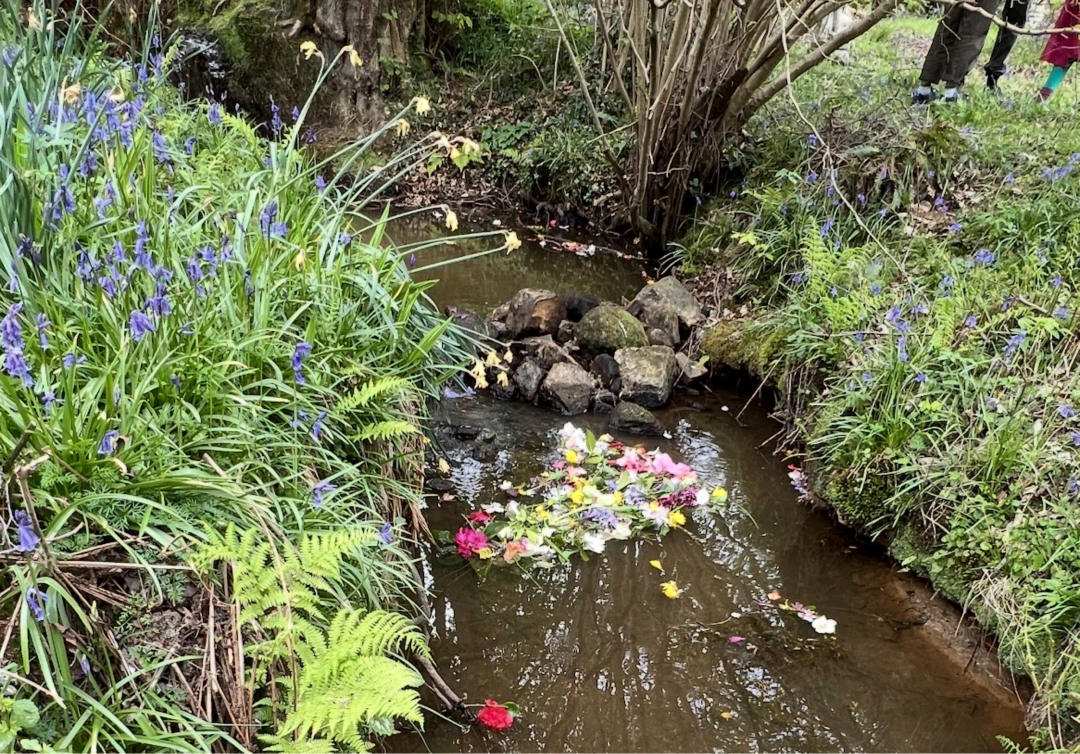
During fieldwork on contemporary ritual honoring water in Southern England, I attended a spring ceremony honoring the River Medway. It was offered by Friends of the River Medway, a group that supports the river through physical cleanups, legal action, and shared community ritual. This May Day ceremony began with a guided meditation that envisioned water moving from the cellular level to the oceanic, and back again through this river and its flows. Following the meditation, we breathed intentions for the river into flowers and offered them along with a Water Goddess sculpted of the local Wealden clay. We processed the gifts to the river and watched them be carried into the water and then submerged. The moment the clay goddess dissolved amid the ripples and the flowers drifted away, there was a striking, palpable collective movement of awe.
This moment has stayed with me. In the rhythm of returning to the experience and naming and renaming what was remembered, the awe returned in layers of sensation.
Awe was seeing the gifts swallowed by the river. Awe was hearing a gasp while experiencing it in my body, as air was collectively swallowed. Awe was the wide-eyed glances. Awe was A cappella singing, lingering long after the voices stopped. Awe was shared silence with a hundred others.
The protocol gave me a different attunement. It helped me stay close to what registered in my body and to bring language closer to embodied memory. It is important to note that “Not every body will feel or respond in the same way to a given gesture. Cultural background, training, and momentary state all intervene” (Foster, 2011:6). Still, there are times when a group senses together. This moment was one of them, and I have since discussed it with my interlocutors. Like dancers propelled by music or choreography, we moved and sensed in relation to shared community and environmental rhythms. There was a collective resonance. I was not only observing; I was part of the dance. The writing vibrations gave me permission to play with words and felt memory until they resonated differently between my body and the page.
Movement 3/ Dissonance
Touch your fingertips to your shoulders. Reaching your elbows out into the space, draw wide elbow circles in both directions. Where do you feel resistance? What happens if you pause there? Is it a tremor, pull, or memory? If you’re in an office or library, there are other kinds of dissonance in moving in such spaces. Where is the resistance?
When I returned to academia a few years ago, it felt like finding my footing in unfamiliar dance patterns or learning a new language. Last year, I presented my work in an academic setting. Midway through, my voice shook and tension gathered in my shoulders, throat, and neck. Near the end, I asked everyone to stand up and move to help explain a concept. What had been awkward shifted into a rhythm closer to teaching a dance phrase or a Pilates mat class. I was struck by how quickly a dynamic could change when my own orientation changed. I changed. The room changed. Smiles appeared. Attention redistributed. Dissonance did not disappear, but it became workable. The room didn’t change first. I did.
This kind of dissonance in research is akin to what Fiona Murphy calls ‘wrongness’, not as personal failure but as the revealing of systems built to produce certain answers and specific kinds of sense-making (Murphy, 2025). She urges us, “Let restlessness guide you. Let the forms shift. Let the work be strange, porous, uncontainable. Find others who refuse the story that knowledge must be neat, that scholarship must be smooth. Build the academy you want to live in—one jagged, luminous fragment at a time” (Murphy, 2025). Murphy’s words are an invitation to move with unfamiliar rhythms rather than forcing them into regularity. What does not fit, what is uncertain, might be exactly what the work most urgently needs.
In academia, I have since chosen to take on its structures not through mirroring its cadence exactly, but through the filter of my own body with its cultivated rhythms of experience, practice, and attention. I notice where my rhythms meet the institution’s patterns, and in those meetings, dissonance and uncertainty can open into possibility. When I anchor in myself and stay with what does not quite fit, something usually shifts, and a small synchrony appears. That’s often where learning happens.
Movement 4/ Attunement together
Recall a recent doctor visit. What did you notice? In the room? In your body? Between you and another? What was shared, negotiated, and ultimately created?
When I work with a new Pilates client, we begin with their goals. I listen to their words but also feel around their words. Where is their weight and gaze? How do they gesture and breathe? Based on my movement knowledge and skills in working with others, coupled with the expertise of their own bodies and lifeworlds, we negotiate a space of shared resonance within which we try to work together. What I am explaining is difficult to put into words. I also cannot give you a recipe for how to do it or promise a result. It is an embodied skill of attention that is learned in doing, and in a practice of constantly calibrating and attuning to others, much like in clinical medicine. It is also the nature of being human and living in uncertainty. We sense for what feels right. We seek a rhythm to move forward to.
We sense for what feels right. We seek a rhythm to move forward to.
Protocols are designed to create order through their steps, promising clarity and results. With the resonance protocol, I was attempting to move between institutional structures with yet another structure, albeit a poetic one. The protocol’s abstracted writing vibrations, presented in the prologue, came from preliminary research shadowing a doctor. They felt clever, but not particularly useful. However, in the final protocol step, we shared our words with a partner. As I voiced my word list out loud, travelling from dawn in California to my partner’s afternoon on a small island in Denmark, something changed. The meaning began to move. Not necessarily because of the words themselves, or even how they were received and responded to, but because they were received and responded to at all, in a third empathetic space.
This is what De Jaegher and Di Paolo mean by participatory sense-making, a cognitive theory that holds that meaning emerges through co-created, embodied exchange rather than isolated cognition (De Jaegher and Di Paolo, 2007). This enactive view sees all participants contribute, like a doctor and patient, yet none hold complete control over its outcome (Todd, De Jaegher, and Di Paolo, 2025). It provides a framework for asking how engagement, attunement, and attention are mobilized jointly in complex contexts, and how actions and rhythmic attentions guide trust and meaning-making in uncertain conditions. Our fragments became meaningful because we worked through them together and created something new. Fragments of resonance happen in connection.
In my movement classes, when something I’ve attempted to convey, like “relax your shoulders,” finally makes sense in the body, I call these “Aha! Moments”. In reflecting with my poetic resonance partner, an “Aha!” happened for us both, not in the obvious volley of thoughts and ideas, but in something taking place beneath the surface where rhythms not yet attuned to were nevertheless experienced. In the seeing and being seen. In the collaborative step of the protocol, it stopped being an exercise and became a tuning device. In thinking together, my attention danced between my own ideas, my partner’s words, and our shared empathetic space of connection.
Coda
Physically take up space. Wide to the sides. Vertically up and down. Stretch and move in all directions. Feel the discomfort as well as the power. Then move around the room. With shifted attention to space and body, what has changed?
I still do not know many things, including whether this article’s layered rhythms will resonate, but what fun to encounter not-knowing in this way. The resonance protocol did not offer certainty, but it did give me permission to play with my material, position, and research—to stay curious and to keep dancing with what was unconnected, stiff, and stuck. We need more devices like this. More permission in academia to playfully ask, “What if?” within the structures that hold us. Uncertainty can be overwhelming, full of doubt and fear. It can also hold possibility, curiosity, and playfulness. Either way, I return to how I orient and keep moving.
Uncertainty is pulling in. Uncertainty is reaching out. Uncertainty protects. Uncertainty searches.
Featured image: Flower offerings floating downstream after a May Day Water Ceremony and Festival, southern England (fieldwork, 2022). Photo by author.
References
De Jaegher, H., Di Paolo, E. (2007) Participatory sense-making, Phenomenology and the Cognitive Sciences, 6(4), 485–507. DOI: 10.1007/s11097-007-9076-9
Ellison, S. (2024) Rhythms of Connection: A Call for Feeling in Anthropology, Anthways, Anthropology Journal, Goldsmiths, University of London, 4 (1) pp 52-63. DOI: 10.5281/zenodo.13982318
Foster, S. L. (2011) Choreographing Empathy: Kinesthesia in Performance. (s.l.): Routledge.
Ingold, T. (2023) On not knowing and paying attention: How to walk in a possible world. Irish Journal of Sociology, 31(1), pp.20-36.
Jackson, M. (2023) Uncertain. The Wisdom and Wonder of being Unsure. Guilford, Connecticut, Prometheus Books.
Jackson, M. (2021) “The gift of being unsure of what to do: In times of flux, embracing uncertainty and ambiguity sharpens your thinking.” The Boston Globe (Ideas/Opinion), January 17, 2021.
Judge, J. (2019) Feeling the Beat. The Philosophy of Rhythm: Aesthetics, Music, Poetics. Oxford University Press.
LaMothe K (2018) ‘As the earth dances: A philosophy of bodily becoming.’ In: Fraleigh SH (ed.) Back to the Dance Itself: Phenomenologies of the Body in Performance. University of Illinois Press, pp. 123-140.
Langer, S. K. (1967) Mind: An Essay on Human Feeling. (s.l.): Johns Hopkins University Press.
Lefebvre, H. (2013) Rhythmanalysis: Space, Time and Everyday Life. (s.l.): Bloomsbury Publishing.
McHose C (2006) Phenomenological Space: Interview with Hubert Godard. Contact Quarterly Summer/Fall 2006: 32-38.
Murphy, F. (2025) ‘An ode to being wrong about creativity’. Allegra Lab. March. https://allegralaboratory.net/an-ode-to-being-wrong-about-creativity/ (accessed 24 August 2025).
Newton, A.C. (1995) Basic Concepts in the Theory of Hubert Godard. Rolf Lines. (pp.33-43) March 1995.
Sheets-Johnstone, M. (2011) The Primacy of Movement. (s.l.): John Benjamins Publishing.
Simpkin, A.L., Schwartzstein R.M. (2016) “Tolerating Uncertainty — The Next Medical Revolution?” New England Journal of Medicine 375(18): 1713–1715. https://doi.org/10.1056/NEJMp1606402.
Todd, R., De Jaegher H. & Di Paolo, E (2025) What is Participatory Sensemaking and Why Should We Care?. Available at: https://beckettodd.substack.com/p/what-is-participatory-sensemaking (accessed 24 August 2025).
Tsing A (2019) When the Things We Study Respond to Each Other: Tools for Unpacking ‘the Material’. In: Harvey P, Krohn-Hansen C, Nustad KG (eds) Anthropos and the Material. Duke University Press, pp. 221-244.
Abstract: This experimental essay treats uncertainty as bodily and relational and uses rhythm as a way of noticing it. It begins in the writing vibrations of the Poetic Resonance Protocol and carries their structure through the composition of the piece. Organized as four short movements with an epilogue and coda, the essay moves in smaller and larger rhythmic units of attention, shifting between brief phrases, scenes, and reflective returns. Each movement opens with a simple prompt used as method, inviting readers to register changes in sensation, attention, and orientation across self, other, and space. Vignettes from immersion, ritual fieldwork, academic life, and movement teaching trace resonance, dissonance, and attunement as lived coordination. For anthropology, the piece keeps embodied communication and sensing in view as ethnographic material. Rather than presenting one sustained case, the essay composes an inquiry in fragments, staying curious inside not-knowing.