Nothing beats stage. Nothing beats people.
The spontaneous reactions on people’s faces
as you passionately and achingly tell your story.
The tears, the sighs, the heavy breaths & the laughs
accompanying you along the way.
This is how one of my participants describes how affect surges[1] through spaces where poetry is shared, but which ultimately exceed ethnographic articulation and documentation. I research imaginative lifeworlds in Amman, Jordan, and my primary research space is poetry workshops and performance nights. In this essay, I apply the poetic resonance protocol to approach the affective intensities ethnographically by enlarging the sphere of my analytical attention to encompass my own embodied responses, to attend to the flashes of affect that raise my heartbeat, make my eyes well up, and give me goosebumps. I pay attention to the affective intensities of exile, which I document and analyse through a repetition poem titled “mish hwn w mish hunaak”, a transliteration of the Arabic for “not here and not there”. The poem traces the affective and imaginative landscapes invoked in the poems of Palestinian poets in Amman to ask: What are the invisible yet palpable forces of affect and imagination that move through poetry spaces, and in what ways might we make them open to ethnographic documentation and analysis? How can poetry invoke the textures and materialities of these palpable forces in a way that conventional academic writing cannot? And what do these forces, in turn, tell us about the lived experience of exile in Amman?
Poetry is not only my object of study but my method, whereby the process of composing and performing poetry creates new epistemological and ethnographic contexts for conducting research.
My research investigates the imaginative lifeworlds of poets in Amman, with a focus on the Palestinian diaspora. At the centre of my research is a poetry collective that meets weekly to write and share poetry at a café in the Lweibdeh neighbourhood of Amman called Zawyeh. Our collective is called “Verse as Vision”, and most of the regular attendees are Palestinian women in their 20s, while there are also Syrians, Iraqis, Circassians, and American and European expats who have come to the city to learn Arabic or work for foreign NGOs. For the most part, the workshops are co-developed and co-facilitated by myself and a poet from the community. Together, we decide on a workshop theme connected to their poetry and prompts inspired by their poetic practice. As such, poetry is not only my object of study but my method, whereby the process of composing and performing poetry creates new epistemological and ethnographic contexts for conducting research. My ethnographic field is not only the city of Amman, but the intersubjective space of imagination that is generated in these workshops. In this paper, I experiment with poetry to ask: how can poetic resonance be applied to make this space a tangible object of ethnographic analysis?
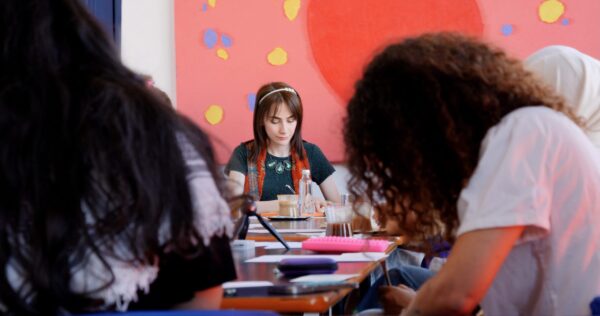
Writing together at one of Verse as Vision’s workshops at Zawyeh, July 2025. Photo by the author.
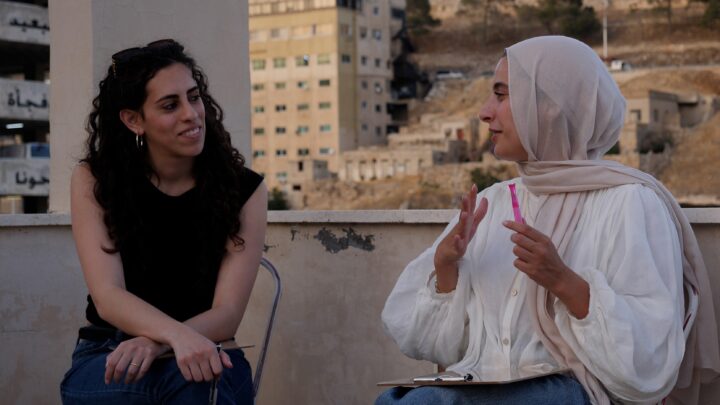
Jwan and Jojo discuss their poems on the roof at Zawyeh. May 2025. Photo by the author.
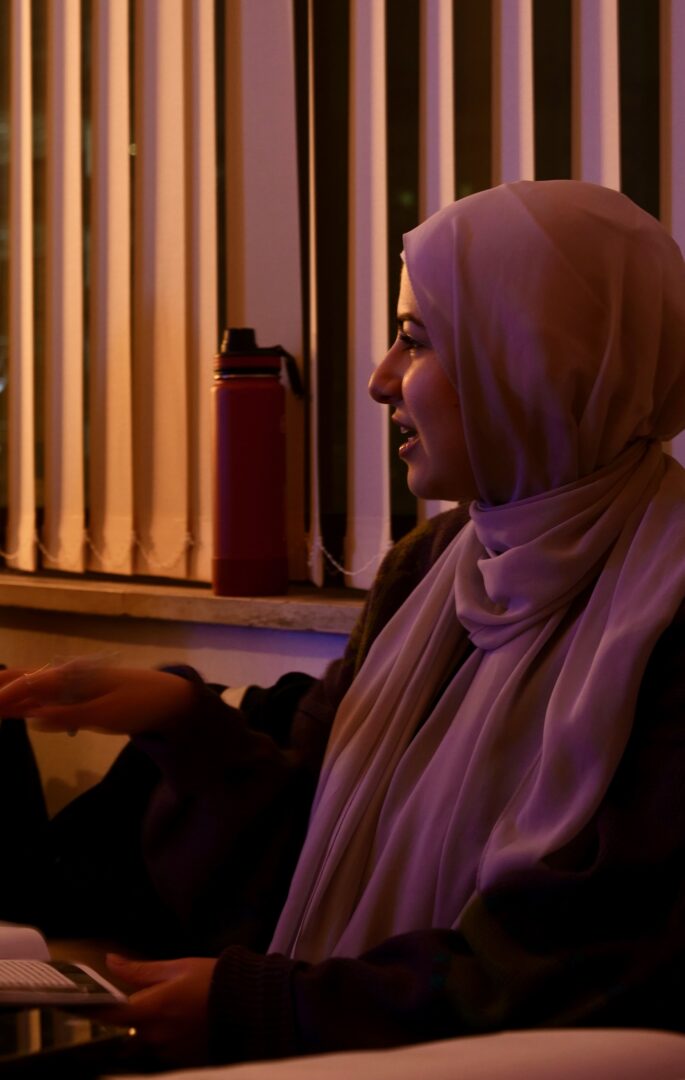
Rania facilitating a session at Zawyeh. December 2025. Photo by the author.
In the In-Between: Amman, Exile, and Poetry
In an interview for Sumou Mag, the poet Zein Sa’dedin describes Amman’s literary identity in the region as a “migratory space.” Similarly, in a workshop, when I prompted my participants to freewrite based on a line from her poem about Amman, Jwan responded with this poem:
albi stays bi amman every time i leave
stays in this space where you are
not here and not there either
mish hwn w mish hunaak
…
staying in the in-between
where you are
not here or there
hwn wala hunaak
…
Us children of the diaspora have no option
than not staying and not leaving as well
here or there
hwn w ila hunack
what it means
to be stuck in the nowhere
With Jwan, I conceptualise Amman as a city of the “between.” The vast majority of its population is composed of successive waves of migrants, starting with the Circassians in the late nineteenth century, then Palestinians in 1948 and 1967; Iraqis in 1990 and 2003; and Syrians since 2011. In the same workshop, one participant described Amman as “a new city full of old stories”, and it is these stories that are retold in my participants’ poetry.
In this piece, I also extend Jwan’s concept of “mish hwn w mish hunaak” to refer to the between-states inhabited through writing and reading poetry, that is, the in-between space of the imagination and the intersubjective in-between. In an interview in 2023, my participant Rabab described being a poet as living in a “third space” that she herself creates, which exists “between the city and what I could add to the city.” I conceptualise the imagination as a space between reality and irreality (cf. Crapanzano 2004), and between the material and the spiritual (cf. Mittermaier 2010).
Furthermore, when poems are shared, we temporarily inhabit an intersubjective space. One participant describes how, in poetry performance spaces, we connect in a way that means we transcend ourselves as individuals and enter into what she calls “the we space.” She continues, “and this we space can be charged in so many different textures.” In the poem to follow, I explore these textures, which arise in the imaginative and the intersubjective in-between.
Repetition Poem: “Mish Hwn W Mish Hunaak”
Jwan’s poem provided me with an emic concept, “mish hwn w mish hunaak”, that I used as the starting point for a repetition poem to write up sensorial and affective vibrations from my data. My engagement with the protocol began with listening back to the workshop recordings. I attended to my bodily responses while engaging with the material, noting moments when my senses were enlivened or when I felt moved by an affective intensity. It was important to listen to the recordings rather than read transcripts, in order to tune in to the atmosphere within the space and create the possibility for the “transmission of affect”, whereby “the emotions or affects of one person, and the enhancing or depressing energies these affects entail, can enter into another” (Brennan 2015, p. 3).
Writing this stanza, therefore, became a process of discovering and gathering the multiplicity of affects, significations, and imaginings carried by water imagery that connect to lived experiences of exile.
This starting line served as the basis for repetition and gave me a specific attunement while listening to my data, namely, experiences of exile. I began collecting lines that called up a strong sensation or held an affective charge and shaping them into stanzas. The first thing I noticed was a strong affective charge around poems that referenced water. When poems about water were shared, there were many silences and tensions, and sometimes participants cried. From here, I started experimenting with being led by images and places around which affective intensities gather, leading me to remembered scenes taking place at teta’s (grandmother’s) house, and imagined scenes of return to Palestine set in a liberated future.
Audio excerpts accompany each stanza, featuring participants reading the poem aloud over a soundscape to transmit the poem’s affects beyond the page.
I Stand at the Shoreline: Writing About Water in the Desert
in the in-between, mish hwn w mish hunaak,
i stand at the shoreline
the salt gathers like crystals
crusting up on the land
the sea not quite sea
undulates softly
the other side is alight with life
meanwhile, in the city of the between,
of night drives, gas trucks, and majnoune[2]
the only sea is in our eyes
but the rain touches the petals
in your grandmother’s garden
Amman is a city in the middle of a desert, yet my participants’ poems are full of rivers, lakes, oceans, shorelines, mist, and rain. Attending to their sensory textures, rather than to predetermined themes, I found that water became a signifier for layered and, at times, conflicting[3] affective intensities of exile. In the poem, Rania stands at the shoreline of the Dead Sea, the closest one can get to Palestine from Jordan, close enough to see the lights on the other side. In a workshop, another participant reflected on how swimming in the Dead Sea or the Mediterranean brings her a sense of belonging; addressing Palestine directly, she writes, “I keep swimming in those seas to feel closer to you.” For others, water evokes broader transnational experiences of displacement. When I asked Thanh, the daughter of Vietnamese refugee parents who grew up in New Orleans, about the rain imagery in her poems, she explained, “most of my poems always have rain … I think this is the case for most refugees, water is always a big theme, like crossing borders, crossing transnationally.” Writing this stanza, therefore, became a process of discovering and gathering the multiplicity of affects, significations, and imaginings carried by water imagery that connect to lived experiences of exile.
Bedtime Stories Carrying the Sharp Smell of Green on the Wind: Teta’s House
in the in-between, mish hwn w mish hunaak,
time folds in, soft as a hand on my cheek
it’s a thursday night at teta’s house
a big sleepover with all the cousins
thin mattresses on the living room floor and
laughter hitting the ceiling back and forth
bedtime stories carrying
the sharp smell of green on the wind
ullulations on top of ramallah’s mountains
mixing with the sound of church bells and the call to prayer
tomorrow morning, we’ll sit on her balcony
a place where history meets laughter, where the weight of exile softens under stories and card games and plates of sliced watermelon
she’ll tell of mornings she’d float peacefully on haifa’s beach
humming to the rhythms of abdul haleem
and the day when she and jiddo[4] turned their backs on the house
how stones began to weep a thin mist
that tasted sharply of orange and thyme
how as their feet moved forward on the road, the keys
they held in their hands grew soft, refusing to turn in the lock
My participants often nostalgically recall Thursday nights and Friday mornings spent with cousins at their teta’s house: a space saturated with songs, stories, and sensory traces of Palestine before the Nakba[5]. In her poetic essay The Balcony Chairs, Jwan describes her grandparents as “living archives, the carriers of stories, songs, and memories of a Palestine before it was torn apart.” Similarly, in an article reflecting on learning to cook with her grandmother, my participant Jude writes that she was “learning more than recipes.” Cooking, she explains, became “a link between past and future, living history infused into every grain of rice and every squeeze of lemon,” turning the kitchen into “a tactile language” that resists “the constant threat of Israel’s attempted erasure of Palestine.” In this stanza, I draw on these articulations to invoke teta’s house as a kind of thin place: a space where Palestine is not only remembered, but sensorially encountered through shared meals and stories.
poetic imagery actively generates an indeterminate space of the imagination in which return and liberation can be enacted through the moving body.
My Feet Remember Without Needing a Map: Enacting Liberation
in the in-between, mish hwn w mish hunaak,
i hop on the train from baghdad to bethlehem
eat oranges in jaffa
am gifted with a party on a hill overlooking al quds
i take my notebook and journal under ancient walls
that have seen histories that seem too abstract have ever been real
i meet my friends and we walk safed’s forests
and dip our feet into a creek only we know
before taking the bus to eat our manqish by the shore
in the between, mish hwn w mish hunaak,
i sit under a tree between midnight and dawn
when the sun rises, i will walk the streets
as if my feet remember
without needing a map
While the stanza on teta’s house evokes memories of Palestine before the Nakba, the final stanza imagines a liberated future in which participants return to Palestine. My participants use poetry as a “technology of the imagination” (Sneath et al. 2009) to conjure futures of freedom. Through poetry, participants transport themselves to an “indeterminate space of the imagination where the impossible becomes possible” (Mortensen, 2021). In a world of militarised borders, checkpoints, and restriction, Thanh creates a poetic world where she can hop on the train and visit the cities that Palestinians were able to move between freely before the founding of the state of Israel; Rania gets to live out an ordinary day with friends in places she has only heard about; and Jwan can finally walk the streets of her homeland.
Reflection: Poetic Images
The title of the repetition poem “mish hwn w mish hunaak” indicates the two layers of analysis I sought to conduct through the poem: experiences of exile and the concept of the imaginative and intersubjective in-between. Experimenting with poetic language attuned me to poetic images (salt gathering like crystals, the sharp smell of green on the wind, creek water running over your feet), understood as “language that calls up a physical sensation, appealing to us at the level of any of our five senses” (Addonizio and Laux, 1997, p. 85). Across the poem, poetic images offered different affordances. In the water stanza, the inherent ambiguity of the image allowed overlapping and, at times, conflicting significations and affects of water to coexist without being stabilised into one interpretive frame. The stanza on teta’s house accumulates smells, sounds, textures, and scenes in a way that mirrors the space it evokes, a house saturated with sensations through which Palestine is made present. In the final stanza, poetic imagery actively generates an indeterminate space of the imagination in which return and liberation can be enacted through the moving body.
Conclusion
In Arabic, a poetic line is called a beyt, which translates to “house.” My participant Rabab refers to poetry nights as a space of “refuge.” Poetry thus creates a space of the imagination that serves an existential purpose for the poet, particularly for the poet in exile. Indeed, Adorno writes that “for a man without a homeland, writing becomes a place to live” (2020). For the purposes of this paper, however, I argue that poetry’s capacity to generate space also holds analytical possibilities, particularly in relation to “holding space.” Writing poetry creates a space of analytical suspension in which the body, rather than abstract concepts, comes to the foreground. In this experimental space, the imaginative and intersubjective in-between becomes tangible. Writing this poem felt like stepping inside the between, walking within landscapes of the imagination, noticing patterns, and attending to affects and sensations, and letting these lead the way into analysis. The resulting poem-experiment extends and more closely reflects the between-space of my ethnographic field than a description of the material, visible aspects of a poetry workshop could.
Poem Credits
Mish Hwn W Mish Hunaak is composed entirely from poetic lines and spoken words shared by participants during workshops and interviews, shaped and arranged by me. Part 1 (water) draws on passages from Rania Dawud’s The Brick-Red Mountains, spoken reflections on Amman shared during workshops, Samer Budair’s Requiem for the Memory of a Mediterranean Moon (published in the anthology Heaven Looks Like Us), and Thanh Nguyen’s Full Moon for Pessimists. Part 2 (teta) combines spoken words from a workshop about teta, imagery from Maya Maroni, and passages from Jwan Zreiq’s The Balcony Chairs, Masa Faddah’s Lost at Sea, and Nasser Anassari’s When Teta and Jiddo Turned Their Backs on the Stone Walls of Their Town. Part 3 (return) is composed from passages by Thanh Nguyen, Rania Dawud, and Jwan Zreiq, in that order.
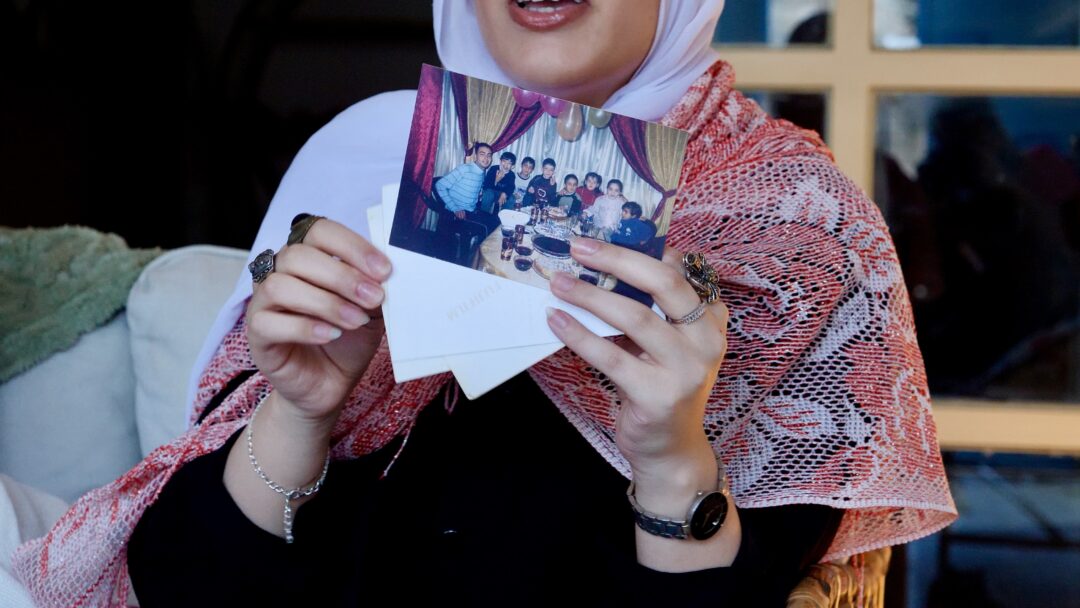
Featured image: A participant shares an image taken at her teta’s house as part of an object elicitation exercise in a workshop called “Teta”, July 2025. Photo by the author.
Notes
[1] These affective intensities are not experienced uniformly across participants or occasions, nor do they arise at every poetry night. Rather, poetry spaces create the conditions under which moments of heightened affect can intermittently emerge.
[2] bougainvillea
[3] My participant Jwan Zreiq theorises the conflicting affects and significations of water, writing that for Palestinians, water is both “the medium of displacement”, recalling bodies crossing the Jordan River during the Nakba, and a symbol of liberation, invoked in slogans such as “from the river to the sea.”
[4] Grandfather
[5] This analytic focus on teta’s house emerged through collaboration with researcher Eleri Connick, whose work on object elicitation and “material witnesses” of Palestinian exile in Amman highlighted the recurring significance of grandmothers’ houses as key sites of memory and narration.
References
Addonizio, K. and Laux, D. (1997) The Poet’s Companion: A Guide to the Pleasures of Writing Poetry. New York: W. W. Norton & Company.
Adorno, T. (2020) Minima Moralia: Reflections from Damaged Life. London: Verso.
Brennan, T. (2015) The Transmission of Affect. Ithaca, NY: Cornell University Press.
Crapanzano, V. (2004) Imaginative Horizons: An Essay in Literary-Philosophical Anthropology. Chicago: University of Chicago Press.
Mittermaier, A. (2010) Dreams That Matter: Egyptian Landscapes of the Imagination. Berkeley: University of California Press.
Mortensen, E. L. (2021) ‘Poetic Imagination: Love and Longing among Syrian Men in Exile in Amman’, Anthropology of the Middle East, 16(2), pp. 75–90.
Sneath, D., Holbraad, M. and Pedersen, M. A. (2009) ‘Technologies of the Imagination: An Introduction’, Ethnos, 74(1), pp. 5–30.
Abstract: When I am in spaces where poetry is performed, there are invisible yet palpable forces which raise my heartbeat, make my tears well up, and give me goosebumps. And yet, these forces ultimately exceed ethnographic documentation. I research imaginative lifeworlds in Amman, Jordan, where my primary research space is poetry workshops and performance nights. In this essay, I apply the poetic resonance to approach these affective intensities ethnographically by enlarging the sphere of my analytical attention to encompass my own embodied response. In particular, I pay attention to the affective intensities of exile, which I document and analyse through a research poem titled “Mish hon and mish hunack” (a transliteration of the Arabic for “not here and not there”). The poem traces the affective and imaginative landscapes invoked in the poems of Palestinian poets in Amman to ask: What are the invisible yet palpable forces if affect and imagination that move through poetry spaces and in what ways might we make them open to ethnographic documentation and analysis? How can poetry invoke the textures and materialities of these palpable forces in a way that conventional academic writing cannot? And what do these forces in turn tell us about the lived experience of exile in Amman?