
“Feeling climate is feeling life”
(Knebusch 2008, p. 6)
Anthropology and ethnography are concerned with lived experience, with embodiment and the everyday. My PhD began with a simple premise: what would it mean to extend this to climate change? What would it mean to build an ethnography of and with climate and its affectivity? Over the past year of my PhD work, through my ever-evolving ethnographic practices, through the development of my own skill in attention, witnessing, and affective attunement, my research questions have breathed and grown and shifted and shrunk, but whatever form that they settle into or out of, the heart of it remains the same: what does climate change feel like? Or, methodologically speaking, what does it mean to feel climate?
feeling climate
okay—
feeling climate
okay—
feeling climate
This essay moves through my engagement with these methodological questions, reflecting on my experimentation with the poetic resonance protocol to explore a sensorially grounded, experiential account of climate change in place, rooted autoethnographically in my experience as a body affectively entangled with climate. Poetic resonance has become a particularly useful way of understanding the fleeting, partial, and haunting nature of climate affectivity; the way it shows up in strange places, how it sits inside the body, and flares up when you take a wrong step. In its emphasis on the fragmented possibility of the poetic and the creative, on writing as a way of understanding our research sites, subjects, and objects—our affective relations and our experiences of and with them—poetic resonance offers space within academic research for writing that pushes the boundaries, for work that seeks to “affect and make us be open to be affected” (Hernández et al. 2021, p. 858). Poetic resonance enables us to pay attention to and undertake the “quivering unease of doing research differently” (Springgay and Truman 2018, p. 203).
Poetic resonance has become a particularly useful way of understanding the fleeting, partial, and haunting nature of climate affectivity; the way it shows up in strange places, how it sits inside the body, and flares up when you take a wrong step.
The poem feeling climate, fragmented and presented throughout this essay, was built from iterative engagements with the poetic resonance protocol. It is uncomfortable and unfinished; exposed and vulnerable. It unravels the affectivity of climate change through its presence in my everyday, embodied experience; where and how it resonates within me, what textures it takes, what rhythms it follows.
it’s like, it’s like
it’s—
The climate change hyper-object (Morton 2013) is inherently slippery, a more-than-human mess of atmosphere, fossil fuels, culture, and capital; an “elusive ethnographic subject” (Caf 2024, p. 299) that is “relational, non-stable,” crossing “bodies, sounds, affects and time-spaces” (Koro et al. 2024, p. 675). It became clear to me early on in my PhD that when it came to climate, what I was interested in exploring was this more-than-human elusiveness. (Here I am using the term more-than-human as opposed to related terms such as nonhuman or other-than-human because I am specifically interested in the way that climate change exists on scales beyond the individual human and the typical rhythms of everyday life, hence, more-than-human.) What was less clear was how to approach this.
Was it possible to access, experience, and represent the more-than-human in any meaningful and ethical way?
How could I do research with something as murky and atmospheric as climate change? Was it possible to access, experience, and represent the more-than-human in any meaningful and ethical way? Anthropology is an inherently situated discipline, and ethnography a method grounded in place and positionality: could I construct an affective ethnography of climate change, one that paid attention to both its inherently elusive, more-than-human nature, whilst remaining grounded bodily in place and time?
heat, heat—that
sits on the skin.
it sits it sweats
it swallows it swamps
it’s sickening, sickening,
sickening—
no.
What does it mean to pay attention to the affect of a body on climate and the affect of climate on a body? Approaches such as sensory ethnography, multispecies ethnography, and posthuman ethnography offer an understanding of the complexities of “human-more-than-human entanglements” (Collins 2023, p. 851). Autoethnography, my other central methodology, provides an approach to research that pivots upon the embodied experience of the researcher. Poetic resonance similarly places the researcher inside the research, and the research inside the researcher. As the introduction to this thematic thread explores, poetic inquiry is a particularly appropriate approach to research that seeks to blur the boundaries between mind, body, and world. In holding space, in listening for affect, and enacting ambivalence, poetic resonance offers a modality of immersion and attunement. It makes space for me to sit in a climate encounter, to spiral into the elusive, messy weeds of its affectivity; to peel back the layers and find what lies underneath. What feelings emerge and reemerge—what threads mingle and coalesce?
In holding space, in listening for affect, and enacting ambivalence, poetic resonance offers a modality of immersion and attunement.
The environmental humanities—which I situate myself, this research, and the essay in—is well versed in exploring human entanglements within more-than-human worlds. Like poetic resonance, it situates the researcher within a mode of immersion, attunement, and responsiveness: “To understand more-than-human worlds is, in a word, to witness them: to be with, be for and be changed by them”(Verlie and Neimanis 2023, p. 119). To bear witness is to be moved; to be affected. This is not a passive experience: we are a part of the worlds we research. Kathleen Stewart’s (2011) modality of atmospheric attunement invites us to think of the materiality and affectivity of atmospheres, atmospheres as dynamic worlding events in which we live, and the sensory experience of attunement to atmospheres as emergent forms of worlding. In becoming attuned to the atmospheres in which we live, we are actively participating in creating the world around us.
I’m hollowed, I’m haunted;
filled up to the brim.
It’s everywhere,
everywhere,
here,
it’s
here—
it sits in my throat
clawing inside;
it’s in me it is me
(I can’t break free of its cloak)
It begins with the body. It begins with attention and attunement. Where and how do I encounter climate change in my everyday life? What triggers such an encounter? What does it feel like? What kind of resonances does the encounter hold? Autoethnographic field notes as well as visual and audio recordings are used to document the affective encounter and then are drawn on later—in part through the poetic resonance protocol—through an iterative process of creative writing to draw out the resonances between these encounters; to begin to untangle the disparate threads of climate change into something of a larger picture. What is emerging is an evolving but intimate picture of the ways in which the affectivity of climate change sits inside the body—my body—and what this might say about the particular world in which I am embedded and climate change’s presence within that world.
In her lively and intimate ethnography of the Rižana river in Slovenia, Caf moves beyond the question of what is the Rižana to where is the Rižana, centring the river’s “flickering presence-absence”, its dynamic capacity to be both “everywhere and nowhere” (2024, p. 299). I too am shifting between asking what is climate change to where is climate change. Climate change finds us where we are. To speak of climate change in the abstract, devoid of embodied and emplaced context, is an inherently partial picture. If we think of climate as an affective atmosphere (Verlie 2022)—a relational entanglement—then climate change can only be meaningfully understood in the ways in which it interacts with other bodies. That is, to speak of climate change is to speak of our experience of, with, and within it.
My experience of climate change is a particular one, an embodied and emplaced one. It is a queer experience, an experience of disability and chronic pain. It is also an experience of privilege: racial, geographic, class. It is located in the deep south, in a valley by a river in Te Wai Pounamu, Aotearoa, in a city bordering the South Pacific Ocean. It is also globalised, Americanised; it is diffused through digital webs of relations, and mediated by science fiction, fantasy, horror, and all manner of speculative storytelling. It is generational, oriented inevitably towards the future, or rather futures—mine and that of the planet at large, in all the possibilities stretched out before us.
the wallowing, the weighting
the burden of
Time
I don’t want this world I don’t want this life
For Morton, one of the primary characteristics of a hyperobject is viscosity, that is, they are things that stick. Just as poetic resonance is an experiential experimentation, so too for Morton is our experience of hyperobjects the primary way we come to know them. Hyperobjects may be things that exist on temporal and spatial scales beyond the human, but they are not things entirely removed:
I do not access hyperobjects across a distance, through some transparent medium. Hyperobjects are here, right here in my social and experiential space… Every day, global warming burns the skin on the back of my neck, making me itch with physical discomfort and inner anxiety. (Morton 2013, p. 27)
For me, the question of where is climate change might be answered like this: in my discomfort with any day that stretches beyond 21°C. In the ambiguous space between dread and appreciation, with every morning frost that does or does not arrive. In the feeling of wind on my skin when I sit outside with a cup of coffee in the morning. In my avoidance of the news. In a poem I read yesterday. In the space between the pages of a novel that is not marketed as climate fiction but that feels irrevocably touched by it, and the way the words press into me. In every off-hand mention of it in YouTube videos I watch while doing the dishes. In the persistence and presence of the rain. In the subtle tugging of guilt every time I drive my 2004 Toyota Corolla instead of taking the bus. In the things I do not say when people ask me what I do. In my chest and my throat; in the pit of my stomach and the nervous movement of my fingers.
Futures pressing and
Presents decaying
The past it lingers—
Rotting; renewing
I tell people that my research centres around the question of what it means to live inside of climate change. What does it mean to inhabit climatic affective atmospheres? What does it mean to feel it? What I am really asking is how do I live with climate change? What does it mean for me; to feel it, to embody it, to begin to build my life around this violent, unjust, traumatically affecting (Richardson 2018) thing?
I feel honoured, and I feel smothered.
My supervisor suggested to me once the phrase “climate saturated” as a descriptor of my positionality. Someone who is engaged in the work of climate change; someone who regularly bumps up against the climate hyper-object in their day to day life; someone who is routinely swallowed up and spat out by climate affectivity and emotion. Saturated. To be filled up, to being entirely consumed. To become something else, to become with something else. To become magnetised, charged. To become unable to move forward. To become overwhelmed. What I am, is haunted. By the speculative future, by the combined and uneven present, by the horrors and hopes of the past; by the “flickering presence-absence” (Caf 2024, p. 299) of climate change.
it’s pain, it’s painful,
it’s lingering
unease
it’s quiet and disquieting,
at times: bone deep
—relief.
I am slowly and surely building a life around climate change. At times I am excited, motivated to continue my work in new and interesting ways, appreciative of feeling settled, of having something I can call ‘my work’ and a pathway for my life. At times I am horrified, sickened, despairing. I don’t want this to be my future, I don’t want to feel like I can’t do the things that my peers do—travel, explore different worlds, be many different things. I feel trapped and I feel privileged; I feel honoured, and I feel smothered.
I am learning to feel climate, I am learning how to exist inside of it in ways that I can live with. I am learning to write its ambivalence, its discomfort, its horror and its hopefulness. I am learning what it means, not just to be haunted, but to be propelled forward by that haunting, tumbling into a life not entirely expected but one that could not have been any other way. A haunting can be more than just a burden if you let it. “The ghost demands attention. The present wavers…What will happen, of course, is not given in advance, but something must be done” (Gordon 2011, p. 3).
there’s gratitude; sometimes,
small pockets of light.
clouds move—
breath slows—
the cold is not so cold, anymore.
Poetic resonance is a spiral inwards, into the atmospheres and ambiguities of our research sites, of our data.
Poetic resonance is a spiral inwards, into the atmospheres and ambiguities of our research sites, of our data. To spiral into climate is to sit in the dread of its haunting, to feel all its sickening potential. It is also to feel the weight of air on your skin, to listen to wind move through the trees, and to be reminded of the miraculousness of the planet—that it allows anything living at all.
Feeling climate
feeling climate
okay—
feeling climate
okay—
feeling climate
it’s like, it’s like
it’s—
heat, heat—that
sits on the skin.
it sits it sweats
it swallows it swamps
it’s sickening, sickening,
sickening—
no.
I’m hollowed, I’m haunted;
filled up to the brim.
It’s everywhere,
everywhere,
here,
it’s
here—
it sits in my throat
clawing inside;
it’s in me it is me
(I can’t break free of its cloak)
the wallowing, the weighting
the burden of
Time
I don’t want this world I don’t want this life
Futures pressing and
Presents decaying
The past it lingers—
Rotting; renewing
it’s pain, it’s painful,
it’s lingering
unease
it’s quiet and disquieting,
at times: bone deep
—relief.
there’s gratitude; sometimes,
small pockets of light.
clouds move—
breath slows—
the cold is not so cold, anymore.
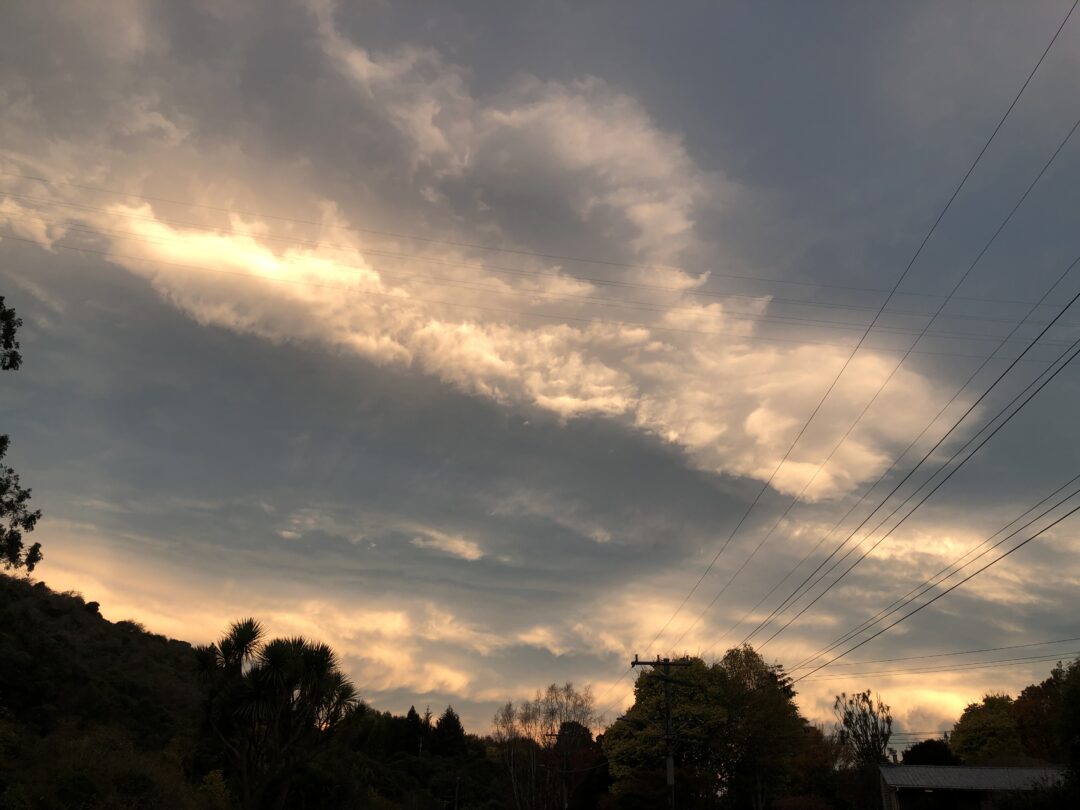
Featured image: Vibrant sunset in the Leith Valley. Photo taken by author.
References:
Caf, Nataša Rogelja. 2024. “Casting a Sideways Glance: Walking-Writing Experiments with the River.” in Walking as Embodied Research. Routledge.
Collins, Kimberlee. 2023. “Critical Posthuman Ethnography: Grappling with Human-More-than-Human Interconnection for Critical Public Health.” Critical Public Health 33(5):848–55. doi:10.1080/09581596.2023.2273199.
Gordon, Avery F. 2011. “Some Thoughts on Haunting and Futurity.” Borderlands E-Journal 10(2):1–21.
Hernández, Kj, June M. Rubis, Noah Theriault, Zoe Todd, Audra Mitchell, Bawaka Country, Laklak Burarrwanga, Ritjilili Ganambarr, Merrkiyawuy Ganambarr-Stubbs, Banbapuy Ganambarr, Djawundil Maymuru, Sandie Suchet-Pearson, Kate Lloyd, and Sarah Wright. 2021. “The Creatures Collective: Manifestings.” Environment and Planning E: Nature and Space 4(3):838–63. doi:10.1177/2514848620938316.
Knebusch, Julien. 2008. “Art and Climate (Change) Perception: Outline of a Phenomenology of Climate.”
Koro, Mirka, Anani Vasquez, Timothy Wells, Mariia Vitrukh, and Jorge Sandoval. 2024. “Speculative Methodological Subjects.” International Journal of Social Research Methodology 27(6):675–91. doi:10.1080/13645579.2023.2248832.
Morton, Timothy. 2013. Hyperobjects: Philosophy and Ecology after the End of the World. U of Minnesota Press.
Richardson, Michael. 2018. “Climate Trauma, or the Affects of the Catastrophe to Come.” Environmental Humanities 10(1):1–19. doi:10.1215/22011919-4385444.
Springgay, Stephanie, and Sarah E. Truman. 2018. “On the Need for Methods Beyond Proceduralism: Speculative Middles, (In)Tensions, and Response-Ability in Research.” Qualitative Inquiry 24(3):203–14. doi:10.1177/1077800417704464.
Stewart, Kathleen. 2011. “Atmospheric Attunements.” Environment and Planning D: Society and Space 29(3):445–53. doi:10.1068/d9109.
Verlie, Blanche. 2022. Learning to Live with Climate Change: From Anxiety to Transformation. 1st ed. London: Routledge.
Verlie, Blanche, and Astrida Neimanis. 2023. “Breathing Climate Crises: Feminist Environmental Humanities and More-than-Human Witnessing.” Angelaki 28(4):117–31. doi:10.1080/0969725x.2023.2233810.
Abstract: What does it mean to do research with climate? This essay reflects on the potential of poetic resonance as a method of creative experimentation and (auto)ethnographic practice, attuning the researcher/writer to the sensory experience of body and place. As both a writing practice and mode of attention, poetic resonance is a potentially generative approach to building an embodied and emplaced sensory ethnography of climate change. This essay reflects on my PhD research as I draw on poetic resonance as a method of attuning myself to climatic-affective atmospheres (Verlie 2022), and in doing so, gain insights about the possibility of doing meaningful ethnographic work with elusive more-than-human subjects.