
On the national highway that cuts across the lower slopes of the Western Ghats, the surface itself is rarely the problem. The tarmac is smooth, freshly marked, built to carry speed and weight with confidence. What remains unsettled is the land beside it, the steep faces of rock and soil carved away to make the road passable in the first place. Each rainy season, water works its way into these exposed cuts. Sometimes there are visible slips, small cascades of mud and stone sliding onto the shoulder. Sometimes there are none. Still, the district administration closes certain stretches pre-emptively, not because the road has failed, but because the mountain might. Buses divert. Shopkeepers quietly change delivery routes. People learn to leave earlier than they once did. Delay settles into everyday life. Nothing here quite settles.
I have spent years tracing climatic phenomena—floods, landslides, and extreme rainfall—in Kerala, a south Indian state. The region is shaped by the Western Ghats, a long mountain chain running parallel to India’s western coast. At first I encountered these events mainly as disasters in archives and official reports. The 1924 floods, still the largest in recorded history, reshaped river courses and colonial governance. The 2018 floods saturated phones and televisions with images of submerged towns. Landslides continue to swallow houses and plantations. These appeared to me as moments of rupture, damage, emergency, sharp interruptions in otherwise stable worlds.
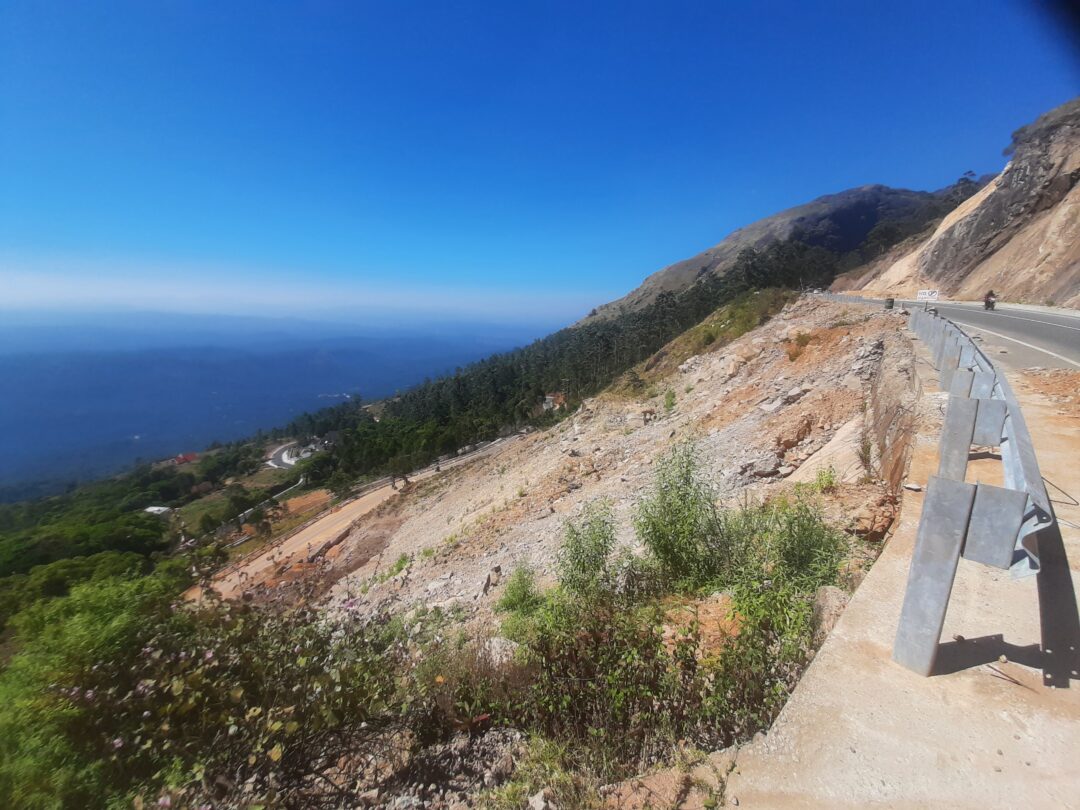
Precarious Repair: Snapshot of a landslide site in the Western Ghats of Kerala, India. Photo by Author, 2023
Cut Slopes and Unsettled Ground
Over time, something shifted in how I learned to see them. Slopes fail, sediments travel, channels reroute, roads chase stability and rarely catch it. What we call disaster often marks not an exception but an intensified moment within longer material rearrangements. The land does not return to a previous state after the waters recede or the debris is cleared. It keeps composing itself differently, sometimes quietly, sometimes violently.
This sense of unsettled continuity did not remain abstract for long. It began to seep into how I noticed repetition, interruption, and unfinishedness more generally, even into the textures of sleep and distraction. One morning I woke from a dream that felt like a YouTube feed looping endlessly in my head, faces, half-scenes, fragments of conversations refreshing without pause. I wanted stillness, breathing, quiet. Instead there was montage after montage. Restless. Unsatisfying.
Later that morning, half distracted, I watched a short video claiming that the mind sometimes “hurts in order to heal.” I am not sure I believe that sentence. But it lingered, not as explanation so much as irritation. It made me think about repetition, about how certain patterns return not to resolve themselves but to bend slightly each time. The dream did not teach me anything about mountains, yet it unsettled how I was already thinking about persistence, disturbance, and partial repair, about movement that continues without arriving.
In the Ghats, monsoon rains return every year. Soil swells. Slopes loosen. Retaining walls crack. Engineers arrive with drills and cement. News channels declare disaster season, turning rain into threat rather than pulse. If Barad reminds us that phenomena emerge through entangled material and social arrangements (Barad, 2007), disaster studies has long argued that there is no purely natural disaster, only natural processes meeting vulnerability and design.
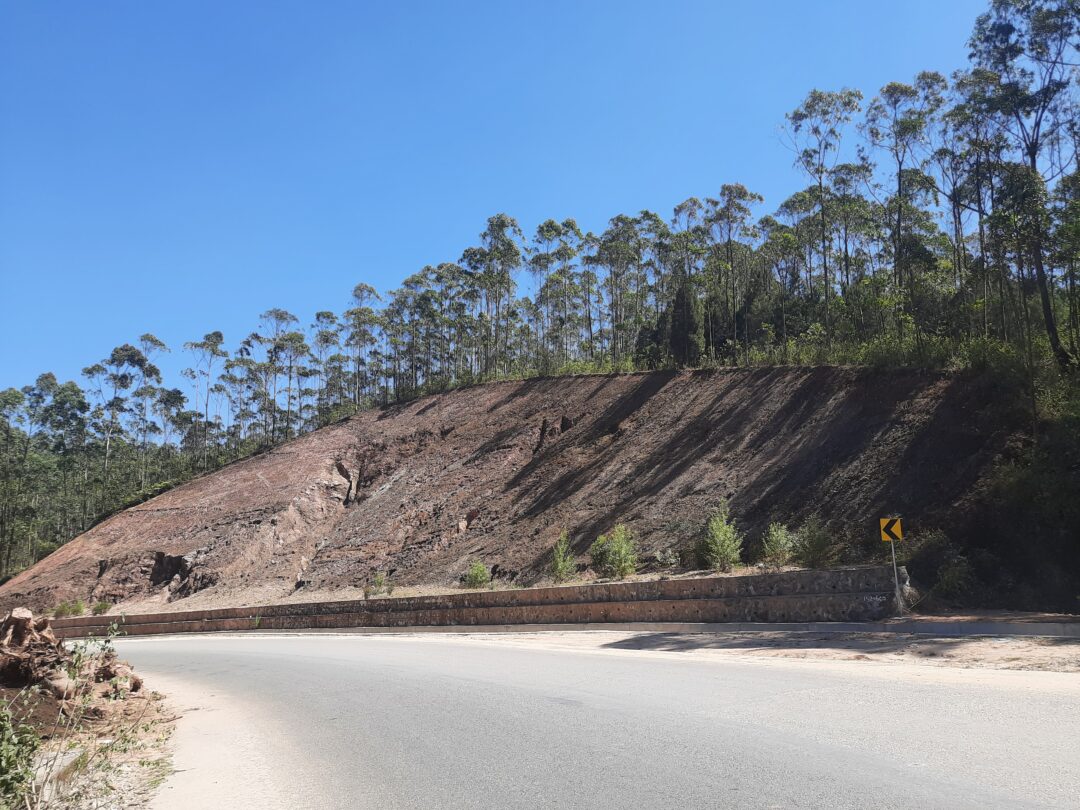
After the Cut: A Hillslope Learning to Hold. Photo by Author, 2023
That convergence is visible everywhere here. Roads cut into unstable gradients. Drainage channels redirect water instead of absorbing it. Dams interrupt sediment flows and downstream rhythms.
I am not suggesting that mountains intend or decide. But material systems exert patterned pressures that shape what humans can and cannot stabilize over time. When slopes give way, it is not simply failure. It is interaction unfolding across histories of cutting, planting, building, neglect and repair.
Colonial officers sensed this unease long ago. They wrote anxiously about “denudation,” the stripping of forests that supposedly left hills exposed to erosion and floods (General Department 1925). These texts were never neutral descriptions. They were attempts to translate unruly monsoon landscapes into administrative categories that could be measured, disciplined, governed. Over time the vocabulary shifted. Denudation became soil conservation. Soil conservation became disaster risk and resilience. The impulse stayed largely the same. Fix the ground. Make the moving earth behave.
But the ground never really did.
Living with Provisional Stability
To live in the Ghats is to live with uncertainty that is geological and social at once. Fragility here is not simply weakness; it is continuous negotiation. Repairs hold temporarily. Slopes rearrange elsewhere. Memory absorbs past failures while anticipating future ones. People adjust routes, rebuild walls, wait out closures, learn to inhabit provisional stability without fully trusting it.
This way of living with provisionality is not unique to these mountains. It echoes broader postcolonial landscapes shaped by layered infrastructures, uneven maintenance, and development projects that arrive faster than their ability to endure. Here, uncertainty has long been part of ordinary life, not as spectacle but as background condition, negotiated daily through small adjustments rather than solved once and for all.
The problem may not be instability itself, but our desire for permanence. Every landslide is read as loss, every scar as damage. Yet disturbance also redistributes soils, reshapes drainage, alters vegetation, reorganizes infrastructure. None of this erases suffering or excuses flawed development practices. It complicates the idea that landscapes ever return to equilibrium in the first place.
In the Ghats, movement is not a romantic flow. It is frictional, uneven, often exhausting. Pink reminds us that mobility is always patterned, structured, and unevenly lived (Pink 2015). The movement of sediment is not the movement of memory. The movement of roads is not the movement of algorithms. But they intersect in how they generate repetition without closure, producing rhythms that never quite settle into resolution.
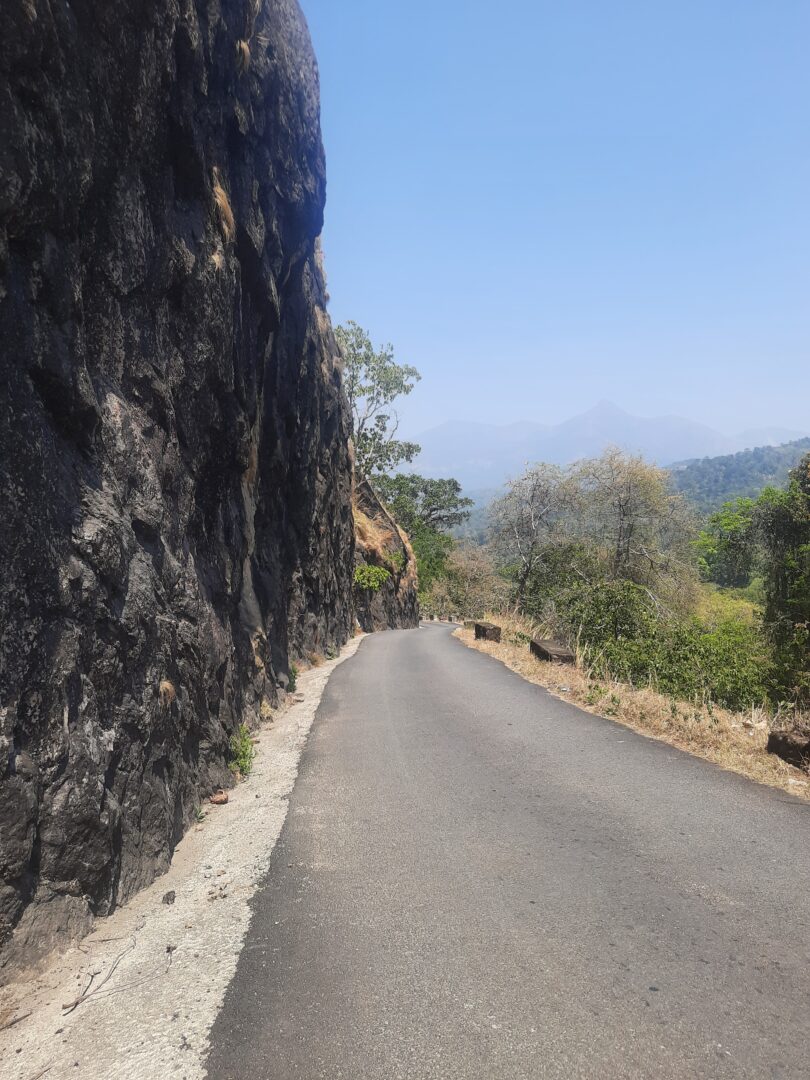
Where the Road Learns the Mountain. Photo by Author, 2023
I think again of the looping feed in the dream. What unsettled me was not speed so much as the refusal to finish. Something similar operates in monsoon landscapes. Roads reopen knowing they will close again. Slopes stabilize briefly, then shift elsewhere. Living here means learning to inhabit unfinishedness rather than trying endlessly to conquer it.
This is not healing in any comforting sense. Healing suggests closure, restoration, moral reassurance. What I see instead is reconfiguration and persistent adjustment, a landscape that keeps rearranging itself under pressure from rain, gravity, infrastructure, and history. Nail describes a world constituted through motion rather than stability (Nail 2016), not movement as metaphor, but movement as condition.
Yet even this language risks drifting too far into abstraction. The Ghats are not concepts. They are wet soil on shoes, diesel smells at blocked roads, phone calls warning of slips ahead, waiting inside buses, improvised detours negotiated on the fly. These are the textures through which instability becomes liveable.
What interests me is not whether the land recovers, but how people, infrastructures, and institutions learn, or fail, to live inside ongoing rearrangement. Crisis here is less interruption than background condition. This demands a different mode of historical storytelling, not only stories of rupture and repair, but stories of persistence, delay, hesitation, and partial fixing.
From this vantage point, climate change does not appear only as an unprecedented rupture, but as a force that intensifies existing unevenness, amplifying long-standing fragilities in land use, infrastructure, governance, and care. The unease many now describe as new has, in places like this, been lived for generations, though never in the same form and never without real suffering.
Thinking beyond disaster may mean thinking with this mobility rather than against it (Pink 2015). It means accepting that stability is negotiated rather than achieved, that governance is always catching up, that archives record anxiety as much as knowledge, and that living in monsoon ecologies means inhabiting rhythms that resist full control.
I return, briefly, to the dream. The looping images no longer feel like torment. They feel like reminder, not that everything moves in the same way, but that repetition does not guarantee resolution. The mind circles. The land rearranges. Neither promises stillness.
What remains open is how we choose to live with that condition: how much uncertainty we tolerate, how much permanence we demand, how we narrate damage without collapsing into despair or fantasy, how we stay attentive to the ordinary labor of living on unstable ground.
The mountains will continue to shift. So will the roads. So will the stories we tell about them. The question is whether our ways of knowing can remain responsive to a world that refuses to settle.
References
Barad, Karen. 2007. Meeting the Universe Halfway: Quantum Physics and the Entanglement of Matter and Meaning. Durham, NC: Duke University Press.
General Department. 1925. File no 509/25 Vol 13, Bundle no 216. Government of Kerala State Archives.
Nail, Thomas. 2018. Being and motion. New York: Oxford University Press.
Pink, Sarah. 2015. Doing sensory ethnography (2nd ed). London: Sage
Abstract: This note reflects on living with instability along a national highway in Kerala’s Western Ghats, where smooth roads coexist with shifting slopes and seasonal closures. Drawing on archival research, everyday observation, and a lingering dream about repetition without resolution, I trace how floods, landslides, and monsoon rhythms appear less as sudden disasters than as ongoing material rearrangements. Colonial histories of land management, contemporary infrastructures, and everyday adjustments fold into one another, producing provisional forms of stability that never fully settle. Rather than treating climate change as an unprecedented rupture, the note considers how it intensifies long-standing unevenness, asking what it means to live, govern, and narrate life on ground that keeps moving.