
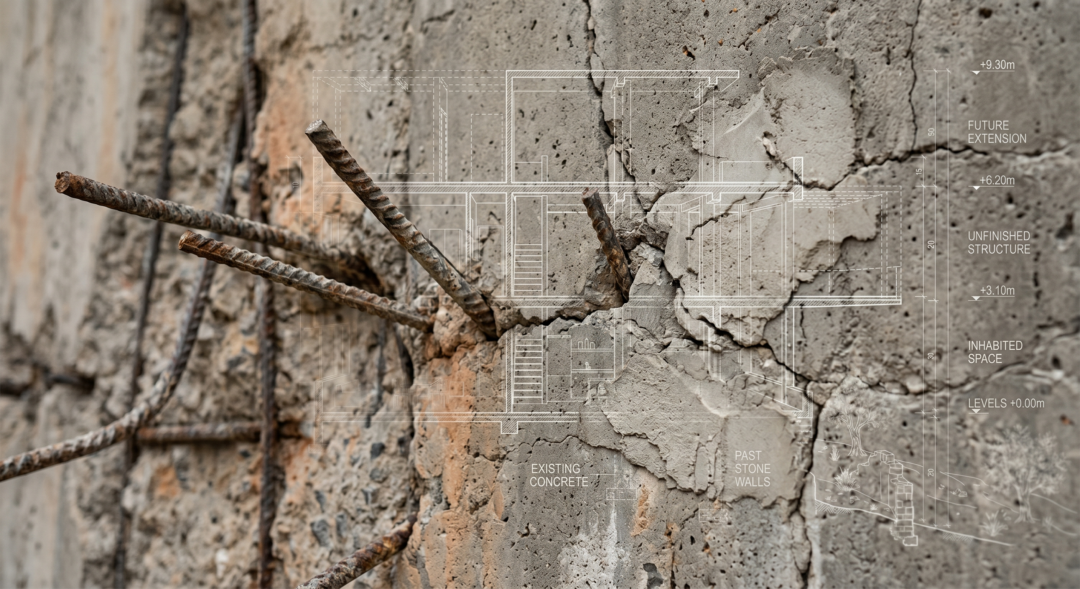
In a village in southern Lebanon, a family lives in the one room of their house that can still be closed. The rest stands open to the sky—reinforcement bars rising from a half-finished upper floor, a staircase that leads nowhere, walls patched with mismatched blocks. Rain enters through the unfinished slab. In winter, the wind moves through the house. The father, who built it, runs his hand over an exposed concrete bar and says: “If we leave again, the loss is smaller.” He completed the ground floor years ago, intending to add another level when his children were grown. Then came the war, and after it, the expectation that violence might return. Now he calls it “finished enough.” The building is not quite a ruin, not quite a home. It is architecture built with the possibility of departure as an active condition.
In these landscapes, incompletion is not the absence of architecture but one of its operative conditions.
Across southern Lebanon, villages shaped by repeated Israeli bombardments—2006, 2024, and again in recent months—are landscapes of suspended construction. Roofs remain unfinished, façades unpainted, upper floors added years later or never at all. After each episode of violence, people rebuild just enough to return, not enough to feel secure. These are often described as signs of poverty or neglect. But that reading misses what the buildings actually do. They are not simply incomplete; they are structured around the possibility that life may have to begin again somewhere else. In these landscapes, incompletion is not the absence of architecture but one of its operative conditions.
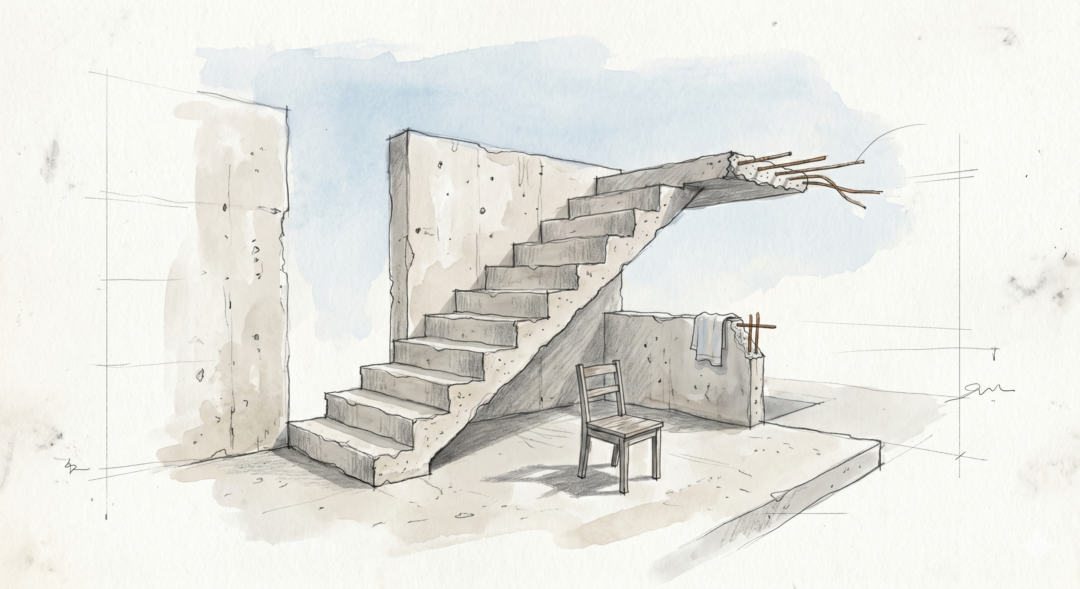
Drawing by author.
Houses are often built in stages, floor by floor, according to what families can afford or what the future seems to allow. This incremental mode of construction is widespread across Lebanon and cannot be reduced to conflict alone: it reflects economic constraints, remittance flows, and long-term family strategies. Yet in the south, repeated destruction transforms the meaning of this familiar practice. What might elsewhere be a gradual process of extension becomes, here, a way of holding the future open under conditions of uncertainty. A ground floor is completed so that life can begin, while the upper level remains unfinished, its steel bars exposed. The next floor may be built years later, or never. The unfinished structure keeps open the possibility of staying, but also the possibility of leaving.
Displacement is an architectural condition.
Migration research has largely been organized around movement: borders crossed, routes traced, policies analyzed. Yet much of displacement is lived in moments when movement stops or is repeatedly interrupted. People wait—in houses, shelters, and partially rebuilt environments—often for years. This waiting is not abstract. It is a waiting for specific conditions: for the cessation of violence, for the possibility of return, for economic recovery, or for the next moment of forced departure. While a growing body of work has examined camps, homemaking, and the spatial dimensions of displacement (Beeckmans et al. 2022), the materiality of everyday built environments—walls, rooms, unfinished structures—remains less central as an analytical entry point.
This essay argues that displacement is not a movement that occasionally pauses in buildings. Displacement is an architectural condition. If displacement is organized through built environments as much as through movement, then migration studies does not merely lack attention to architecture. It has mislocated its object. The field has treated walls, rooms, and unfinished structures as the backdrop to mobility. But in contexts of repeated conflict, the built environment is where displacement takes its most durable form. Buildings do not shelter displacement; they are where displacement is most materially inscribed.
After each war, reconstruction resumes, only to be interrupted again. The result is a built environment that never fully settles.
Work on Beirut’s peripheries has shown how urban space is organized through the anticipation of future violence, collapsing distinctions between war and peace into a continuous spatial condition (Bou Akar 2018). This essay shifts the scale of that insight. Rather than focusing on planning or urban frontiers, it examines how this anticipatory logic is embedded in ordinary domestic construction. The unfinished house is the architectural counterpart to what Bou Akar describes at the urban scale: a space organized not only by past destruction, but by the expectation that violence may return.
The landscape of southern Lebanon makes this visible in a way that migration categories alone cannot. In villages near the border, houses are often built over generations. Construction stops not because the project is abandoned, but because the future is uncertain. Economic instability, the threat of renewed bombardment, and the possibility of displacement elsewhere make it difficult to know whether it is worth continuing. After each war, reconstruction resumes, only to be interrupted again. The result is a built environment that never fully settles.
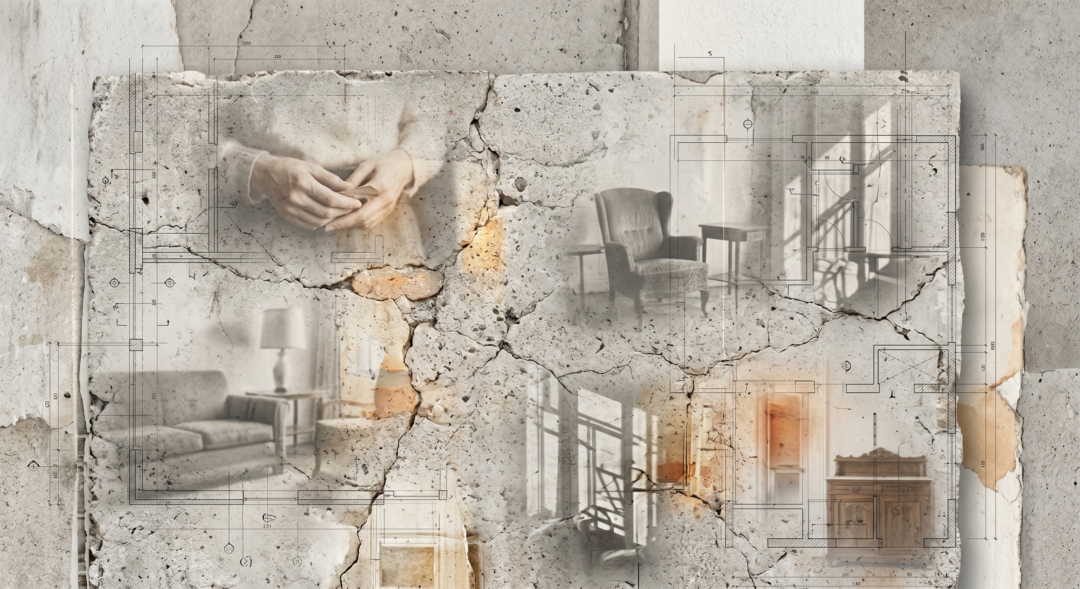
Visuals by author.
Provisionality here is not failure. It is a form of situated knowledge. Leaving a house unfinished allows it to be extended later if circumstances improve, or abandoned with less loss if displacement becomes necessary again. Minimal repairs make it possible to inhabit a damaged structure without investing in a future that may not arrive. Families rebuild just enough to live, not enough to feel secure. “Finished enough” is not resignation. It is a calculation about the future embedded in concrete and steel. Unfinished construction operates as a material technique for distributing risk across time. It allows investment, attachment, and loss to remain partial, staged, and reversible. Architecture does not simply reflect uncertainty; it organizes how uncertainty is lived, managed, and endured.
“Finished enough” is not resignation. It is a calculation about the future embedded in concrete and steel.
In some villages, entire streets show the same pattern: concrete frames left exposed, upper floors without walls, balconies without railings. These are not abandoned buildings but inhabited ones. Laundry hangs from unfinished slabs. Satellite dishes are fixed to walls that were never plastered. Children play on staircases that were meant to lead to another floor. Life continues inside structures that were never meant to remain incomplete for so long. What appears as interruption becomes a durable condition.
This is not only about ruins. Ann Stoler’s work has shown how ruins persist as ongoing effects of violence, shaping the present rather than marking a closed past (Stoler 2013). The unfinished house introduces a different temporal orientation. If ruins point toward what has been destroyed, unfinished structures point toward what remains undecided. They do not only bear witness to past violence; they register the anticipation that it may return.
This distinction is not absolute. As Hiba Bou Akar’s work suggests, construction and destruction are often intertwined, and the anticipation of future conflict can shape everyday spatial practices. In this sense, unfinished houses should not be understood as entirely distinct from other forms of conflict urbanism, but as part of a broader field in which the future is imagined through the lens of possible violence. What is specific here is the way this anticipation is embedded in domestic construction, in the scale of the house and the rhythms of everyday life.
In southern Lebanon, a wall left standing becomes a boundary; an unfinished floor becomes storage; a damaged room becomes the space where life continues. These are not passive remains. They actively organize everyday practices—where people sleep, how they store belongings, whether they host others, whether they imagine staying.
(…) building in stages becomes something more than an economic strategy: a way of managing uncertainty, of remaining without fully committing, of preparing for the possibility of leaving.
The organization of space is also an organization of time. The unfinished house is oriented toward the future: its incomplete upper floor signals an intention that may never be realized, holding open the possibility of extension or departure. The repaired room is oriented toward the present: patched walls, sealed openings, minimal interventions that make life possible without committing to permanence. The ruin bears witness to the past: a collapsed structure, a wall marked by violence, a house that remains uninhabitable yet still standing. In many cases, all three coexist within the same environment. Displacement is experienced not only as movement, but as suspension—living in a present shaped by past destruction and uncertain futures.
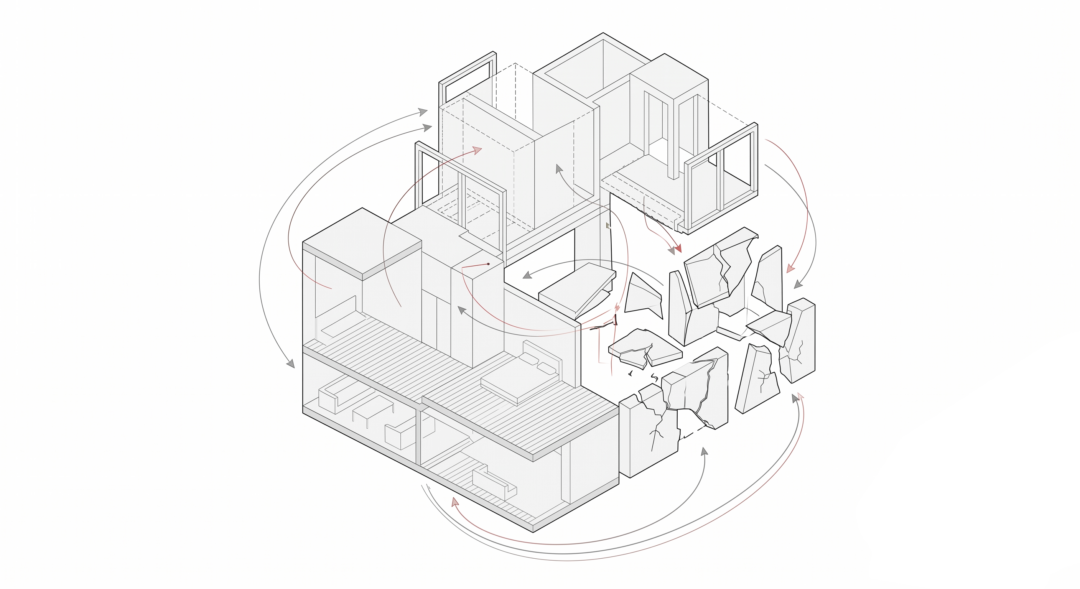
Schematics by author.
These forms should not be reduced to a single explanation. Unfinished construction is not only a response to displacement; it is also shaped by economic constraints, family growth, and long-standing building practices. The point is not to replace these explanations, but to show how repeated violence reconfigures them. In this context, building in stages becomes something more than an economic strategy: a way of managing uncertainty, of remaining without fully committing, of preparing for the possibility of leaving.
Eyal Weizman’s work has shown how states use architecture as a tool of control, embedding political strategy in infrastructure and planning (Weizman 2007). The buildings described here suggest a different dynamic: how civilians use architecture to navigate conditions in which stability is not guaranteed. This is not an architecture of control, but an architecture that redistributes the conditions of staying and leaving—in a context where state authority, military violence, and para-state actors unevenly structure protection and reconstruction.
He built not only a house, but also a way to leave it.
This does not mean that these houses are simply “built to be left.” People build because they intend to remain, to repair, to continue living on their land. Yet they also build in a way that acknowledges that staying may not be permanent. The structure holds both possibilities at once. It is precisely this tension—between inhabiting and leaving—that gives these buildings their form.
If migration studies begins from movement, architecture begins from what remains. Return to the unfinished house. The family lives in the one room they can close. The rest—the exposed reinforcement bars, the staircase to nowhere, the walls marked by repair—holds together past destruction, present survival, and the possibility of future departure. The father runs his hand over the steel and says: “If we leave again, the loss is smaller.” The building has become anticipation made material. He built not only a house, but also a way to leave it. To read such buildings as marginal to migration is to invert the relation. These are not the setting for displacement, but where it takes its most enduring form.
Featured image: Photo by author.
References
Beeckmans, L., Gola, A., Singh, A., & Heynen, H. (eds.) (2022). Making Home(s) in Displacement: Critical Reflections on a Spatial Practice. Leuven: Leuven University Press.
Bou Akar, H. (2018). For the War Yet to Come: Planning Beirut’s Frontiers. Stanford: Stanford University Press.
Stoler, A. L. (2013). Imperial Debris: On Ruins and Ruination. Durham, NC: Duke University Press.
Weizman, E. (2007). Hollow Land: Israel’s Architecture of Occupation. London: Verso.
Abstract: This essay argues that migration studies can learn from architecture by attending not only to movement, borders, and routes, but also to the built environments where displacement becomes materially durable. Drawing on southern Lebanon, it examines unfinished and partially repaired houses as spatial forms shaped by repeated violence, economic uncertainty, and the anticipation of future departure. Rather than treating buildings as the background to migration, the essay shows how walls, rooms, exposed reinforcement bars, and staged construction organize the experience of waiting, return, and possible loss. In this sense, displacement is not simply interrupted by architecture; it is often lived through it.