

Gideon Levy. 2024. The Killing of Gaza: Reports on a Catastrophe. New York: Verso.
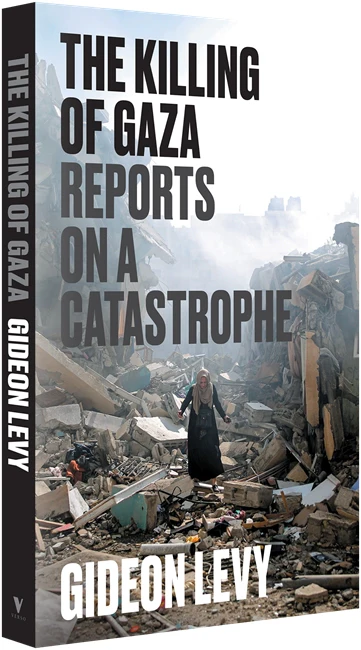
In The Killing of Gaza: Reports on a Catastrophe, Gideon Levy, a veteran Israeli journalist for Haaretz, presents a curated selection of his published articles, creating a sustained examination of Israeli violence and extremism toward Palestinians and transforming the individual news articles into a cohesive argument about repeated patterns of military overreaction and the predictable nature of the conflict. From his unique position as an Israeli critic within Israeli society, Levy offers an insider’s perspective that challenges dominant narratives about the conflict while drawing on his decades of reporting. This collection represents both a journalistic record and a moral calculation, as Levy documents systematic violence against Palestinian civilians. The book’s significance thus lies not just in its documentation of events, but in Levy’s position as one of Israel’s most prominent internal critics, giving particular weight to his assessments of Israeli policy and military conduct.
Levy’s decision to present these articles without additional commentary or contextual framing is both the collection’s greatest strength and its most significant limitation. The unmodified presentation of these articles allows Levy’s original reporting to retain its immediacy and emotional force. As many of the articles are personal testimonies and intimate portraits of Palestinian families, the authenticity of their unmodified form could be diluted by retrospective analysis or editorialization. This approach supports the book’s central theme pertaining to the normalization of violence particularly well, as the accumulation of these individual reports emphasizes the patterns of systematic brutality more powerfully than an analytical exposition might achieve.
However, this same restraint creates significant accessibility challenges for readers encountering the material months or years after its publication. References to Israeli political figures remain unexplained, while context about specific incidents or policy developments is assumed rather than provided. By tasking the reader to fill in these gaps themselves, the collection risks having its narrative fragmented or contested by external sources that could introduce misinformation or competing interpretations that ultimately undermine Levy’s purpose. For instance, several of the featured articles, like “Biden Wants Peace, But Israel Wants War” from June 2, 2024, discuss critical developments in the conflict and possible peace efforts. Yet with no additional information included in the book, one must look elsewhere to complete the picture. This tension points to broader questions about the relationship between journalism and historical analysis, particularly in ongoing conflicts where the line between immediate reporting and lasting documentation becomes blurred.
The first part of the book, which includes articles written from 2014 to October 7, 2023, systematically documents and builds evidence of the normalization of violence. These articles chronicle the Israeli military’s regular, escalating restrictions on the movement of Palestinians, detail increasingly hostile Israeli actions and attitudes toward Palestinians such as the construction of the border barrier, and shine intimate spotlights on the suffering of individual Palestinians. Throughout these articles, Levy creates an explicit pattern of reference, connecting each new incident to his previous reporting, demonstrating how catastrophic violence gradually became routine policy.
This cascade of ballooning evidence culminates in Part Two, beginning with an article written on October 9, 2023, two days after Hamas’s attack. This second section shifts from building the case for Israel’s normalized violence to documenting its development in real-time. Writing as the conflict unfolded, Levy’s articles have an urgent immediacy, describing how the patterns of state and civilian conduct, discussed in Part One, now operate on a catastrophic scale. In the October 9th article, “Israel Can’t Imprison 2 Million Gazans Without Paying a Cruel Price”, Levy explicitly connects the unfolding brutality to the systematic patterns revealed in Part One, cataloguing the normalized behaviors that preceded the crisis: “We’ll arrest, kill, harass, dispossess, and we’ll protect the settlers busy with their pogroms” (126). These behaviors, along with widespread Israeli arrogance and the belief that “we can do whatever we like”, (126) directly enabled the tragedy. This article clearly highlights Levy’s central argument that extraordinary Israeli violence was not an abnormal reaction, but the predictable escalation of already established norms of violence. As Levy notes, “Israel hasn’t stopped punishing Gaza since 1948, not for a moment” (128).
Rather than positioning himself as a neutral analyst, Levy embraces the role of a witness, clearly amplifying Palestinian voices and experiences to serve as the evidence in what amounts to an ethical indictment of Israeli conduct.
Beyond its function as a journalistic record, Levy’s emphasis on personal testimonies and intimate portraits suggests his project functions as a moral account of Israeli society’s ethical failures towards Palestinians. Rather than positioning himself as a neutral analyst, Levy embraces the role of a witness, clearly amplifying Palestinian voices and experiences to serve as the evidence in what amounts to an ethical indictment of Israeli conduct. This positioning is particularly pronounced in articles like “Broken Families in Limbo” from July 8, 2016, where Levy imbues his reporting with an emotional intensity not often seen in the media. The detailed portrait he renders of Khaled Dawabsheh and his family has an immense emotional and moral weight, functioning beyond just a simple human-interest story. Levy’s decision to focus on Palestinian voices instead of Israeli political analysis (which is the focus of a few of the articles) reflects a deliberate moral choice to centre the experiences of those suffering the consequences of the policies he critiques.
Just as importantly, Levy is not just documenting Palestinian suffering for external consumption, but confronting his own society with the tragic human cost of its policies, arrogance, and apathy.
Moreover, Levy’s position as an Israeli journalist writing primarily for Israeli audiences adds a particular urgency to the collection. Just as importantly, Levy is not just documenting Palestinian suffering for external consumption, but confronting his own society with the tragic human cost of its policies, arrogance, and apathy. This establishes a unique form of moral accountability as Levy’s credibility and position force Israeli readers to confront uncomfortable truths about their own and their nation’s conduct. Levy cannot be dismissed as an outsider with an anti-Israel bias or an insufficient understanding of Israeli security concerns. His decades of reporting from within Israeli society and knowledge of internal politics and culture give him the authority and legitimacy necessary to challenge the reader’s assumptions and complicity. Furthermore, with his repeated use of the collective ‘we’ in articles like the October 9, 2023 piece, Levy implicates himself within the society he critiques, shunning the comfortable disassociation of external judgement.
Another methodological concern lies in the inherent limitations of the format. In a carefully curated collection designed to demonstrate the normalization of violence and document specific patterns of behavior, readers will almost inevitably arrive at the author’s intended conclusion, raising critical questions about what was omitted from Levy’s central narrative. His editorial decisions about which articles to include and exclude from nearly a decade of reporting necessarily shape the argument in ways that may not be immediately apparent to readers. This curatorial approach, while fulfilling Levy’s moral and political arguments effectively, risks creating what amounts to a confirmation bias on a structural level, where the evidence presented supports the central argument precisely because nothing else is included. Such an editorial choice, while perhaps necessary for creating a coherent narrative or achieving Levy’s aims, limits the collection’s capacity to engage with the full complexity of the Israel-Palestine dynamic and may inadvertently weaken Levy’s narrative by making the current crisis appear predetermined.
Still, the collection’s greatest strength lies in precisely what makes it methodologically imperfect: its uncompromising moral clarity and emotional immediacy create a sense of intimacy that an academic analysis could struggle to convey
The Killing of Gaza succeeds as both moral testimony and historical documentation, despite its limitations. Levy’s central narrative about the normalization of Israeli violence toward Palestinians emerges convincingly through his accumulated evidence, even if his curatorial choices and analytical restraint limit the work’s capacity for comprehensive understanding. Still, the collection’s greatest strength lies in precisely what makes it methodologically imperfect: its uncompromising moral clarity and emotional immediacy create a sense of intimacy that an academic analysis could struggle to convey. Levy’s position as an internal critic gives the work a particular weight within the broader literature on Israeli-Palestinian conflict, as this insider’s perspective and moral authority within Israeli society make his narrative’s indictment especially hard to dismiss. While Levy’s positionality limits the analytical dimensions of the book, it serves well his purpose of confronting Israeli society with uncomfortable truths about its conduct.
Ultimately, The Killing of Gaza makes a significant contribution to Israeli and Palestinian literature, demonstrating both the power and the limitations of journalism as historical documentation. Levy’s achievement lies not in providing a definitive analysis of the Israeli-Palestinian conflict nor in suggesting an easy path forward, but in creating an undeniable moral record that challenges readers to confront the human cost of normalized violence. In a period where such moral clarity is often difficult to find, Levy’s collection’s value as a record of testimony may outweigh its analytical limitations.
Featured Image: Colorful Disaster. Source: Wikimedia Commons.