

After more than eight years of no contact, I conducted a video call with a former non-influential officer from an Alawite background, originally from my hometown, who served as a military engineer in Aleppo. He spoke calmly, his facial expression showing embarrassment, as he explained that he never believed in either the revolution or the dictatorship. Instead, he believed in the state. However, his tone soon shifted to anger and sarcasm as he described the spread of poverty and rampant corruption in the army and state institutions.
“The regime did not benefit the people who fought with it. All the laws issued only served the rich. Even military service for the sons of wealthy Sunnis from Aleppo and Damascus was arranged at home in exchange for bribes to senior officers. The poverty caused by the regime’s policies made the Alawites fodder for death in the army, while wealthy Sunnis had the right to live”.
Then, with a bitter laugh, he added, “I joined the army because of poverty. If I had studied economics, I would have joined the army of unemployed. I studied military engineering because it secured me a monthly salary from the beginning of my studies. In the end, I became a person who could die at any moment”.
I wanted to ask about the fear of death in war, but I did not want to distress him. Instead, I softened the question: Did you lose people you knew in the army?”
I studied military engineering because it secured me a monthly salary from the beginning of my studies. In the end, I became a person who could die at any moment
Although he did not directly participate in combat because he was an engineer, he sighed and admitted, “I lost many friends, and that is what frustrated me, especially seeing young soldiers die”. He turned his face to the left and the right, as if seeking a way to escape the weight of his words. However, his voice regained confidence when I shifted the discussion to battle in Aleppo. He elaborated:
“In Aleppo, the army had enough weapons, numerous numbers of soldiers, and the regime’s ability to fight for several more years. The issue is no one wants to die anymore, leaving their families without social and financial protection⎯like their colleagues who died in the early years of the war”. Then in a quiet but resolute tone, he said: “Why should we die for Asad? We gradually realised how corrupt this regime is and how little it cares about our lives”. Finally, with a resigned sigh, he concluded: “We are exhausted from death and poverty”.
I begin with this ethnographic account because the physical and symbolic death of the army as an institution contributed to the regime collapse. The accumulation of individual death led to collective emotional death, reflected in the weakening of the repressive state’s institutions⎯creating an opening for Syrians to imagine life beyond the regime. Since the 2011 revolution, Syrians have experienced death in different ways, leading to a state of exhaustion. Taʿab (تعب) is not merely physical fatigue but all-encompassing exhaustion⎯emotional, psychological, economic and existential⎯born from the relentless presence of death, the weight of loss, and the struggle to keep living despite it.
During the revolution and war, death was never just individual fate; it was collective, political, and symbolic. After the regime’s collapse, those who had lived under Asad’s control for over a decade began to experience death in a more individualised manner, marked by efforts to protect oneself. Meanwhile, those in rebel-held and autonomous areas continued to frame death politically, with rebels viewing it as the cost of freedom and dignity. At the same time, radical Islamist groups embedded it within their ideological and political projects.
Since the 2011 revolution, Syrians have experienced death in different ways, leading to a state of exhaustion.
The exhaustion from pervasive death in Syria extends to the initial phase of change to the challenge of maintaining life after the regime’s collapse. While many lives were lost, Syrians resisted cycles of retribution, expressing a collective desire for peace over vengeance. Instances of violence were often met with communal efforts to contain them, reframing death as an individual rather than a collective act to prevent societal fragmentation.
During this fragile transition, Syrians employed various survival strategies: peaceful protesting, withdrawing, and cooperating with the emerging authority. Those who had suffered violence often exercised patience to prevent reigniting destruction. Rather than politicising death, many communities sought to depoliticise it, emphasising life as a shared aspiration. Calls for citizenship-based state and transitional justice mechanisms reflected a refusal to let death define the future, as far as they could, instead envisioning a society based on peace and accountability.
Rather than politicising death, many communities sought to depoliticise it, emphasising life as a shared aspiration.
However, the persistence of violence, despite its relative decline, underscores the lack of accountability. The new leaders have yet to implement a framework for transitional justice, as many of their members would face condemnation. Reports from local human rights and community peace organisations and my ongoing engagement with regional actors indicate that death in Syria now manifests in forms. Beyond killings in clashes between the new regime and wanted individuals, politically and socially motivated revenge persists. This includes assassinations of former regime members and retribution against those who previously supported or worked with the previous regime but fled their areas to escape reprisals from anti-regime locals. In my area, for instance, three displaced people from Idlib, who had been living on the coast since 2011, were killed. Sectarian violence persists as a continuation of the Alawite-Sunni tensions that erupted violently in 2011-2012 in Homs and rural Hama, but this time without Alawite involvement. The sectarian killing of Alawite people spread throughout the entire coastal region. In March 2025, thousands of Alawite civilians were killed by the new regime following a battle with an armed group in Lattakia.
Death in Syria is more than physical; it is an existential rupture shaping both individual and collective experiences within the system of governance. The regime’s collapse resulted from the disintegration of its oppressive structures. Yet, from exhaustion emerged the possibility of renewal. Syrians carried death’s weight—mourning, resisting, and reimagining life—transforming loss into a fragile yet persistent path toward rebirth, or adapting to the present as an unchangeable reality.
Death in Syria is more than physical; it is an existential rupture shaping both individual and collective experiences within the system of governance.
Syrians wanted a present without death⎯a life free from violence and fear⎯ driven by a deep desire to avoid the repetition of death. Meanwhile, with the containment of the revolutionary forces, radical Islamist groups are actively shaping a new political regime in which the mechanism of death persists. The collective killing in the coastal massacres has revealed that the new regime produces both physical and symbolic death, individually and collectively, targeting people based on shared sectarian identity.
Despite Syrians’ yearning for life and efforts to resist death’s repetition, its presence remains pervasive, shaping not only memory but also anticipation. The revolution and war’s emotional toll created a refusal to accept death as destiny, but the absence of accountability and the resurgence of political power’s violence reimposed fear for the future. Syrians continue to confront death symbolically and physically, not only as a past wound but as a looming threat. The future is thus haunted by the possibility of renewed war, forcing many to navigate between survival, silence, or confrontation—trapped between hope for life and the mechanisms that reproduce death.
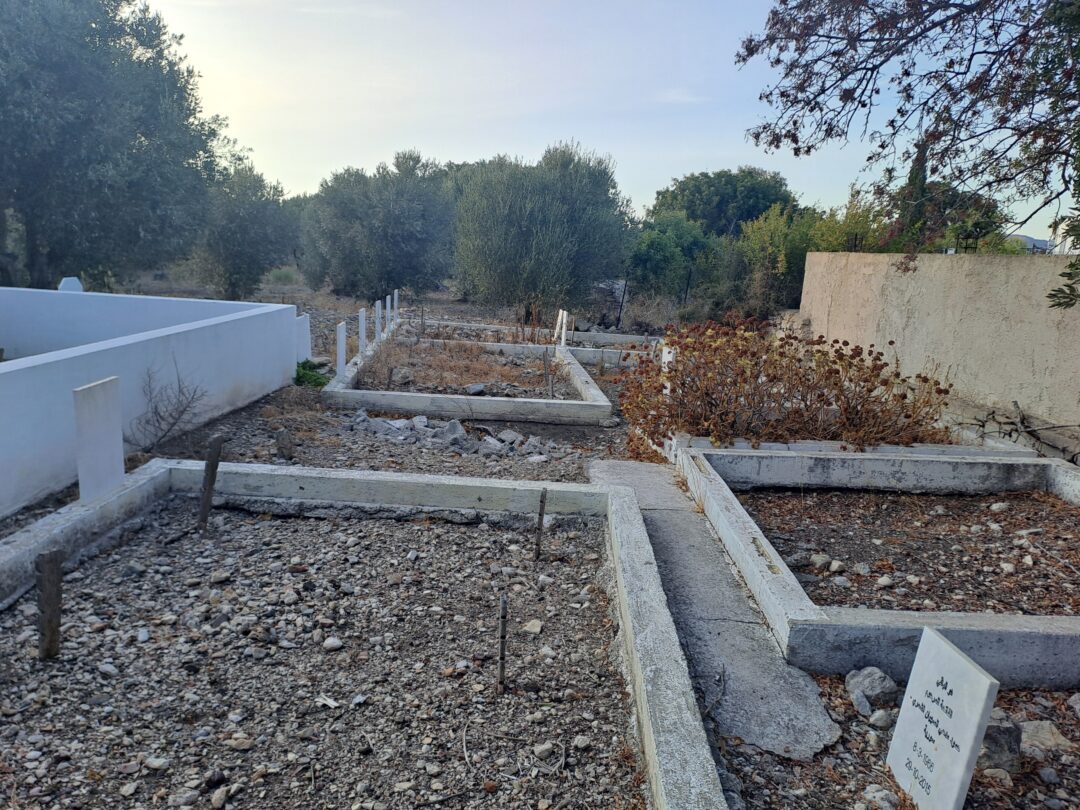
Featured image: “The cemetery of Syrians who died during their journey to Europe, Kos, Greece.” Courtesy of the author.
Abstract: This essay explores the pervasive impact of death in Syria, tracking its emotional toll through the revolution, war, and the aftermath of the war’s de-escalation. It examines how collective exhaustion from death shaped societal response and eroded the regime’s foundation, leading to its collapse. By reflecting on the relationship between individual dying and collective death, the essay shows how this exhaustion led Syrians, who lived under Asad’s regime, to contain violence after the regime’s collapse.