
On the morning of December 8, 2024, just hours after the fall of the Al-Asad regime was officially declared, Syrians descended upon the symbolic and material manifestations of tyranny, tearing down statues, destroying portraits, and raiding presidential palaces and residences. Footage of citizens rummaging through the ruling family’s personal possessions flooded the media. Amid the expected opulence and decadence, they found a trove of humbler, more revealing items: family photographs, including this shot of a youthful Bashar Al-Asad in his underwear.
Tantalisingly leaked in dribs and drabs during the days following December 8, similar photographs—Bashar in the bathtub, Bashar at the beach in Speedos, Bashar riding a bike in skimpy shorts—inundated Syrian social media in what became known as the #kalsoon trend. The old-fashioned term Syrians used for Bashar’s underwear, kalsoon, is one contemporary Syrians associate with their grandparents, and is akin to “pantaloons” in English.
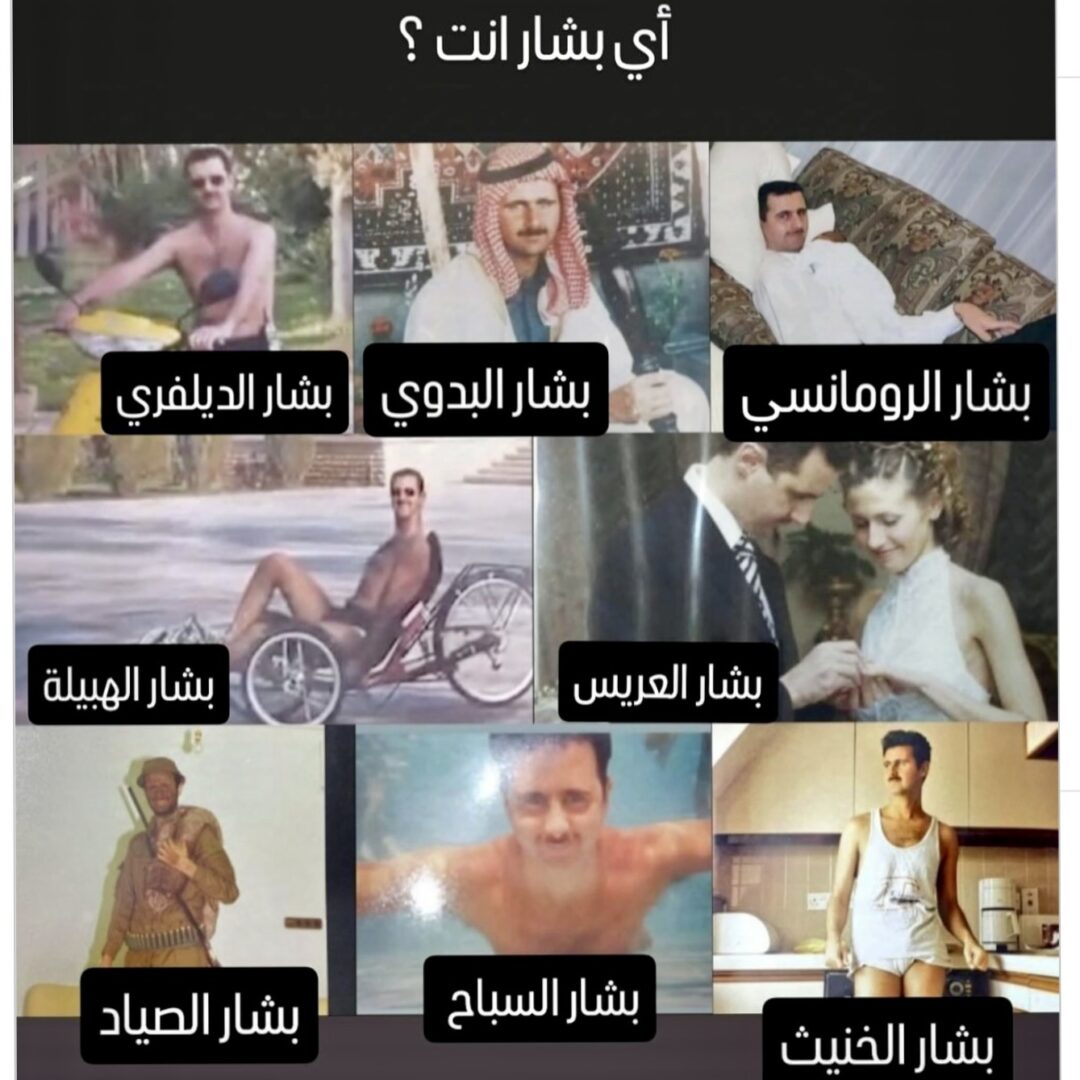
Which Bashar Are You?
As Syrian journalist Nawar Jabbour put it, the trend became “a powerful, vengeful tool for collective ridicule, embodying the people’s suppressed frustration and dismantling decades of carefully constructed symbolism” (2025). The flood of Bashar-in-kalsoon memes, bearing hashtags #Bashar_Al-Asad and #kalsoon, recalls the carnivalesque deployment of scatological humour to take down the powerful during the early days of the Syrian uprising (Halabi 2017). The ubiquity of these images led Egyptian media scholar Amal Bakry to quip on Facebook: “Spare us! I’m tired of seeing photos of Bashar in his underwear, Bashar in bathing suits, Bashar in hotpants and now, to top it off, a photo of his father in bathing trunks!

Amal Bakry Facebook post.
Drama had uncannily presaged the regime’s undoing. Syrians had seen a dictator in his underwear before, in the 2018 television serial, The Back of Beyond (Al-Waq Waq). Scripted by exiled screenwriter Mamduh Hamada, this Lord of the Flies meets Gilligan’s Island black comedy situates Syrians of various religions, classes, regions, and ethnicities on a deserted island, shipwrecked on their way to America and its perceived freedoms (Salamandra 2019, 2023). In the wake of the regime’s collapse, social media commentators noted the life-imitating-art surreality. A widely shared Instagram post featured a clip from the serial: knee deep in waves, “The Marshall,” a buffoonish army officer who will soon become the island’s strongman, imagines he is being watched by US satellites. Leaving his pants to dry on a rock, he composes himself by rearranging the stars on his lapel. A rival steals his trousers, and he frets: “could it be that an image of me in my drawers has reached the Pentagon?!” The caption above this post deals a triple blow, mocking Bashar Al-Asad’s speech impediment, his subservience to the Russian president, and his underwear predicament: “his exthelenthy” is worried that his image has reached Putin.” #kalsoon was a drama déjà vu.
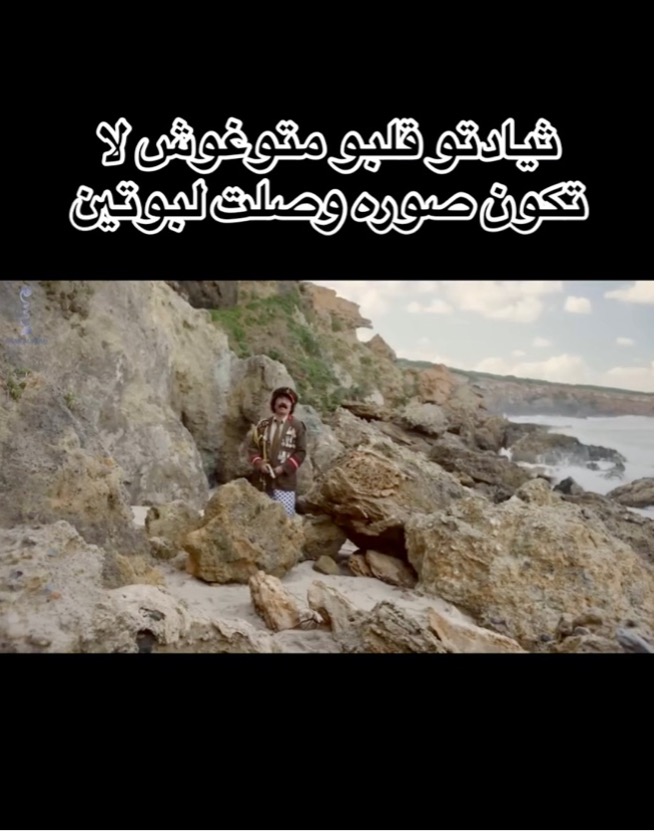
Back of Beyond Instagram post screenshot.
Back of Beyond Instagram post video.
It is unsurprising that fictional television serials and their creators have featured so prominently in responses to the unfolding events. Given the former regime’s strangulation of participatory politics and suppression of journalism and academia, the drama industry has become the nation’s chief cultural export and largest platform for socio-political expression; its creators have served as its most influential public intellectuals. During the revolution of 2011-2024, drama serials offered some of the boldest representations of the ongoing turmoil. Decades of critical commentary on politics and society positioned the industry at the forefront of public discourse about the regime’s collapse. News media sought out actors, screen writers, and directors for comment, and viewers debated their sincerity. On platforms such as Facebook, Instagram, and X, fans shared memes, clips, and quotations from serials, and segments of interviews with industry figures that spoke to the moment. These posts highlighted how television drama, one of Syria’s few arenas for critique under the Al-Asad dictatorship, has also become its most skilled political prognosticator.
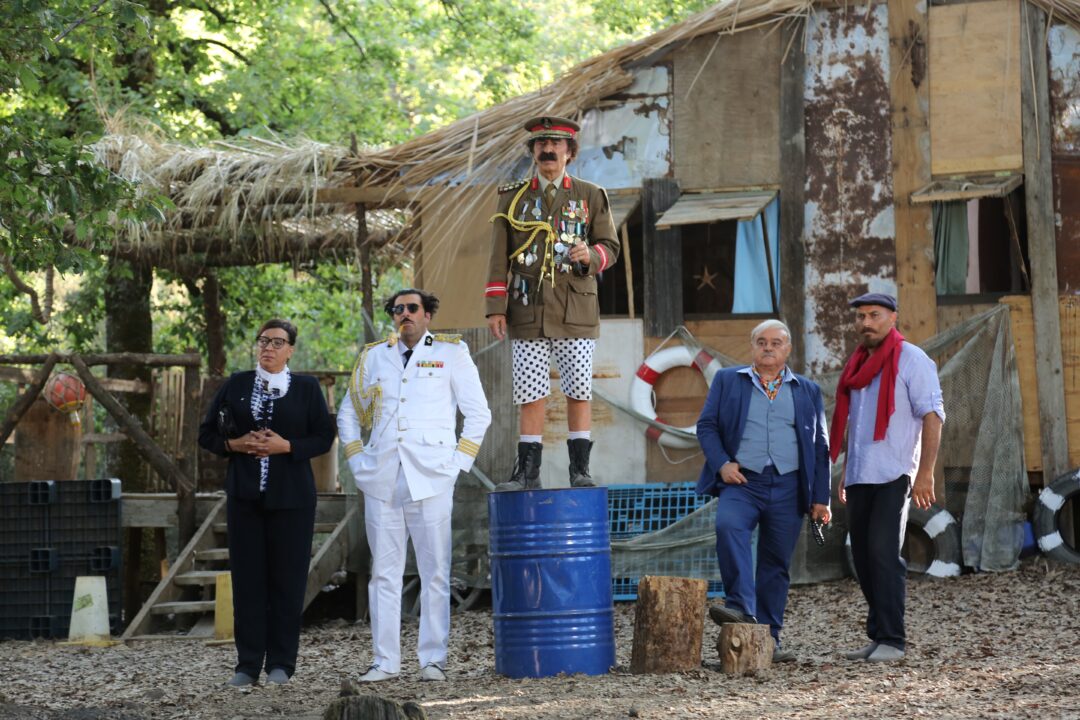
Still from Back of Beyond, photo courtesy of Allaith Hajjo.
The #kalsoon social media outpouring prompts a revisiting of the Al-Asad regime’s much-debated role in shaping television drama. Since the early 1990s, prominent businessmen with links to the leadership and its security services—relationships that enabled them to operate—owned the major production companies, these in turn routinely enlisted politically ambiguous or “gray” directors and oppositional screenwriters (Salamandra, forthcoming). Nevertheless, leading drama creators routinely navigated a labyrinth of competing forces to generate critical, subversive material (Halabi 2023a, Salamandra 2015, 2012). The industry produced 45, 30-episode serials a year at its mid 2000s zenith; few of these were closely followed, and many were rapidly forgotten. Journalists and scholars have tended to focus on the content of individual dramas that echoed regime narratives but failed to attract wide audiences. Such analyses reveal much about authoritarian attempts at hegemony, but little about drama makers’ attempts to evade them, or about what Syria’s sophisticated audiences value and put to work (Halabi 2023b).
Television drama, one of Syria’s few arenas for critique under the Al-Asad dictatorship, has also become its most skilled political prognosticator.
Landmark works like Back of Beyond, created with minuscule funding, little infrastructure, and heavy official interference, offered Syrians an opportunity to dress down their dictator long before #kalsoon afforded them one (Halabi 2017). These script-driven works, penned by the nation’s leading authors and poets, are best understood in dialogue with audiences who went on to invoke and transform them. Our long-view ethnography highlights the avidly watched and fondly remembered serials that comprise what we call Syria’s television heritage. These works speak to Syrians’ past and present, forming a malleable repertoire for reimagining the nation’s future.
Featured image: Photograph found in Bashar Al-Asad’s Presidential Palace.
References
Halabi, Nour. 2023a. “Syrian Television Drama in the Satellite Era: The Impact of Gulf Investment in the Early 2000s.” In The World is Watching Musalsalat, edited by Hadeel Eltayeb and Pamela Erskine-Loftus. Edinburgh: Akkadia Press.
—-2023b. “Visualizing Inequality: The Spatial Politics of Revolution Depicted in Syrian Television Drama.” In In Middle Eastern Television Drama: Politics, Aesthetics, Practices, edited by Christa Salamandra & Nour Halabi. Routledge.
—-2018. “If Walls Could Speak: Borders and Walls as Communication Devices.” In Interventions: Communication Theory and Practice, edited by Adrienne Shaw & D. Travers Scott. Peter Lang.
—-2017. The Contingency of Meaning to the Party of God: Carnivalesque Humor in Revolutionary Times.” International Journal of Communication 11.
Jabbour, Nawar. 2025. “Why Did Bashar Al-Asad Leave His Photo Albums Behind.” Daraj, January 3.
Salamandra, Christa. 2023. “Past Continuous: Memory and History in Syrian Social Drama.” In Middle Eastern Television Drama: Politics, Aesthetics, Practices, edited by Christa Salamandra & Nour Halabi. Routledge.
—-2019. “The Past Continuous: Memory and History in Syrian Social Drama,” Middle East Critique 28, no. 2.
—-2015. “Syria’s Drama Outpouring between Complicity and Critique.” In Syria from Reform to Revolt: Culture, Society and Religion, edited by Christa Salamandra and Leif Stenberg. Syracuse University Press, 2015.
—-2012. “Prelude to an Uprising: Syrian Fictional Television and Socio-Political Critique,” Jadaliyya, May 2012.
—-Forthcoming. Waiting for Light: Syrian Television Drama Production in the Satellite Era.
Abstract: The fall of Al-Asad has catapulted Syrian television drama into the spotlight. Returning exiles share videos set to serial theme songs. Memes, clips, and quotes on social media demonstrate how dramas reflect shared experience, and how some —like The Back of Beyond (al-Waq Waq) with its underwear-clad dictator— uncannily presaged the regime’s undoing. Ethnography straddling temporal and geographic scales reveals drama as diverse, intertextual, transnational, and a telling point of access into a transforming Syria.