

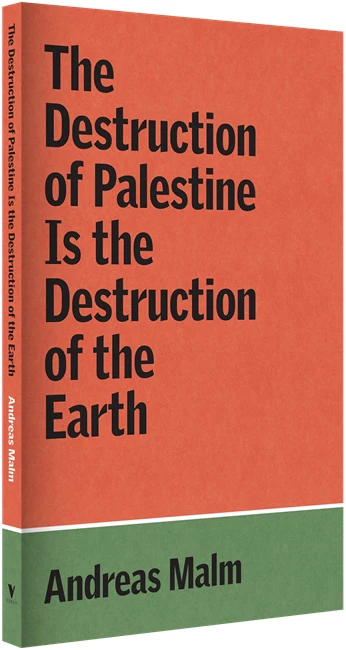
Andreas Malm. 2024. The Destruction of Palestine is the Destruction of the Earth. London. New York: Verso
Urgency is the word that best captures Andreas Malm’s swift, concise monograph. Urgency to recognise, to act, to resist. The very structure of the book reflects this urgency: brief yet immediate. Originally appearing as a Verso Blog post, the main text was followed by a second part, addressing Matan Kaminer’s objections to the former post. The Destruction of Palestine is the Destruction of the Earth is a compelling exercise in analysing historical and seemingly disparate phenomena in longue durée. Following an evocative preface, the book unfolds in three parts. The central section examines how destruction in Palestine mirrors global environmental destruction, with Malm arguing that Palestinian violence serves as a microcosm of planetary-scale processes. This relationship is historically anchored in the pivotal year of 1840, which Malm identifies as a turning point toward fossil-fuel-based imperial domination propelled by colonial powers. The final two sections respond to the critiques of the original text, which accept the historical account but object to their stance on: i) Palestinian resistance and ii) the role of the Israeli lobby.
Malm opens with a poignant preface titled No Limits, which, true to its name, presents the staggering toll of victims from the ongoing genocide. He identifies the defining feature of this violence as a “blatant and shrill breaking of limits” (Malm, viii)—violations repeated so relentlessly that any notion of boundary becomes meaningless. Nonetheless, infuriating as these events are, they are in perfect consonance with development—or rather destruction—on another front: that of the climate. Here, too, the extraction frenzy continues unabated, limitless, driven primarily by the United States and its network of settler-colonial petrostates. Even as hurricanes and floods devastate the Caribbean, Brazil, and other vulnerable regions of the Global South, fossil fuel production continues at an unprecedented pace. Malm also acknowledges the limits of his own account, noting its brevity and the fact that it does not engage with the wealth of Arabic-language sources that could further illuminate this trajectory.
He characterises it as a transnational effort by advanced capitalist countries, together with Israel, involving not only mass killing but also the deliberate starvation of Gaza, adding insightfully, “One could be forgiven for thinking that they want the Palestinians to die” (2).
In the first section, titled the same as the monograph, Malm lays out his central thesis, describing the ongoing violence in Palestine as the “First Advanced Late Capitalist Genocide” (2). He characterises it as a transnational effort by advanced capitalist countries, together with Israel, involving not only mass killing but also the deliberate starvation of Gaza, adding insightfully, “One could be forgiven for thinking that they want the Palestinians to die” (2). In a powerful example of parallel devastation and prefiguration, he recounts the impact of Storm Daniel in Libya, a climate catastrophe exacerbated by global warming that occurred just days before October 7th. One Palestinian survivor described the storm as a “second Nakba,” having already lost his home to Israeli aggression (10). Although these two modes of destruction may seem different—intentional and unintentional—their distinction is increasingly blurred, Malm argues. While climate violence may not be driven by the intention to kill, its outcomes are certain. Once it is known that this form of capital accumulation kills, “the absence of intention begins to fill up” (11).
In developing an extended analysis of the fossil empire and its entanglement with Palestine, Malm then turns to the pivotal year 1840, when the British Empire first deployed steamboats, powered by coal, in a major military conflict. British naval supremacy was established through the use of these steam-powered vessels in its war against Muhammad Ali Pasha, the autonomous Ottoman governor, on the coasts of Lebanon and Palestine. Pasha’s refusal to accept the Balta Liman Treaty, which undermined British economic interests in the cotton industry, led to his subjugation through the complete pulverisation of Beirut and the Palestinian town of Akka by British naval forces. His defeat—facilitated by coal and steam—secured for Britain not only the surrender of Egypt and the dismantling of a proto-Arab empire, but also laid the groundwork for colonial ambitions in Palestine. That same year, Britain first proposed the colonisation of Palestine by Jews, under the emerging wave of Christian Zionism. In this vision, Jews were cast as agents of imperial prosperity, expected to contribute through mercantile enterprise while serving as a counterweight to potentially hostile powers in the region. Imperial bureaucrats promoted the idea of Palestine as a barren, uninhabited land that should be repopulated by Jews, who would transform it into a thriving marketplace and generate wealth for the British Empire. This new state, naturally, would exist under British protection, secured by steam power. In the wake of the 1840 campaign, Palestine was reimagined as a land without people, to be claimed through technological force fueled by fossil energy. Religious sentiment was fused with economic interest to frame the Jewish inheritance of Palestine as both divinely ordained and materially advantageous, delivered by steamboat. This vision soon crossed the Atlantic, where U.S. media and Jewish Zionist preachers echoed the idea, differing only in that American, not British, steamships should facilitate the repopulation of the land.
In the wake of the 1840 campaign, Palestine was reimagined as a land without people, to be claimed through technological force fueled by fossil energy.
What, then, are we to make of these events? Malm argues that the globalisation of steam power coincided with the initial conception of the Zionist project, though the latter remained an idea for decades before materialising. Still, by the time Zionism took concrete form, the infrastructure was already in place; it had existed at the level of Superstructure on the Base of the fossil empire (43). As Malm succinctly puts it: “Before Zionism was Jewish, it was imperial” (45). He further notes that others have drawn similar connections, referencing Jonathan Parry’s account of steam power’s role in the annexation of Yemen and Iraq. However, Malm critiques Parry for failing to acknowledge that the underlying driver of this imperial expansion was the logic of capital accumulation. Eventually, British imperial power was shared with—and later transferred to—the United States, while real Jewish actors were integrated into the Zionist project. In this context, the genocide in Gaza appears far from accidental. Imperial support for such violence, then, is not a historical anomaly but a durable structure, one that has persisted for over two centuries, sustained and propelled by the power of fossil fuels.
Malm, thereafter, briefly traces the interconnected dual destructions throughout history, demonstrating how the destruction of Palestine became inextricably linked with the expansion of fossil fuel capital, as empires supported the Israeli settler state in its campaign to eliminate Palestine. He identifies three key historical moments in this process. First, during the implementation of the Balfour Declaration by the British Mandate in 1917, vast oil reserves were discovered around the Persian Gulf, including in Palestine. The mandate’s central industrial project—an oil pipeline transporting crude oil from Iraq to the Haifa refinery—became the vehicle through which land was systematically transferred from Palestinians to Jewish settlers. The second instance occurred in 1947, when Western support for Israel was driven by the consolidation of fossil capital and the desire to prevent Arabs from gaining greater bargaining power following a potential Palestinian victory. Finally, from 1967 onward, the West, led by the United States, intervened to protect fossil capital interests. Malm concludes that this pattern reveals a deeper structural relationship rather than merely an escalation between two nations: the steps toward Palestine’s destruction were simultaneously the steps toward Earth’s destruction, both materialised through fossil fuel expansion.
To explain why this defence continues, Malm provides another perspective through recent data, demonstrating that Israeli capital has now become a major player in North Sea oil and gas expansion, creating a reciprocal loop that flows in both directions. It becomes undeniably in the empire’s interest to back and support the genocide following the events of October 7th, which had the potential to upend these operations. To further underscore the ecological violence of the war, Malm presents stark environmental data: “An early, provisional, conservative analysis found that emissions caused during the first sixty days of the war equalled annual emissions of between twenty and thirty-three low-emitting countries,” (54) recent figures exceeding even these estimates.
Accordingly, a Technological genocide is defined by two characteristics: i) “it is executed by means of the most advanced military technology,” and ii) “it is at least partly animated by the drive to restore technological supremacy after a humiliating and successful challenge” (72).
In this context, Malm briefly expands on the Lobby Theory, arguing that it oversimplifies and reduces the United States’ role to that of a passive agent working on behalf of Israel, ignoring America’s own aggressive imperial drivers. He contends that Zionism serves as a tool for the broader project of colonial domination, citing Joe Biden, the former U.S. President, who has repeatedly and unapologetically stated: “Were there not an Israel, the United States of America would have to invent an Israel to protect our interests in the region” (60). He finally suggests that the left should make a sharp break with this reductive theory and instead recognise the deeper, structural relationships involved in this genocide that reveal the indifference of the bourgeoisie to the lives of people in the Global South, whose lives are often deemed expendable.
He then lends a final perspective on the genocide, terming it the First Technogenocide. Accordingly, a Technological genocide is defined by two characteristics: i) “it is executed by means of the most advanced military technology,” and ii) “it is at least partly animated by the drive to restore technological supremacy after a humiliating and successful challenge” (72). No other genocide fulfils both requirements except the current one. Since Tufan al-Aqsa negated all technological dominance over Palestine in one fell swoop, Palestine had to be destroyed. As Malm puts it: “Because high-tech supremacy came to mean nothing on the morning of 7th October, it had to become everything again” (73). He concludes the section on a promising note that, despite everything, resistance still stands.
In the second section of the book, Malm responds to critics of his original post who question his support for Palestinian resistance. He begins by sharing a personal note about his own experience in Gaza and how encountering the Palestinian resistance first introduced him to the climate struggle. In response to critics claiming that the resistance is itself soaked in fossil fuel capital, he replies that he would rather see that capital being used in resistance than directed towards destruction. For those who object to the killing of settlers, Malm points out that his own brand of activism is not necessarily nonviolent, then echoes Mandela, who deemed certain civilian deaths in the struggle against apartheid tragic yet inevitable. A few other responses concern the nature of Hamas, addressing questions about their authoritarian character and their political and secular stance. In a final rejoinder against objections that blame Hamas for the ensuing horrific genocide, he explains that distributing culpability to the fighters is to blame the victims for standing up against oppression; had that logic been applied throughout history, no other uprising should have taken place nor be celebrated. He further adds that the state of Israel could have chosen an alternative approach following the events of October 7th, but instead plunged into genocide due to their deep and burning hatred for Palestinians (99).
The final section concisely rejects the lobby theory, which proposes that since this alliance is harmful to American strategic interests, it must be imposed upon America by an alien actor. Arguing against this kind of exonerating revisionism, Malm first questions the logic and meaning of ‘interest’ for the Empire, then points out that Israel functions as both a police officer and a colonial military base that ensures American and European imperialist hegemony in the region while protecting their fossil fuel interests (107). Comparing the current situation with the Holocaust, he adds that one cannot view it as a mere exception but rather as a product of Western civilisation itself; to deny that Western civilisation can perpetrate genocide will only lead to further destruction (108).
Needless to say, the book arrives at a moment of pressing relevance, as this genocide continues unabated and normalised by the occupying state and enabled by the complicity of its allies. If there is a single regret about the current review, it is that it did not appear even earlier. By the time of this writing, more of Palestine has been destroyed; more of the Earth has been damaged. More empty rhetoric of condemnation has been followed by more atrocities, each darker than the previous one, to the level that it has become so normalised that any response seems perverse. Even when starving refugees were first shot, there was symbolic and performative outrage, but that act too has become normalised. People have been reduced to figures, while climate catastrophes have been reduced to statistical data. Malm’s work reminds us that the events unfolding since October 7th, 2023, cannot be understood in isolation, nor did they simply begin on that date. To treat them as such is to obscure the deeper historical structures and the networks of complicity that sustain this ongoing atrocity.
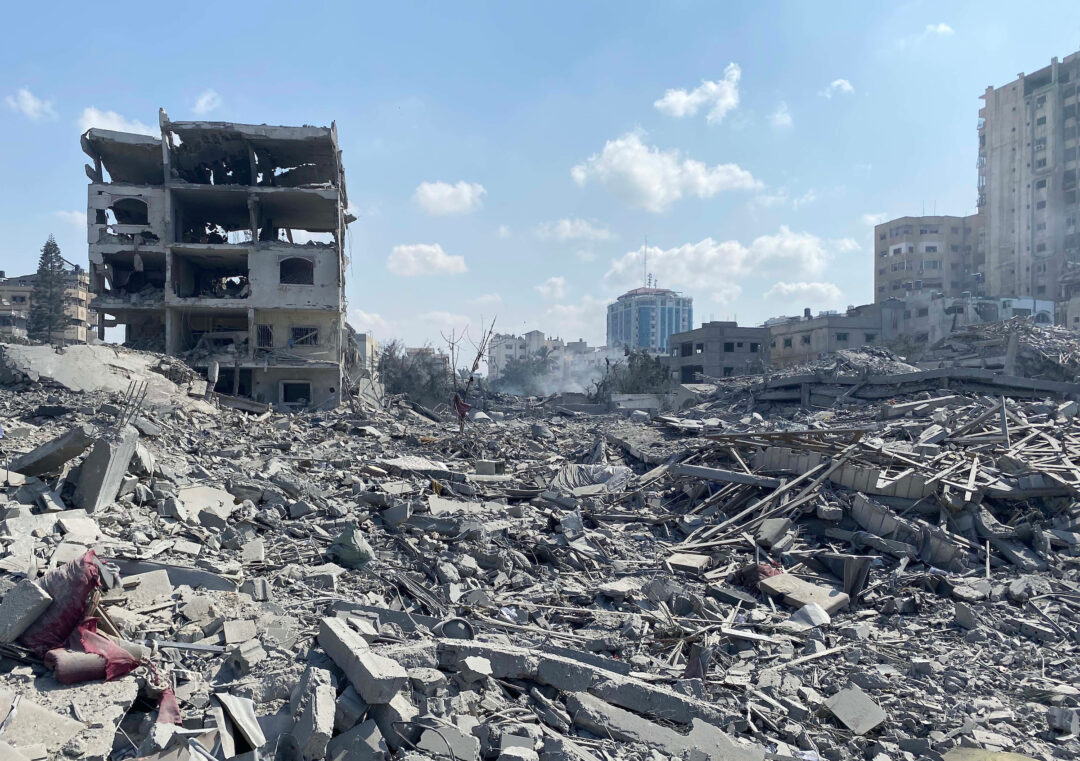
Featured Image: Damage in Gaza Strip during the October 2023 – 29. Source: Wikipedia.