


I. Hair as an Opening
I first met her in the summer of 2020. An elderly woman, her silver hair coiled atop her head like a crown, stood at the edge of the stone steps outside her home and waved to me. Balanced carefully above her head was a massive, horn-shaped bundle of black hair — not grown, not synthetic, but composed of strands from her grandmother, her mother, and her younger self.
Inside the house, her daughter was combing the bundle. The only sounds were the laughter of her great-grandchild tumbling across the floor, and the quiet rhythm of hair being brushed, twisted, wound into place.
I was a student with a notebook, a phone camera, and a head full of untamed questions.
But the questions weren’t what mattered. It was the hair. The ritual of touching, wrapping, performing. In those moments, I glimpsed something more intimate — a visual inheritance braided across generations, a gendered map of survival quietly resisting erasure.
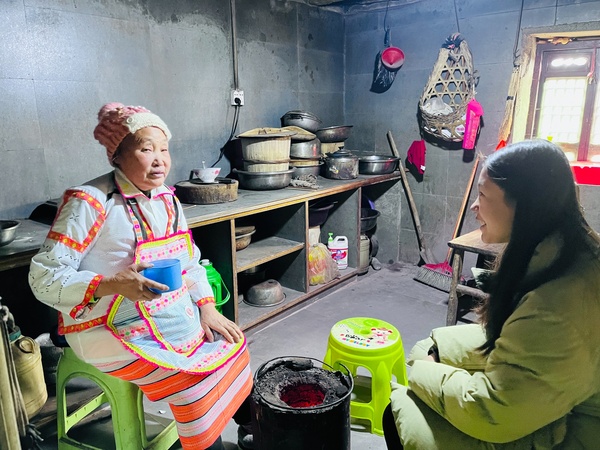
Fieldwork kitchen conversation. Photo by author
When I returned in August 2024 and again in early 2025, I began to notice what I had once missed: the way a woman slightly tilted her head as she wound the horn; the way her fingers trembled — sometimes with age, sometimes with memory. I brought sharper lenses, more fluent local dialect, deeper training. But more importantly, I had learned to be quiet. To wait for stories that are never told out loud.
Hair, I came to realize, is not just a symbol. It is a living archive.
II. Ethnographic Setting: A Village of Living Archives
Nestled in the misty mountains of Liupanshui, Guizhou Province in China, the Longhorn Miao village sits at the edge of disappearance—and display. In state brochures, it is hailed as an “ecomuseum,” a cultural gem highlighted in official itineraries and tourism campaigns, especially for international visitors. But beneath the celebratory tone lies a layered reality of internal loss and external scripting.
I had learned to be quiet. To wait for stories that are never told out loud.
The village is small — less than five thousand residents, many of them elderly. Most young people have left for better opportunities in cities like Guiyang or along the coast (Wang et al., 2023). Those who remain carry not only memory, but the burden of representation.
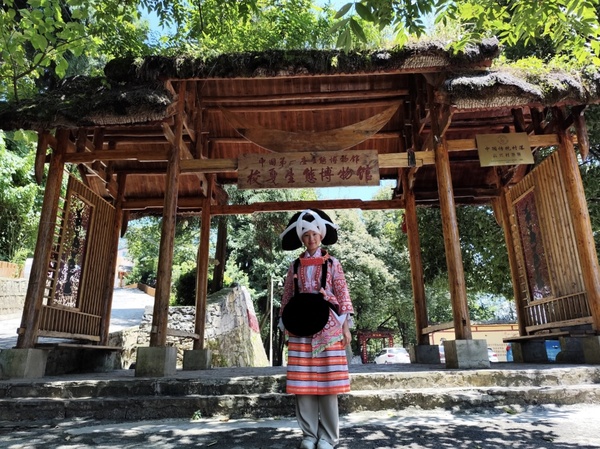
Village gate during the festival. Photo by author
Over three visits, I came to know one woman well: Wang Yuanying, a 72-year-old bearer of intangible heritage. Her family spans four generations under one roof. Wang is the matriarch — respected, resolute, and still the moral center of the household. For her, preserving Longhorn Miao traditions is not just work, but a lifelong devotion.
She welcomed my visits, happily demonstrating weaving, lusheng flute playing, and traditional songs. For a modest fee of 100 yuan, she performed heritage—but not head-combing. Her hands could no longer manage it. That task had passed to her daughter, who also worked part-time at the village Information Center. Whenever important visitors arrived, the Center would call her in to perform the hair ritual. She was paid modestly for it. It was enough. She lived without worry and visited her mother often.
The family’s old wooden home had been replaced with concrete—part of a state-funded housing initiative. Electricity now reaches every household, yet the scent of woodsmoke still hangs in the air. At the village center stands the Information Center, co-funded by Norway and local authorities in 2005. Inside, laminated photos of women in traditional dress smile blankly at rows of tourists. Outside, the real women prepare rice, sweep floors, and tend to children. On festival days, they brush their horn-shaped hair.
The “living archive” is curated — sometimes by outsiders, sometimes by necessity, sometimes in the name of tradition. But the women themselves remember what the museum plaques forget.
III. Gendered Practice: Hair as Embodied Memory
For Longhorn Miao women, hair is not a passive marker of identity. It is practised, cared for, transmitted.
Each morning in the past decades, women like those in Wang’s family began their day by tending to their hair. The bundle held strands from grandmothers, mothers, sisters—even lost hair from youth. It was unrolled, brushed, moistened. The scent — earthy, herbal, mingled with sweat and memory — lingered in the air.
Then, the hair is wound around a wooden horn-like comb and fastened with twine. The entire process could take up to twenty minutes. It was not rushed. It was not theatrical — unless someone was watching. But even then, meaning clung to every movement.
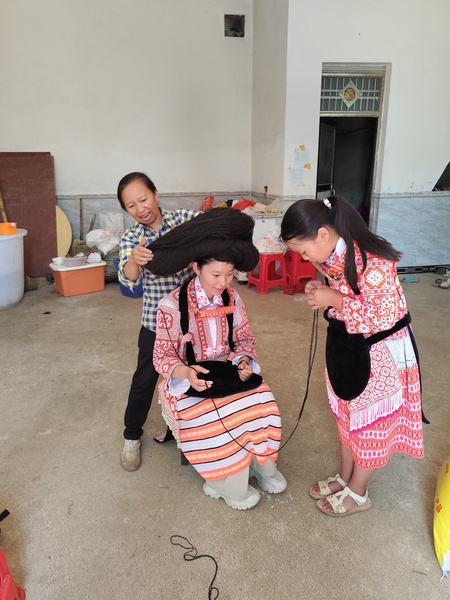
Hair ritual as encounter. Photo by author.
One afternoon, a girl in full costume—no more than eight years old—trailed me as I wandered through the village. She invited me home. “Come, we’ll comb your hair,” she said brightly. I knew it was part of their family’s livelihood. I gladly accepted.
Her grandmother, hands calloused but gentle, did the honours. “These days, many use black yarn instead of real hair,” she explained. “It’s lighter. Easier to wear.” She paused, then added, “But the real thing? The real hairs are heavy — but they’re real. Can’t be replaced.”
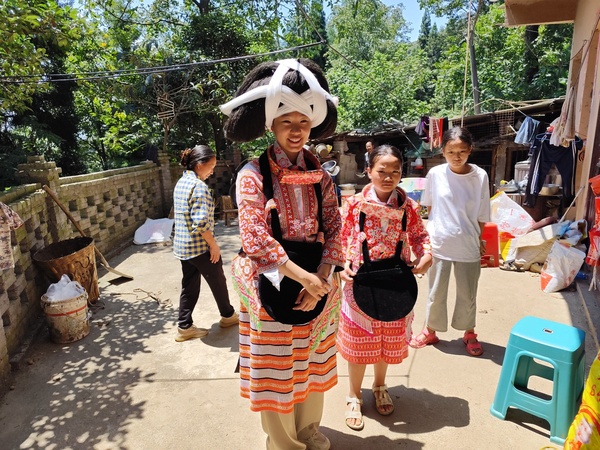
Family portrait post hair-bonding. Photo by author
This moment stayed with me. It blurred the lines between object and emotion. The practice was everyday yet ceremonial. Public yet deeply private.
It was more than cultural expression. It was gendered inheritance, performed on the body.
IV. Hair and Heritage: Between Spectacle and Survival
The state’s designation of Longhorn Miao culture as intangible heritage brought both visibility and distortion. During the annual Tiaohua Festival — once rooted in courtship and agrarian rhythms — the village became a stage.
On the eve of the festival, a bonfire dance unfolded. Teenagers, dressed in both traditional wear and modern clothes, held hands and danced in a wide circle. I watched their glances, their shyness, their flirtation. It was natural. Beautiful. Unscripted.
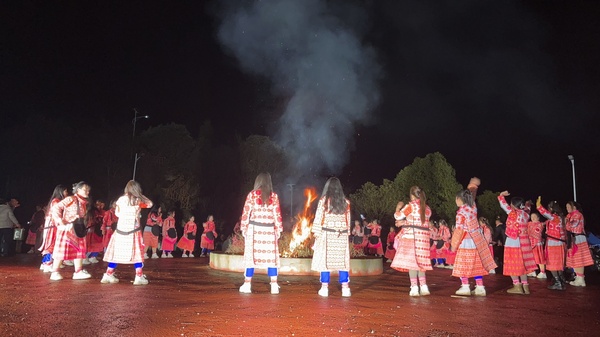
Festival bonfire dance. Photo by author
But the next morning, tour buses arrived. Women were summoned, costumed, instructed to dance to the lusheng flute, greet officials with standardized phrases, and pose for photos. Drones hovered. Loudspeakers played pre-recorded ethnic music. The event was orchestrated, carefully arranged for external consumption.
Heritage preservation, meant to empower, can turn living practice into spectacle.
In early 2025, I witnessed such a performance. After one show, an older woman sat beside me. She wore the traditional outfit, but no headpiece. She sighed. “This is not for us,” she said quietly. “It’s for them.” I asked if many of the younger women returned willingly to perform. “They come for the money,” she said. “The government pays them for the day. If they dance well, they get extra oil and sugar.”
There’s a painful irony here. Heritage preservation, meant to empower, can turn living practice into spectacle. While heritage is often framed as a tool of cultural preservation and empowerment, it is increasingly entangled in mechanisms of display and regulation. Spivak’s question —“Can the subaltern speak at all?” — echoed in my mind. The women do speak. But their voices are often muffled by the demands of visibility.
The more visible a tradition becomes, the hollower it risks becoming. Yet to refuse visibility altogether is to risk disappearance.
V. Ethnographic Vulnerability: Positionality, Shame, and Listening
My third visit coincided with the Tiaohua Festival. That day, I watched waves of tourists from home and abroad arrive, followed by numerous professional film crews. Their presence, though polite and well-intentioned, was impossible to ignore. So was its effect.
Women grew quieter. More composed. More performative. Among them was Wang Yuanying’s daughter, called to perform the hair ritual. She said nothing. Surrounded by flashes, she worked in silence.
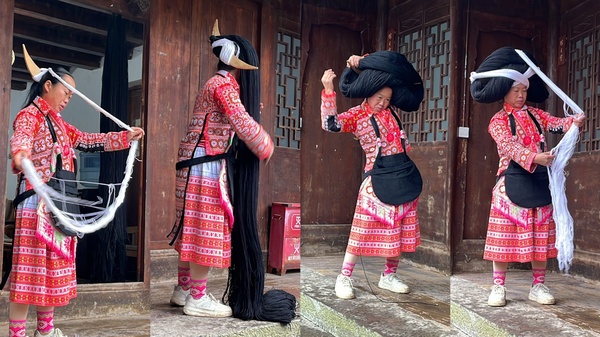
Hair ritual sequence performance. Photo by author.
Over five years, I had come to know Mr. Liu, a former employee of the village’s Information Center. By the time of this visit, he had resigned. “The tourists here,” he told me, “Have few manners. The only ones who care about Miao culture are some foreigners—and the researchers like you.”
To refuse visibility altogether is to risk disappearance.
He recalled the way some visitors would burst in shouting, “Come see the Miaozi (disrespectful appellation for Longhorn Miao)!” as if entering a zoo. “It hurt,” he said, eyes downcast. “It was disrespectful.”
I asked myself: how many visitors at this grand festival cared to understand the stories behind the songs, the dances, the hair? Margery Wolf once described the feminist dilemma in ethnography—the impossibility of being both insider and outsider, both observer and advocate (Wolf, 1992). I felt this acutely. My fieldnotes became littered with ambivalence. Shame. Silence. Guilt.
I stopped looking for “authentic” answers. I tried to become a better listener.
VI. Still Braiding: Choosing Silence, Refusing Display
Not all hair is shaped into horns.
On a quiet morning, I returned once again to Wang Yuanying’s courtyard. Her great-granddaughter, home from school, sat on the doorstep with her hair down, loose and unadorned. Her mother crouched behind her, gently running her fingers through the strands — like straightening thread, one line at a time.
“Not wearing the horned hair today?” I asked. “It’s not a festival,” she said softly, with a smile. There was no apology in her voice. In that moment, I realized: the shape of hair is also an act of choice.
Once in another home, I saw a horn frame wrapped carefully and placed at the top of a wardrobe. It belonged to an eighty-year-old woman, worn only for festivals. “Not for every day,” she said. “For special occasions — or when the girl gets married.”
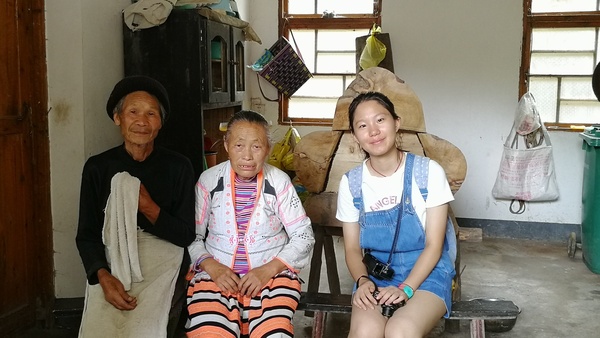
Elders’ portrait. Photo by author
Hair, as tradition, is not always a flag held high. It can be folded quietly away, like a memory not ready to be disturbed.
This encounter reminded me of bell hooks’ idea of the oppositional gaze — a way of looking back, of reclaiming agency in how one is represented (hooks, 1992). The Longhorn Miao women rarely speak in official narratives. But they resist, in silence, in sideways glances, in choosing how to be seen and when not to be.
They are not passive inheritors. Nor are they performers without voice. They choose when to wear the horn, when not to dress up, when to speak, and when to stay silent. These choices are not accidental. They are dignified boundaries.
They do not shout “no.” But each time they refuse to braid their hair, they say it.
Sometimes, cultural resistance does not happen on stages or in reports. It happens at the kitchen door, in a quiet “not today,” in the morning hair left undone.
VII. Listening in Silence, Remembering Without End
The Longhorn Miao women taught me that visibility is not the same as empowerment. Their hair is not a relic — it is a living archive, woven with grief, pride, resistance, and grace.
To dwell, not just record. To feel, not just explain.
I once believed ethnography was about asking questions, finding answers. But over time, I saw how easily ethnographic writing slips into pronouncements — final statements about a people, a culture, a tradition. These women taught me to write differently. To leave space for silence. To let ambiguity survive on the page. To accept that not every question has an answer — and not every answer need translation.
I began rewriting. Not “what they are,” but “what we did together.”
As Trinh T. Minh-ha reminds us: To write is to name. And to name is to fix (Trinh, 1989). I no longer seek finality — I seek the unfinished.
I used to think recording could preserve culture. But I saw that true transmission happens when women sit together in the afternoon, their hair falling freely, their words unhurried. I thought my writing could make them seen. But now I hope I’ve learned to see how they want to be seen. I stopped asking, “Will you keep braiding the horned hair?” The question no longer felt necessary. What mattered wasn’t if they continued the tradition, but how they chose when to show it, and when to withhold it — and how they lived when no one was looking.
After the Tiaohua Festival, the village returned to stillness. No tourists. No cameras. The women sat by their doors, working. Children chased chickens behind the houses. I sat at the edge of the village, watching a woman boil water, rinse rice, and slowly let down her hair. I didn’t photograph. I didn’t ask. She didn’t speak. Neither did I.
But in that moment, the field was still there. The story was still unfolding.
Featured image: Children on Festival Day. Photo by author.
References
hooks, b., 1992. Black Looks: Race and Representation. Boston: South End Press.
Trinh, T.M., 1989. Woman, Native, Other: Writing Postcoloniality and Feminism. Bloomington: Indiana University Press.
Wang, J., Luo, D., Pan, S. and Zhang, Y., 2023. Records of Traditional Villages in Liuzhi Special Administrative Region, 1^th edition. Guizhou, China: Liuzhi Special Administrative Region Archives.
Wolf, M., 1992. A thrice-told tale: Feminism, postmodernism, and ethnographic responsibility. Stanford University Press.
Abstract: this fieldnote draws on fieldwork conducted in Guizhou, China, and weaves together ethnographic narrative and a curated selection of original photographs to explore the role of hair, ritual, and intergenerational memory among Longhorn Miao women.