
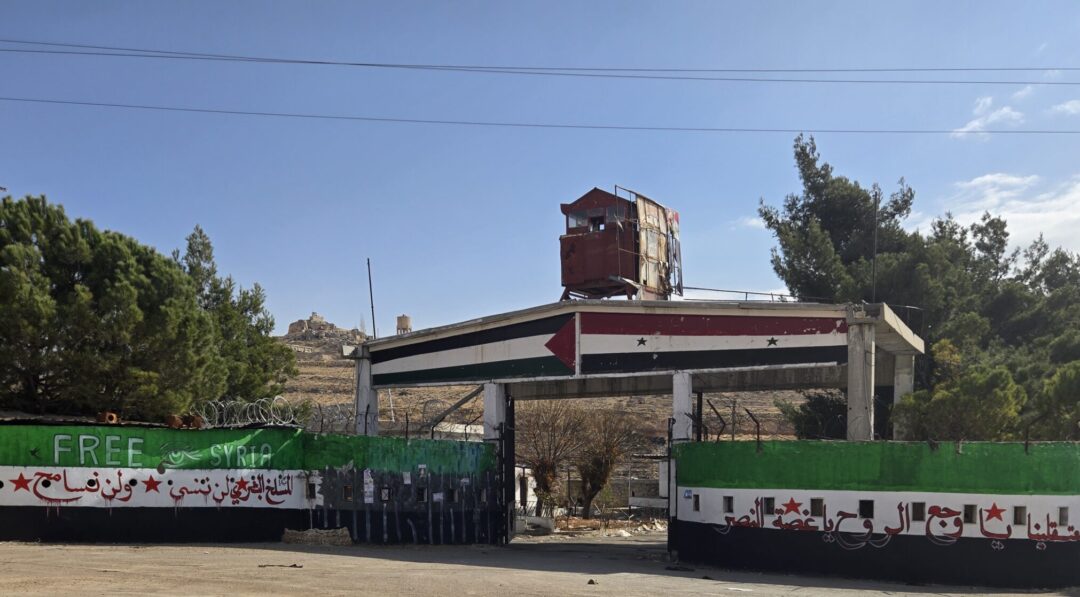
Sednaya Prison, long cloaked in secrecy and fear, has stood as a stark symbol of the Asad regime’s repression. For decades, it served as a site of unimaginable suffering, its name inducing horror and silence among Syrians. Much like the country itself, Sednaya personified the persistent carceral spaces that the regime used to assert its power, and structured the different knowledge dynamisms that ruled the country. Yet, twelve days after the fall of Asad, I found myself standing before its gates, confronted by a reality that completely differed from the one I had imagined through hundreds of hours of interviews and continuous contact with former research participants in the past years. It was a deeply emotional and unsettling visit, both as a researcher and, for the first time, as a Syrian citizen whose unconsciously constructed Abad (the eternal political rule: forever and never ending) of Asad was suddenly destroyed for real. This was the very place where my courageous research participants had endured years of suffering—years they spent simply refusing to bow to Asad’s regime. I never thought I would experience such a visit unless I too were imprisoned. In my mind, I had already been there countless times, accompanying my research participants through their memories and learning about music in Sednaya. Yet, in a dream, Asaad Shlash—the only musicologist in Sednaya from 1987 to 1996—told me, “I told you, Sednaya in the 1990s is different from now. I cannot teach you how to play the oud like in the 1990s.” I woke from that nightmare to find myself standing at the main gates of Sednaya, a place I had once only studied from afar. What does it mean to be at this site after years of studying its history and culture remotely?
Sednaya personified the persistent carceral spaces that the regime used to assert its power.
The experience of standing before Sednaya’s gates marked the intersection of personal and academic shifts in understanding. Until that moment, I had only accessed the prison through the narratives of those who had survived its horrors. But as I stood at the entrance, I realized that the knowledge produced in exile, and the knowledge of Sednaya itself, is not static—it is constantly evolving. In exile, Syrian political prisoners’ testimonies, often heard only in whispers and fragments, were transformed into something that could be shared with the world. Research and oral histories were shaped not only by the trauma of these former political prisoners and their desire to document the regime’s brutalities, but also by their commitment to preserving a cultural memory, especially through music that is a recognition of their carceral experience. Music, in the context of Sednaya, was both a tool of survival and a deeply political act. The work of artists like Asaad Shlash and others is emblematic of the ways in which prison culture took shape: songs were composed not only to cope with the extreme conditions but also to create a hidden network of resistance that could withstand even the harshest forms of surveillance.
Music, in the context of Sednaya, was both a tool of survival and a deeply political act.
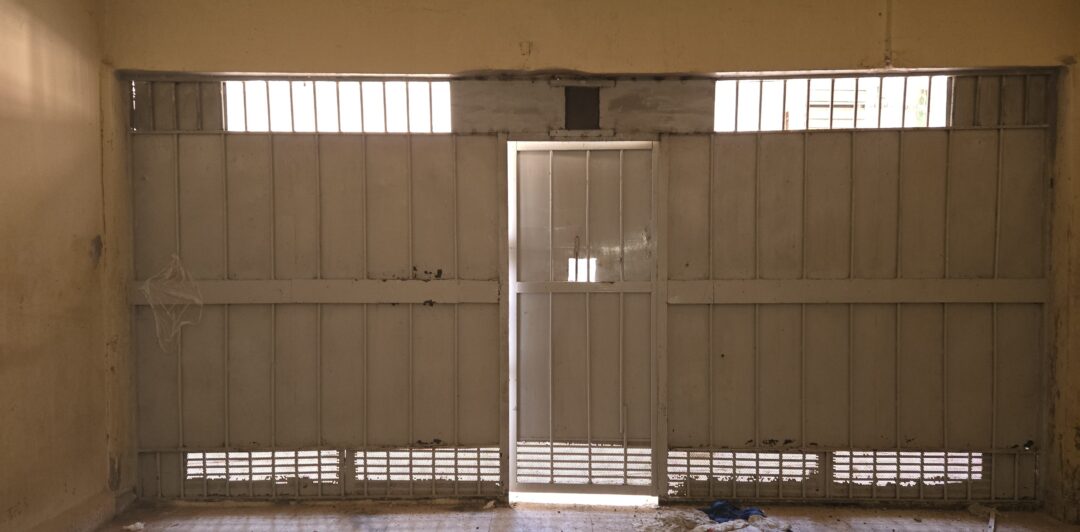
The Door of a Ward, photo by author.
Al-Sijniyya (Prison Song) is a term I have coined to highlight undocumented Syrian prison songs. This research began in 2021, with little prior documentation—except for one song by Faraj Bayrakdar, performed by Khater Dawwa in 2014. Since then, 34 songs, various musical practices, instruments, and five types of ouds have been archived through cultural events in Europe, the USA, and soon Syria. While Sednaya in the 1980s was not yet the “human slaughterhouse” it became, serious human rights violations were already taking place.
Sednaya’s seclusion long restricted fieldwork, limiting access for those outside the state-sanctioned circle of knowledge producers. For decades, scholars studying Syrian politics and prisons relied on scant testimonies or exiled activists. Even after the 2011 revolution, Sednaya’s full role in shaping the carceral and social order remained unclear. However, as more ex-prisoners spoke out, it became evident that the prison was not just a site of repression but also a space where resilience and resourcefulness shaped political knowledge.
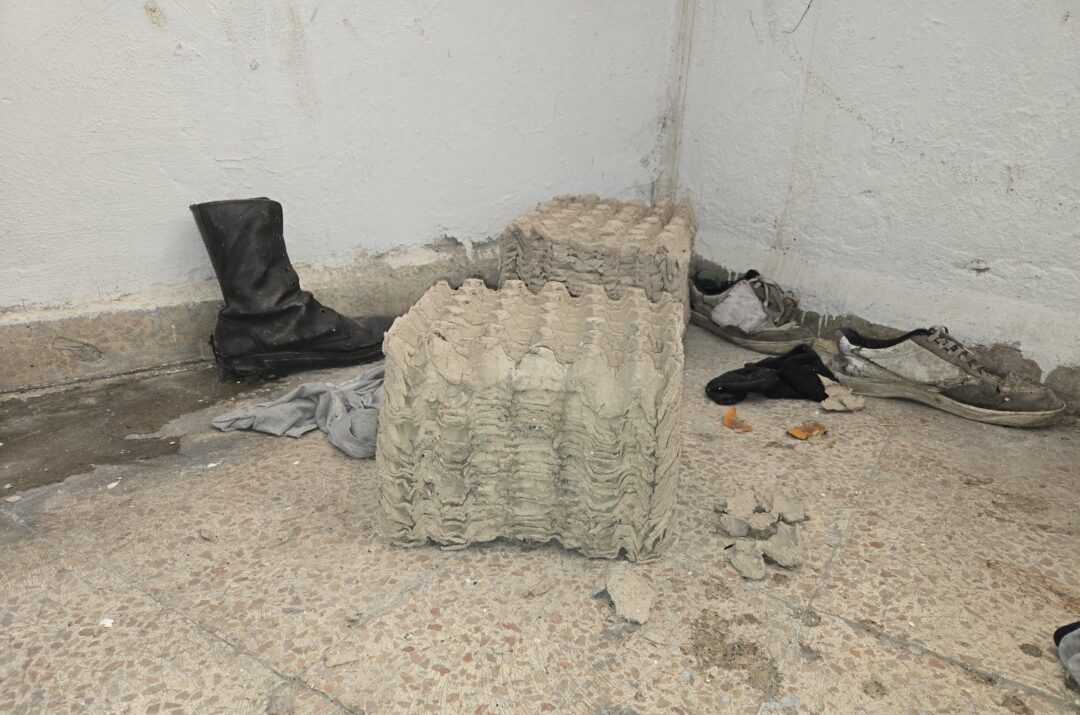
Chairs Made from Cardboard Egg Trays, photo by author.
Yet, my visit to Sednaya made it impossible to continue with the same detached academic approach that I had once adopted. I had been gathering fragments, pieces of a puzzle, through interviews and secondary sources, through imagined sketches and imagined realities. But now the physicality of the prison itself introduced a new layer to my understanding. No longer could I simply observe or analyze from afar—I had entered the space where the knowledge I studied had been forged. My engagement with the site transformed the research process into something more visceral and personal. What has changed after December 8? The fall of a regime, accompanied by a radical political transformation, is being observed closely—meticulously and with cautious optimism. This fall marks a turning point for the first time in academic knowledge on prisons that is being firmly established in the field, shaping Syrian studies with new frameworks and structures—if the spaces are kept open, as they are so far. Unlike in the past, this knowledge is now emerging from within Syria itself, rather than being produced from external perspectives.
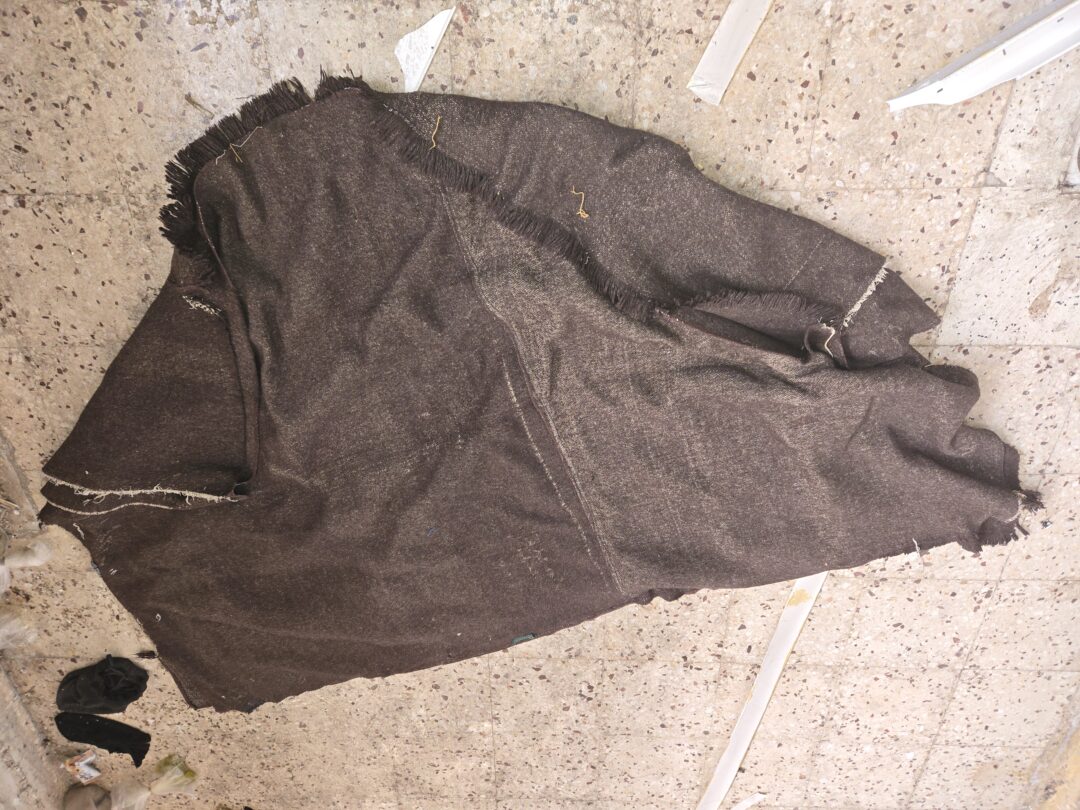
A Blanket That the Musical Strings Were Made from at Sednaya, photo by author.
The echoes of Sednaya emerged in my research not through physical presence but through the voices and memories of those who survived it. Access to this prison—sealed off by violence and secrecy—was never spatial but imaginative, not in person but metaphoric. This contradiction is not a barrier; it is an opening. It reveals how knowledge of the prison can be produced without entering it at all.
Researching Sednaya post-Asad demands a new paradigm. One that moves beyond traditional fieldwork and reorients both theory and method. Imagination becomes a method and survivor narratives become spatial maps. Fragments, refusals, and silences are treated as archives. Syrians, particularly former detainees, must be recognised not as distant subjects but as co-authors and producers of knowledge. Some recommendations for future research are: including no intermediators between researchers and participants; sharing research outputs with participants primarily in Arabic; publishing open-access; creating the space and conditions for participants to co-write with researchers, and disseminating research presented in the participants’ own voices on academic platforms.
Let us envision a new Syria, and with it, new approaches to prison research that are as creative, pluralistic, and defiant as the lives that survived those walls.
To this we must add a critical reassessment of the very theories we inherit. Foucauldian and Agambenian frameworks have helped me illuminate the structure and logic of Asad’s carceral system. But this carries the risk of circumscribing my understanding by closed conceptual spaces. I am still wondering how much Max Weber has helped me understand the Asad regime and its fall. Let us envision a new Syria, and with it, new approaches to prison research that are as creative, pluralistic, and defiant as the lives that survived those walls. To engage with such prisons is to draw from new poetics and canons not necessarily rooted in Western theories but emerging from the field itself, felt from the pain, drawn by the space, and heard by voices. That task remains ours: to listen carefully, share our academic spaces ethically with the survivors, to imagine fiercely, and to write responsibly in ways that carry the weight of what remained.
Featured image: Sednaya’s Newly Painted Entrance, photo by author
Abstract: Emerging from the ruins of a collapsed regime, this article confronts the lasting legacy of the Sednaya Prison. Long shrouded in secrecy, Sednaya is reexamined not only as a site of brutality but also as a hidden archive of resistance and cultural creation, especially through undocumented prison songs termed al-Sijniyya. A first-time physical encounter with the prison, following years of remote research and survivor testimony, ruptures the distance between imagination and reality, forcing a reckoning with the ethics, methods, and limits of academic inquiry. Drawing on testimonies, dreams, music, and memory, the article calls for a radical rethinking of prison studies—one rooted in survivor co-authorship, direct collaboration, and epistemologies formed from within Syria. It challenges reliance on Western theoretical paradigms, proposing instead a research ethos that listens closely to carceral voices and writes from the pain, resilience, and creativity born inside those walls.