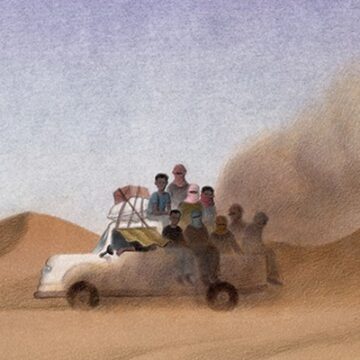
In this episode, YAIM members describe how they kept their sanity inside Tariq al Sikka through music, shared prayers, and solidarity across nationalities, before recounting what happened once they were repatriated to The Gambia through what IOM calls Assisted Voluntary Return. It traces the gap between what they were promised and what they actually received, and follows their attempts to build a livelihood with a reintegration package of roughly 1,000 euros designed around a neoliberal entrepreneurship model that ignores both the psychological toll of the journey and the collective, family-based economy of Gambian society, and the infrastructural limitations of the country.
Transcript of Episode 5: Return
Footnotes by Viola Castellano
Intro:
My name is Tijan Jerju, Fatou Cham, my name is Fatou Darboe, Fatou Bojang from Gambia, Lamin Kotta, my name is Saikou Tunkara.
Viola
I am Viola Castellano and this is Backway to Europe: Talking Borders and Migration with Gambians on the Move.
This podcast series is produced in collaboration with Gambian advocates and activists. It centers their analyses of the border regime through their direct experiences of “the backway”—the local term for the illegalized route to Europe. These experiences resonate with many who have attempted to reach Europe across West Africa and beyond.
In the next seven episodes, you’ll hear from members of Youth Against Irregular Migration (YAIM)1 , an advocacy organization founded by young Gambians who met in a Libyan detention center. The topics and discussions emerged from years of collaboration and are rooted in their advocacy work. I use my research as an anthropologist working on border externalization to provide context and put my findings in dialogue with YAIM’s reflections.
In the previous episode we discussed the conditions of people living in detention centers in Libya and YAIM members shared their experience of detention in Tariq al Sikka,. In this episode, they will describe what they did in those months to keep their sanity and humanity, what they expected from their so-called voluntary humanitarian return and what they got instead.
Lamin Kotta
Yeah, I want to elaborate on that, you know, because at the detention center, the time sometimes we get bored, some people, you know, they get frustrated because what they’ve lost and what they have already seen.
But sometimes, you know, even us, I would be sitting with my friend Lamin.
Yeah, we sometimes chat, you know, but sometimes we get frustrated, but one way or the other, we started, you know, when we started singing some of the songs, at least we bring our minds back to the time we were in Gambia.
So, in that case, when we started doing those things, you know, after then, Mustafa, Mustafa will be the MC, and then I’ll be an artist.
That’s where I get my name, Turbulence. That Turbulence was given to me in the prison because, you know, I was, when they called me Turbulence from Gambia, I take my mic, you know, a bottle, you know, at least come and entertain, you know, when later then I pass it to another, about three to four Gambian artists will come out and sing, and then from there we pass it to Nigerians, and then all the nationality in the prison, we all contributed in that.
But through that, you know, you can see that, you know, there’s life in that,
So through that, through that entertainment, we come together,
we share ideas, sometimes we sit together, you know, we talk about the issue why we are here. But to elaborate more on Qur’an, the set of Seiku and the other friends, Nua and others, they try to do that, but for us, we go and sit beside them, we also pray together, as far as when they read the Qur’an already, after the prayers, then we all join our hands together and pray.
So through that, you know, a lot of Nigerians, one man is there, you know, that guy, he lost all his money, but since he came to the prison, he was just opening his eyes.
Yeah, he would not talk to anybody, but through that entertainment, we brought him back to life, you know, because at least when we started that entertainment, he started enjoying himself, you know, one of our friends also came from the sea, they caught him from the sea after they brought him to the prison, but the time he entered the prison, he was about, he’s almost frustrated, because he will just sit with you, instant, and he’ll slap you, without doing nothing to him.[1]
So in that case, we just check up on the Nigerian guys, they call us, you know, one of your brothers is here, he’s slapping people, you know, but thank God, our boys, Saikou with other friends that are inside the same house with him, try to motivate him, so in him that, hey, we have been here for how many months, we are so still, you have to cope with the system, this is how it is, so this is the journey, it’s not the end of your life, so you have to keep on.
But when we came back, the boy become an artist,But in life in prison, sometimes, although, you know,it’s static, but I enjoy some of the things, when I think about it, you know, I feel I get love, you know,because, you know, it was nice, but sometimes, you know,it’s too stressful because you are not on yourself, you know, you are controlled by somebody locking in the house, whereby you cannot even have what you want, unless they provide everything for you.
So in that, you will be in that detention centers, you know, some will be outside, when we make a lot of noise, around people, they will just come with their guns and shoot, just to make us fear, so that we can stop those noises.
But still, for us, it’s just an entertainment. But one of my best days, they tell us, you know,
Gambia is going home, the Gambian people, they are going home, you see, emotional and love, you know, because we are leaving, but the friends that we are living there, they were all happy that, you know, we are going. So they try to organize a little bit show, so they remove all the mattresses and put them aside, then we started singing, every nationality will come and sing, but some of us, we are sad, we are going back to where we came from and how we left that place, so we are going back to the same thing, you know, but thank God, as far as you are living, you are alive, then I think it’s better, you know, as far as you don’t get what you want,but at least you get life, and then you are going back to your nation after that.
In your nation, maybe you can have something, because we lose hope that we can’t make it here, but not thinking that, you know, the little money that we have, we are spending onto that journey.
So we utilize that money here, at least we will make something out of it, you know.
Saikou
even though we are living on that situation, but we make life happen, you know. Sometimes we use to organize musical entertainment, you know, where we will call some artists from different countries, you know, and also they will come sing and dance, but we make it happen in our own living in the prison there, you know.
We even make some cameras, like the bottles, the water bottles we have, you know, we will design it in our own, like a camera, you know, some will take it, and like his focus in camera, you know, like video, like the entertainment was going.
Viola
The image of Saikou, Lamin and others in Tariq Al Sikka turning plastic bottles into mikes and cameras and doing freestyle battles, got stuck in my mind and is something I come back to in moments in which everything seems hopeless, a feeling getting more and more familiar in dire global future scenarios. Singing and praying, people were capable of resisting and connecting. As Saikou said, they made life happen in an unlivable environment.
Saikou
And then also we used to read Quran there, you know, which also bring us together,
it kept us calm, you know, and also free our minds, you know.
Yes, so, but we the Muslims, because you know, the Libya, it’s an Islamic state, you know,
so sometimes we have an opportunity to go out in Friday prayers, you know,
Tijan
They saw us reading the Quran, that’s why they take us for Friday prayers, because they taught us, these Arab people, they taught us with the black people, we don’t have this Quran[2]. So that they say, wow, these people, they memorized the Quran, and they are reading off-head of the Quran, so why can’t we take the, one day they take us out, and then they start sharing these Quran books, among us, and then later on, we see the Nigerian people, some of them turn from Christian to Muslim.
Saikou
Those Nigerian brothers, you know, that time, we don’t have anything that, anything much that we can give to them, but we embrace them, and we also welcome them, you know.
And the little thing that we have, we also share with them, because that Islam we know,
as your brothers,especially when someone is converted to Islam, everyone will come out,
to help the individual, to also have something, which like financial or anything, just like to make him feel like we are all the same, we are all brothers.
But we did not have that much of a means, but the welcoming,and to embrace them,
and the little thing we have also, we make sure for them also, we share with them,
and no problem will come upon them.
Okay, yes, so in the prison also, it’s not like there’s a segregation between the Muslims and the Christians, no, you will not even know, because we are all brothers, we are all brothers there, so the only thing that make us fight there.
Maybe the place was very much congestive, very tired, many people are there, so we don’t have free, so that make us fight, maybe you will see this country people and this country people, but not like the Christians and the Muslims, we don’t even, we never have that problem there, because even our, the time of their praying, they will wake up early in the morning to pray, sing again, and then say good morning Jesus and those things[3].
But for us also, if we are praying, so they will also come, they will not make noise, they will even create a place for us. But one of my boy there asks me, why you allow this pastor to come and pray for you, because you are a Muslim, but my response is that, that is his belief,
not my belief, what he believes is that what he is saying. So I did not go there to ask him help or whatsoever, but he feel like I am feeling sick as a humanity, so I will try the brothership that is between me and him, and even he also is sick,I can even go there and pray for him.
Lamin Kotta
We’ve got the Christians, they do their prayers, nobody disturbs them. We also, when we are praying, they don’t use to disturb us.
So we respect each other, religion. And when it comes to trouble, yes, we cannot be one, because we are not speaking the same language.
We have Nigerian people, we have Afrikaans people, we have Malian people, we have Senegalese, we have so many nationalities there, so we cannot communicate.
So that always brings problem inside, that detains on center. And anytime we start fighting, these Arab people, they will never come inside to come, to make us calm down.
They are outside here, they fight and decide on everything, but they don’t come inside.
So we ourselves, we fight until we are tired. Now what we do is to do entertainment, like to bring musical system, you know, because we know whenever there is music, there will be no crime or violence.
For example, when Senegal is moving, to go back to Senegal tomorrow. So in this night, we do our show, we do to show them love, to show them that, okay, you people are going tomorrow, so you can also pray for us to go.
Viola
But while the other nationalities get repatriated, for Gambians things didn’t seem to move quickly…
Lamin
But for us, the Gambian, we are very, very, very suffer in that prison, in that detains on center because of why Senegal is dead.
I think two flight is moved from Senegal, the Gambian, we cannot move.
When it comes to Nigerians, more than two or three flights, they fly back to Nigerians, we cannot move.
So I think our government, they have that problem.
They don’t realize they are people when they are suffering in outside countries.
And they have to, because of, you know, these other nationalities. I don’t know about them, but they care, they are people, when they are people, I live in that kind of situation.
They come quick to pick them up. So why we, the Gambian, our government have to do that also, to realize that our people are suffering in there, because they cannot say they don’t know it.
Because this world now is more, it’s digital. They know it, they are people, they are in detention center, they are suffering there.
So why not take steps to bring them back, when only going back is the solution.
Tombong
So like my colleague said, our government officials, we did not see anyone who came
to that prison, even to visit us, to check on us, but that time it was a newly president.
That time Barrow was, you know, be the president recently, so I hope that is the reason why
I make it, you know, slow, for us. Some of the nationality, they have their ambassador come there, or their people come there to visit their people, but hence Gambia we didn’t.
We only see one man, some people say that he was a Gambian, but he came to Libya for,
he stayed for Libya for many years, many years here.
So they formed the association from the Gambian people who in Libya, they formed the association.
So he’s the one who facilitate our things, and he takes our details, and they send our
details to Gambia here, and we are waiting for the approval of the government.
And when the government approve our, when they approve the details that they take from
us, and then they say that it’s these days you guys are going back to your country.
Viola
The delay in repatriating Gambians could probably be chalked up to the new Gambian government’s slow pace in verifying identities and giving the green light for the IOM to operate the return flights.[4]
But here’s where things get interesting. The IOM defines “voluntary return” as a decision made freely—without any kind of physical, psychological, or material pressure—and based on full, informed consent.
Now, let’s pause for a second. When returning is the only way out of detention or to escape abuse, can we really call that voluntary? Or – as many activists, scholars, and even those speaking on this podcast argue – are these returns basically just deportations under a different name?
Even when these kinds of returns were later rebranded as humanitarian, the word voluntary still remained front and center in the official language used for repatriations from detention centers[5].
Saikou
Because for us, we don’t, they don’t force us to tell us that okay, you go back by force. Because I am not supposed to, that is helping us to come back. But when you don’t go back, you will die in that prison.
So that’s why we are back, and I will come back, because I don’t want to die in that prison.
Yes, like he said, we are not forced to come back there, but there is a condition that forces us to come back.
So they don’t come and tell us that by force, it’s a force, you guys will go back to your country.
But the condition that they bring is that, not IOM, but the Libyan people, they tell us that if you guys don’t appreciate to go back, or you don’t want to go back to your home, so you will die in prison here, we will not let you go out, we will not take any money from you to release you.
So the condition is go back home or die in prison.
Tijan
Yeah, like how my colleagues said, something like it’s true, like the condition that they
put in the table is there’s no going forward. Because the European Union have already said that these migrants are too many in Europe,
Viola
Once the identities were confirmed, the procedure for repatriation started, with the issuing an emergency document to allow for the repatriation
Saikou
So the IOM people, they were coming there,
Laming Bojang
They give us, you know, a, a paper what, you know, where, by our pictures are there, so that that will be our passport for us to learn in the Gambia, so those documents they were giving us, so the time we reach at the airport, they return back to the documents to us and then we are having those documents for a long time. Those are the documents even I want to use to have an ID card again as an emergency pass.
Viola
But the IOM doesn’t just handle the logistics of getting people home—it also offers what’s called a reintegration package. It’s meant to make repatriation a bit more appealing and, in theory, to help returnees rebuild their lives and reintegrate into their communities.
But that raises a couple of important questions: What exactly did this reintegration support include? And just as crucial—what were people actually told when they signed their repatriation agreements?
Tijan
Yeah, before we, before we, we left, uh, to, uh, from Libya, like they told us many, many, many, many things that, uh, uh, then hence you guys agree to go back. Uh, this thing that you have, uh, from, uh, you receive and so that you can help yourself So they tell us many, many, many, many, many things. Hence we came back. We didn’t see those, those things.
Yeah. Like how my colleagues say that for me to, I don’t hear, I don’t, I don’t talk directly with the IOM delegation, but I hear people going, people who used to go outside.
Some, because some of us, when the food is arrive, normally they used to take some people from each cell to serve people, food for the prisoners.
We normally call them campos. So those campos, they normally go outside for the whole day. They will just come and open the door. In the morning, they will come and open the door. They say, campos, all the campos people who go out.
So they normally, those people, when they come back, they are the ones used to feed us with the information that this, this thing will happen, this thing will go, this, this, this country will go, and this, this country will go.
So they normally have discussions with the Arab people and then the IOM, the people that came there. Yeah.
Saikou
[6]Yes, they do, you know, but for me, I forgot the amount of the money that they say we will receive when we return back here, you know, but there are many rumors, 778.
You know, many things was promising that they will give it to us, you know, but when we return back, we did not see those things[..]
Tombong
Yeah, specifically, for me, I wouldn’t say like, we’ve been promised from our government, but perhaps the IOM guys tell us that, okay, each of you will have up to 1,000 euros.
But aside from that, I didn’t have any of the promises that our government made for like, okay, if we are back, they’re going to give us this and that.
But for IOM, they specifically tell us that this is the package that you people will have as your integration.
So and then basically, like the time you were coming, because IOM was in existence, but they were not fully operated in the Gambia.
So they started fully operating in the Gambia. That was 2017. You know, they started that full operation, you know, so this was the reason why we were not part of that integration package.
But the integration package was in plan. So in 2017, that was the time Gambia was part of that, you know, support from the EU, the fund that you’re talking of[7], you know. So from there, then, you know, we try to say like, okay, we are also part of these people because IOM was the guy that facilitated our coming here.
So some people even have their money before we came first before those people. So they have it before us. Like I told you, they were saying that we were not part of the program, you know.
But, you know, we luckily later on have because first, when we came back here, we did not relax. We have many radio interviews, TVs, you know, journalists, you know, so that helped
us, you know, because they were listening in many returnees, you know[8]
Viola
The first thing Saikou, Fatou, and the others, began advocating for was exactly that—their missing reintegration packages. They had returned with the promise of support, but nothing came.
Thanks to their determination—and the media spotlight on returnees at the time, since they were among the very first groups coming back from Libya—they eventually succeeded. They got their packages, even if it took a full year after their return. And the return was not easy at all, and they felt once again neglected by international organizations and the Gambian government alike
Fatou Cham
Regarding the detention center, much has been discussed among the Libyan government, the Gambian government, and the European Union. We were told that if we returned to our country, we would receive support to help us rebuild our lives. During our journey, we had exhausted many resources, and we were promised a reintegration package upon our return.
However, to our surprise, we received only 2,500 Dalasis from IOM officials to take home. Some people started to complain at the airport because we had arrived with the expectation of receiving much more. Additionally, instead of being provided with proper transportation, a truck was sent to pick us up. The truck transported us from the airport to Westfield, where returnees were dropped off on the highway and left to find their own way home.
Tijan
So this is why they, and then they never check our health, whether we come with a blight
or we come with sickness, and then they see in our flight we come with someone, I don’t
think two people who were in a bad condition, but they rush those people to the hospital,
but they didn’t check us whether we come with sickness or not with sickness, yeah.
Viola
But when they finally received their reintegration packages, things turned out to be more complicated than they expected.
The IOM doesn’t hand out the support as direct financial aid. Instead, they cover the costs of goods and services you need to start a business. But as everyone I spoke with in these years told me 1,000 euros just isn’t enough to launch a sustainable business—especially in a place where basic infrastructure, like reliable electricity, is often missing.
Fatou Cham
For me, the first time I went to the IOM office, they asked me to bring the invoice. That invoice will be the kind of business I want to do.
So the first time I was at that time, I was training hairdressing. So I told them that I need a customer. So they told me that you have to go back and bring that invoice so that we can give you that.
Viola
Fatou quickly found out that 1000 euro cannot possibly cover the expenses for a hairdressing parlor. With such meagre perspective, she had to get creative to get her reintegration, and access the funds
Fatou Cham
I went back to them. I told them that I don’t want customers again.
What I want is to sell cement. So they asked me again, do you have that place to put that cement there?
I told them that in our village because there is no one selling the cement there. If you want to do something with the cement, you have to cross to the bar and get this cement and go with it.
Viola
Fatou prepared the invoice for buying cement from a local factory for the value of the reintegration package, and after a month IOM approved it. She went back to the factory, but with a different plan in mind
Fatou Cham
[..]I told them that I don’t need cement anymore. What I need is money. So the man told me that you have to sit here until someone came to buy a cement so that we can sell your cement to them. So I told him that, okay, no problem. I will sit. I was sitting there for more than two hours to let someone come to sell that cement to him.
Viola
The man who sold the cement for Fatou kept his share, more or less 10% of the total value, but she finally had some cash at hand. She used the money for daily expenses, like transportation or buying staff for her hairdresser job. But most importantly, as the majority of returnees…
Fatou Cham
But to be honest, I used it for the family issues.
Fatou Bojang
On my first trip, I didn’t go to IOM, but after returning from that journey, I traveled to Algeria. However, it wasn’t until I came back from my second trip that my mother told me about IOM.
When asked about my travels, I told them that my trip to Algeria was my second. They asked which year I had traveled, but I couldn’t remember. So, I called someone who informed me that my first trip was in 2017.
After returning from my first trip to Libya, I was given D2,500. Following my second trip to Algeria, I received D3,500. When they checked the records, everything was confirmed. However, one of them told me that getting the full amount would be difficult. I insisted that the documents proved I had taken two separate trips. In the end, they gave me D15,000.
I told my uncle to use the money, but he refused, saying, “I’m your uncle.” I replied, “But you’ve also done a lot for me.”
When I got home, I gave the money to a woman for safekeeping since I didn’t have a bank account at the time. That turned out to be the worst mistake I ever made—later, she claimed that thieves had broken into her house and stolen the money.
Viola
Tombong, on the other hand, took a different route. He decided to use his reintegration package to work into the transport business.
Tombong
I went back home. I buy this motorbike, you know, because at that time at Basse[9], you know, people are having a lot of money using this motorbike to move people from one location to others.
And then someday even cross the border to go to Walingara because we are very close to Senegal in that part of the country.
So, you know, I was using that motorbike as a task. I give it to a friend in our village who normally goes for that daily service. And then if he closed from work and then whatsoever he had, you know, that was this amount that we normally agree on to say, like, okay, each of the day you need to bring this amount.
So this is how things were moving. And then, you know, it was going fine because my aim and objective of that, you know, plan is to at least have something that my family can sustain.
So, but, you know, that was this time where, you know, there were many accidents within Basel with these motorbike issues. You know, so the authorities or the police try to stop people from riding motorbikes as a task in Basse.
So I later sell the motorbike and then give the money to my mom to say, like, okay, you know, you can, because at the time, that was like, that was a Tabasky[10] coming, you know, and it was fast approaching.
So, and then I told mom, like, come on, have this money. And then, because we left with a few months to go to Tabasky, perhaps, you know, we can buy a ram that, you know, at least we can at least celebrate the Tabasky.
Viola
Tombong used part of his money to pay for the most important muslim celebration of the year, the Tabaski, and buy the ram that is ritually eaten on that occasion. But as I listened to these stories, one thing really stood out. No matter how people access their reintegration funds – or what they plan to use them for – more often than not, the money ends up going to their families. It’s just not enough to start a business, and there are usually more pressing needs at home. The model imposed by IOM is a neoliberal one, where everyone is imagined as a potential entrepreneur. The thing is, this individualized model of reintegration doesn’t quite match how Gambian society actually works. Resources here are shared – redistributed among families and communities. That is why Lamin Mustapha and Saikou put together their reintegration funds to initiate a collective business.
Saikou
Yeah, for me, my reintegration package, the financial support that I have, I received from IOM, it was 60,000 dalasi (aprox. 1000 euro). I also bring them the inverse of cement at Gassim.
So they give me the supply, they give me the receipt, the check to go and collect my cement, but I also sell that cement there. So the price the factory is giving to me, if it is $200, I will sell it for $299 to the customer, making it the first business for me to have my money.
Because what I want to do, the money cannot do it. We want to have this motorbike, because we were saying that we want to buy a motorbike to go and collect the garbage waste collection.
So my money alone cannot do it. So we plan to join me and someone. So Mustafa, we plan to join to make that business. So I have to sell my cement and get the money to join that money together so that we can have that and also we can even have some little money
so that we can even settle some things. Because when someone goes to this backway, especially our case, when we are returning back, we don’t have anything.
And the time we left, all of our everything was shared, people shared of the families among them. So by the time we came back, we didn’t have anything.
So we need money to settle some of the needs that we cannot live without. So we flow up, Mustafa brings something and I bring something, we keep it together and have this motorbike.
So having this motorbike, we were doing the business, but the dependency was very high on it because we are all depending on this motorbike and then the money we are having there is not that much.
So to take care of the bike, the maintenance and those things, it became our problem. But we were managing till the Kanifing Municipal Council, they bring these trucks.
So we were asking people, for example the bag 25, but they are asking 10. So this made our business to collapse because many of our customers, they divert us, they go to where it is cheap, which affected us.
And before they even brought these trucks, we went there to have a discourse with them. We did not meet the mayor, but we met the deputy mayor. So we have a discourse with them to tell them what we are doing in the ways of management and what we want to do and also what we can do together for us and them.
But he told us that this is nice, courageous. So from there we did not even hear from them and then later on we are seeing them, they are bringing these trucks and those things.
But they can even collaborate with us because that’s what we said, even this street, if they give us the contract of the street, maybe they can bring the dustbins to the streets. So even our motorbike cannot collect all of them, but you will see if we have more bins to collect.
And we also expect the council to also do the same, to advocate, to sensitize people, to make our environment clean [..],, but it seems like you are not fighting the cause because people’s minds are not changed the way they will keep their waste.
So that’s how my integration package went, perhaps.
Lamin
The integration package. Yeah, although it was very, very hard for us to have it, because we spend, I can say, we spend so many months, you know, struggling.
That time I can remember I used to go to IOM early in the morning. Sometimes I read there, even the staff, they don’t come, we wait them. And it’s not only me, sometimes I meet people there, they are sitting in the gate, waiting for them, because we need it.
We come with zero pocket. Yeah, we don’t come with nothing. Yeah, the only money we have from the airport is 2,500 dalasi (30 Euro). That kind of sustain was to three days.
So we are suffering and the only money we are thinking, it even makes some people can’t go to work, because they are thinking they have money in IOM.
So they are not going to work. They don’t care. The only money that they are thinking is our integration package.
So, but what makes me angry is that, you know, after having that integration package, after you go out and have this business trading, the time he was working with these people, Migrants as Messenger[11]. I say, wow, this is not good. They have to bring this trade before having our integration package. Because since I went to the train, I realized that, oh, this is how you do business.
So I went there. I don’t even see my cement. I don’t need to see the only thing I need from them. They tell me this is the amount that you are supposed to have. I think there’s no problem. I count it. I take my money and go home.
So after I started to do my plan, like the plan that I came with, I went to look at this second hand cars. So I found one golf type three.
So, you know, so the guy told me, yes, it’s good. The engine is fine and you can manage it. This, this, that. Yeah, he said it from me again, 45 grand, 45,000.
But the car, since I brought it, the car always has a problem, problem. The car even give me double stress.
You know, I’m having my deported stress and the car also. So it’s not easy.
So, you know, when I, when I prepare to go to work in the middle of the night, my car will break down.
So at the next day, I take it to the mechanism, they work it, everything, they solve it out. I start working again, the same time problem.
So I say, hey, this car cannot move. You know what I’m going to do? Let me just sell this car. I sell the car. You know what I’m saying? I go and give the little money to my mother. I tell them to use this money to invest, to do business.
So the rest of money, I go and keep it. So, I follow on that. And the work that we were doing, it was going very, very, very nice because, you know, we have so many customers.
Anywhere we go, people say, you are Gambian. Yeah, we are Gambian. Oh, Gambian work in this kind of work. Oh, we cannot believe it. Just give us your number. So some of them we work by month. We come and collect every month, we go and take our pay.
And it’s not, we are not, you know, we don’t, you know, we are not doing only that.
When we go to your compound, Saikou knows what I’m talking about. When you go to your compound and we say waste, you say there is no waste and your compound is kind of rough. These grasses and all these things.
We tell you, okay, we don’t even mind when there is no dustbin. We can even, if you want, clear all these grass and make your compound decent clean.
The guy will say, yeah, you can do it. Okay. How much?
We charge him, we say, okay, we started me and say, we do it several times. We clean all the compounds. After cleaning, we take all the dustbins, the grass, everything.
Viola
Lamin, Saikou, and Mustapha launched a small-scale trash collection and cleaning service – something that also aimed to raise awareness around waste and the environment.Despite their efforts and creativity, they still could not manage to turn their initiative into a successful business, mainly because of the unfair competition with the much less eco friendly Kanifing Municipal Waste collection.But, if the majority of reintegration businesses fail, as I could also observe during my years of research, why the IOM doesn’t give returnees the funds directly?
Tombong
At the initial stage, they were given cash to the migrants. But what happened is, they realized most of these migrants that they were given cash, they will later go back where they are coming from. So they come up with this strategy to say like, okay, let’s approach them in this way to ensure that at least they can stay and then also try to see how this reintegration package will improve their lives. So that’s why the invoice and everything comes. They will ask you to say like, okay, what type of business do you want to do? Do you want to go to school?
Viola
To avoid that people used the money to take the backway again, IOM switched to the business support model[12]. But I always wondered how people who went through such journey, had been held for months in hellish detention centers, who often contracted huge debts to pay for their journeys, and who are no entrepreneurs are expected to start a successful business out of 1000 euro, and reintegrate in a society that stigmatizes so-called failed returnees.
Saikou
Like you said, you know, it’s not easy, like, someone come from those situations, you know, and the type of income you are telling him to do the business and those things, but you will see that the little money that is there is not giving opportunity, you know, to do many things, you know.
So, only you have to do this small business and those things which is not, you know, you know, it’s not helpful, you know, and then all of us are not into business.
All of them don’t want business.You will see that they are, this integration package is more promoting or encouraging people, you know, to do business which is led us, many people, you know, failed. Some people even receive their money and they go back, you know, you know, they go back to this journey.
Some people even took their money, they didn’t even do business again, you know, they are into something, somehow family problem, some, you know, want to do something, some, you know, but because of the money is little, they cannot even get what they want, you know, like someone to buy cars or want to buy something, you know.
But you will see the money that are given to you, it’s not allowing you to have those things because it’s not that much, you know, so you will say, ah, let me keep the money, you know, if I have support from my people, oh, I have, oh, I try, if I have some, I can double up those money, you know, to add it to buy what I want.
Tombong
Yes, regarding the reintegration, like to say why all, you know, it’s happening in this way, I think, um, IOM, um, they, they, they rush it, you know, considering that people coming from a war zone, because that’s how I call Libya, it’s a war zone.
You know, you don’t know how those people living in, you know, what kind of, you know, situation they have been through, you know, with all those years.
So I think we need a very welcoming session that will be very fruitful. And so we are all back to our sense and everything that is, you know, needed has, has a human being, you know, before figuring out whatsoever you want to do with your life again after like having many, many, um, teared parts in your life, you know, you need to, you know, collect those pieces and put yourself together. And then there are ways to do that, not, you know, just jumping in and say that you’re going to do that. But our organization, we were very strong enough to say like, you know, we were very, very consistent in terms of this psychosocial support.
There is no specialist. There’s no expert that gives us this psychosocial support. But, you know, us as migrants, we try to counsel one another and try to listen to one another idea and everything, you know, at some point, you know, if I have stress at my home, you know, coming over to the meeting ground, you will see like, I have to see a friend that I can disclose my, that stress to, and then I don’t know if the, the discussion is always amazing because I will fill my mind and then I always have it in mind that I always have someone that I can talk to, that they can listen to.
And this is how we all go about our integration, like to say in terms of psychosocial support, because this is the most needed thing, you know, before telling us that, okay, that is this package is for you.
Because if you give me that package, I wouldn’t put it in the best use, you know, because at some point, you know, like you said, some have depth here when they were going, you know, some stole people’s property when they were going.
So imagine that individual passing, no, that, okay, this particular person is around, you know, he will figure you out, you know, regardless of like you being at base or anywhere, you know, so that’s something that you also have to live with.
You know, so I think it’s important, you know, in their future activities or project, the integration need to be very much prepared, you know, to ensure, you know, people can have that sustainability in their integration.
Viola
In this episode, we took a closer look at powerful stories of resilience and solidarity in detention and we unpacked the pitfalls of return and reintegration programs. As repatriation – whether forced or disguised as voluntary – becomes an increasingly common tool for hindering migration, it’s more important than ever to understand what’s really happening on the ground.
In our next episode, we’ll explore how inequalities, colonial legacies, neocolonialism and the exploitation of resources continue to shape the everyday reality of people in the Gambia, and how these structural factors create the condition for something that looks more like displacement than migration. Thanks so much for listening and till next episode.
This podcast series is made possible thanks to the participation of Fatou Bojang, LaminBojang, Fatou Cham, Madou Cissey, Fatoumata Darboe, Tijan Jerju, Lamin Kotta,Tombong Kuyate, Saikou Tunkara. It has been funded by the German Research Foundation and the Outreach Program of the University of Bayreuth. It has been funded by the German Research Foundation and the Outreach Program of the University of Bayreuth.
Editing and storytelling codevelopment by Daniele Lucchini and sound design by Ismael Astri Lo and Daniele Lucchini. Conceptual guidance from Ian McCook. The voices in English when Fatou Bojang and Fatou Cham speak in mandinka are those of Samira Marty and Julia Leman. We warmly thank all colleagues and friends whose invaluable advice helped shape this series. Thank you for listening – we hope you’ll
continue the journey with us.
[1] The frustration and anger Lamin describes in his companion are a common response to push-backs at sea, especially in Libya where people know they will face even more violence. I know people who attempted the crossing more than 4 times, being intercepted and brought to detention centers every time. Additionally, push-backs from the so-called Libyan Coast Guard are often violent. For example, In 2017, Sea-Watch observed the Libyan vessel nearly overrun a migrant rubber boat, prompting many refugees to jump into the water out of fear; at least five died: https://sea-watch.org/en/update-evidence-for-reckless-behavior-of-libyan-coast-guards/
[2] For an African scholarly perspective on the historically layered forms of de-humanization and racism Sub-Saharan Africans suffer in Libya as a result of border externalization see Mafu, L. (2019). The Libyan/Trans-Mediterranean slave trade, the African Union, and the failure of human morality. Sage open, 9(1), 2158244019828849.
[3] The Gambia has a tradition of religious and ethnic inclusion and tolerance, even more than 90% of the population practices Islam while a small percentage is Christian. I was invited to religious celebrations, both Muslim and Christian, in mixed-faith families, which constitute an accepted and practiced arrangement. It is also worthy to note that Islamization was a slow and protracted process in The Gambia, with mass conversion reached only in the 19th century, and even later for the rural and inland regions. For an anthropological account on historical and contemporary Islam in the country , see Janson, M. (2014). Islam, youth and modernity in the Gambia: the Tablighi Jama’at (No. 45). Cambridge University Press.
[4] Standard Operating Procedures (SOPs) for Assisted Voluntary Return and Reintegration (AVRR) to Gambia, developed under EU-IOM Joint Initiatives (2018), mandate nationality verification by Gambia Immigration Department (GID) before IOM proceeds with travel and reintegration. Due to the recent shift in government, and the moment of political uncertainty that developed when former President Yahya Jammeh refused to accept the electoral defeat at the end of 2016, Gambian institutions were in a phase of transition and were not capable of responding to the situation of Gambians trapped in Libyan detention centers.
[5] Please note that in 2025 the Working Group on Arbitrary Detention and the Special Rapporteur on the human rights of migrants of the UN, addressed a joint communication to the Government of Italy over Italy’s financial support for Voluntary Humanitarian Return (VHR) programmes in Libya. The experts highlighted issues such as lack of due process, questionable voluntariness of returns, potential exposure to human rights violations, and insufficient reintegration support. They also raised alarms about externalisation of migration control, cooperation with Libyan authorities who reportedly do not respect fundamental rights, data protection, and compliance with the principle of non-refoulement: https://spcommreports.ohchr.org/TMResultsBase/DownLoadPublicCommunicationFile?gId=29915
[6] 1000 to 1500 euro is the value of the IOM reintegration package:https://trust-fund-for-africa.europa.eu/document/download/93cefaf1-be52-4c0e-8b17-db4459522982_en?filename=The+Gambia_Report+Mapping+-+Altai.pdf
[7] The EU-funded Emergency Trust Fund for Africa, an ad-hoc financial instrument implemented from 2017 to 2021 to enforce migration management in collaboration with African governments. The Fund financed border enforcement in Libya as well as Assisted Voluntary Return programs like the one YAIM members got. I would say that its securitarian aspect, increasing border violence, was then complemented by its humanitarian aspect, like AVR and AHR. Additionally, activities and initiatives to “tackle the root cause of migration” in countries like The Gambia were also implemented, channeling development aid for migration control. For a critical overview of the Fund, see Zaun, N., & Nantermoz, O. (2023). Depoliticising EU migration policies: the EUTF Africa and the politicisation of development aid. Journal of Ethnic and Migration Studies, 49(12), 2986-3004.
[8] See https://deeply.thenewhumanitarian.org/refugees/articles/2018/03/26/gambias-migration-paradox-the-horror-and-promise-of-the-back-way
[9] Basse Santa Su, usually known as Basse, is the easternmost major town in The Gambia and the capital of the Upper River Division.
[10] Tabaski is the Wolof expression of the Muslim holiday Eid-Al-Adha, where usually a male sheep goat (ram) is consumed by the entire family. Rams can be very expensive in the Gambia and are considered one of the fixed family expenses of the year.
[11] https://www.migrantsasmessengers.org/volunteers
[12] Here the broader EU framework for skill development, business training and reintegration, which at the time of YAIM return was coordinated by European cooperation agencies: https://trust-fund-for-africa.europa.eu/our-programmes/building-future-make-it-gambia_en
llustration by Daniele Castellano, suggestion of scene depicted:YAIM
Abstract: Backway to Europe is a podcast series produced in collaboration with Gambian advocates and activists. It centers their analyses of the border regime through their direct experiences of “the backway” — the local term for the illegalized route to Europe. These experiences resonate with many who have attempted to reach Europe across West Africa and beyond. Episode 1 begins where the story itself begins: with the hyper-restrictive European visa system for Gambian nationals that renders the backway the only viable option for many. It explains why obtaining a visa is almost impossible and sets the stage for later episodes, which show how European influence on Gambian national politics operates through global and historically layered inequalities that perpetuate neocolonial dynamics. The second episode explores the material and symbolic motivations for Gambian youth choosing the backway to Europe, contrasting the modern, individualized pressure to provide for family through remittances with the more communal and respected social status of “semesters” (emigrants) from previous generations. The third episode discusses how YAIM members retrace their perilous backway journey towards Europe in 2016/2017, across West African borders into Libya, highlighting the systemic violence, corruption, and gendered abuse inherent in these routes. In this fourth episode, we will discuss what happened once they were transferred to the detention center of Tariq al Sika and how it COULD BE connected to what was going on regarding the agreements between Libya, Italy and the EU. Episode 5 shows returnees’ solidarity and their struggle with broken promises and limited reintegration support.