

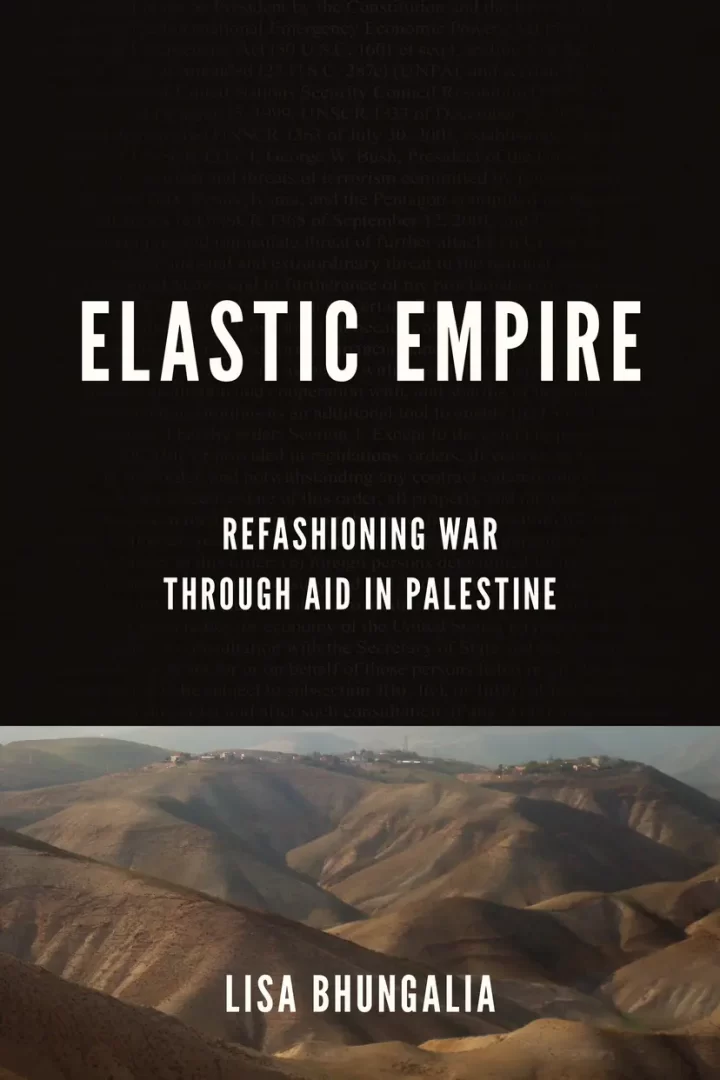
Lisa Bhungalia. 2023. Elastic Empire: Refashioning War Through Aid in Palestine. Stanford: Stanford University Press.
Israel kills 59 Palestinians in Gaza, many while trying to get aid
– Al Jazeera, 15 June 2025
Dozens of aid seekers among 82 people killed in Israeli attacks on Gaza
– Al Jazeera, 20 June 2025
Aid seekers in Gaza continue to be targeted as Israeli attacks kill 26
– Al Jazeera, 21 June 2025
These headlines, which emerged over a week in June 2025 as I started this piece, make writing this intervention especially jarring. I type, delete, re-type, and delete again, unsure of what makes sense. How do you conjure words in a time of “livestreamed” genocide? Do we require a book to tell us the story of aid as war in Palestine? After all, we are seeing it play out in real time on our phone screens every day in the form of ghastly photos of aid seekers and fleeting headlines announcing the number of them murdered. How does one forget images from February 2024 of bags of flour stained with blood, in what was promptly called the flour massacre? Over a hundred people waiting to receive humanitarian aid were killed. And yet, perhaps, this moment makes books like Lisa Bhungalia’s Elastic Empire: Refashioning War Through Aid in Palestine necessary, to “infiltrate a space”, in the words of Mohammed El-Kurd, that is dominated by silencing, erasure, and complicity – a space where Palestinian truths, as Hala Alyan bemoans, “always come with an asterisk”?
The book becomes especially relevant considering Israel’s recent refusal to let humanitarian aid enter Gaza. On 27 May 2025, Gaza Humanitarian Foundation (GHF), backed and funded by the US and approved by Israel, commenced operations to distribute aid in Gaza. Aid organizations have criticized GHF for making aid conditional on political and military aims while weaponizing “starvation as a bargaining chip”. It was at the distribution sites set up by GHF that Palestinians recorded absolute carnage day after day with hundreds of aid seekers killed. On 24 June, the UN Human Rights Office noted that, since the GHF aid rollout began, Israeli soldiers had killed more than 400 Palestinian aid seekers. The United Nations Relief and Works Agency (UNRWA) Chief called it an “abomination” and “death trap” that humiliates desperate people. According to Francesca Albanese, the UN Special Rapporteur on the Occupied Palestinian Territories, this ‘aid’ system has been used as a tactic of genocide.
These are the debilitating operations of aid warfare in Palestine that Lisa Bhungalia’s book demystifies. Through research spanning over a decade between 2009 and 2021, she argues that Palestine is the archetypal example of the workings of American empire, where the latter’s presence is viscerally felt, especially through military aid and weapons contracts. Building on an analysis of law, policy, and procedure, Bhungalia’s ethnographic exploration shows how precarity and intimate insecurity are thrust upon Palestinians through the securitized and apparently humane aid regime of the US. Blending into civilian aid flows, the regime works in elastic and unsuspecting ways. Channeled through humanitarian infrastructures and architectures of care, US sovereign power takes hold over and is embedded into everyday life in Palestine. Foregrounding these concealed tactics of war, the book examines the forms of sovereignty that take shape “when a security regime is enfolded into the humanitarian infrastructures on which populations weathering wars, displacement, and dispossession are dependent” (51). The spatial view of sovereignty we are then presented is not conventionally restricted to defined territorial boundaries. Rather, it is like a string that can (and does) stretch far, and flexes, shape shifts, and bends unevenly across global space, in what the book frames as elastic sovereignty.
The book is divided into five chapters. Taken together, they trace the history of the consolidation of US terrorism financing law, locating Palestine at the center of this history and mapping its varied impacts. Bhungalia articulates what she calls the elastic imperiality of the US security state and its versatile modes of power as they are felt in daily infrastructures of life in the West Bank and Gaza, ranging from greenhouses to libraries to municipalities to eatables. “Terrorism lists”, as Bhungalia notes, have intimate implications for people’s everyday lives, as do the transnational donor aid practices governed by norms set by the US counterterrorism paradigm. Recounting the stories of six Palestinian organizations banned under the list, she shows how their subjection to these slow and invisibilized processes of constricting violence progressively erodes conditions of livability. Despite this counterterrorism architecture, which is deeply embedded in Palestinian infrastructures, landscapes, bodies, and everyday lives, the book argues that it is not all-determining, drawing examples of how Palestinians creatively and strategically respond within the bounds of permissibility.
Bhungalia refers to these quieter, slow modalities of violence as asphyxiatory violence – the shrouding of imperial and settler colonial violence in a cloak of invisibility.
As Bhungalia demonstrates, the US architecture of warmaking through aid is a process of slow suffocation that remains shrouded in secrecy, rendering deliberate “unknowability”, thereby making it crucial to put these ongoing distributions of war in Palestine and elsewhere “back on the map” (175). Transnational aid flows, while framed in the language of care and relief for particular populations, specifically Palestinians, are in essence “a more silent war waged through the interlacing of aid and law” (8). Bhungalia refers to these quieter, slow modalities of violence as asphyxiatory violence – the shrouding of imperial and settler colonial violence in a cloak of invisibility.
The book provides critical insights on the events that have historically shaped the definition of “terrorism” in the second half of the twentieth century and their severe ramifications for aid work in Palestine in the later decades. Bhungalia traces how an Israeli think tank founded by Benjamin Netanyahu in 1976 played a crucial role in reframing the debate on terrorism. “Terrorism” was posited as a direct assault on “civilization”, “democracies,” and “the West” and seen to be “arguably fueled by the Soviet Union and Arab states” (32). These interventions enabled a redrawing of the ideological boundaries of the term, allowing for it to be weaponized against resistance movements. It thus became a way to delegitimize peoples’ right to self-determination and political violence towards that end, and was mobilized specifically in response to Palestinian resistance in the 1970s.
Deeply embedded within this understanding of terrorism, Bhungalia argues, is the transnational US counterterrorism infrastructure that was unleashed on the world, especially by the global ‘war on terror’. Said war criminalizes a broad notion of “material support” for terrorism, thereby allowing US law to infiltrate everyday life in Palestine and making aid a site of punitive governance. Within this speculative security model, Palestinian bodies are seen as threats-in-waiting, whose guilt is pre-emptively built into security lists through racialized presumptions of intentionality. These lists “infuse aid space in Palestine” (87), as they permeate institutional structures and everyday life. Simultaneously, they function as an instrument of counterinsurgency.
According to Bhungalia, in an effort to maintain their compliance with these lists and decrease the risk of being challenged under US law, agencies like the United States Agency for International Development (USAID) initiated processes of extreme vetting, thrusting the responsibility of compliance onto civilian agents that received US grants and contracts. Such outsourcing offset the risk faced by USAID but increased the vulnerability of racialized aid workers, making them responsible for adhering to US law through excessive self-policing, surveillance, and policing mechanisms in their aid programs.
As Bhungalia notes, the extreme vetting that USAID demanded of these NGOs and the newly integrated compliance measures affecting the US security regime’s operations and subcontracting did not go without resistance. In 2003, after USAID introduced a host of compliance measures, a prominent Palestinian coalition of NGOs called the Palestinian Non-Governmental Organisations Network (PNGO) announced a boycott of USAID for “setting unacceptable conditions” (91), framing their act as a refusal to be pressured into a “state of defence” (92). Refashioning US intervention to such resistance, a new wave of NGOs emerged, playing a part in the gradual weakening of the PNGO boycott. With the funding pool shrinking, more institutions were forced to accept the conditionalities.
In 2021, UNRWA signed the framework for cooperation between UNRWA and the US, modifying its mandate to provide relief based on the subjective calculations of a foreign state’s determination of who is or is not a terrorist. With this agreement and to avoid losing access to US funds, the UNRWA began undertaking surveillance functions on behalf of the US government over the refugee populations it was meant to serve.
Palestine continues to serve as the laboratory, Bhungalia reminds us, for “evolving tactics and instruments of global counterinsurgency” (56).
The hyper-securitized aid practices fashioned for Palestine have been replicated globally over the years. As the book argues, “Palestine has played a central role in the formation and evolution of a legal-war technology that today animates contemporary war-making and counterinsurgency—not just in the United States or Israel/Palestine but the world over” (47). What is practiced in Palestine on those purportedly seen as lying outside of the human condition is exported elsewhere, in bits and pieces, through technical and material interventions. Palestine continues to serve as the laboratory, Bhungalia reminds us, for “evolving tactics and instruments of global counterinsurgency” (56).
Postscript: Thinking with the Book and Beyond
What does it mean to read an academic work on the weaponization of aid, especially in times of genocide when violence in the name of aid is hyper-visible every day? In the contemporary moment of carnage through GHF in Gaza, Lisa Bhungalia’s book offers an important account of the behind-the-scenes story of aid as warfare architectures. Yet, as we are witnessing, war through aid has not remained restricted to asphyxiatory violence alone. Aid violence has taken spectacular, genocidal forms. The graveyard of the international rules-based order and of the humanitarian system in Gaza is clearly visible. Against this backdrop, reading the book feels heavy, the academic jargon hard to bring into focus in the face of image after image of people killed at aid distribution centres. Its theorizing and narrative are, for this reader, in a time of genocide, overpowered by what is unfolding in Gaza.
These infrastructures of aid on which Palestinians are (made) reliant are dehumanizing. They proliferate punitive regulation, surveillance, and the policing of Palestinian bodies! Such weaponization and dehumanization then demand of Palestinians and their allies to constantly refer to the former’s victimhood within the frame of humanitarian crisis to cast them as deserving of aid. With the flow of aid to purportedly risky organizations or individuals forbidden under US law, receiving aid then becomes a reflection of “politics of appeal” for determining “worthiness”. Some Palestinian bodies are able to “escape the circumscribed category of the terrorist and find refuge in the even narrower node of victimhood” (El-Kurd 2025, 15). This results in reductionist narratives around Palestinian agency and resistance, often reflected in invocations of “civilians” or “women and children”. While books like Bhungalia’s are important for a nuanced understanding of aid infrastructures, the contemporary moment of genocide demands of us as allies to learn from and build on such knowledge – but also to move beyond academic engagements to practice direct action rooted in the Palestinian struggle for liberation.
In “Literary Criticism in a Time of Genocide”, Steve Salaita (2024) reminds us:
“During a genocide […] The busywork starts to feel obscene. Publishing a book loses much of its pleasure. Everything is disrupted—“normal life” becomes a kind of cruelty underlain by regret and guilt and anger.
All I want is for the genocide to end—this includes punishment for its perpetrators and supporters—and the subsequent liberation of its victims. Everything else is academic.”
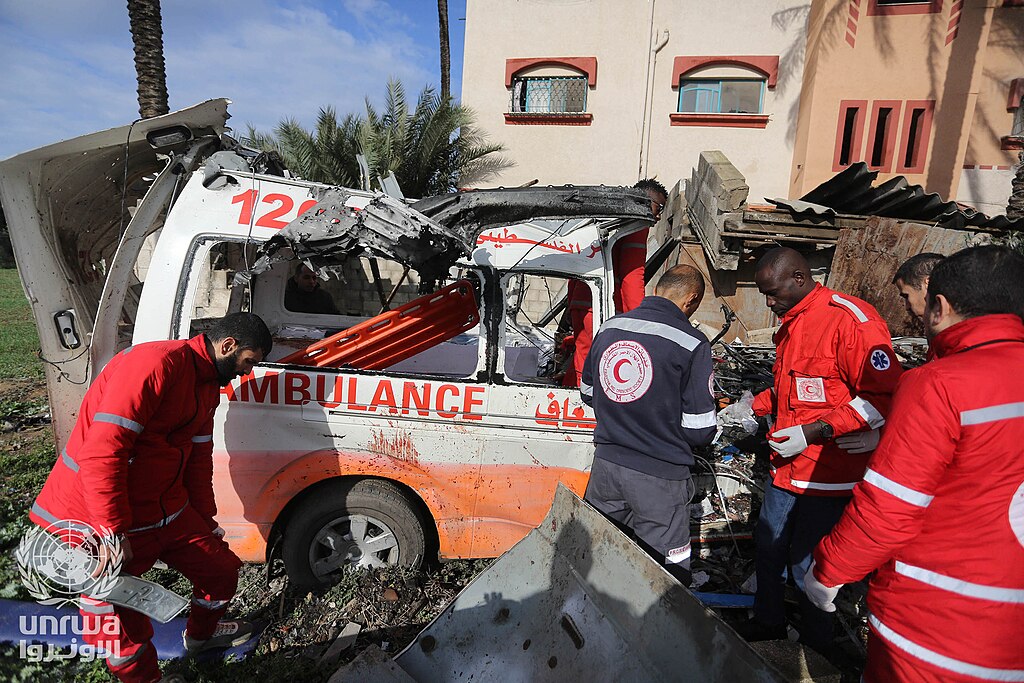
Featured Image: Palestinian Red Crescent Personnel inspect a destroyed ambulance in Deir el-Balah, Gaza Strip. Source: Wikimedia Commons.
References
El-Kurd, Mohammed. 2025. Perfect Victims: And the Politics of Appeal. Chicago: Haymarket Books.
Salaita, Steve. 2024. “Literary Criticism in a Time of Genocide.” https://stevesalaita.com/literary-criticism-in-a-time-of-genocide/