
Since October 2023, I have been exposed to images and videos from Gaza that I will never forget. Although I tried to protect myself from the ‘worst images,’ this was not always possible. What I saw was an unimaginable scale of violence and destruction. Parents searching for their children in the rubble. Injured children looking for their parents in the streets. A girl running through a refugee camp amidst burning tents, unaware that her entire family was dead. A father lifting his decapitated child from the fire. Babies in incubators without power because hospitals had been bombed. The many people carrying child corpses wrapped in white cloth kept haunting me in my dreams. My relatives and friends often asked me why I kept watching, since I could do nothing to change the situation. But for some reasons, I needed to see. If I could not act, at least I had to bear witness.
More recently, I came across a girl pleading, “Please don’t scroll. You are my only hope” in my Instagram feed. The clip asked for donations while documenting life under genocide. This video, like many others circulating on social media, can be conceived as a digital testimony. This essay examines how people self-represent under life-threatening conditions and how platforms shape both witnessing and survival strategies within their censoring logic. It also considers what this experience does to us as viewers, followers, witnesses, or donors.
On war photography
The Vietnam War demonstrated that when the public is exposed to graphic images of civilian suffering, opinions can shift dramatically. Coverage showing the realities of war eroded public support for the conflict, while iconic photographs like “Napalm Girl” and the “Saigon execution” became powerful symbols of its human cost (Hallin 1986; Perlmutter 1998). The “CNN effect” theory, according to which 24/7 real time news coverage of humanitarian crisis can pressure policy makers to act quickly, certainly influenced perceptions of the Bosnian war (1992–1995). Images heavily influence “what we care about, ultimately what evaluations are attached to these conflicts”, Susan Sontag writes in Regarding the Pain of Others (2003). In later conflicts, such as the Iraq War in 2003, journalists were often embedded with military units, placing them under military supervision and restricting what they could report (Butler 2010). Social media unsettles these rules. During the Syrian war, citizen journalism enabled the documentation of war crimes and gave narrative agency to victims on the ground (Al-Ghazzi 2014). But in the case of Gaza, a new pattern emerged: beyond civilian reporting, Palestinians use platforms for survival-oriented fundraising, competing for attention and aid.
“Please don’t scroll”
The first step is to capture the attention of someone scrolling through Instagram and disrupt their habitual swiping. A common opening is the appeal “Please don’t scroll” (@mo_matter, 90k – post not online anymore) or “Please don’t skip this video” (@fady.nassar.376, 2k). This is often followed by calls for support like “You are the only one who can help us” (@razan_y.s, 19k), directly addressing the viewers, creating moral pressure. Some go further and say in a warning tone, “I will never forgive you if you scroll this video” (@nim.8m 360k), or even more drastically: “If you skip me, you kill me” (@noor_jabeer2, 96k – profile not online anymore). The message that is conveyed is that viewers should not only watch but react, show solidarity, and share. Ignoring must not be an option.
The Israeli-American cultural theorist Ariella Aïsha Azoulay speaks of a “civil contract” (Azoulay 2008, 85) of photography that links photographers, subjects and viewers. In her view, photography is not only a documentary medium but a political space in which rights and visibility are negotiated. The viewer is actively invited to participate. She writes: “The photo acts, thus making others act” (ibid., 110). Here, this principle is radically intensified. Viewers are actively urged to look and to help.
The videos circulating from Gaza (…) demand that viewers not only witness suffering, but respond: to prove that they are still human enough to be moved.
Because people are more likely to linger on a visually exciting video, a common strategy is to use viral suspense clips (e.g., a large stone falling from a bridge into water). The visually appealing material keeps people watching, while the abrupt shift forces them out of the trance of scrolling and exposes the absurdity of their consumption habits in light of Palestinian suffering. The trivial viral clip clashes with the urgency of the appeal. Some accounts call this a “test of humanity” (@loloyakai55 / @sharafoz): whether, within the numbing rhythm of doomscrolling, compassion can still turn into action. As Susan Sontag reminds us, “compassion is an unstable emotion. It needs to be translated into action, or it withers” (Sontag 2003, 79). The act of scrolling past, of turning away, has become normalized; “It seems normal to turn away from images that simply make us feel bad” (ibid., 91). The videos circulating from Gaza confront this passivity directly: they demand that viewers not only witness suffering, but respond: to prove, as it were, that they are still human enough to be moved.
“From under the rubble to tell the story”
Many Palestinians document their everyday lives during the war through their accounts. One example is 20-year-old Hosam Alkhaldy (@hosam.gaza, 782k), who lost his entire family in an Israeli bombing after relocating to the south of Gaza, to an alleged “safe zone”. He says: “I watched my loved ones die before my eyes.” He later films his return to his destroyed house and records himself at night as planes fly overhead. He says he is ready to die and posts short updates like “I’m still alive.”
Many videos are technically polished and follow current trends, produced by creators who were active before the war and already skilled in platform storytelling, like @sobhe_sayyed (18k) in his before / after videos.
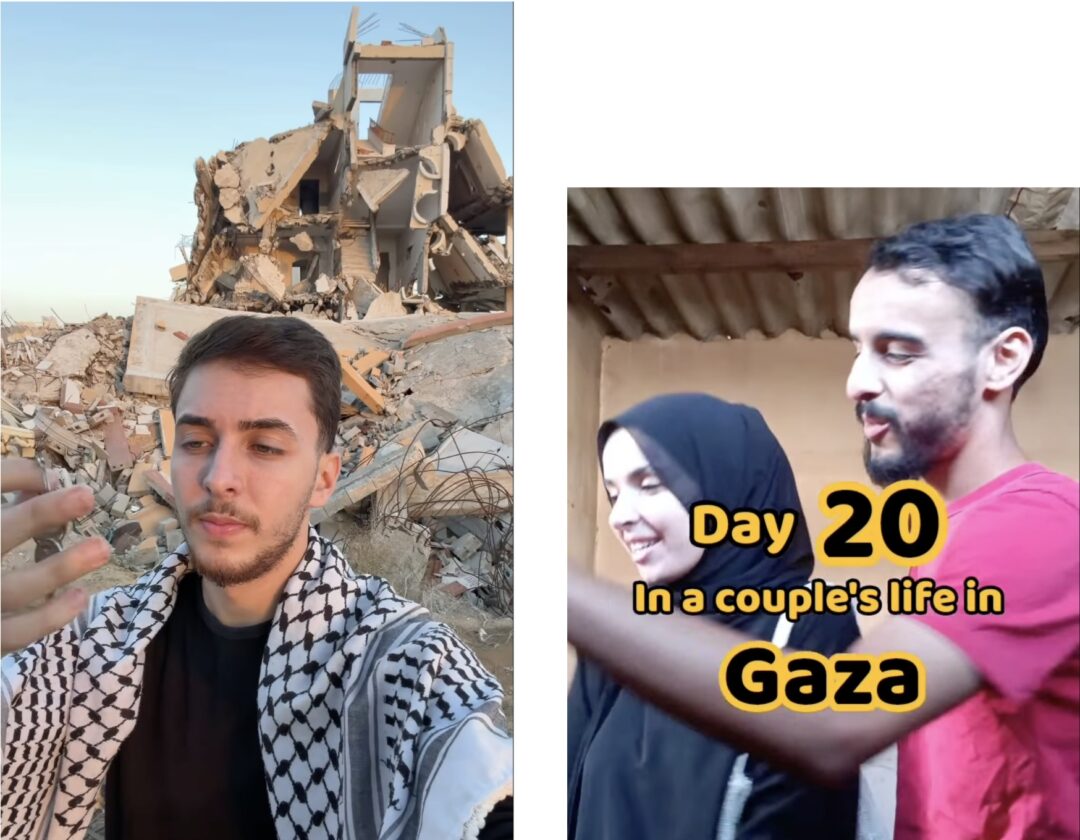
Figure 1 (left): Hosam (@hosam.gaza) returning to his destroyed home after his first displacement. Source: Screenshot, Instagram-Post, posted 11.9.2025. Figure 2 (right): Hadeel and Abed (@zwo_gazans) documenting their daily lives in Gaza. Source: Screenshot, Instagram-Post, posted 17.6.2025.
Another example is the profile of Hadeel and Abed, who share their daily life in Gaza under the profile @two_gazans (172k). They previously ran a content marketing agency but their office was destroyed. They now post scenes of their everyday: “Day 42 in a couple life in Gaza“, feeding their cats, walking through rubble, drinking coffee, cutting their hair, cooking with whatever is available, or watching the sunset. Hadeel and Abed have already raised over $28,000. They need it primarily for survival – food has become expensive, if it is even available. But they also hope to one day rebuild their business. If they survive.
Sharing fragments of daily life – something many did long before the war – becomes a form of testimony. What once served to connect or entertain turns into a search for active witnesses: a way to show destruction and loss, but also continued existence amid the unlivable.
Fundraising appeals
Many of the videos examined are explicitly designed to go viral, and this is stated openly: “Please don’t skip this video. In 5 seconds, you can change everything for me and my family.” (@l.yan.ahmed 98k). Viewers are urged to watch the video multiple times, like it, comment, share, or use the audio. Only few achieve major reach. One example is the account of twin brothers from Gaza (@twins_gaza1, 682k). In a video, they ask viewers to comment with emojis of their national flags, reaching 1 million likes and 400k comments. Viewers also push the videos: they post random words to boost the algorithm or long passages such as song lyrics since longer comments rank better.
Many profiles are only weeks old and include “Gaza” in their names, signaling they were created for this situation. Some users likely learned some English specifically for this purpose. Social media becomes a strategy of hope: for visibility and for financial support. Almost all accounts provide PayPal or crowdfunding links such as GoFundMe or Chuffed.
In addition to a livestreamed genocide, we are witnessing the absolute atomization of Palestinian society.
These strategies reflect a privatized form of humanitarian communication in which Palestinians, abandoned by the world and cut off from aid as Israel blocks relief supplies, must seek support individually. Since the siege began, Gazans have been left without electricity, food, or fuel, triggering a humanitarian catastrophe of a magnitude unseen since World War II (MSF 2025). This creates what Sara Ahmed calls an “affective economy” (Ahmed 2004): feelings circulate and generate value. Empathy becomes currency, turning attention into visibility, reach, and possible survival.
To sustain life in the midst of genocide, some creators rely on platform “tricks” while others turn to emotional exposure, showing injuries or children, exhibiting their suffering to invite empathy. This privatized form of humanitarian communication relies on a competition of pain: whose suffering seems most severe, whose link gets clicked, who gets scrolled past. The result is dystopian. The siege collapses solidarity into algorithmic competition, forcing Palestinians to stage their despair to survive. In addition to a livestreamed genocide, we are witnessing the absolute atomization of Palestinian society.
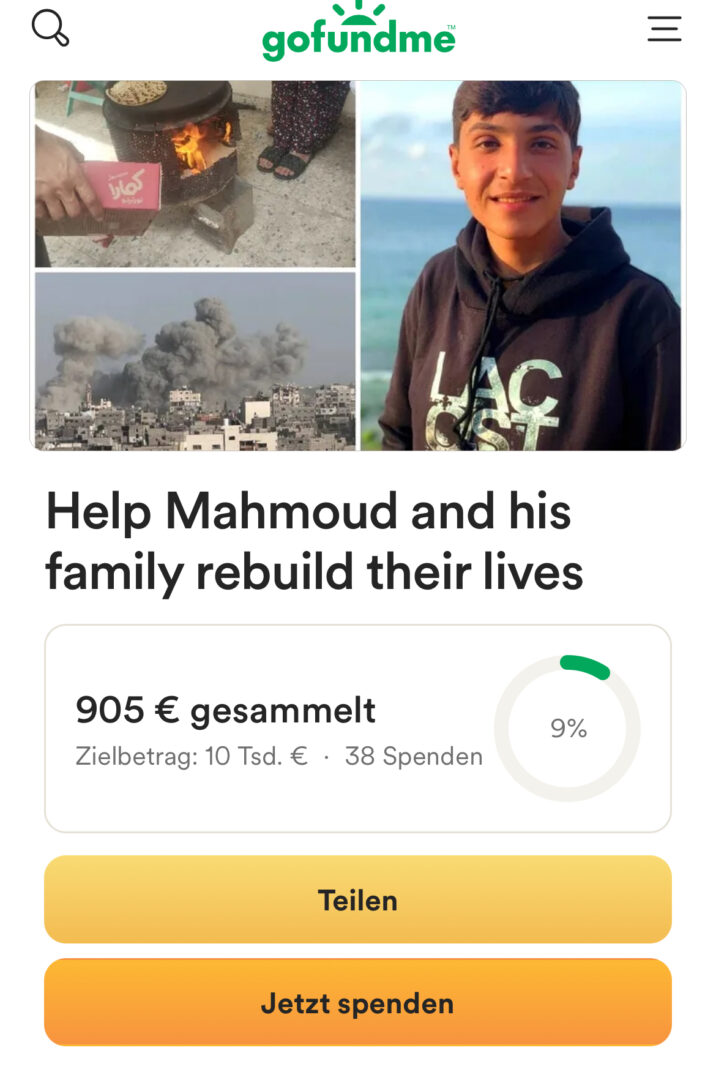
Figure 3: Mahmoud’s (@m3hmu0d) Gofundme page to raise money for him and his family. Source: Screenshot, the Gofundme is no longer available.
Digital resistance
The videos from Gaza are boosted by viewers located outside the strip who repost, translate, and comment on these clips, vouching for their authenticity and helping them achieve a broader reach. Viti, a writer, introduces Palestinian profiles on her channel and urges her community to donate: “Repost at minimum… Act now, be generous. Do a good thing for today.” Reposting is presented as a minimal effort and donating is framed as a daily ‘good deed.’ Another example is @nermeen.store, who also introduces profiles, always with the note that they have had direct contact. While such reposts are motivated by solidarity and can play an important role in increasing visibility, this form of mediation nevertheless points to a structural asymmetry of credibility: Palestinian footage tends to be perceived as more trustworthy once it is endorsed by Western (often white) voices.
These efforts of mediation are a direct response to concerns over fraud. Even though the videos are compelling and raw, a grey zone may exist: some people may steal viral clips to post on their own pages, others may receive large donations and neither use them nor pass them on. As M., one of my interlocutors, put it, in a society stricken by bombing, siege, and hunger, trust and solidarity quickly erode. People are left to only take care of themselves.
Mainstream media tend to focus on fraud narratives, as seen in debates over images of starving children. Critics claim that the children’s suffering stems from pre-existing conditions and thus cannot serve as evidence of an emerging famine (Euronews 2025). Israel has repeatedly denied any humanitarian crisis in Gaza (AA 2025).
In this context, the term “Pallywood” (a combination of “Palestine” and “Hollywood”) has circulated widely on social media. It is used to cast doubt on the authenticity of images and videos from Gaza, while journalists and NGOs are discredited as mouthpieces of Hamas. The notion draws on racist discourses that relativize and deny real suffering. This marks a dangerous shift: instead of addressing occupation, obstruction of aid or actual suffering, it seeks to systematically undermine empathy with Palestinians by questioning the realness of their suffering (Bildungsstätte Anne Frank 2025).
Children without childhood
The appearance of children in these videos is striking. Some children seem to barely understand the words they utter (@save_layan_and_eman, 5k). Relatives who run the account likely believe children are more effective to attract empathy because they evoke stronger emotional responses.
As anthropologists of humanitarianism have discussed, children are central to humanitarian communication because childhood functions as a moral claim, a symbol of innocence. Miriam Ticktin argues that innocence is not a neutral sentiment but a political category that defines who counts as a “worthy victim” (Ticktin 2017, 577). Palestinian children are not automatically granted this status. Their suffering is often doubted or reframed as manipulation. At the same time, the very act of speaking, documenting, and explaining marks the erosion of childhood itself, as the following examples show:
A boy named Kazeem looks seriously into the camera and says: “Today is the 600th day. We do not have shelter, no water, no food” (@kazeem_kareem24, 417k). Ten-year-old Toleen, holding her baby sister, asks: “Did you see the girl in the fire? Don’t you care that we see this horror every day and wait for it to be our turn? Why isn’t anyone stopping this?” (@toleen.nasser86, 21k).
Childhood does not exist in genocide – only children trying to survive it.
Another boy, Abdulrahman Abu Hattab (@reachabed, 585k), explains daily life: making milk from powdered milk, accessing the internet via scratch cards. He asks whether one can even be happy in Gaza (“no, because everything that used to be fun is gone”). Mahmoud from Rafah (@Mahmoud_mosa13, 220k) asks his friend Amir what will happen in Gaza. Amir answers: “I tell you, we will all die in Gaza. Slowly… And no one will talk about us. And then it’s over.” Mahmoud replies: “That will happen.”
These children no longer have a childhood. They speak with fear and exhaustion and take on adults’ chores. A report from early 2025 found that 96% of children in Gaza believe they will die soon and 49% wish for it (warchild 2025). Childhood does not exist in genocide – only children trying to survive it.
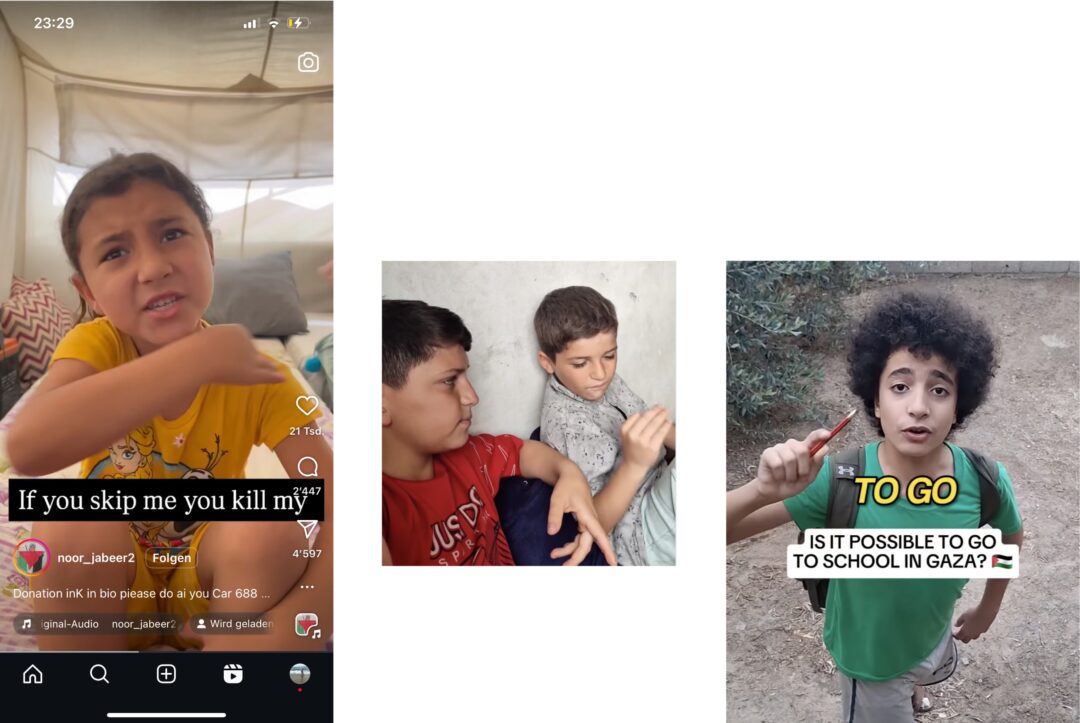
Figure 4 (left): “If you skip me you kill me” The Profile is not online anymore. Figure 5 (middle): Mahmoud (@Mahmoud_mosa13) and his friend Amir think “they will all die”. Source: Screenshot, Instagram-Post, posted 8.4.2025. Figure 6 (right): Abdulrahman (@reachabed) answers questions from viewers about his everyday life, like “is it possible to go to school in Gaza” (Answer: no, as most of the schools have been destroyed). Source: Screenshot, Instagram-Post, posted 24.8.2025.
Digital apartheid
While Palestinian content creators face death every day, their digital existence is simultaneously under threat. Their content is systematically suppressed through censorship and shadowbanning, so they distort key words to escape detection: “G@za” for “Gaza” or “gen0c1de” for “genocide”. Many reports block accounts or restrict livestreams. International viewers (@dariadaria 2025) also note dramatic drops in reach after expressing pro-Palestinian views.
Platforms are not neutral infrastructures but active participants in public discourse (Gillespie 2018). Platforms operate based on their own content moderation rules, which are neither democratically legitimized nor publicly accountable. They are quite susceptible to influence: A 2023 Human Rights Watch study found systematic suppression of Palestinian content by Meta through six recurring patterns such as removal of content, account suspension, deletion or shadowbanning.
A major driver is Israel’s Cyber Unit, which regularly reports Palestinian posts as “incitement to violence” or “terrorism promotion”. Meta usually complies (EFF 2024). Censorship is visible on TikTok too: “TikTok blocked us, because we live in Gaza,” says Sahar (@sahargaza_, 316k).
Therefore the unequal treatment of Palestinians compared to Israelis is not only evident in legal systems, freedom of movement, access to basic rights, protection from violence, or political participation (Amnesty International 2022) but also extends into the digital realm. The Electronic Frontier Foundation (EFF) calls this a “digital apartheid”. In October 2025, Israel signed a six-million-dollar contract to influence one of the world’s most widely used AI models, ChatGPT, toward a more pro-Israeli stance (Middle East Monitor 2025).
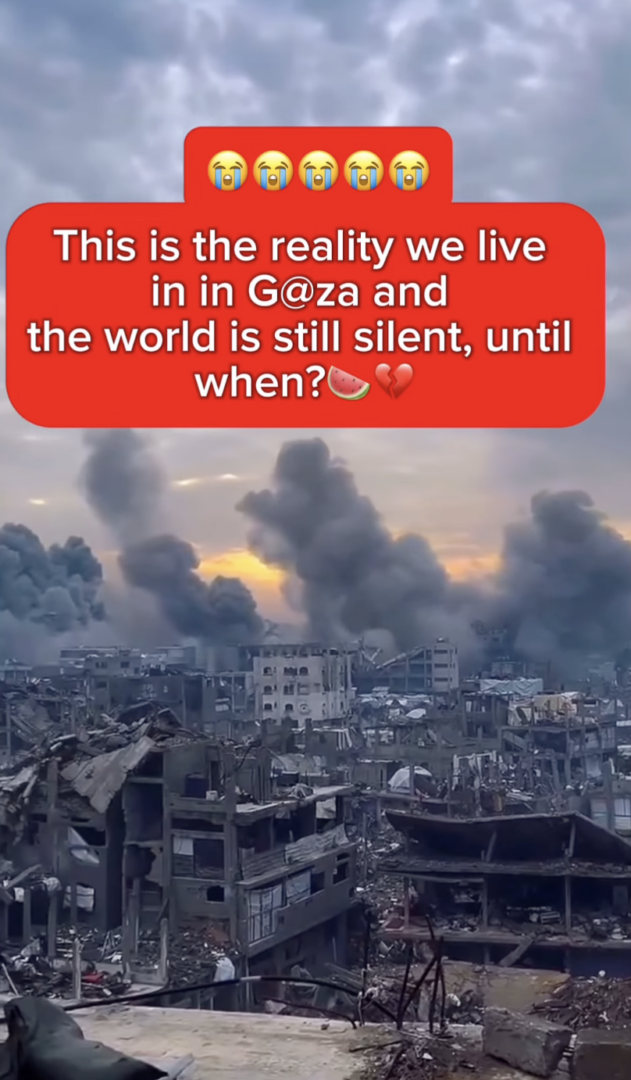
Figure 7: Mo (@mo_matter) showing his reality in “G@za” (altered spelling to avoid censorship). Source: Screenshot, Instagram-Post, posted 24.8.2025.
Conclusion
The social media accounts examined in this research reveal how Palestinians use social media as a survival strategy and a privatized form of humanitarian communication. Platforms are used to attract international attention and raise funds. Many accounts are owned by people who were not previously active online and had to acquire the technical and linguistic skills. Others, mostly owned by young people from Gaza, were already familiar with social media and actively used them before the war. They now document the state of emergency and their attempts to maintain daily life within it. Their posts can be understood as civilian war reporting and as digital testimonies. They are also an expression of a desire for normalcy and connection with the outside world. As Imad (@emad_family2003, 55k) writes: “You are not just followers, you are my support and my lifeline in a time of oppression (…)”
Despite algorithmic censorship, shadowbanning and “digital apartheid” (EFF 2024), these voices have a global reach. When Abdalkarim Ghattas (@karim96.gaza, 57k) tearfully says: “I’m still alive, but I’m barely holding on,” 1’452 people from all over the world respond in digital solidarity: “Karim, we can hear you. We see you. We will not abandon you.”
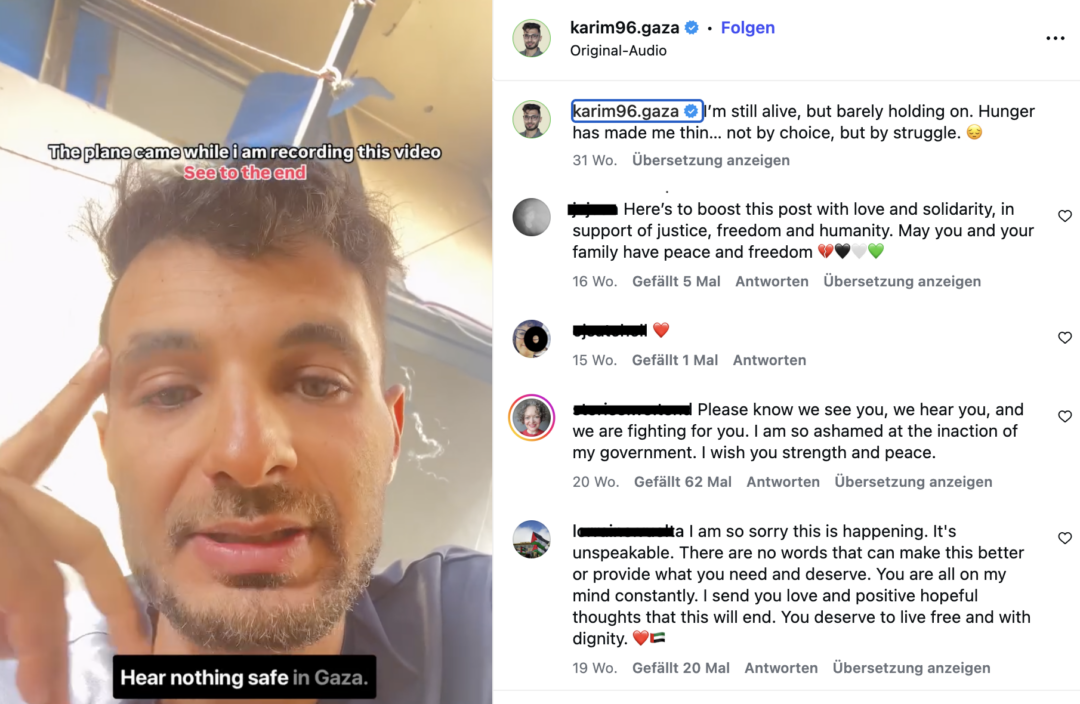
Figure 8: “I’m still alive, but I’m barely holding on” says Karim (@karim96_gaza) People in the comment sections express solidarity and empathy. Source: Screenshot, Instagram-Post.
But as moving as these digital encounters are, a painful power asymmetry remains: The viewers can see but can do little. Testimony on social media, in this case, mainly means: not looking away. Donating, sharing, commenting is possible. Yet, the structural injustice and military violence remain outside of our ability to act. This gap creates a specific form of powerlessness: viewers witness immense suffering without being able to stop it. Opening Instagram, once a casual act, now comes with hesitation about what might appear. And still, forcing oneself to look feels like an act of solidarity. And even though it may seem little, it still has meaning for the people in Gaza. Emad (55k) thanks his followers: “Here in Gaza, despite the war, the pain, and the devastation, we have not lost hope. That hope is drawn from your solidarity, from your voices, your compassion, and your continued humanitarian support. (…) Thank you for not ignoring our suffering and for not leaving us alone in the storm.”
Acting digitally will never be enough. The images call on us to act beyond the screen: to march, speak up, engage others, sign petitions, refuse.
The past months have changed how I see the world. The images from Gaza form a mental and digital archive of destruction. I watched, liked, shared, commented. I spoke with those affected, I donated and showed solidarity. And yet, these forms of action remain paradoxical. There is a persistent contradiction in trying to express care through the tools of a social medium that itself reproduces inequalities. Acting digitally will never be enough. The images call on us to act beyond the screen: to march, speak up, engage others, sign petitions, refuse. While our actions may be small, we must still take them. Because we have seen and we know.
Featured image: Foto by Leon Seibert on Unsplash, 2019.
Bibliography
Ahmed, Sara. 2004. Affective Economies. Social Text 22(2), Duke University Press. 117–139.
Azoulay, Ariella Aïsha. 2008. The Civil Contract of Photography. New York: Zone Books.
Butler, Judith. 2010. Frames of War: When Is Life Grievable? London / New York: Verso.
Gillespie, Tarleton. 2018. Custodians of the Internet: Platforms, Content Moderation, and the Hidden Decisions that Shape Social Media. New Haven, CT: Yale University Press.
Hallin, Daniel C. 1986. The “Uncensored War”: The Media and Vietnam. Berkeley: University of California Press.
Perlmutter, David D. 1998. Photojournalism and Foreign Policy: Icons of Outrage in International Crises. Westport, CT: Greenwood Press.
Sontag, Susan. 2003. Regarding the Pain of Others. New York: Farrar, Straus and Giroux.
Ticktin, Miriam 2017. A World Without Innocence. American Ethnologist 44(4): 577–590.
The follower numbers of the instagram accounts mentioned were recorded before July 2025
Abstract: This article examines the social media use of Gazans since the Israeli military offensive following 7 October 2023. Based on a qualitative analysis of Instagram videos, it documents how social media is used both as a practice of documenting everyday life under extreme conditions of violence and as a fundraising tool within a digitally constrained and uneven communicative space shaped by platform censorship and unequal visibility. Particular attention is paid to the role of children within this privatized form of humanitarian communication. These practices arise because the civilian population is largely cut off from institutional humanitarian aid as a result of Israel’s blockade of Gaza, forcing Palestinians to seek support individually through platforms. As a consequence, humanitarian communication becomes privatized and competitive, requiring people to vie for visibility, attention, and donations. The article analyses recurring visual and communicative strategies, including explicit calls to watch, share, and donate, and examines the relationship between content producers and audiences outside Gaza.


Such a powerful and heavy read. It is heartbreaking to see how social media brings these raw realities straight to our screens, but bearing witness to it all is so important. Really appreciate you sharing this deep dive into digital testimony and humanitarian communication!