
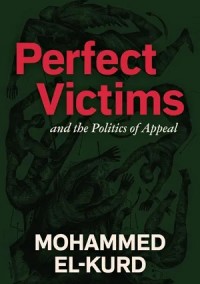
Mohammed El-Kurd. 2025. Perfect Victims and the Politics of Appeal. Chicago: Haymarket Books.
“To refuse that which has been refused to you,” Fred Moten says in a 2018 interview with Saidiya Hartman. It is a phrase that weaves through the Black Radical Tradition and that resonates with Black feminist thinkers such as Fannie Lou Hamer and Sylvia Wynter. Refusal here is not simply the rejection of exclusions produced by the material and structural conditions of racism, colonialism, and dispossession. It is a rejection of the entire structure on which those conditions rest (Halberstam 2013). In this sense, refusal is not a demand for inclusion within today’s existing order, but a rejection of the terms through which that order produces an exclusionary category of the human. In doing so, these thinkers raise a fundamental question: what do liberation and freedom mean when the very conditions of humanity have been denied to you in the first place? Refusal, in this sense, becomes not retreat, but possibility: an insistence that the terms of one’s oppression do not dictate the terms of one’s liberation, but instead make possible the creation of different ways of thinking and being.
In writer and poet Mohammed El-Kurd’s book Perfect Victims, this notion of “to refuse what has been refused to you” finds its clearest expression in a simple yet resolute phrase: “Even if!“. It rejects the idea that any type of Palestinian behavior could ever justify Zionist colonialism and its accompanying dispossessions and atrocities. The book critically examines dominant representational frameworks that cast Palestinians primarily in terms of victimhood, as well as the politics of appealing to Western moral standards in order to be recognized as “worthy” of humanization. It demonstrates how these frameworks eclipse and depoliticize any serious analysis of the power relations and material conditions that shape the Zionist settler colonial genocidal violence that is — and has long been — perpetrated on Palestinian land and bodies. These frameworks, as El-Kurd shows, safeguard the capitalist and imperial interests of Israel and Western governments, rather than the lives and livelihoods of Palestinian people. Ultimately, El-Kurd invites readers to reconsider how stories on the Palestinian cause are told.
The book consists of a collection of nine essays, each opening with newspaper articles, poets, personal stories, and Palestinian proverbs. These materials empirically trace how Zionist violence shapes both modes of representation of Palestinians and Palestinian consciousness. In a refined and incisive manner, El-Kurd combines these sources with political analysis that balances poetic reflection and humor with sharp critique. This review specifically highlights three forms of refusal that El-Kurd elaborates: the rejection of the politics of victimhood, the refusal of terrorist labeling, and the critique of the frameworks that govern solidarity. It also considers what these forms of refusal might mean beyond the specific context in which the book is written.
Refusing to be disciplined into victimhood
El-Kurd opens the book by laying bare the systematic and normalized dehumanization of Palestinian life dominant in Western media portrayals, including in “left-leaning” outlets. Newspaper headlines reduce lives to numbers to be mourned, while interview questions dehistoricize a liberation struggle into isolated acts of violence that must be condemned. Through such examples, El-Kurd argues that Western media and institutions “refuse to look us [Palestinians] in the eye” (p. 20). Rather than engaging Palestinians as political subjects shaped by a history of dispossession and resistance, dominant narratives reduce them to objects of pity or moral judgement.
El-Kurd interrogates this recurring dynamic through the politics of appeal. These are relations of power that force Palestinians to perform a suffering that appeals to Western values. This way, humanization becomes dependent on proximity to innocence: it depends on sanitized narratives that foreground women and children, emphasize suffering and pain, display passive and impeccable behavior toward the settler, remain non-threatening or disavow any form of resistance. In other words, Palestinian victimhood is rendered palpable to the Western gaze and denotes not simply suffering per se, but suffering that is tolerated only insofar as it is performed correctly. A politics of appeal thus directs empathy only to those identified as victims, rather than fostering solidarity with the broader population. In this way, it excludes those deemed undeserving of sympathy, but who nonetheless live under the same conditions of Zionist settler-colonial oppression. Moreover, this logic of victimhood is not only conditional but also retrospective: victimhood is activated only once violence has already been inflicted — not as a basis for preventing it.
The constant demand to “prove” one’s humanity exposes the hierarchical logic of recognition itself, operating within a colonial grammar that dictates whose lives are grievable, whose suffering commands attention, and for whom political struggle is rendered thinkable.
Rather than granting Palestinians dignity or sovereignty as inherent to their humanity, they must earn recognition by the figure of the “acceptable victim.” The constant demand to “prove” one’s humanity exposes the hierarchical logic of recognition itself, operating within a colonial grammar that dictates whose lives are grievable, whose suffering commands attention, and for whom political struggle is rendered thinkable. This grammar reproduces a fragmentation of Palestinian lives. Now not only speaking to Western audiences but centering Palestinian agency, El-Kurd asks, “Why contribute to a hierarchy of lives where citizenry, like race, class, gender, ‘civility,’ plays a role in determining whether someone deserves compassion or due diligence?” (p. 44).
It is precisely this ethical space that the book rejects. By arguing that performances of victimhood will not advance the Palestinian cause any inch beyond a moral framework operating on Western sensibilities, the book refuses the reduction of Palestinians to passive sufferers. El-Kurd shows how anti-appeal means not just the concrete struggle to counter the ideological claims of Zionism, but to defeat its political project. It means shattering the logics of conditional humanization, of white supremacy, of Islamophobia, of racism. Anti-appeal then becomes an assertion of Palestinian dignity and resistance. This way, the book makes a gestural connection beyond merely a critique of dominant modes of media representation of Palestinians.
Refusing to become recognizable by narratives of terrorism
When Palestinians resist, however, their possibility of recognition by this limited humanitarian framework collapses: they are condemned, labeled terrorists, and effectively expelled from the category of the human. The logic of the “perfect victim” produces a false opposite: the “imperfect victim,” encompassing militants, activists, intellectuals, and anyone who resists the script of passive suffering. El-Kurd writes, “We are always one error away from transforming into terrorists,” before asking, “But what are the implications of that argument?” (p. 144).
Western media’s swift equation of anti-colonial resistance with terrorism obscures genuine intellectual engagement with the political meaning of anti-colonial ruptures. When political analysis stops at ethical condemnation over the use of violence itself, what anti-colonial resistance might articulate — over a century of Zionist settler colonial violence, the material and ideological complicity of Western governments, the military-industrial complex, imperial global structures — remains systematically sidelined. This way, this moral framework serves imperial power in at least two ways: first, it reproduces a hierarchy that privileges the innocent “good Arab” over the anti-colonial militant, in so doing hollowing out what forms resistance may legitimately take and “defanging” those forms that challenge power; and, second, it secures Western superiority, allowing complicit governments to position themselves as ethical arbiters rather than colonial actors.
Western media’s swift equation of anti-colonial resistance with terrorism obscures genuine intellectual engagement with the political meaning of anti-colonial ruptures.
Throughout the book, El-Kurd shows how Western media coverage systematically flattens the political potential of resistance. When outlets report on acts of Palestinian anti-colonial resistance, they predominantly present these as eruptions isolated in time and geography – stripped of temporal depth and conceptual legitimacy. Media outlets rarely engage with resistance forces’ own political statements, manifestos, or strategic lines. Yet as Abdaljawad Omar (2024) argues, precisely actions like Operation Al-Aqsa Flood cannot be divorced from Palestinian politics. They renew political imaginaries capable of exposing the fragility of the so-called most powerful army in the world and the impermanence of Zionist control. These actions thus bear not only a material role but also an ideological one: they reopen imaginaries of the very possibility of liberation. Refusing to become recognizable by narratives of terrorism then not only reflects the refusal to separate the critique of uses of anti-colonial violence from the violence of Zionism’s everyday atrocities, accumulation of death, dispossession, and erasure of Palestinian life. It also means abandoning a grammar of victimhood and suffering for genuine engagement with the possibilities of liberation that anti-colonial resistance holds.
Since Al-Aqsa Flood, this dynamic of controlling what forms resistance might take has intensified outside Palestine. Western governments increasingly ban and criminalize Palestinian solidarity movements — like Palestine Action and Samidoun — as well as individual activists through legal prosecutions, revocation of citizenship, and public stigmatization. Beyond Palestine-solidarity movements, organizations such as Belgium’s environmental collective Code Rood have increasingly been equated with violent extremism, facing the same prospect of restrictive legal frameworks as Samidoun. El-Kurd’s analysis allows the reader to understand that these designations function not only to repress specific activist groups. By separating direct actions from permissible “good demonstrations”, it not only politically fragments different struggles but also establishes the conditions for the ways activist groups struggle. It is George Jackson (1990, p.29) that helps us keep in mind that “Repression is indeed a part of revolution, a natural aspect of antithesis, the always-to-be-expected defense-attack reflex of the beleaguered, toothless tiger.[…] Can power be seriously challenged without a response?”.
Refusing frameworks of symbolic solidarity
To insist, then, on “Even if!” is to refuse the selectivity of anti-colonial solidarity altogether. “Even if!” gives the reader a tool. It exposes the simplistic rhetorical moves — straw-man arguments, slippery slopes, appeals to identity politics — that recur wherever selective solidarity is granted. Even if, the book argues, resistance fighters built tunnels under civilian infrastructure, why align with a logic that uses this rhetoric to legitimize genocide? Or, even if a young man throws a Molotov cocktail at Israeli soldiers, the question remains: what historical and material conditions made that act necessary in the first place?
The question then becomes not whether a people’s behavior or resistance is innocent enough to deserve support, but whether readers are willing to stand with the concrete manifestations of the Palestinian liberation struggle, on their own terms. Echoing Frantz Fanon, El-Kurd offers a materialist lens: the reality of resistance should not be romanticized or fetishized, but should be seen as a real, material response to concrete material and social conditions — the complete erasure of people, land, and culture — and to condemn the response while ignoring these historical conditions is not critique, but disengagement. One might disagree with the tactics or ideology of the forces leading the Palestinian resistance, but one ought to reckon that it is these forces that have the capacity to organize Palestinians, to lead the armed struggle, and to mobilize their allies and solidarity movements (Abdaljawad 2024).
What the book then helps to center is that extending solidarity with a struggle, means backing the larger political cause: the problem is not the tactics of resistance themselves, but the enduring political inertia and systemic violence that render sustained resistance necessary.
Through rejecting the media’s representation modes of appeal to Palestinian victimhood, El-Kurd’s analysis of solidarity with the Palestinian liberation struggle extends beyond Palestine. Consider how Western media outlets today recycle the same condemnations of resistance in Lebanon, Iran, and the imperial core. Similar moral condemnation of resistance, armed or not, is readily mobilized today. Often contemporary political analysis continues to stop at whether a slogan spray-painted on a university wall is an act of vandalism or not, or whether a missile fired is “proportional” or not. What the book then helps to center is that extending solidarity with a struggle, means backing the larger political cause: the problem is not the tactics of resistance themselves, but the enduring political inertia and systemic violence that render sustained resistance necessary. Solidarity with Palestine does not end when Zionism ends. It continues until the global order where imperialism, settler colonialism, and all other forms of oppression still make sense shatters.
Refusal as opening
More than being a book of critique and deconstruction, Perfect Victims is a book that creates openings. By refusing the terms on which the Palestinian cause is so often made legible to Western audiences, El-Kurd creates space for anti-colonial narratives, frameworks, and a reimagined basis for solidarity. The three modes of refusal I trace throughout the book — of perfect victimhood, of terrorist labeling, and of conditional solidarity — are not endpoints, but entry points. They invite the reader to question the taken-for-grantedness of categories like “victim” and “terrorist,” and to ask what solidarity might look like when it no longer fragments the Palestinian people along lines drawn by settler colonial logic.
To refuse that framework is therefore not to reject analysis, but to insist that analysis begin from the conditions of the struggle itself, rather than from the moral grammar of those who administer the Zionist colonial dispossessions, bombings, and atrocities. One of the book’s most important contributions is to translate anticolonial theory of thinkers like Frantz Fanon, Sylvia Wynter, and Fred Moten into practical tools for untangling the everyday political and discourse on Palestine. Perfect Victims bring the reader one step closer with understanding what “to refuse that which has been refused to you” means in practice.
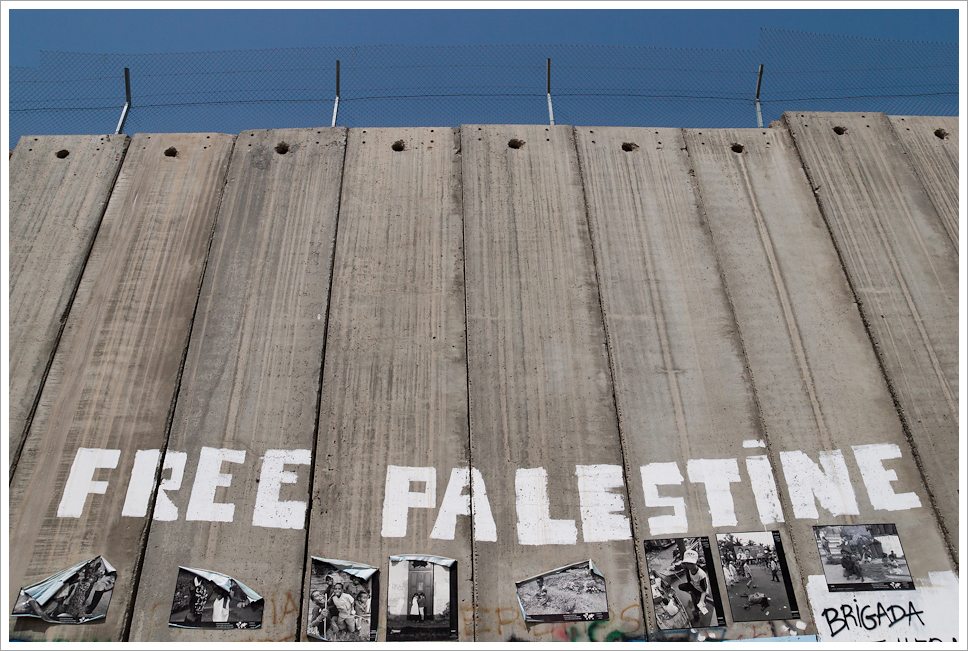
Featured Image: Israeli West Bank barrier, graffiti. Source: Wikimedia Commons.
References
Chimurenga Chronic. (Ed[s].). (2016). To Refuse That Which Has Been Refused to You (Edited transcript of a conversation from the series “Black Outdoors: Humanities Futures After Property and Possession”). Chimurenga Chronic. https://chimurengachronic.co.za/to-refuse-that-which-has-been-refused-to-you-2/
Halberstam, J. (2013). The Wild Beyond: With and For the Undercommons. In S. Harney & F. Moten, The Undercommons: Fugitive Planning & Black Study (pp. 2-12). Minor Compositions.
Jackson, G. (1990). Blood in My Eye. Black Classic Press.
Omar, A. (2024). Shock Without Awe. Radical Philosophy, 2, 47.
Omar, A. (2024, May 31). The Question of Hamas and the Left. Mondoweiss. Accessed at (2026, March 1st) from https://mondoweiss.net/2024/05/the-question-of-hamas-and-the-left/