In this episode, the conversation turns to the structural conditions that make the backway feel like the only viable option for so many Gambians. Moving from the individual to the systemic, the episode examines how unemployment, an inherited colonial education system that teaches in English and ignores local knowledge, nepotism in the job market, and the extractive exploitation of Gambian resources – from fishing deals with the EU and China to pharmaceutical dumping – reproduce poverty and dependency across generations. The episode argues that these are not incidental failures but the ongoing effects of colonial and neocolonial dynamics that continue to shape everyday life in The Gambia, and that any honest conversation about the so-called root causes of migration must start there.
Transcript of Episode 6: (Neo)colonialism
Footnotes by Viola Castellano
Intro:
My name is Tijan Jerju, Fatou Cham, my name is Fatou Darboe, Fatou Bojang from Gambia, Lamin Kotta, my name is Saikou Tunkara.
Viola
I am Viola Castellano and this is Backway to Europe: Talking Borders and Migration with Gambians on the Move.
This podcast series is produced in collaboration with Gambian advocates and activists. It centers their analyses of the border regime through their direct experiences of “the backway”—the local term for the illegalized route to Europe. These experiences resonate with many who have attempted to reach Europe across West Africa and beyond.
In the next seven episodes, you’ll hear from members of Youth Against Irregular Migration (YAIM), an advocacy organization founded by young Gambians who met in a Libyan detention center. The topics and discussions emerged from years of collaboration and are rooted in their advocacy work. I use my research as an anthropologist working on border externalization to provide context and put my findings in dialogue with YAIM’s reflections.
In the previous episode we discussed the impact of voluntary repatriation and reintegration programs, coming to a full circle from when we initially started, from the Gambia through West and North Africa and then back to the Gambia again. In this episode, we will discuss the
structural problems and forms of neocolonial power that Gambia faces, the real root causes of migration
Fatou Darboe
First of all, I will talk about the challenges of the young people in the Gambia here. The first thing is lack of employment.
I would say 60% or 40% of the youth in this country are not employed1.
Even if the people who are employed are not satisfied because the wages that they give is too small.
For example, I am working as a teacher. You expect to give me five thousand dalasi as a salary every month. And I’m renting. I don’t have my own house. I am renting. I have a family to take care of. I have to feed them.
Out of that, the 5,000 dalasi (58 euro) I’m earning a month, 3,000 is out for house rent. If I buy a bag of rice for 1,005, now it means what is left for me is 500.
I cannot use that 500 to feed my family for one month. It’s impossible. The employment and the salary for jobs in the government are too lame.
It’s something that is not reasonable because you cannot expect me to be feeding a family of five or six for just 5,000.
Viola
I witness what Fa is describing talking with a Gambian family I have known since years, where the parents work as teachers and rent a small house in the urban area. They are chronically indebted and cannot cope with the smallest expenses which are not related to mere feeding, despite double shifts and other side jobs.
Fatou Cham
What you said is very important. When you’re working and earning just 5000 dalasi, and you have to buy a bag of rice from that amount, you’re left with nothing. It’s even more difficult when you’re a family man.
Now, why do we say that travel has no age limit? It’s because many people travel out of hardship. You see people risking their lives to reach Europe because the value of their currency is far higher than ours in The Gambia. I even saw an old woman taking the “back way” route to travel.
Everyone wants to lift their family out of poverty, and that’s the driving force behind these dangerous trips. In The Gambia, getting a job often depends on who you know. Even with qualifications, if you don’t have the right connections, you may not find meaningful work. Some people get jobs simply because their parents held similar positions, regardless of their own skills or education.
That’s why people, regardless of age, continue to travel — because they’re searching for better opportunities and a chance to change their lives.
Tombong
The next thing is the dependency ratio. Like I said, I’m the only one working in the family. I have 10 people to feed or 15 people to feed and I am the only one working2.
Except 15 people, 10 people, depending on me, I cannot survive with 5,000.
Viola
This aspect concerns extensive families more than nuclear ones as the one I described before, but is a constant trait especially in rural areas, where agriculture is not enough to provide for their needs.
The educational system bears a huge responsibility in these poor economic outcomes…
Lamin Bojang
Youths graduating from junior school, a senior secondary school, they cannot even apply a job because of the kind of educational system that we have, you know, even the skills that we train, if I told that there’s no apprenticeship or you go to a school, a tertiary
institution to learn a skills, they will give you a six months, six months training, and that six months cannot make you a professional because at least you should know what is in the field before getting to the job. So this is also affecting us as Gambians, and every Gambian want to be independent and to live on your own, at least even if you contribute a quarter to the family development. So it is never easy for us. That’s why all the youths try to embark at least to live in a greener place, to help their brothers and sisters to live a better life.
Fatou Darboe
I want to say something concerning that. You know, the educational system in the Gambia is poor, but the public school is worse and most of the big people and most of the tycoons and the rich people, they don’t send their children in public schools. If we go to Marina International, Sibac and other schools, the schools that we term as the best schools in the Gambia, we go there, children of the ministers, children of the lawyers and others are the ones that are studying there.3
Us from the poor background, we are the ones who go to Women’s School, Serakunda School and others. So the educational system is poor, but the public, it’s worse, I believe.
An unequal educational system is then followed by an unequal access to the job market, where the most privileged secure the best jobs thanks to their networks
Tombong
The job is given to whom you know in the country at some point, you know, like I know him from a very recognized institution and then, he’s managing director there or so, so he’s having and he being a relative to me or a family to me, even I’m not fit for the job or you know, because of that relationship, then you know, will provide me that job when you know, the one that is more eligible and qualified to be in that position will be denied or deprived from not getting that kind of opportunities in the country.
Tijan
For me, like how my colleagues say, the education system has to change because our poor fathers, they don’t go to school, but they have better life than us, I can say, because they feed themselves like they work and they themselves do agriculture and some stuff like that. And then like the white people came, they say education, education, education, education.4
And then they started to differentiate between two countries, like the borders. You have to see borders like this, borders like that.
That’s why people are so suffering on this. If you come to education, you’ll be there for
12 years or 15 good years following some one academic and then after that to have work, it’s going to be so difficult to you, we all cannot work on the office unless some people will go to mechanics, some people will go to machinery, some people will go to agriculture and some people will go to service, like serving the nation, like the soldiers and other. So know that if you are able to be an agricultural person, know that one day or later,
someone who is sitting in a office will need you.
And then if you are an instructor building a house, know that someone, even the president, will need you, need your service.
Fatou Darboe
We are not taught skill works. What we know is if you are five years old, go to nursery school, you start singing there, trying to know what ABC, how to spell some certain words, then you go to primary school. In the primary school, there is no syllabus or no subject that is related to skill works. Then you go to junior school, the same thing. The only subject related to skills is home science and woodwork.
If you know, like, the educational system should be in a way that, make it flexible in a way that if I want to be, sometimes you see a skill in someone. You know that this person will be very good with handiwork. Sometimes you will see someone in the class trying to do some stuff with their hands and drawing old stuff, but they are not encouraged. Even in this thing, art and craft, we are only taught once in a week, it’s Friday. Sometimes the teachers don’t even teach about it. So you are not taught any skill until grade 12. Grade 12, I am 20 years, 21, 22. How do you expect me to go back and start learning skills or skills that I want to know? Even if I have a skill around 12, 13 years old, it will disappear5.
Now what I will be concentrating on, now I’m an adult, 20 years old, 22 years old, I have to concentrate on feeding the family. I have to concentrate on this. I have to get a work. I have to do this. I have to do this.
Saikou
You know, but I think the most important thing is, you know, because before, you know, this educational system came here, our people used to learn, you know, they learn from the environment.
Viola
As Saikou says, Gambia’s education system hasn’t really changed since colonial times. It was designed to serve British administration, not local needs. Pre-colonial knowledge – like farming, fishing, and craftsmanship – was left out. Even after independence, reforms barely
scratched the surface6. Schools are still underfunded, and there’s a huge gap between what’s taught and what society actually needs.And one major issue remains: the language. Kids are still taught in English – a language many don’t speak at home – making learning even harder.
Lamin Bojang
Another point again, you know, Gambia, what is our problem? We believe in English, English language.
If you don’t pass English language to have a job in this Gambia is a problem. Even university, when you want to go to university, you don’t pass English language, you will not go there.
And that English is not our mother tongue7. If I told that it is our mother tongue, why, we will do something greater than that. Yeah. That’s also affecting us, even mathematics too.
And those subjects, there are only two subjects that you know that in the Gambia, we look after them. And that is affecting us. We forget about the other, subject that we do.
Tombong
And then even like taking up the education like he said here. The education has to start from the grass root. That’s where they can have this early education in our primary to secondary and even our tertiary.
Because by the time if I’m not fit to sit in the office, then I am fit to open my own work shop where I can. Because along the line I will take a career or a skill that I will graduate with.
Different from my academic areas. So I think that will also help The curriculum have to be revisited. Our educational curriculum have to be very revisited. And then let’s put things there that we are very connected to than the western thing8.
I think that’s the bottom line of everything in our education system. We don’t have to be very much western to our education. Because at the end of the day that will not help.
Fatou Darboe
We are using English as an, as a way of communicating in the Gambia here, some, some people, some, if some Gambians listen to this broadcast, others will laugh, because most of us cannot speak good English, and our English, they will be like, this is not the way you say it in English, stuff like that, that is not the most important thing, like Saikou is saying some of
the herbs, you translate, you can say it in English, they have a scientific name for it, we are not saying, we are not from Europe, we don’t know their names, if we were using our own language or the language that we know to teach us about science and other things, we will be able to do stuff that people out there are doing, but we are using another man’s language in teaching us, so you don’t expect me to use your language, you will be an expert in it, I will just be there struggling of, if I said this right, Europe and stuff like that, yes, that is what I wanted to add to what Saikou said.
Tijan
And I want to add something there too, like in our, if we use, in our own language, we’re going to develop, because if you see in some country that use their own language, they are developing now. Because if you go to China, they use their own language, they develop, it took European people to come to China to learn their language, and then before
they learn their language, China’s have already developed them, they have already developed themselves. If you go to India, they have their own language too, and then they develop. If you go to Arab people, the Arab people, you know, they are developed, but they are using their own language, and it took times, the European people to come there and learn their language,before they realize those people, what they are changing their language, they have already developed.
So we, the African countries that have in English or French, or Portuguese, to develop is going to be so difficult, because we are not going to hide our secret to them, because the secret, whatever we want to write, we wrote it in English. And then for us, some people who speak English, the grammar is not much good in writing or speaking it, but it took a second, the English people to understand what we are trying to do for a year, or 10 years, but it took a second to English people to understand what we are trying to do.
Fatou Darboe
We always speak Mandinka9 when we are doing, when we are doing our social interaction and stuff like that, but when we are doing our official work, we use English.
Tombong
People have to understand. Our culture don’t have to go away.
When people can’t name things in their own language – or use those definitions to build something for the collective good – and when they’re not taught how to engage with their environment’s resources or understand the needs of their society, that has real, tangible consequences.
Tijan
We have resources, and then some of us, if you ask students, which kind of resources did we have in Gambia here, nobody would say that these resources and the benefit of that resources, no one will tell the person that this is the benefit that we have from our resources.
One example is that of fishing. Without the infrastructure to manage and process its own resources, The Gambia – like many West African countries10 – is pushed into signing deals with countries that do have that capacity. And these deals often come at a real cost to the local population.
When you look at it through the farming, to the fishing side.
In the Gambia, what makes the fish so expensive for us is because, you know, foreign investors come to the Gambia, have their fishing plans.
And they go fishing and have our fish and export them11. So with the people that are living in the country, we cannot have the access to the fish than the one that are transporting those fish.
So it is very difficult because the equipment that they have, they use for fishing. If at all that they use their equipment for us, when our boatmen they get to the sea, they will not have enough fish. Because these people, what they have, you know, the quantity of fish that they will catch, it will be more, it will be so increased that, you know, when our guys, when they go to the sea, they will not have even, they will just have few.
So when they get that few, they went to the market to sell that few fish, it will be expensive for us to buy it.12
But the one that are taking it to China and then manufacture it, then they later send those manufactured products to us. Again, we buy it. So we buy those foods, the foods that we eat is from abroad, everything that we eat is from abroad.
Fatou Darboe
When I was young, fish was cheap in the Gambia, honestly. But nowadays, go to the market and ask, you know, we do it in groups, like, I don’t know how to explain in English. They sum it, I don’t know how you are going to understand that. At first, it was, if you have 50 dalasi, you can buy, you can buy, like, a fish that is very nice. Yeah, group of fish. Yes, four or five fish. At first, you can have five fish for 50 and it’s fine. Five fish for 25. But now go to the market, five fish. If you don’t have 200, you will not have fish. It’s because now we have people who are fishing, who are not us. You know, if I want to, like, if I’m selling in the Gambia here, if I see that this one is my cousin, this one is my family, this one is related to this, at least I will have that sympathy in me. Even if I have to sell the fish at a high cost, but it’s going to be something that is affordable. But if I’m fishing it, and if I’m the one catching
the fish, and I don’t know anybody here, I can sell it however I want it. I believe that is what is happening now. People are selling it, like, however they want. At first, it was very cheap. You can have fish anywhere. But now go to the houses, households. Now they eat chicken instead of fish because chicken is more cheaper, or chicken is more affordable than fish now in the Gambia. And we have a sea, we have fish in our seas and it’s crazy.
Fatou Bojang
Right now, fish is more expensive than meat.
If you check, fish is actually healthier than meat — but in The Gambia, people are eating more meat than fish. It’s mostly people from other nationalities who come and benefit from our rivers.
Now, for Gambians to buy fish at a reasonable price is very difficult. In the rural areas, sometimes it’s cheaper than in Kombo because people there do fishing themselves.
Even me — I went to the market and asked for the price of fish. They told me 50 dalasi . I just turned around and went home. I told my family that fish was too expensive and I couldn’t buy it. But they told me that’s the normal price here.
Back in my village, fish is cheaper — between 5 dalasi and 10 dalasi. If you buy for 10 dalasi, your whole family can eat.
This is something that really affects us, because when you compare life in the rural areas to life in town, you realize rural life is cheaper.
But still, people leave the rural villages and come to Kombo in search of greener pastures. And what we often find here is more difficult than what we left behind in the village
Viola
Many in these years of research told me that the backway doesn’t start when people cross national borders, but when they move from the rural villages in the urban areas, which is the district of Kombo South. Despite life in the so-called provinces is cheaper as people live in a more communitarian way and of the product of subsistence agriculture, opportunities for future-making are still concentrated in places like Serekunda and Banjul
Saikou
Life living in provinces, you know, it’s somehow easier, it’s somehow difficult, you know, but when I say that it’s somehow easier, you know, there are many things in provinces there, if you need it, maybe you will not even buy it, you know, it’s not cost for you to, you know, pull out the money and buy those things, you can have it easier. And they have a lot of access to land, you know, to do farming and many things. But you will see that, you know, and the opportunities, there are many more opportunities in combo here than the open area. So that makes many people, you know, coming from the open area, rural area to come to this, to come to here, open area in combo here, you know, because I can even say the, even the education, you know, if you graduated from grade 12th, you know, your university and those
things, you need to come to combo here, around combo here to have those things. And there are many projects that are coming, the skill trainings and those things, it is difficult for people to have it in rural area. So they will come here to have those things. And what they are, they are doing in rural area, most of them are farmers, you know, and now farming is not that much attractive, it’s not working that well. So they will come here and have as a look for job, you know, to be employed, you know, and do maybe this by the job for them also to have something to give to their families. So, but you will see the rain season and without
the rain season, the rain season, many people will go back to there. But if the rain season is confusing, so there is nothing for them, there is nothing they are doing there, because the rain season is stopped, you know, you don’t have this borehole or water, you know, things to continue to farm, you know, so you only depend on rain and season. So if the rain season is finished, you and your family, you will all sit and, you know, look at each other.
As a reaction to a disruptive impact with globalization, young generations like the one to which YAIM members belong have started to re-evaluate the knowledge of their ancestors, and to claim self-determination as the only path toward a more sustainable future
Tombong
We have to really consider who we are as a nation. By doing that, there are certain things that will change. Like he said, we have our different traditional medicines here. And then we have these traditional healers. But at some point, if you go to those traditional healers, they will later tell you that these traditional healers are telling you something that is not factual.
And then the Ministry of Health will stood and say like okay, we don’t recognize these also traditional healers in the country. So I think it’s high time our ignorance stops.People have to understand. There are certain sickness that are not even related to say like there are medicines that are made by Europeans. But these are sickness that are related to our cultures, our tradition and everything. And then they have the ways how to address those kind of sickness. Perhaps at some point you will be sick and then taken to the hospital.
The doctor will do every medical examination and everything. At the end of the day, the reasons will be I haven’t seen any sickness.
But immediately you are sent to the traditional healer. That you have an interaction will obviously tell you this is what is affecting you or this is what your sickness is all about.
So people have to understand this point. People need to understand. We need to be very proud of who we are as a Gambian and as an African.
Because if that happens, perhaps even Europeans will come with their everything and so. They will understand these people. They consider their culture and everything first before any other implications will come up. So I think it’s very important.
But this will not happen without having this awareness or sensitization on people’s mind. People need to understand this and then this have to start from the grass root. And then getting down to the top level there.
Saikou
Because I think now, Gambia here, we are losing our culture. Even the Mandinkas, many Mandinkas are here, you know, the other tribe. But if you ask them what are your culture, they don’t even know. Most of them now, they don’t know what is there, they are even culture. You know, because now we even need to stop calling it African traditional medicine, but we can call it African natural medicine, or natural medicine.
Because these three, they are natures.They are natural, you know. It’s not about calling them African traditional medicines, you know, but we can call it traditional, or natural medicines, or African natural healers.
Tijan
We need leaders that know that they are Africans. Because before Mali13, they are under European colonialism and then later on, the one who took over, he knew that he is an African, and then he want to work like an African.
So the rest country that are working like Europeans, the leaders that are working like Europeans, they have to come back and work like Africans, so that we can go and develop ourselves.
Yeah, because if you come to, like my colleague said, a lot of us, they don’t know their culture. Yeah, because we copy the culture of Europeans, like how they dress, like how they talk, their lifestyles, and then if we follow like our old fathers do, it will help us.
Like, for example, if you go to agriculture, like how our poor fathers survive in the agriculture, you will see they don’t have those fertilizers, but they have rice more before now.14
And then there’s a question that we need,and then we need to ask ourselves, like how those people manage to have rice done now.
Fatou Bojang
You all spoke well. God made us all, but we are not equal in terms of knowledge. In the past, Kunta Kinteh15 made the white people respect black people. Today, a lot of white people want to marry black people—many white people in Europe who cannot find life partners will marry blacks from Ghana, Gambia, Sierra Leone, and other countries where people travel to Europe. The white people are blessed with knowledge and everything—but in the end, black and white should be one. That’s all I have to say
Tijan
And then Africa will not united because why I say that is some of the country they don’t have full independent. They have half independent from the Europeans from the colonization because still we are in their depending on them because why I say that if you come if you are an African leader fighting for your people the European will get involve saying that you
are a dictator or they will massacre you. If you go to life of Thomas Sankara he was fighting for his people.
Yeah so obviously if you come to Thomas Sankara he was fighting for his people…come to Patrick Lumumba also he is fighting for his people if you come to Mohammed Gaddafi he was fighting for his people but the Europeans invaded there, destroy everything pointing their finger on you saying that you are a dictator convincing your people to go against you saying that you are a dictator calling you a dictator and your people will just come against you. That’s why I’m saying that still Africa will be remain slavering from the face of Europeans.
Saikou
You said that Africa will never unite. I just agree that we will unite. Do you maybe take a long time?
Fatou Cham
What I want to say is this: Africa must unite, because if we say we want to remain in the hands of white people, we will never have true independence. Anything they bring to us will always come with their own terms and conditions—terms that benefit their countries, not ours.
We need to follow the example of our ancestors. We shouldn’t just say, “Our ancestors fought for us, and that’s in the past.” No—we also need to ask ourselves how we can bring real change and finish what they started.
The old system is still in place today. As Tijan said in his speech, it hasn’t gone anywhere. White people will continue to use us, and in the end, we are left with very little to gain.
Tijan
We have more resources than the Europeans but the technical work is there in Europe but the labor work is Africans. So that’s why we Africans develop ourselves.If I told you we are going to unite, it’s going to be a long, long, long process. Is a long way process of uniting Africans. Because everyone who stands for african people the europeans will go to damage you, or they end you. so that you can not go further. Like how you said, European people they will come, researching here, everything, medicines, when they discover a new medicine, they will bring it to Africa to test it. But that is work, the quality one it remains in europe. So just the second one product, they bring it to Africa. They forget that that medicine it was tested in Africa before to approve that, before people to use it.
Saikou
Also I think for us as Africans we have to have strong leaders. That is our problem. We don’t have that much strong leaders that can stand fully for their people.
Viola
In this episode, we explored how education, the use of resources, and opportunities for building a future are all deeply connected. And as we talked through these issues, a few concrete examples came up that really deserve to be highlighted.
When we discussed exploitative fishing, two main cases stood out. First, the three Chinese fish meal factories along the coast – plundering the sea of fish, destroying local livelihoods, and polluting the environment. And second, the EU–Gambia fishing deal. On paper, it’s supposed to be about sustainability. But in reality, it allows European fleets to take almost all of Gambia’s tuna, selling it on the global market for thousands of euros per ton, while Gambia receives just 500,000 euros a year and a symbolic 70 euros per ton.
When Tijan mentioned medicine testing in Gambia, he was referring to a famous British research center for tropical diseases. In the past, experiments were carried out there on the local population – without their consent.
And more broadly, we see a dependency on imported products that shapes everyday life.
Families often struggle to afford enough food, while pharmaceuticals come in through
low-quality markets. That can be deadly. In 2022, 70 children died of kidney failure after taking a contaminated batch of cough syrup.
In this context, hope is fragile. Many people know all too well that the country is still shaped by colonial and extractive dynamics. And that’s why the backway often feels like the only way out.
But there are other ways forward. One is recognizing and valuing the knowledge people have built over centuries, and recentering the diverse, participatory ways of life that have always defined Gambia. Another is advocacy – and this is exactly the path being taken by the members of YAIM.
And that’s where we’re heading in our next and final episode. We’ll dive into how advocacy is shaping new possibilities.
Thank you so much for listening to these conversations. We hope you’ll stay with us until the very end of the series.
This podcast series is made possible thanks to the participation of Fatou Bojang, LaminBojang, Fatou Cham, Madou Cissey, Fatoumata Darboe, Tijan Jerju, Lamin Kotta,Tombong Kuyate, Saikou Tunkara. It has been funded by the German Research Foundation and the Outreach Program of the University of Bayreuth. It has been funded by the German Research Foundation and the Outreach Program of the University of Bayreuth. Editing and storytelling codevelopment by Daniele Lucchini and sound design by Ismael Astri Lo and Daniele Lucchini. Conceptual guidance from Ian McCook. The voices in English when Fatou Bojang and Fatou Cham speak in mandinka are those of Samira Marty and Julia Leman. We warmly thank all colleagues and friends whose invaluable advice helped shape this series. Thank you for listening – we hope you’ll continue the journey with us.
1 From this recent survey, the unemployment rate for the youth is 45% while 56% of the overall population is unemployed, in a country where 60% of the population is under 25 years old: https://thepoint.gm/africa/gambia/youth-forum/latest-gbos-survey-pegs-unemployment-at-56-4-and-yo uth-unemployment-at-45-3
2 Families are often extended, with many children and elderly people who depend on one breadwinner. According to a report of 2016 “8.0 percent of households are single-person households,
24.1 percent are occupied by 2 to 4 persons, 23.2 percent by 5-6 persons, 31.8 percent by 7-10 persons and 12.8 percent by at least 11 persons. Smaller households (4 persons or less) are more common in the urban than the rural areas and the reverse is true for larger households (5 persons or more).”https://mofea.gov.gm/wp-content/uploads/2024/03/Gambia-Integrated-Household-Survey-sum mary-findings-on-welfare.pdf
3Here Fatou is also referring to an educational stratification that concerns the urban coastal area. In rural villages the educational resources are scarce and often children stop going to schools to help their parents in farming. The family structure follows patrilinear structures where patriarchs/migrants are primary earners, but stabilize their revenues through the farming labor of the youth. For a nuanced ethnography of the dynamic between mobility and immobility in Soninke rural villages see Gaibazzi, P. (2015). Bush bound: Young men and rural permanence in migrant West Africa. Berghahn Books.
4 Western-style scolarization (formal compulsory schooling) was not strictly “imposed” as mandatory in colonial Gambia until post-independence (post-1965), but British colonial education began in the 1820s via missionary schools in Bathurst (now Banjul), expanding slowly to the Protectorate under indirect rule. See Cherno Omar Barry “A Brief History of Education in The Gambia”, IOU Press, 2022.
5 Gambia’s school curriculum follows a British-inherited 6-3-3-4 structure (lower basic Grades 1-6, upper basic 7-9, senior secondary 10-12, tertiary 4 years), with free compulsory basic education since 2013-15. English, Mathematics, Integrated Science, Social Studies (Gambian history/geography, civics). Electives (senior secondary): Sciences, Arts/Humanities, Commerce, Agriculture/TVE: https://www.iicba.unesco.org/en/gambia
6 Interesting to notice that very recently the government launched an ambitious educational reform, which has as one of the goals the development of new curricula which emphasise “practical skills and critical competencies, ensuring that students are better prepared to meet the demands of the modern world and contribute meaningfully to national development”: https://allafrica.com/stories/202509020028.html
7 The issue of colonial languages in education and more broadly in society has been and continues to be one of the pillars of anticolonial and decolonial critique. From Sékou Touré, Expérience Guinéenne et Unité Africaine (1961): https://excerpts.numilog.com/books/9782402604680.pdf to Frantz Fanon “The wretched of the earth”: https://monoskop.org/images/6/6b/Fanon_Frantz_The_Wretched_of_the_Earth_1963.pdf, to Amilcar Cabral “National Liberation and Culture” (1970)(https://static1.squarespace.com/static/5ed80a2018b1370c9a4f48a9/t/5f01ed5f2005f03d23bd9 5ea/1593961823516/e-DocCabral3.5.pdf) to Ngũgĩ wa Thiong’o, Decolonising the Mind (1986): https://analepsis.org/wp-content/uploads/2018/10/decolonising-the-mind.pdf. For more contemporary contributions see Hassan, M. (2024). Decolonial Language Education and Identity Realization in Africa. Current Issues in Comparative Education, 26(1).
8 On epistemic decolonization see Ndlovu-Gatsheni, S. (2018). Epistemic freedom in Africa: Deprovincialization and decolonization. Routledge.
9 The Gambia has more than 10 main languages spoken by different ethnic groups: Mandinka speakers are the majority, followed by Fula, Wolof, Sarahule, Jola, Serer as the most spoken.
10 Although China is usually seen as the main actor in overfishing, the EU is also deeply involved, see Ramos, R., & Grémillet, D. (2013). Overfishing in west Africa by EU vessels. Nature, 496(7445),
300-300.
11 Talking about the concern with the “root causes of migration” of the EU, is worth noticing the “sustainable fishing deal” that the EU has with The Gambia since 2018: The EU pays The Gambia
€550,000 annually under the Sustainable Fisheries Partnership Agreement (SFPA) protocol, signed in 2019 and renewed in 2025 for 6 years, with half (€275,000) dedicated to fisheries sector support like artisanal development and IUU combat. EU vessels can fish up to 3,300 tons/year of tuna/tuna-like species + 750 tons hake for EU vessels. Frozen yellowfin tuna averages US$1,500-1,700/ton at origin, while Gambia charges €136 per ton (~US$147/ton) for tuna fished in its waters by EU vessels. The ratio is €136/ton “sale” to EU fleets vs €1,500+ resale, so the extractive dynamic is evident. The partnership was declared “dormant” in 2025.
12 LIMINAL, a laboratory investigating intersectional (im-)mobilities and border violence based in the University of Bologna, documented how Chinese-owned Fishmeal and Fish Oil (FMFO) factories are appropriating vast amounts of pelagic fish stock in The Gambia. The documentary they produced is available at https://liminal-lab.org/work/emptying_the_sea
13 Tijan refers to Mali’s current military government, led by Colonel Assimi Goïta, which broke with France (former colonial power), expelling French troops (2022). He dissolved parties (2025), rejected elections, and secured a renewable 5-year term from the Transitional Council – claiming pan-African sovereignty beyond neocolonial ECOWAS/France.
14 Agricultural revenues collapsed in The Gambia for a variety of factors, including climate change and the declining prices of groundnut prices, a monoculture imposed during colonialism. The resulting cash-crop system focused on groundnut made The Gambia dependent on imports, while Structural Adjustment Policies promoted by the International Monetary Fund de-subsidized heavily agriculture. On the consequences of interrupted rural mobility and its entanglement with contemporary African mobility see De Haas, M., & Travieso, E. (2022). Cash-crop migration systems in East and West Africa: Rise, endurance, decline. In Migration in Africa (pp. 231-255). Routledge.
15 Kunta Kinte is the fictionalized protagonist of Alex Haley’s 1976 novel Roots: The Saga of an American Family, portrayed as a Mandinka youth born c. 1750 in Juffureh village, captured in 1767 while gathering wood. He endured the Middle Passage on the Lord Ligonier slave ship to Maryland.
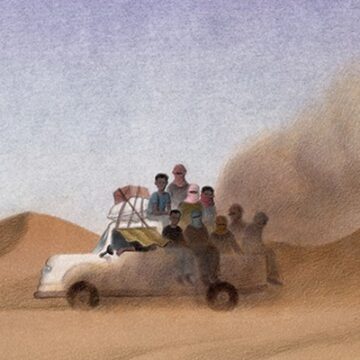
llustration by Daniele Castellano, suggestion of scene depicted:YAIM
Abstract: Backway to Europe is a podcast series produced in collaboration with Gambian advocates and activists. It centers their analyses of the border regime through their direct experiences of “the backway” — the local term for the illegalized route to Europe. These experiences resonate with many who have attempted to reach Europe across West Africa and beyond. Episode 1 begins where the story itself begins: with the hyper-restrictive European visa system for Gambian nationals that renders the backway the only viable option for many. It explains why obtaining a visa is almost impossible and sets the stage for later episodes, which show how European influence on Gambian national politics operates through global and historically layered inequalities that perpetuate neocolonial dynamics. The second episode explores the material and symbolic motivations for Gambian youth choosing the backway to Europe, contrasting the modern, individualized pressure to provide for family through remittances with the more communal and respected social status of “semesters” (emigrants) from previous generations. The third episode discusses how YAIM members retrace their perilous backway journey towards Europe in 2016/2017, across West African borders into Libya, highlighting the systemic violence, corruption, and gendered abuse inherent in these routes. In this fourth episode, we will discuss what happened once they were transferred to the detention center of Tariq al Sika and how it COULD BE connected to what was going on regarding the agreements between Libya, Italy and the EU. Episode 5 shows returnees’ solidarity and their struggle with broken promises and limited reintegration support. The sixth episode talks about migration from The Gambia is driven by structural inequalities rooted in colonial and neocolonial systems, not just individual choice.