
During Tania’s summer 2025 internship at the Open Door Clinic in Addison County, Vermont, she translated for a migrant farmworker, as doctors explained that the patient had preeclampsia. The employer, who regularly drove the farmworker to appointments, sat in on the prenatal visit. The employer’s provision of transportation appeared, at one level, as care. But the migrant farmworker’s inability to move independently had also placed her in a relationship of intimate vulnerability, one in which access to medical care depended on employer goodwill, and where the boundaries between work, housing, mobility, and privacy had already become blurred.
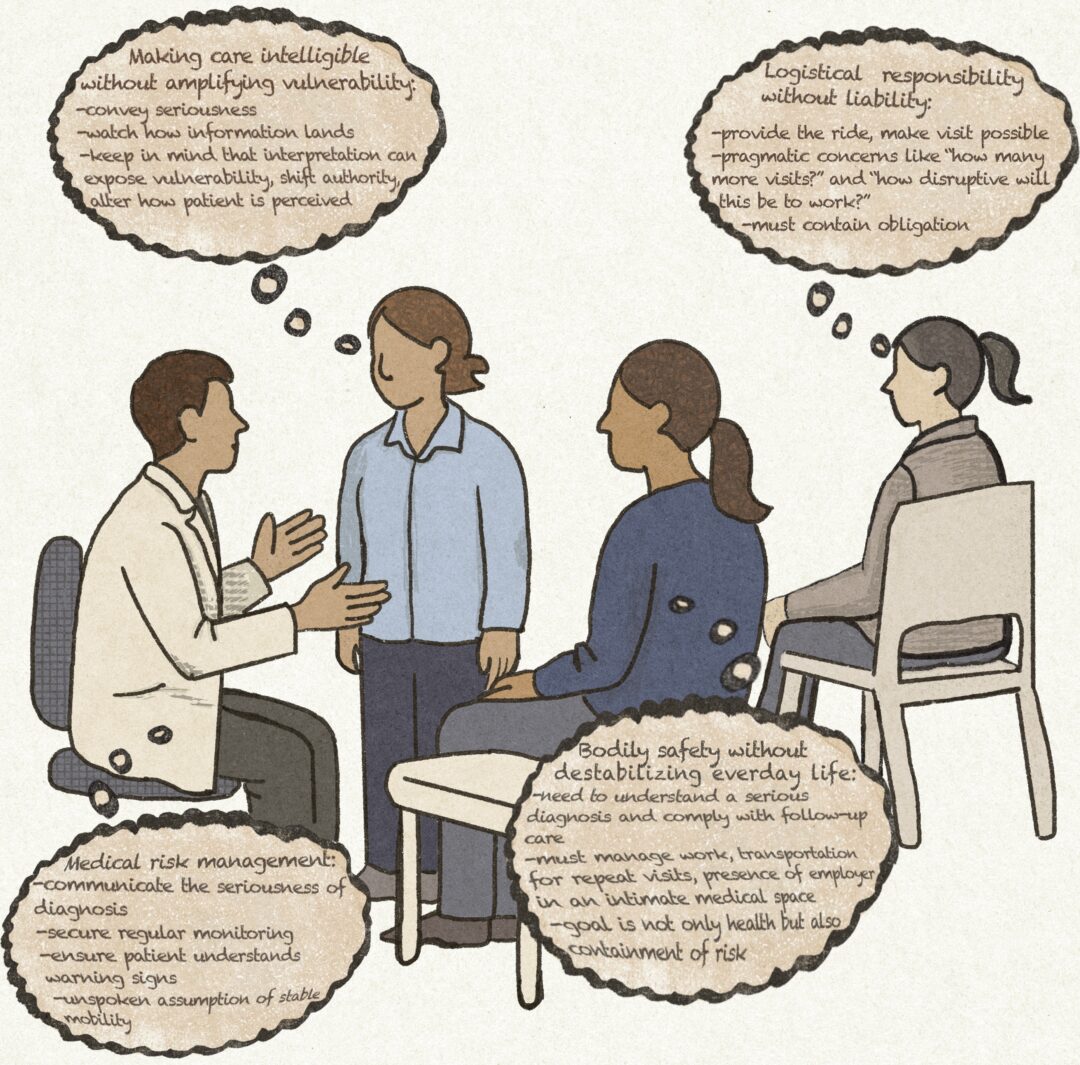
A prenatal consultation structured by overlapping obligations: clinical risk management, employer-provided transportation, interpretive mediation, and the patient’s need to secure care without destabilizing work and everyday life. Because the employer who provided transportation was also present in the room, information about her health could travel back into the same relationship that organized her work, housing, and her ability to remain in the United States.
That encounter pushed us to ask what transportation means in the everyday lives of migrant farmworkers in rural Vermont. What happens when the ability to get to a grocery store, a clinic, a restaurant, or even simply off the farm depends on an employer, a relative, or a paid driver? How does mobility, or the lack of it, shape social relations, emotional well-being, and the practical conditions of getting through everyday life?
Drawing on semi-structured interviews and participant observation conducted by Tania with migrant farmworkers in Addison Country, Vermont, since summer 2025, as well as sustained weekly analytical meetings between Tania and Fulya in which fieldnotes were collectively interpreted, scenes were reconstructed, and visual materials iteratively developed and later illustrated by Fulya, this essay examines mobility, immobility, and transportation dependence. This work yielded detailed accounts of transportation as more than a logistical issue, as more than just movement between points. In rural Vermont, transportation is inseparable from broader conditions of structural vulnerability, since it shapes how people can seek care, preserve distance from employers, spend leisure time off-site, and who must remain physically and socially confined to the land where they work and live. In this sense, transportation is both a material barrier and a social terrain through which paternalism, dependence, reciprocity, and isolation are negotiated on a daily basis.
Mobility in rural Vermont
Transportation matters everywhere, but it takes on particular weight in rural agricultural regions where daily life is organized around distance, remoteness, dispersed infrastructure, and scarce public transit. In Addison County, most farms sit outside central town areas, while public transportation routes remain limited in both geography and schedule. The Tri-Town Shuttle connects Middlebury, Vergennes, Bristol, and New Haven, while Vermont Translines and Tri-Valley Transit connect larger regional destinations such as Burlington and Rutland. Yet these routes do not adequately serve outlying farm areas, nor do they provide the kind of flexible, multilingual, high-frequency service required by workers whose schedules are long, irregular, and tied to agricultural labor rhythms. Walking or biking also cannot be assumed as simple alternatives here. For workers living on dispersed farms, distance is compounded by roads built primarily for trucks, cars, and agricultural traffic rather than safe pedestrian movement. Outside town centers, sidewalks, shoulders, and bike lanes are often discontinuous or absent, making movement especially risky after dark, in winter weather, or along higher-speed rural roads. Transportation dependence is therefore also a safety issue.
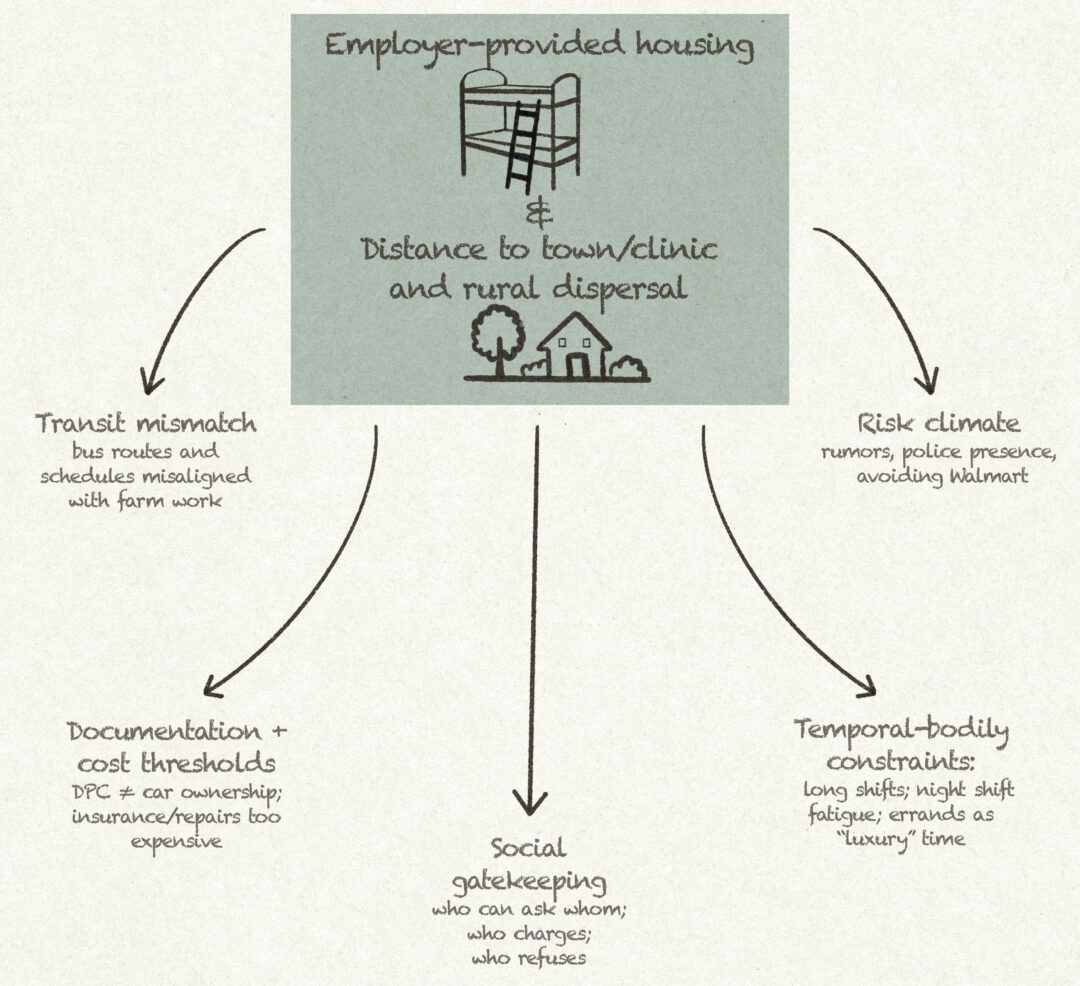
A systems diagram mapping how employer-provided housing, rural distance, policy constraints, labor schedules, and enforcement climates converge to produce transportation dependence, mediated through forms of social gatekeeping that determine who can move, when, and at what risk.
Vermont’s Driver’s Privilege Card (DPC), available regardless of immigration status since 2014, is often cited as an important policy intervention because it allows undocumented residents to legally obtain permission to drive without proving lawful presence (National Conference of State Legislatures 2025). The DPC formally recognizes the reality that immigrant workers are transportation stakeholders in the state. But permission to drive is not the same thing as access to mobility. Car ownership still requires money and documents for purchase, insurance, repairs, registration, and fuel. For migrant farmworkers, these costs are often prohibitive. Furthermore, workers stated that the earlier arrangements around giving and receiving rides were established through limited, informal, yet socially dense forms of mutual aid, whereas today transportation is increasingly individualized, reframed as a matter of personal responsibility and choice.
Legal access to driving, then, does not eliminate immobility. It reorganizes it.
Fred, one of Tania’s interlocutors, was explicit that things had changed drastically over time. Having previously lived in Vermont for a decade before returning to Mexico and then coming back, he contrasted an earlier period, when there were fewer Latino workers and stronger feelings of mutual support, with the present, in which “everyone is looking for economic gain.” In his telling, people with cars once took others to stores or to visit places without turning every trip into a transaction. Now transportation is increasingly priced, normalized as a service rather than an obligation or gesture of solidarity. Legal access to driving, then, does not eliminate immobility. It reorganizes it.
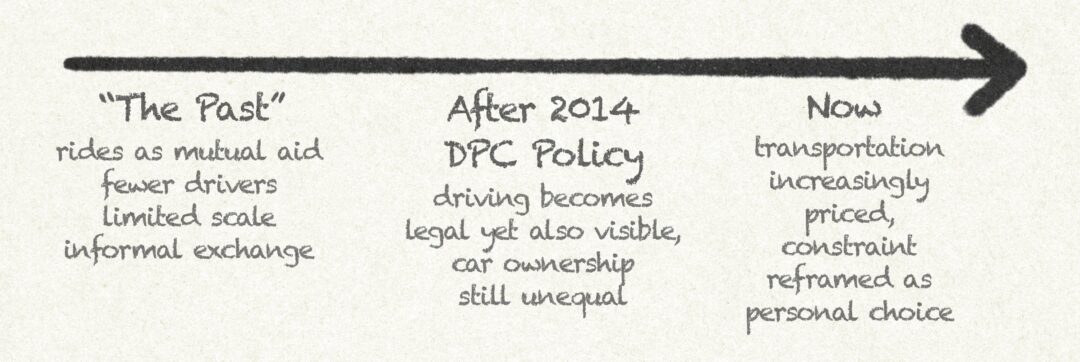
A temporal schematic tracking the transformation of transportation from informal, reciprocal ride-sharing to a system shaped by legal recognition (Driver’s Privilege Card) yet marked by persistent inequality and increasing monetization, reframing mobility as individual responsibility.
Structural vulnerability and the emotional life of immobility
Scholarship on migrant farm labor has long shown that health, work, and legality are deeply entangled, as Seth Holmes (2013) and Sarah Horton (2016) both demonstrate forms of structural violence at the intersections of such matters. Horton, particularly, traces how labor conditions, legal precarity, and chronic stress become literally embodied in illness. Transportation deprivation is part of the infrastructure of vulnerability for migrant farmworkers.
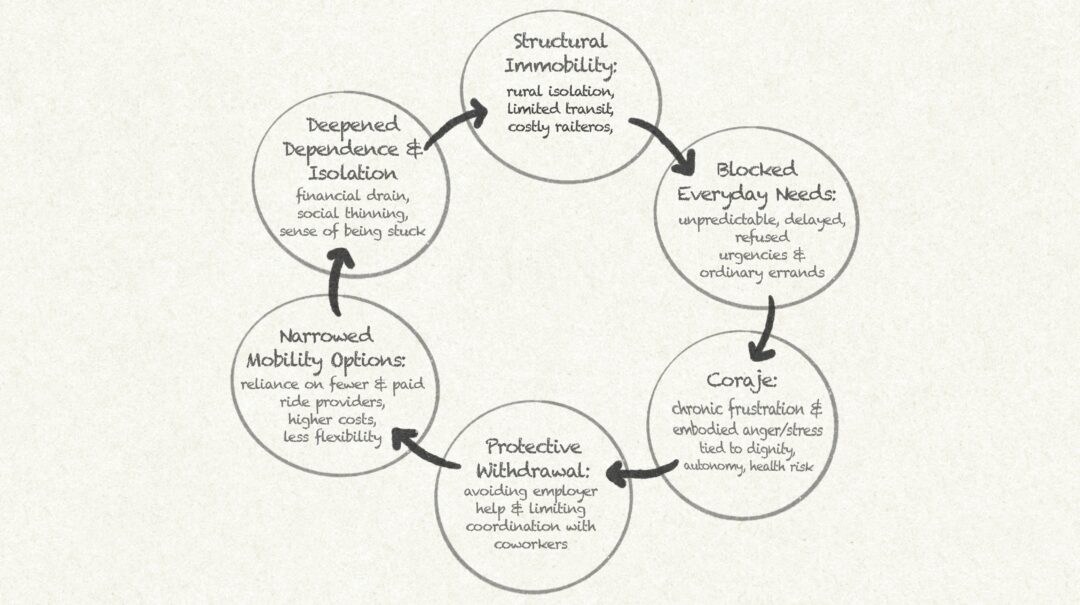
Fred offered the clearest articulation of this. He has a DPC but does not own a car. To run errands, go to appointments, or leave the farm, he relies primarily on a raitera––a term derived from the English word “ride” and reshaped into Spanish usage, now widely used among Spanish-speaking migrants to describe informal transportation providers (Guzmán 2022). Fred often has to arrange rides four to seven days in advance. To save money, he shops only every two weeks. When last-minute needs arise and no one is available to take him, he feels coraje, a word he used repeatedly.
Horton defines coraje as a culturally specific form of deep-seated, embodied anger, linked in her work to hypertension and cardiovascular stress among farmworkers (Horton 2016, 96–97). For Fred, coraje emerged not from a dramatic event but from the “repeated humiliation of dependence,” including the feeling that his need for transportation could be turned into someone else’s opportunity for gain. He did not describe every paid ride as exploitation; he understood that drivers also spent time, gas, and money. But he was troubled by how easily mutual aid had become transactional, leaving him to feel that others could decide when his needs mattered. “It’s about having urgent things to do, needing help, and finding that no one cares or wants to take you.” He added, “I have errands to run just like anyone else.” This was a claim to ordinary social personhood against a condition that he felt continually diminished it.
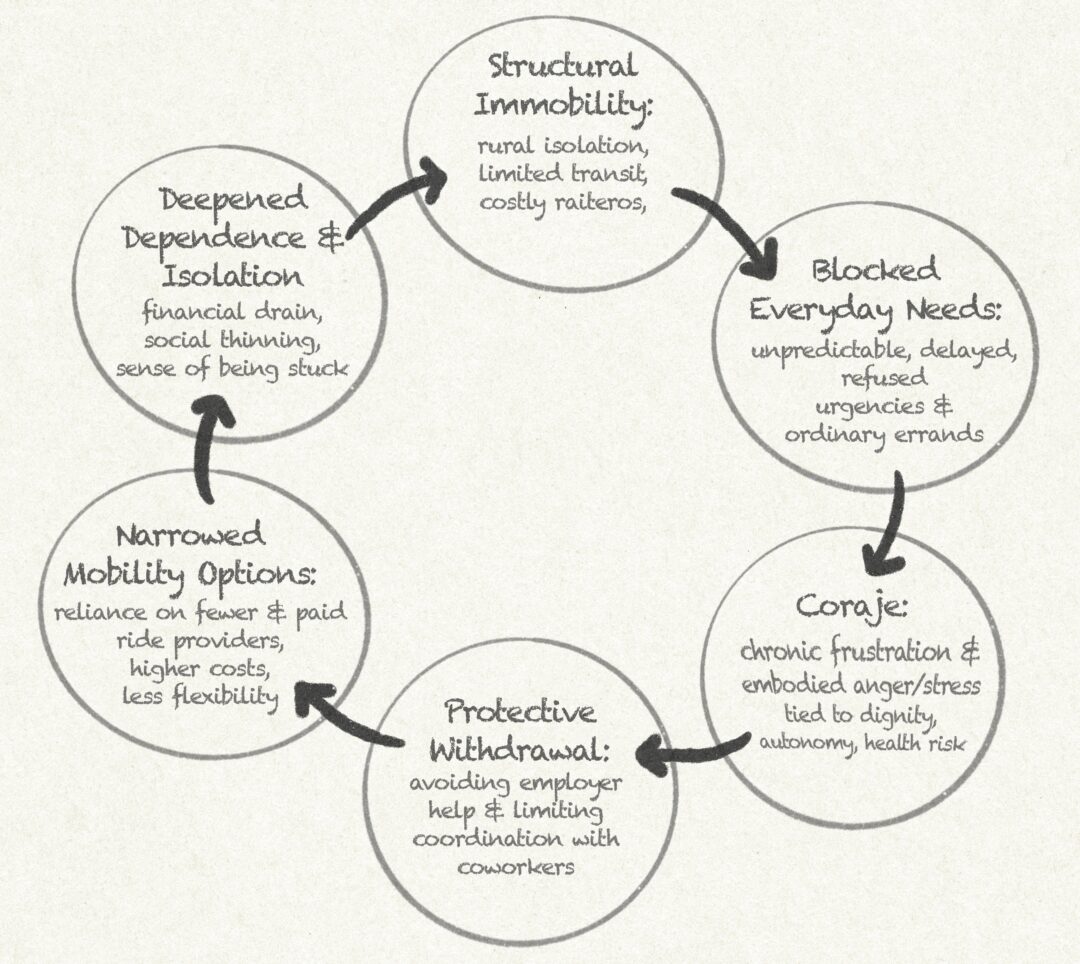
A cyclical model tracing how limited transportation produces blocked access to everyday needs, giving rise to coraje (chronic frustration tied to dignity, autonomy, and health) which in turn leads to withdrawal, narrowed mobility options, and deepened dependence and isolation.
Without safe, reliable, and affordable transportation, even ordinary forms of belonging become difficult to sustain, such as meeting others and attending events.
Immobility produces a kind of suspended social existence. Fred’s inability to move freely isolated him not only from services but from comfort, spontaneity, community life, and forms of ordinary pleasure. The place he most wished to visit more often was Burlington, specifically to eat at “good Mexican restaurants.” That desire was about taste, familiarity, sociability, and access to a fragment of home otherwise denied by rural isolation. Without safe, reliable, and affordable transportation, even ordinary forms of belonging become difficult to sustain, such as meeting others and attending events. Fred repeatedly described his time in the United States as a sacrifice that would allow him to build a future in Mexico. He did not want to spend his money on property in the United States; instead, he wanted to send it home. “I suffer here to live there,” he said.
Cars, autonomy, and uneven power
Jim has lived in Vermont with his wife and daughter on his employer’s property, and is the only worker on the farm who owns a car. He described feeling comfortable driving because he has a DPC and savings for repairs or emergencies. Mobility required, beyond a vehicle, bureaucratic recognition and economic buffer.
Jim often drives coworkers to doctors’ appointments or grocery stores. He charges them for gas and described these arrangements as “fair yet still transactional.” His position was shaped not only by car ownership, but also by seniority: he had lived on the farm for seven years, had a DPC, savings for repairs, and enough familiarity with local roads and institutions to move with more confidence than newer workers. He was not dependent on others in the same way his coworkers were dependent on him. He could say yes or no. He could decide when a trip was worth making, and determine the terms under which mobility would be shared. In contrast, others dependent on him for mobility may not be able to say no to him when he needed something from them. He occupied a structurally vulnerable position as a migrant worker, but within his social network he also held a scarce and valued resource.
Guzmán and Medeiros (2020) show that informal transportation networks among migrant workers are shaped by meso-level policies, local conditions, and tactical adaptation under regimes of immobility. In some cases, community reciprocity lowers costs and redistributes risk. In others, mobility becomes monetized. Tania’s interviews suggest that both logics coexist in Addison County, but not evenly.
Distance from employers
Transportation also matters because it shapes how migrant workers manage employer relationships. In contexts where housing is employer-provided and work takes place on the same land, mobility becomes one of the only means of maintaining personal boundaries. This speaks to the paternalism built into employer-controlled labor and housing arrangements. Gray argues that paternalism in farm labor ultimately serves the interests of the farm business, even when it is presented as generosity or care (Gray 2014, 56, 60). Hondagneu-Sotelo’s work on domestic workers shows how employers may invoke familial closeness while preserving the power to abruptly reassert inequality and distance (Hondagneu-Sotelo 2001, 117). Farm labor is not domestic service, but the underlying instability of fictive kinship is similar. A worker may be treated “like family” only so long as the arrangement serves the employer’s terms. For migrant farmworkers, the ability to leave matters not only for errands but for preserving some separation between labor and life, and between the employer and the employee.
None of Tania’s interlocutors described wanting close relationships with their employers. In fact, distance was often treated as protective. Sam, who had been in Vermont less than a year, said his employer was kind and often offered use of a truck for personal errands. The employer used kinship idioms to frame such generosity. Yet, Sam still preferred to rely on his brother, who lived an hour away, for rides rather than accept “too much help” from the employer. He did not want to feel indebted. He also did not want the relationship to become too intimate. His refusal was a way of drawing a line in an environment where boundaries are already fragile.
Fear, visibility, and the politics of movement
These transportation struggles unfold within a national political climate that has further intensified migrant vulnerability. During my interviews, I asked participants whether Trump’s second presidency had changed how they thought about moving around in Vermont. Their answers suggested that ordinary mobility for them has been shaped by rumor, visibility, and perceived enforcement risk, rather than just money or infrastructure.
Jim described a period early in the second presidency when many undocumented migrants were afraid to go out in public. He ran errands for others. He also stopped taking people to Walmart after hearing rumors that migrants were being detained there. Sam similarly said that he had become more cautious and limited his outings largely to essential places such as grocery stores and doctor’s appointments. Fred, by contrast, said he felt relatively safe because he was in Vermont and not “another state,” his long familiarity with Vermont shaping a different sense of risk. As Teresa Mares (2019) shows in her work on Vermont farmworkers, migrant visibility is geographically variable and shaped by border enforcement patterns, racialization, and local political context. Addison County is not Franklin County, where proximity to the Canadian border intensifies border-patrol exposure. But even in Addison County, visibility remains racialized and politically charged. In a predominantly white rural state, simply being seen can carry risk. Transportation in such settings becomes one of the main arenas through which that risk is calculated and managed.
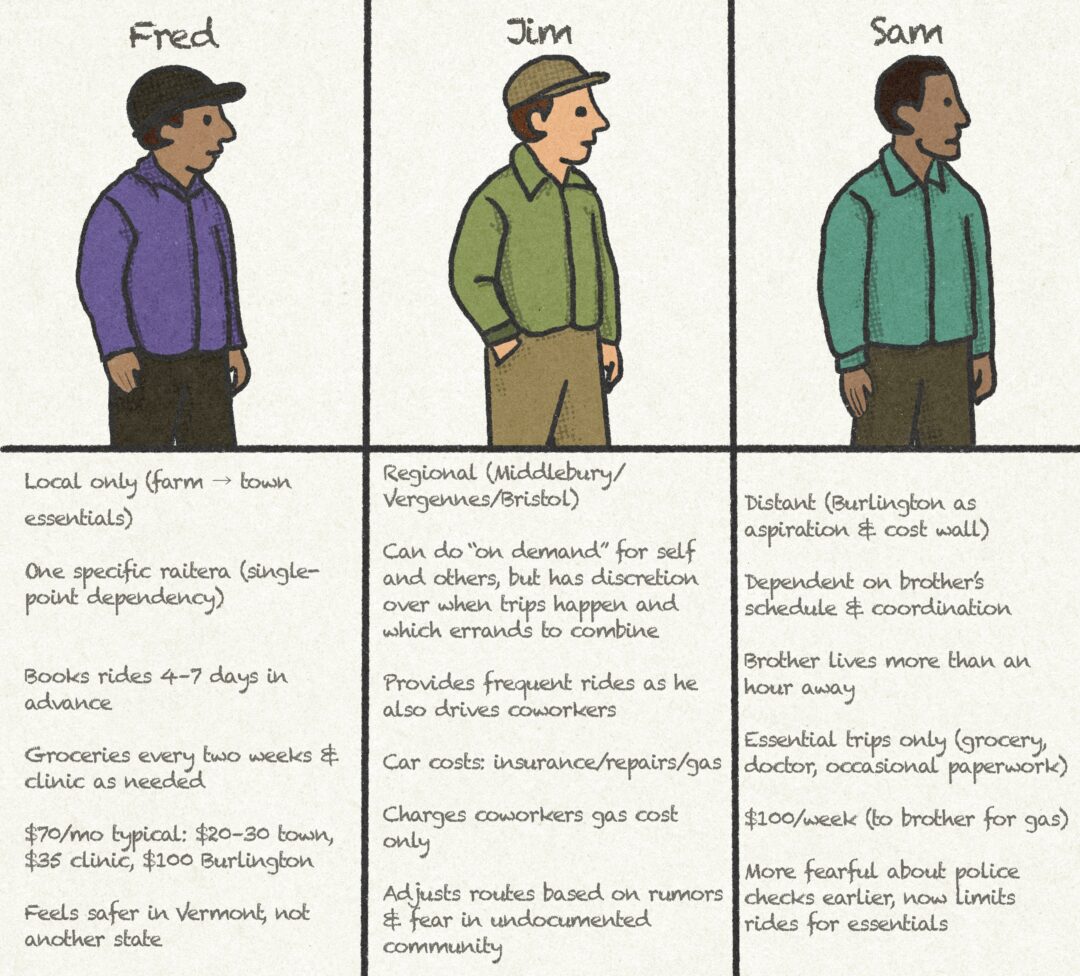
Comparative portraits of three interlocutors (Fred, Jim, and Sam) showing how differential access to cars, social networks, and resources produces distinct forms of mobility management, ranging from single-point dependence to conditional autonomy and constrained long-distance access.
Recent events in Vermont further underscore that mobility is not only structured by infrastructure and economy, but also by enforcement and risk. In March 2026, a highly visible Immigration and Customs Enforcement (ICE) raid in South Burlington, resulting in arrests, public confrontation, and the deployment of force against protesters, marked a shift in how federal enforcement is perceived within the state (Elder-Connors 2026). While Addison County has often been understood by migrant workers as relatively “safe” compared to other regions, such events reconfigure that perception. Simple movement, such as driving to a grocery store, traveling to Burlington, or simply being visible in public spaces, becomes newly charged. Workers who already limit their movement due to transportation barriers may now further withdraw, even from essential matters such as hospital visits. Immobility is not simply imposed through lack of access; it is produced through fear, rumor, and geographies of enforcement.
Transportation dependence turns distance and remoteness into discipline, making the Vermont farm a place where migrant life is sustained through the very immobility that constrains it.
Transportation is a condition of livelihood, care, and future-making for migrant farmworkers in rural Vermont. Because workers’ lives are organized across borders, constrained movement on the farm also shapes what they can sustain elsewhere: remittances, family obligations, hopes of return, and the possibility of building a life beyond the United States. Fred’s phrase, “I suffer here to live there,” captures this tension. His immobility in Vermont was not separate from his attachment to Mexico, but one of the costs through which he pursued that future. Transportation dependence turns distance and remoteness into discipline, making the Vermont farm a place where migrant life is sustained through the very immobility that constrains it.
Featured Image: Coraje Loop by Fulya Pinar.
Authors’ note: Fred, Jim, and Sam are pseudonyms.
References
Elder-Connors, Liam. “The South Burlington ICE Raid Explained.” Vermont Public, March 12, 2026, https://www.vermontpublic.org/local-news/2026-03-12/the-south-burlington-ice-raid-explained.
Gray, Margaret. 2014. Labor and the Locavore: The Making of a Comprehensive Food Ethic. Berkeley: University of California Press.
Guzmán, Jennifer R. 2022. “Raitera, Ally, Accomplice: Giving Rides as Engaged Ethnography.” Anthropology and Humanism 47 (2): 312–28.
Guzmán, Jennifer R., and Melanie A. Medeiros. 2020. “Damned If You Drive, Damned If You Don’t: Meso-Level Policy and Im/migrant Farmworker Tactics under a Regime of Immobility.” Human Organization 79 (2): 130–39.
Holmes, Seth M. 2013. Fresh Fruit, Broken Bodies: Migrant Farmworkers in the United States. Oakland: University of California Press.
Hondagneu-Sotelo, Pierrette. 2001. Doméstica: Immigrant Workers Cleaning and Caring in the Shadows of Affluence. Berkeley: University of California Press.
Horton, Sarah Bronwen. 2016. They Leave Their Kidneys in the Fields: Illness, Injury, and Illegality Among U.S. Farmworkers. Oakland: University of California Press.
Mares, Teresa M. 2019. Life on the Other Border: Farmworkers and Food Justice in Vermont. Oakland: University of California Press.
National Conference of State Legislatures. 2025. “States Offering Driver’s Licenses to Immigrants.”
Abstract: This essay examines transportation as a central dimension of migrant farmworker life in rural Vermont. It argues that mobility functions as a relational infrastructure that organizes access to care, shapes labor relations, and structures everyday vulnerability. Drawing on interviews and participant observation in Addison County from summer 2025 to spring 2026, the analysis begins from a clinical encounter in which prenatal care depended on employer-provided transportation, placing treatment deeply entrenched in relations of dependence. It shows how movement is organized via uneven arrangements with employers, relatives, and paid drivers, through which reciprocity, monetization, and control are continually negotiated. These conditions produce differentiated mobility possibilities and redistribute power within social networks. Transportation here emerges as a key site where vulnerability is both organized and lived.