In November 2023, I followed a trail of social-media breadcrumbs to the Greek island of Evia and found myself in the middle of a form of flight that complicates dominant understandings of forced migration. Israeli women were leaving a country at war with their children while their husbands stayed behind – a striking configuration in a field where men are often assumed to move first. Through ethnographic fieldwork with women who sometimes described themselves as “privileged refugees”, I trace a mode of displacement that is largely absent from migration statistics yet deeply embedded in transnational circuits of passports, savings, and digital communication.
In what follows, I use “privileged refugees” as an emic term and treat it analytically as a deliberately uneasy formulation rather than as a stable category. It is the phrase many of my interlocutors reached for to describe our situation, and I keep it in quotation marks to signal its distance not only from legal definitions of refugee status, but also from dominant scholarly and policy uses of the term. I do not seek to redefine “refugee” itself, but to use this formulation to think about forms of flight that are made possible by privilege and that escape humanitarian and legal frameworks, while still being experienced and narrated as displacement.
The Politics of Invisible Displacement
What does it mean when experiences of displacement become difficult to see – not because they are small or insignificant, but because they travel along socially and politically privileged routes; when the very conditions that enable some people to leave also render their departure less likely to register as a problem for state apparatuses designed to count, categorise, and contain mobility?
In the aftermath of 7 October 2023, as Israeli society reeled from profound violence and uncertainty, war intensified across Palestine/Israel. Gaza burned under massive bombardment, with entire neighbourhoods destroyed and thousands of Palestinians killed or displaced, including many women and children. In the West Bank, settlers attacked Palestinian communities while the state intervention to curb settler violence has been widely documented as limited or inconsistent. These events unfolded in a region already shaped by the Nakba of 1948, the displacement of Palestinians, and decades of occupation and military rule. I cannot do justice here to Palestinian experiences of loss and displacement which have been documented elsewhere, including in Allegra’s Framing Gaza thread. This article focuses instead on a different, much more privileged form of flight that emerged in the same moment.
Alongside the spectacular scenes of destruction and mass displacement, something quieter happened that was barely visible to official categories: hundreds of Israeli families – primarily women with children – slipped into the European landscape and beyond. They dispersed across Greek islands, Dutch cities, Portuguese coastal towns, and Thai beaches. Many travelled on European passports inherited through ancestry laws, booked Airbnbs, and appeared, for all administrative purposes, to be tourists on extended holidays. They did not experience themselves as tourists. They spoke of escaping sirens, news alerts, sleepless children. They were fleeing a war they experienced as existential, while also knowing that their ability to leave, to rent apartments, and to remain lawfully in Europe set them apart from refugees who fled with no money, no documents, and no clear path to legal status. It was in relation to these other figures of displacement that some of the women began to call themselves “privileged refugees”.
This article examines this paradox: a set of lives in motion that falls into the blind spots of both migration scholarship and state surveillance.
This article examines this paradox: a set of lives in motion that falls into the blind spots of both migration scholarship and state surveillance. Their relative privilege (passports, savings, remote jobs, dense social networks) makes their movement possible, but also means it is rarely recognised as displacement or as requiring protection. My aim is not to claim a legal refugee status for these women, none of whom applied for asylum, but to ask what becomes thinkable – and what remains unsaid – when people whose mobility is enabled by relative privilege in a deeply unequal mobility regime narrate their own flight through the language of refuge.
As an anthropologist of migration, I found myself in an unusual methodological position in October 2023. I am a Jewish-Israeli woman and the granddaughter of Jews who migrated from Morocco to Israel and experienced racism and discrimination in almost every sphere of life. I grew up hearing how my parents and grandparents were marked as less valuable because of their North African origins, and I encountered racism myself. At the same time, I hold Israeli citizenship and benefit from belonging to the Jewish majority in a state built through Palestinian displacement; my sister is married to a Muslim Palestinian man, and my nieces and nephews are Palestinian. The violence of this moment cut through my family and community in uneven ways. When the war began, I was not looking in from the outside: I was already inside the social worlds that would later become my field.
In those first chaotic days, when conventional news struggled to capture the speed and scale of events, social media became both lifeline and research portal. WhatsApp groups filled with messages such as: “Does anyone know about flights to Cyprus?” “My kids haven’t slept in three days.” “Is Greece safe?” Facebook posts mapped an invisible geography of fear and possibility, connecting women who had never met but were engaged in the same urgent calculation: how to protect their children when their society felt as if it was collapsing.
Rather than keeping a clear distance between “field” and “home”, I chose to follow these women into their self-organised geographies of flight. In November 2023, I packed my family’s bags and travelled to Evia, Greece, to spend a month living alongside Israeli women and children who had recently left Israel. This choice forced me to grapple with the ethics of writing from within a situation of shared national trauma and highly unequal global mobility, and it deeply shaped how I came to understand what I call here “privileged refugees”.
The Gendered Geography of Contemporary Flight
In many of the families I encountered, it was women who were packing bags, booking flights, and moving across borders, while their husbands remained in Israel. While some entire families did leave together, my research focuses on women who made the difficult decision to leave without their partners. These men were not, in most cases, legally prevented from travelling. Rather, they were navigating a different moral and emotional landscape. The discourse of national solidarity – of “everyone doing their part” – created a gendered moral geography in which mothers could legitimately leave to protect children, while many fathers felt compelled to stay to support parents, workplaces, or reserve units, or simply because leaving felt like a betrayal.
This inversion placed women in unfamiliar roles under extraordinary conditions. “I can’t believe I’m driving here alone with three children,” Anna told me, as she nursed her two-month-old baby and while her older two played in the courtyard of our shared accommodation. “Back home, I wouldn’t drive anywhere alone with them [without the help from another adult]. But here we’re managing.” Her story, like those of many others, reveals how crisis can push women into new forms of mobility and responsibility, not in the abstract but through the daily labour of getting from one place to another, finding housing, and making temporary lives in places that only half feel like refuge.
Anna linked her decision directly to this gendered moral economy. “My husband isn’t conscripted into the army, but he couldn’t come with us,” she explained. “He didn’t want to leave his parents alone, and from his work perspective it’s also problematic to leave. But I felt I had to save the children.” In the pages that follow, I read such accounts not as exceptional heroism but as part of a broader pattern in which Jewish-Israeli women, equipped with particular resources and constrained by particular expectations, enact forms of flight that are at once deeply gendered and profoundly shaped by privilege.
The Infrastructure of Privileged Flight
What enables some people to cross borders without ever entering refugee systems, while others are channelled into camps, registration procedures, and humanitarian infrastructures? The contrast is not primarily about the control exercised by states of origin, but about how states of destination differentially classify, filter, and register crisis-driven mobility. The answer lies not only in financial resources, but in what I call an infrastructure of privilege: the historically produced intersection of citizenship, technology, and social capital that opens particular corridors of flight while closing others.
One key element of this infrastructure of privilege is the possession of multiple passports. Some of the women in Evia held European citizenship through ancestry laws linked to Holocaust histories, alongside their Israeli passports. They carried credit cards that worked across borders, smartphones with international data plans, and belonged to social networks that stretched across continents. Most were middle-class Jewish-Israeli families, with jobs that could be done remotely or temporarily paused. Class was not incidental to this mobility; it structured who could leave quickly, who could sustain temporary life abroad, and who could imagine departure as a viable option at all. Crucially, they had the legal right to enter and remain in European countries without seeking formal protection. They could book flights and Airbnbs, sign short-term rental contracts, and enrol children in local activities while appearing, on paper, to be tourists or temporary residents.
The notion of “privileged refugees” invites us to pay attention to the upper and middle segments of stratified mobility regimes: those who are in motion because of crisis but whose routes do not pass through asylum systems or humanitarian infrastructures.
This infrastructure does not erase the fear and uncertainty that motivated their departure, but it shapes how their flight is experienced and recognised. Unlike refugees who must appear before asylum systems to be seen at all, these women could move through legal channels that required no declaration of vulnerability. What they described as displacement thus unfolded largely outside the institutional gaze.
Rethinking “Privileged Refugees”
“It’s like a refugee camp, but invisible,” Tali observed. “We fled from war, but we’re privileged, we rent cars, live in vacation homes. Still, we’re refugees in some way.” Her comparison captured the contradiction many women articulated: they were not waiting in line for food distributions or asylum interviews, yet their lives were also on hold, suspended between places, decisions, and futures.
The term “privileged refugees”, as my interlocutors used it, unsettles familiar assumptions in migration studies rather than replacing existing categories. When women called us “privileged refugees”, they were making explicit comparisons to other figures of displacement, as well as to less mobile Israelis for whom leaving in this way was not an option.
The notion of “privileged refugees” invites us to pay attention to the upper and middle segments of stratified mobility regimes: those who are in motion because of crisis but whose routes do not pass through asylum systems or humanitarian infrastructures. This kind of invisibility is not politically neutral. It emerges from the ways in which states categorise mobility: when crisis-driven movement travels through authorised, economically secure channels, it does not activate refugee regimes at all. When displacement takes forms that resemble tourism or lifestyle mobility, it can be convenient for states and institutions. Host societies are not forced to confront questions of long-term integration or legal protection. Origin societies can frame departures as temporary “breaks” rather than as indicators of deep social and political crisis. International organisations, which often mobilise in response to visible humanitarian emergencies, have little mandate to respond to people who arrive on regular flights and rent private accommodation.
The phenomenon of “privileged refugees” forces us to think beyond simple binaries that dominate migration discourse: forced versus voluntary, refugee versus migrant, victim versus agent.
At the same time, invisibility brings its own vulnerabilities. The women I worked with had no status that acknowledged their situation as displacement, no tailored support, and no formal recognition of the specific strains they faced. They depended entirely on personal savings, precarious remote work, family help, and the goodwill of landlords, employers, and local authorities. Their ability to remain in Europe was conditional on continued income and on the absence of sudden policy changes or bureaucratic problems.
The phenomenon of “privileged refugees” forces us to think beyond simple binaries that dominate migration discourse: forced versus voluntary, refugee versus migrant, victim versus agent. The women in Evia were both forced and choosing: they weighed risks, responsibilities, and attachments in the context of war, while knowing that staying was also a choice. They were both vulnerable and privileged: exposed to fear, uncertainty, and isolation, yet protected by passports, bank accounts, and the option of return.
Implications: Making “Privileged Refugees” Thinkable
The phenomenon I describe here has several implications for how we study and respond to contemporary displacement.
First, it highlights the limits of existing legal and scholarly categories for capturing the full spectrum of crisis-driven mobility in a world where citizenship, class, and digital connectivity matter enormously. People can be in genuine flight from violence and upheaval without ever entering asylum systems or appearing in refugee statistics.
Second, it shows that privilege does not cancel vulnerability; it reconfigures it. The women in Evia were protected in ways that many refugees are not, yet their lives were also marked by fear, unstable routines, and open-ended waiting. Understanding these differentiated pathways through crisis is crucial if we want a more nuanced picture of displacement.
Third, it highlights the role of digital technologies not only in organising departure and settlement, but in shaping what displacement feels like when home is always one notification away. Constant connectivity can intensify anxiety and blur the boundary between “here” and “there”.
Finally, it demonstrates that gender continues to shape mobility in ways that do not always fit classical models. In this case, maternal responsibility, national expectations, and labour market positions came together to produce patterns in which women led the flight while men often stayed behind.
Making “privileged refugees” visible is one way of asking harder questions about who can flee, on what terms, and at what cost – and of imagining solidarities that do not depend on erasing these differences.
The story of “privileged refugees” is not about deservingness or about reallocating scarce humanitarian resources. It is about developing a more sophisticated understanding of how privilege intersects with particular forms of vulnerability, and about recognising that different forms of displacement call for different forms of solidarity, ranging from legal protection and humanitarian assistance to social recognition, community support, and public acknowledgment of experiences that remain outside formal refugee frameworks.
Many of the women I met were not asking for aid. Rather, they were trying to make sense of their own displacement and to articulate experiences that did not fit conventional categories of migration or refuge: that having options does not mean having no fear; that being able to pay for a plane ticket does not make departure purely voluntary; and that living in a holiday rental does not automatically translate into ease or belonging.
As I write this, some of those women have returned to Israel. Others have moved on to different temporary locations, and a few have begun to imagine more permanent lives elsewhere. Their dispersion makes them difficult to track through conventional research methods, yet their experiences speak to broader transformations in how displacement unfolds in an unequal world.
Attending to privileged forms of flight does not mean turning away from those who are most exposed to violence, dispossession, and border regimes. On the contrary, it requires us to hold both in view: to see how the geopolitical arrangements that enable some people to be trapped in camps or under bombardment enable others to leave quietly, and how these trajectories are historically and politically entangled. Making “privileged refugees” visible is one way of asking harder questions about who can flee, on what terms, and at what cost – and of imagining solidarities that do not depend on erasing these differences.
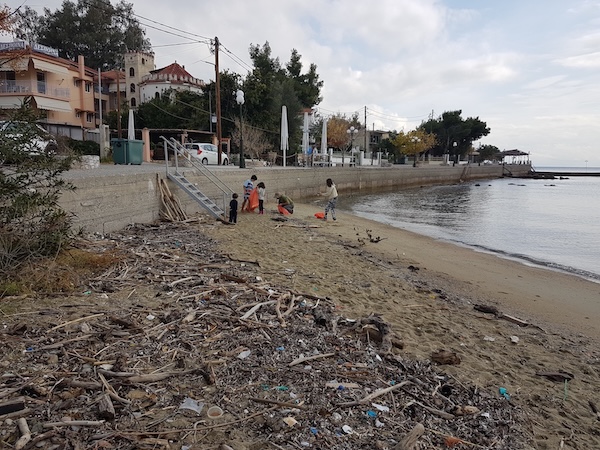
Featured image: Children from Israeli families cleaning a beach in Evia, Greece, November 2023. Photo by Alice Gaya.
Abstract: This article examines the flight of Israeli women and children after 7 October 2023 as a form of crisis-driven mobility that remains largely invisible to refugee and migration regimes. Based on ethnographic fieldwork in Evia, Greece, it shows how passports, savings, remote work, digital networks, and gendered expectations enabled some women to leave while shaping how their displacement was experienced and recognised. The article treats “privileged refugees” as an emic and deliberately uneasy formulation, showing how privilege and vulnerability can coexist rather than cancel one another out. By attending to these less visible forms of flight, it asks how migration scholarship might better understand displacement within unequal regimes of mobility.