Settler colonial terror in a question
Amidst arranging a backpack with her family during a short trip away, an inquisitive if not precocious little Palestinian girl of five asked her father, seemingly out of the blue: بابا، هلا بيتنا الي بالخليل انقتل من الاسرائيلية ولا لا؟ (“Dad, did the Israeli’s kill our home?”).
I had gotten to know the family after warmly being offered one of the most hospitable welcomes and wonderful meals I will ever receive in my life. The day remains a cherished memory and lasting connection I owe to a kind-hearted and politically engaged Palestinian student activist, who incidentally happened to be an encampment organiser at the university where I work. I was able to meet his generous family, and little sister, in the West Bank.
What struck me at the time I heard the story and continues to eat away at me to this day, is just how seemingly normal and logical it was for a little Palestinian girl to ask her parents if their home had indeed been “killed” by the occupation.
For context, weeks prior in the area, the Israeli Occupation Forces (IOF) had arbitrarily razed a home without warning, a by no means uncommon occurrence. Similarly, only days before, in a rural village not too far from the little Palestinian girl’s own, soldiers had smashed cupboards, overturned mattresses, shoved a mother to the concrete, and arrested a father at gunpoint while stunned children shuddered in a corner. More broadly across the region, the number of state-sanctioned home demolitions had been rising at an alarming rate amidst the Gaza genocide, which has only fuelled the Israeli government’s ravenous appetite for the wholesale annexation of the West Bank.
The little Palestinian girl’s troubled yet matter-of-fact fixation on whether her family’s home was going to be “killed” by colonial occupiers—pensively murmured during what should have been a restful holiday away—was neither a slip of the tongue nor a matter of a mistaken word having been selected. The little Palestinian girl knew precisely what she was asking. At just five years of age, she was well acquainted with the savage realities of Israel’s racist apartheid regime and programme of rapacious settlement expansion. In short, she was fully aware of what Zionist settler colonialism produces for Palestinian homes, hopes, and dreams—death.
The query also reflected the fact that for most Palestinian families like hers, conceptions of home, land, and happiness are at once inextricably linked and mutually constituted. For her, to demolish a home is to strike at the very heart of what it means to be a family and live a good, dignified life. The five-year-old girl—like thousands of other traumatised Palestinian children—was equipped with both enough life experience and political consciousness to comprehend that Palestinian homes, and the memories they hold, are not simply destroyed by Israel, but arbitrarily and ruthlessly “killed” by it. She further critically understood that settler colonisers afford neither shelter nor sanctuary to anyone they condemn as a “wretched Other,” like her—or Hind Rajab for that matter.
In asking the question of whether her home would be “killed,” the little girl was seeking reassurance, safety, and refuge—none of which are possible given the fact that the Zionist movement wants all Palestinians to know that the Nakba (“Catastrophe”) has never ended. Equally, similar to so many others in her community, she realised that in the face of racialised violence and looming erasure, her family would neither beg for help nor seek to be “perfect victims” in the eyes of anyone. They, as Palestinians, would find a way to stand their ground and resist Israel’s colonial onslaught, remain on the land, and rebuild their home if it was put on the IOF’s kill list.
Realities of the Israeli apartheid regime
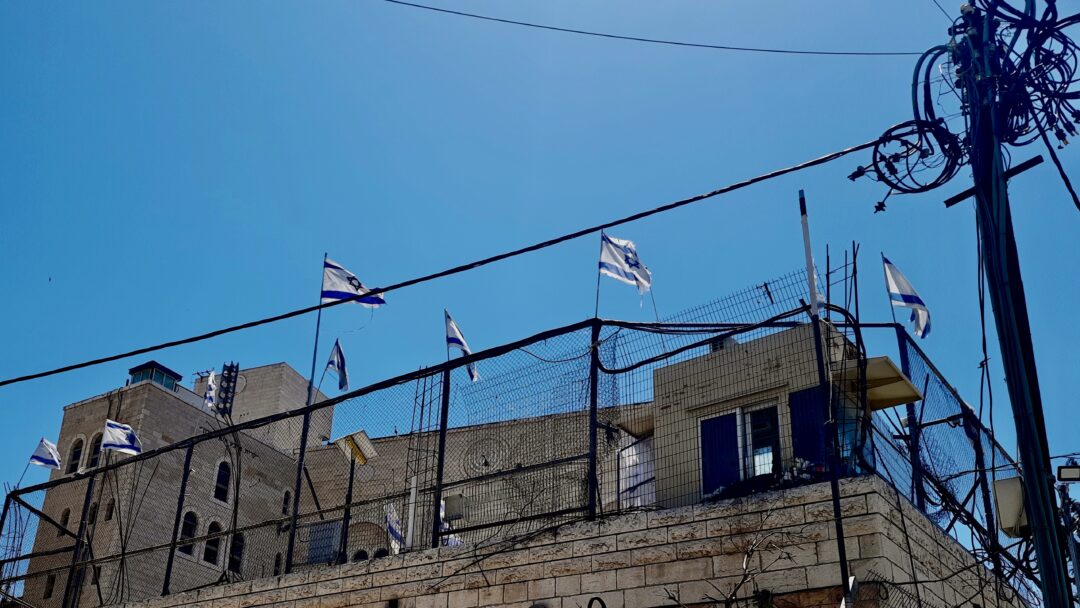
An illegal and armed IOF lookout in Hebron. Photo by ISM.
After only two months in Palestine, it became patently clear to me that Israeli apartheid operates and is enforced at every level; through land, law, and architecture. De jure, it defines the Israeli judicial system. De facto, it visibly imposes itself across the entire landscape. In practice, Israel’s annexation of the West Bank relies on ethnonationalist supremacy and administrative detention, a cruel feature of the state’s inhumane prison structure in which Palestinians are regularly tortured and humiliated.
A complex network of militarised checkpoints, surveillance technologies, and 30-feet-high concrete slabs govern every aspect of Palestinian (im)mobility. The apartheid wall slicing through Bethlehem, the highways segregating Jericho to Jerusalem, and the grating iron gates “securitising” Hebron are but a few physical manifestations of a racialised spatial order designed to isolate and dispossess Palestinians.
In Jenin, siege is expected. Walk through the refugee camp and you witness what remains after each IOF attack: shattered glass, singed walls, smashed beds, and personal belongings strewn across the ground. Residents told me stories of army commanders storming homes at night while panic-stricken children cried and trembled in shock. One mother pointed to a dark alley where her son had been blindfolded and beaten: “He threw a rock at a tank, so they dragged him away.”
Recently, displaced refugees are reporting with more frequency the dystopian sound of drones circling like vulture-sentinels. Armoured tanks rumble into neighbourhoods causing houses to shake long before raiding soldiers are even seen, which magnifies the horror. Most nights come with restless anxieties that rattle and debilitate the mind, body, and spirit—extrajudicial executions follow.
Colonial power suffocates. Seeing what it does to people makes one’s throat tighten and chest swell with rage and pain—or qahr—as I would later learn from Palestinians.
Tubas, Nablus, and the wider Jordan Valley represent a distinct terrain of green colonialism. Here, deracination and the expansion of illegal settlements are increasing via “agricultural entrepreneurship” and “sustainable ecotourism.” Farming outposts installed by settlers, illegal even under Israeli law when initially established, are used to confiscate land, steal groundwater, and cut off access routes.
Palestinian shepherds find grazing field gates locked and roads blocked, in addition to wells filled with concrete and polluted with settler trash. Entire flocks of sheep disappear or are slaughtered at night by marauding Zionist lynch mobs. Bedouin pastoralists wake up to fields set on fire, greenhouses torn apart, and water cisterns contaminated. I saw this happen daily, if not multiple times per day.
The primary objective of colonial terror across the West Bank is to rupture, with impunity, Palestinian continuity on the land. Trauma is the outcome of coordinated Israeli (para)military activities aimed at severing environmental relations, eradicating territorial connections, and erasing ancestral memories. Farmers and shepherds repeatedly told me that when their crops are ruined, water sources poisoned, and animals stolen, they know Israeli settlers will never be held accountable. Broken bones, maimed bodies, and murdered loved ones, soberingly, are also “ordinary.”
From Masafer Yatta to Ramallah to Tulkarm, checkpoints and curfews are used to weaponise both time and space. What should be routine half-hour commutes consistently turn into hours-long Kafkaesque delays. Ambulances are stopped and recurrently hindered from helping wounded and ill patients receive vital treatment. I heard several stories of distraught pregnant mothers delivering newborns on cement floors under rusted razor wire and met young students who suffered nervous breakdowns over missed exams.
At present, there is a grave mental health crisis owed to Israeli atrocities plaguing children in both the West Bank and Gaza, which will take decades of dedicated care and rehabilitation to heal. Disabled Palestinians, too, frequently feel they are unavoidably doomed to be forgotten and forsaken. Life for Palestinians has become a tense negotiation with sadistic settler-occupiers and belligerent armed Zionists who harbour a pathological and paradoxical sense of perpetual victimhood.
Resistance and reason for radical optimism
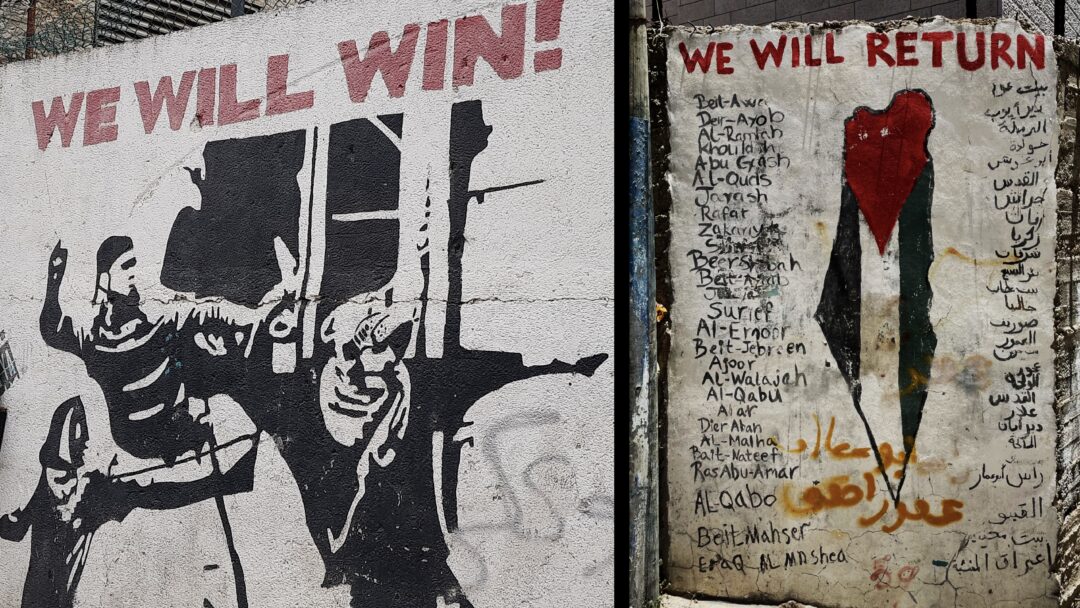
Murals at the entrance of Aida refugee camp. Photo by ISM.
Since October 2023, Israel has killed more than 1000 Palestinians in the West Bank. Villages have been burned down, families expelled, and lands seized under the auspices of “security concerns” and “national development.” The escalating violence reflects the apartheid regime’s military strategy of settler colonial domination, capital accumulation, and historical erasure.
While the Gaza genocide rages on, entire Palestinian communities across the West Bank are being ambushed and laid to waste. Despite the protracted aggression, Palestinians continue to oppose the occupation. This occurs not only in instinctive acts of rebellion and sabotage, but through mutual aid and the practice of insurgent social reproduction.
“To exist is to resist” was a refrain I readily heard. Harvesting olives, saving seeds, and rearing livestock all represent deliberate acts of resistance and self-determination. So too, is the time Palestinians devote to archiving local stories and the educational work they perform to preserve their history, heritage, music, poetry, and art.
In the Hebron Hills, villagers and human rights defenders guide schoolchildren through hostile outposts and settler strongholds. In the Jordan Valley, where no Palestinian field, structure, or shepherd is safe, homes are rebuilt arson after arson, demolition after demolition. Abuses are documented as evidence is compiled daily. It rarely results in justice. Nevertheless, the organising continues. “We must go on,” as numerous Palestinians reminded me.
Resistance in Palestine has necessarily included both armed defence and unarmed defiance. It is by no means a monolith but undeniably remains unified in refusing surrender. Notably, the right to resist occupation is protected under international law. Unfailingly, however, it is admonished and vilified by corporate media, state officials, and hasbara operatives far and wide.
This calculated narrative shift, where the subaltern and oppressed become the “aggressors” and “terrorists,” delegitimises self-defence and liberation struggle, not to mention manufactures consent for a necropolitical status quo. Palestinians, for generations, have contested such cynical framings and continue to assert themselves as progenitors and protagonists of their own emancipation, neither “barbaric extremists” nor passive subjects to be pitied.
As countless Palestinian voices have echoed, the illegal Israeli occupation has produced nothing other than a racist apartheid regime defined by systematic brutality, sexual violence, and crimes against humanity. It manipulates history books, legal statues, and media relations to maintain settler colonial control and eradicate any semblance of indigenous Palestinian presence. To deny, disavow, or diminish these grim realities is to forfeit any moral standing whatsoever, and arguably, relinquish a part of one’s own humanity.
The apartheid regime is also emboldened by a century of imperial intervention and apathy on the part of both the “international community” and local comprador class. It further reproduces itself through the silence and bystanding of the powerful and privileged. Israel’s rampant exploitation and profiteering must also not go overlooked here, in addition to its criminalisation and casting out of Palestinians it reviles as “savage” and “uncivilised.”
On the matter of hope, Palestinians continue to resolutely undermine the occupation. In refugee camps, creative expression blossoms and political education blooms in youth centres, courtyards, kitchens, and alleyways. Young people organise boycotts, distribute food, paint murals, circulate poetry, and play sports. Their resilience is rooted in inherited dreams of self-determination, intergenerational sumud (steadfastness), and the revolutionary aspirations of ancestors and martyrs they honour and refuse to forget.
Indeed, the Palestinian struggle for freedom is an assertion of agency, heritage, land relations, and the right to return. Let us also not forget it is being advanced by a subjugated people experiencing untold violence amid seemingly impossible circumstances. If this does not afford us reason for radical optimism and inspiration to act, then nothing will.
For international sympathisers, the colonial war declared on Palestinians by the Zionist movement raises urgent questions about what—amidst ethnic cleansing, genocide, and complicity—must be done.
Palestinians are providing the answers
Palestinian grassroots leaders are not only confronting and resisting Israel’s illegal occupation—they are clearly stating what type of action is urgently needed from international supporters. In a recent public statement, Palestinian popular committees explained that constant attacks on villages and refugee camps require immediate on-the-ground solidarity, emphasising: “The need for an international effort of popular civic protection is of utmost importance.”
Speaking from the barricades, the popular committees made it clear that going to the West Bank is a meaningful and useful response to the daily dangers posed by IOF soldiers and Zionist settlers. Their appeal unequivocally provides us with an answer to the question of what must be done. Palestinians themselves are calling for presence—for us to go to the West Bank and stand with targeted communities and threatened families. Crucially, their communique outlines how this can be done responsibly and respectfully.
In this vein, the autonomous Palestinian-led International Solidarity Movement (ISM) was created to support (not lead) the struggle for liberation through direct action and civic protection. Civic protection sees volunteers literally walk alongside Palestinians who are experiencing intimidation and violence at the hands of Israeli settlers and soldiers. For over twenty years, ISM activists have responded to calls for support by showing up for Palestinians whose hamlets, fields, homes, and families are under siege.
Specifically, civic protection involves accompanying farmers and shepherds on lands that the Israeli state and Zionist settlers are attempting to steal. It also includes assisting with the olive harvest, escorting children through checkpoints, and staying overnight with families who are being harassed and issued eviction orders. As a critical element of exposing colonial violence, ISM volunteers document human rights violations and publish reports that raise awareness about the punishing realities of apartheid.
Markedly, civic protection does not mean internationals are either “saving” or giving charity to Palestinians, who are neither helpless nor in need of having outsiders explain to them how to resist. For generations, they have developed a vibrant array of tactics and strategies related to collective survival and territorial defence. ISM rejects “saviourism” and views solidarity as the practice of principled, humble “accompliceship,” which admittedly comes with risk and sacrifice, yet remains anchored in a shared conviction to dismantle systems of domination.
Thus, for anyone seeking to move beyond outrage, protest, and online scrolling, civic protection is an effective means of engaging in direct action and offering material solidarity to Palestinians who are bearing the brunt of Israeli war crimes. In addition to building relationships with local families, deterring settler raids, and breaking the isolation of apartheid, it is a way to contribute to a broader fight for global justice on the terms and conditions of Palestinians themselves.
This is a critical moment. The Israeli state and Zionist colonisers are dispossessing, mutilating, and murdering Palestinians as we speak—all while hoping the rest of the world idly sits by and stays quiet. If ever there was a time to answer the call and act, it is now.
Go to Palestine to stand with families whose homes, lives, and lands are under attack.
Go to Palestine to let the rest of the world know Palestine will not be wiped off the map.
Go to Palestine to let craven Zionists and their sycophants know they won’t get away with it.
Go to Palestine because its resistance fighters are sacrificing their lives for what is right.
Go to Palestine not because Palestinians are either helpless or need to be saved—go because the rest of the world has abandoned them for far too long.
Go to Palestine to let little Palestinian girls—who brace for tragedy and fear their homes will be “killed” by the occupation—know they are not alone.
Go to Palestine—and go with all your heart. Visit palsolidarity.org to do just that.
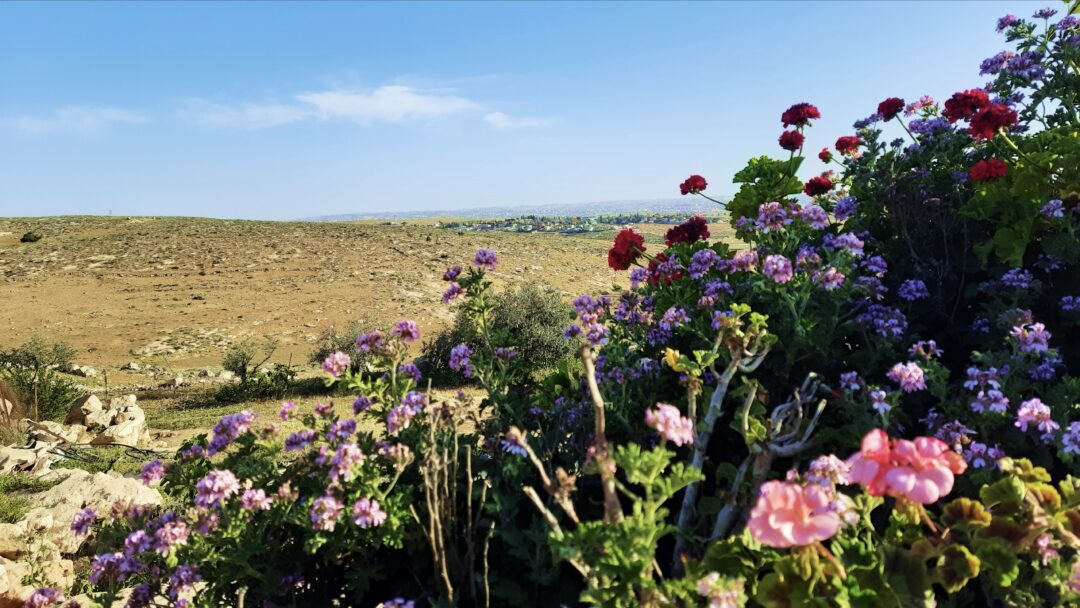
Featured image: A Palestinian woman’s flowers in the West Bank. Photo by ISM.
Abstract: For generations, settler colonialism has endured as an imposed structure of domination and harm in Palestine. From the heavily surveilled alleys of East Jerusalem and militarised checkpoints of Hebron, to the rocky grazing fields of Masafer Yatta and rolling green hills of the Jordan Valley, the Israeli apartheid regime’s assault on the West Bank is unremitting. Notably, Palestinians continue to resist—steadfastly—through a dynamic array of tactics that are necessarily rooted in both militancy and mutuality. Over the past year, as an international solidarity volunteer engaged in civic protection, I witnessed firsthand the ways in which Palestinian communities are defying Zionist occupation and, historically and existentially, elimination. As I write, however, the violence continues to be methodically planned and meted out through both legal mechanisms and a relentless barrage of brutal attacks. For anyone outside of Palestine concerned with freedom, justice, and dignity, the accelerated ethnic cleansing of the West Bank and ongoing Gaza genocide raise pressing questions about what must be done.