
Psychologists have identified at least three common bodily reactions to threat or perceived threat, namely fight, flight, or freeze (see for instance Kozlowska et al. 2015; Bracha 2004).[1] Here, I propose an additional reaction that is emerging in this particular historical period: film.
This proposal emerges from my work with photographers in conflict and war zones, mainly in revolutionary Egypt and war-time Syria (see for instance Mollerup and Mortensen 2018; Mollerup 2017; Bandak et al. 2024; Crone and Mollerup 2024). I interviewed photographers, carried out ethnographic fieldwork at activist spaces, newsrooms, and in editing suites, and I watched raw footage, documentary films, and visual investigations, at times accompanied by conversations with the photographers. Most of the people I spoke with are professional photographers and/or committed activists, but many of them had initially simply seen violence erupt around them and responded by picking up a camera, learning the skills as they went along.
The at-handness of cameras and the awareness of the importance of images as documentation of violence means that often people instinctively start filming when unexpectedly confronted by violence.
My research takes place at a historical time in which there is a readiness for images. At the heart of this era, of course, is the practical issue that so many people across the world have cameras at hand, ready to film in so many different contexts – many, many more contexts than at any time in history. I designate this era, The Time of the Image, drawing on Bryant and Knight’s (2019, 30) reflections on Hobbes’ (1962, 100) notions of a Time of War and a Time of Peace as phenomena that orders time itself. The Time of the Image thus designates a period in history when many people often have cameras within reach, when it for many has become almost second-nature to film, and when violence itself is at times even designed for the sake of cameras. The at-handness of cameras and the awareness of the importance of images as documentation of violence means that often people instinctively start filming when unexpectedly confronted by violence.
Before moving on, let me make one caveat: I am not a psychologist. I do not have theoretical insights to how the autonomic nervous system works. I approach the discussion of filming as a response to threat from the vantage point of anthropology; my field of expertise thus concerns humans as social beings that are encultured. Key to my interest, then, is how we learn bodily responses to threats.
Filming is, in many situations, not a rational response to threat. Yet there are so many accounts of people who instinctively pick up their camera in the heat of the moment when suddenly faced with danger, especially when the danger is coupled with injustice.
Filming is, in many situations, not a rational response to threat. Filming often entails putting your body additionally in harm’s way both because the bodily positions required to film makes people exposed to violence but also because those carrying out the violence often specifically target anyone filming as opposition to the violence (see for instance Mollerup 2020; Mollerup and Mortensen 2018). Yet there are so many accounts of people who instinctively pick up their camera in the heat of the moment when suddenly faced with danger, especially when the danger is coupled with injustice. In what follows, I will discuss two very different accounts of filming as a response to threat.
Firstly, the story of Mahdi Al-Wazni, who became a “sudden photographer” when he found himself faced with an armed attacker in a Copenhagen shopping mall. I digress here from my ethnographic work with photographers in war and conflict zones and rely on public interviews Al-Wazni gave in the days and weeks after the shooting. He was not a photographer before or after this moment, nor was he in any way prepared for the violence. Yet, when faced with danger, the most natural response for him was to pull out his camera. I find it interesting to think with the case of Al-Wazni exactly because of his sudden response of filming in a context that did not invite for premeditated considerations of violence or its documentation. That is, Al-Wazni’s accounts suggests that filming as a response to threat is not restricted to conflict zones where the very narrative of what is happening is contested (cf. Mollerup and Crone 2026). Secondly, the case of Saeed Al Batal, a Syrian photographer and documentary filmmaker who documented the Assad regime’s violence, in particular the siege and violence unleashed on the Damascus-suburb Douma from 2011-2015. I base this account on Al Batal’s writings, his public interviews, and my own online conversations and interviews with him. Both Al-Wazni and Al Batal in different ways describe how the camera gave them a sense of security when faced with danger. In the last section of this essay, I discuss how the experiences and actions of Al-Wazni and Al Batal support my proposal to consider filming an additional response to threat, and how we can understand filming in relation to other responses to threat.
“Baba, you are stupid!”
In the summer of 2022, a Danish man carried out a deadly attack in the Copenhagen shopping mall, Fields. In response, another Danish man, Mahdi Al-Wazni, who was in the mall on a family shopping trip became a “sudden photographer”. He has explained how he stood completely still in the middle of the erupting chaos as he realised that his 2-year-old daughter was missing. She was, unbeknownst to him at the time, in relative safety locked inside a store with other mall visitors. Meanwhile, everyone else had run away and Al-Wazni found himself alone as the gunman appeared. Al-Wazni grabbed his phone and filmed the armed man as he fired his gun several times:
My heart had paused, I couldn’t feel it beating when I realised my daughter was in danger. I was ready to do anything as long as it could bring my daughter to safety. He had a gun as his weapon, and I had a camera as my weapon, and that was how we met. If he were to shoot me, I would at least have exposed him so the police could punish him.[2]
As the gunman moved on to other parts of the mall, Al-Wazni made it outside and immediately shared his video with the police on the scene. The video helped the police identify the killer and apprehend him shortly after just outside the building.[3]
Afterwards, one of Al-Wazni’s older daughters commented on him having stood exposed in front of the killer when filming, “Baba, you are stupid! You are standing in front of him”. Al-Wazni agreed. Reflecting back, he wondered what he had indeed been doing in front of an armed killer.[4]
Al-Wazni’s actions here are not simply freezing even though he does explain standing completely still as the gunman approaches.
Al-Wazni’s actions here are not simply freezing even though he does explain standing completely still as the gunman approaches. It is also not exactly fighting even though he does contest the gunman as he picks up the camera, indeed describing it as “his weapon” in the face of the gun carried by the killer. Before interrogating further how we might comprehend filming in relation to other responses to threats, let me turn to the experiences of Al Batal.
“I bear the camera like a shield”
Al-Wazni’s filming was a temporary, impulsive reaction to a violent turn of a peaceful situation in a country that experiences very little weaponised violence. Meanwhile, even though Syria was a dictatorship well before 2011, it was not until the regime started shooting protesters in broad daylight with live bullets in Deraa in the early days of the protests in March 2011 – to the intense disbelief of most Syrians – that violence in Syria was moved into the visible spaces of people’s everyday lives.[5] So, when Syrian activist and photographer, Saeed Al Batal documented the violence unleashed by the Assad regime in Douma, he navigated a situation of escalating violence that continued over months and years in which filming increasingly became available as a response to threat. Thus, Al Batal’s response to threat is less sudden than Al-Wazni, yet their reflections are similar. Like Al-Wazni, Al Batal finds safety in the camera.
Despite the danger of carrying a camera in a warzone with snipers ever present and frequent air raids, he felt protected.
Al Batal (2014) has described how he carried the camera “as a shield” when faced with incomprehensible horrors. He describes one of the most horrific days he experienced:
At the end of a long and tiring day my feet led me, against my will almost, to the square: the square that the corpses of the massacre’s victims had found before me. There were no field hospitals, nor electricity… the corpses carpeted a pavement that led past what had once been a wedding hall. The assault on Douma was still raging and only the camera was in my hands. For the first few seconds I was stunned, unable to fix my eye on the scene: scattered gobbets of flesh and an acrid odour that left me dizzy. I dipped my gaze towards the camera’s screen. That day, for the first time, I hid behind the camera; I started engaging with reality through the screen, as though watching a movie from my plush armchair in my safe little hilltop hideaway” (paragraph 1).
When Al Batal writes that he uses the camera as a shield, then, he means that the camera protected him, “not from the dangers of detonations, shrapnel and bullets, but from the risk that I might start to think, to despair, to give in” (paragraph 2). Al Batal calls the photograph “the last line of defence against time and my defence against reality” (paragraph 2). What Al Batal retains here, is not only a sense of humanity; it is also the ability to act in deeply traumatising situations. In an interview with Al Batal, he elaborated to me that when he went to the street with his camera after the first massacre on Douma, he felt paralysed, taken over by questions of why he had survived when so many were killed. Al Batal found himself shaking, camera in hand. Yet once he pressed record, he became calmer. His hand steadied, and he found comfort in focusing on the small screen of the camera. Despite the danger of carrying a camera in a warzone with snipers ever present and frequent air raids, he felt protected. Not from bombs but from the overwhelming obligations he felt from what he was witnessing. He started sleeping with his camera at hand in case something happened, but he also explained that he needed to have it close by for calmness. As he has explained elsewhere, “the camera protected my psychological self from being broken amidst all the violence and blood”.[6]
Moving the fight to other times and places
Both Al-Wazni and Al Batal find a sense of protection in carrying a camera. For Al-Wazni, it is an almost physical protection that even if it does not protect his own body at least keeps the killer occupied so that he cannot harm Al-Wazni’s daughter or others. For Al Batal, the camera provides a sense of mental protection from the overwhelming obligation to witness. The camera becomes a shield that enables him to witness the massacres yet not bear witness on his own. The camera quite literally helps to carry the burden of witness, stored in a memory card. Filming in response to threat does not fall neatly within the previously recognised responses to threat. What I find particularly interesting is that in both Al-Wazni’s and Al Batal’s response to threat, there is an element of fighting. Al-Wazni seeks to ensure that even if he is killed, the killer will be identified and put to justice through his video. Al Batal seeks to ensure that the things his mind is unable to witness and recollect at other times will still be carried into spaces where accountability and justice can be achieved.
The camera quite literally helps to carry the burden of witness, stored in a memory card.
Responding to threat or perceived threat by filming is not the same as fight or flight. Nor is it, like freezing, a fight or flight “put on hold” (cf. Kozlowska et al 2015). Rather, it is a response that temporally and spatially reconfigures fight by rendering other means of fighting possible to other people at other times and in other places, thus placing an obligation to witness and act on those who are being entrusted with the images. It is a way of relieving one’s body and senses of the obligation to witness and relying on the body of the camera instead – a memory card in place of one’s own memory – in this way protecting oneself from the violence one is exposed to. Filming, then, might be seen as a response to threat that engages the affordances of image technologies to not only add to, but also reconfigure fight, flight, and freeze. The fight, then, is relocated to other places and times – and potentially to other people.
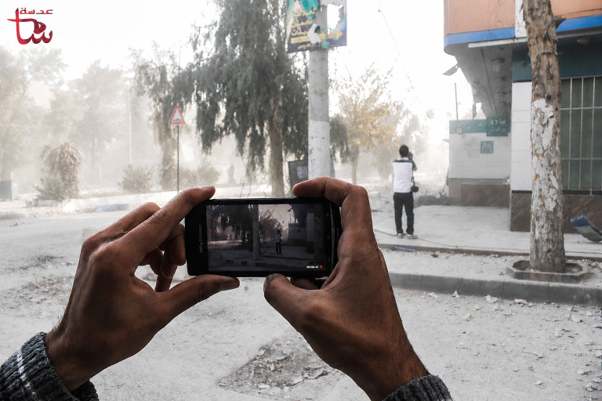
Featured image: Photo by Saeed Al Batal/sam lenses. Citizens filming airstrikes on Douma, Syria, January 5, 2013.
Acknowledgments
This article grows out of the Independent Research Fund Denmark Sapere Aude grant, Views of Violence – Images as evidentiary, documentary and affective (grant ID: 10.46540/2063-00030B). I am further indebted to Saeed Al Batal, Christine Crone, Ditte Marie Munch-Jurisic and Yael Granot for feedback and ideas.
References
Al-Kateab, Waad, and Edward Watts, dirs. 2019. For Sama. With Waad Al-Kateab, Sama Al-Khateab, and Hamza Al-Khateab. Channel 4 News, Channel 4, Frontline. 1h40m.
Bandak, Andreas, Christine Crone, and Nina Grønlykke Mollerup. 2024. ‘Re-Collections: Images beyond the Archive’. Visual Anthropology 37 (1): 1–18. https://doi.org/10.1080/08949468.2023.2285211.
Batal, Saeed Al. 2014. ‘The Photograph Is the Last Line of Defence against Time and My Defence against Reality’. May. Bidayyat.
Batal, Saeed Al, and Ghiath Ayoub, dirs. 2018. Still Recording. Bidayyat for Audiovisual Arts, Films de Force Majeure, Blinker Filmproduktion. 2h.
Bracha, H. Stefan. 2004. ‘Freeze, Flight, Fight, Fright, Faint: Adaptationist Perspectives on the Acute Stress Response Spectrum’. CNS Spectrums 9 (9): 679–85. https://doi.org/10.1017/S1092852900001954.
Bryant, Rebecca, and Daniel M. Knight. 2019. The Anthropology of the Future. Cambridge University Press. https://doi.org/10.1017/9781108378277.
Cantor, Chris, and John Price. 2007. ‘Traumatic Entrapment, Appeasement and Complex Post-Traumatic Stress Disorder: Evolutionary Perspectives of Hostage Reactions, Domestic Abuse and the Stockholm Syndrome’. Australian & New Zealand Journal of Psychiatry 41 (5): 377–84. https://doi.org/10.1080/00048670701261178.
Crone, Christine, and Nina Grønlykke Mollerup. 2024. ‘From Uncanny to Sensible Pasts: Temporal Reorderings in Syrian Documentaries’. History and Anthropology, May, 1–15. https://doi.org/10.1080/02757206.2024.2346888.
Dalsgaard, Andreas, and Obaidah Zytoon, dirs. 2017. The War Show. With Obaidah Zytoon, Nawwara, and Amal. Britdoc Foundation, Fridthjof Film, Oktober. 1h40m.
Farah, Rami, and Signe Byrge Sørensen, dirs. 2021. Our Memory Belongs to Us. Produced by Lyana Saleh and Anne Köhncke. Final Cut for Real. 90 min. http://www.finalcutforreal.dk/our-memory-belongs-to-us.
Hobbes, Thomas. 1962. Leviathan, or the Matter, Forme, and Power of a Commonwealth Ecclesiasticall and Civil. Edited by Michael Oakeshott. Collier Books.
Kozlowska, Kasia, Peter Walker, Loyola McLean, and Pascal Carrive. 2015. ‘Fear and the Defense Cascade: Clinical Implications and Management’. Harvard Review of Psychiatry 23 (4): 263–87. https://doi.org/10.1097/HRP.0000000000000065.
Mollerup, Nina Grønlykke. 2017. ‘Blurred Boundaries or Conflicting Epistemologies: Information Activism and Journalism in Egypt’. Journalism Practice 11 (1): 48–61. https://doi.org/10.1080/17512786.2015.1133250.
Mollerup, Nina Grønlykke. 2020. ‘What Violent Conflict Tells Us about Media and Place-Making (and Vice Versa): Ethnographic Observations from a Revolutionary Uprising’. In Philipp Budka and Birgit Bräuchler (eds) Theorising Media and Conflict, pp. 181-195. Berghahn.
Nina Grønlykke Mollerup, and Christine Crone. 2026 (forthcoming). ‘Seven Promises and Letdowns of Urgent Image Collections of Violence: The Curse of the Archive’. Media, War and Conflict.
Mollerup, Nina Grønlykke, and Mette Mortensen. 2018. ‘Proximity and Distance in the Mediation of Suffering: Local Photographers in War-Torn Aleppo and the International Media Circuit’. Journalism, 1–17. https://doi.org/10.1177/1464884918793054.
Netzel, Natalie. 2023. ‘Trauma-Informed (as a Matter of) Course’. Journal of Gender, Social Policy & the Law 31 (3): 384–439.
Walker, Pete. 2003. ‘Codependency, Trauma and the Fawn Response’. Pete Walker, M.A., MFT, February. https://pete-walker.com/codependencyFawnResponse.htm.
Notes
[1] In addition to fight, flight, and freeze, fawning or appeasing has also been introduced as a common response to threat (see for instance Cantor and Price 2007; Walker 2003; Netzel 2023) while there have also been discussions of fright as a particular form of freezing (Kozlowska et al 2015).
[2] https://www.facebook.com/photo?fbid=10160893939282590&set=a.452685772589. Accessed January 23, 2026. All translations from Danish to English have been done by the author.
[3] https://web.archive.org/web/20220704001934/https://www.tv2lorry.dk/koebenhavn/oejenvidne-ledte-efter-sin-datter-i-fields-optog-video-af-mand-med-gevaer. Accessed January 23, 2026.
[4] https://www.youtube.com/watch?v=9fWSDcyHWxU. Accessed January 23, 2026.
[5] Many Syrian documentaries that have come out since the outbreak of the uprising in 2011 have detailed the escalation of regime violence as well as the efforts to document it. See for instance Our Memory Belongs to Us (Farah and Sørensen 2021), For Sama (Al-Kateab and Watts 2019), The War Show (Dalsgaard and Zytoon 2017), and Saeed Al Batal’s own Still Recording (Batal and Ayoub 2018).
[6] https://www.disorient.de/magazin/art-resistance-killing-machine-interview-syrian-filmmaker-saeed-al-batal. Accessed January 23, 2026.
Abstract: This article proposes filming as a response to threat in addition to the commonly recognised responses, fight, flight and freeze. Looking at the cases of Mahdi Al-Wazni, who filmed a man carrying out a deadly attack in a Danish shopping mall, and Saeed Al Batal, who documented the violence unleashed on Douma, Syria by the Assad regime from 2011 following popular protests, I show how people in very different contexts instinctively start filming when unexpectedly confronted by violence. Despite filming often being irrational in situations of grave danger, both Al-Wazni and Al Batal find a sense of protection in the camera. I thus describe filming as a way of relieving one’s body and senses of the obligation to witness, relying on the body of the camera instead. I argue that this is not quite fighting or freezing but rather using the affordances of the camera to relocate fighting to other places and other times – and potentially to other people.