On Stratified Topologies of Urban Passing
1 April 2024, London. Written while shifting from one transient stay to another, sixteen days before a final departure. This fragment reflects on the tonal and stratified urban space, refusals of belonging, and the uneasy ethics of crossing thresholds without staying.
8:58 AM
The staircase was narrow. With cigarette in mouth, I descended to the bottom floor, saw three homeless men curled up, fast asleep in the corridor—one older; another of uncertain age; the last startlingly young and pale. The floor was scattered with cigarette butts. I called to them softly but no response, so I patted the shoulder of the one nearest to me. “Sorry to wake you, but I can’t bring myself to step over you.”
He scrambled to wake his two companions, apologising repeatedly.
“Could I please have a cigarette, ma’am?” He asked timidly.
I handed over my pack.
He pulled one out and returned the pack. “Thank you.”
After finishing the cigarette, I popped into the dairy next door, asked the shopkeeper I knew to come upstairs with me to grab my luggage.
He pushed the door open.
“What the fuck is going on?”
He looked at the hallway, then at me.
“You three, get the fuck out!”
The three men scrambled up, grabbed their belongings with jackets, and rushed out.
“Get the fuck out, you filthy sons of bitches!”
They passed me quickly, heads down, repeating their apologies. “Who let them in?” he continued shouting, “Good thing you’re alright. These people are dangerous.”
The man I had woken looked back at me once. My face covered in white cement weighed a thousand blades.
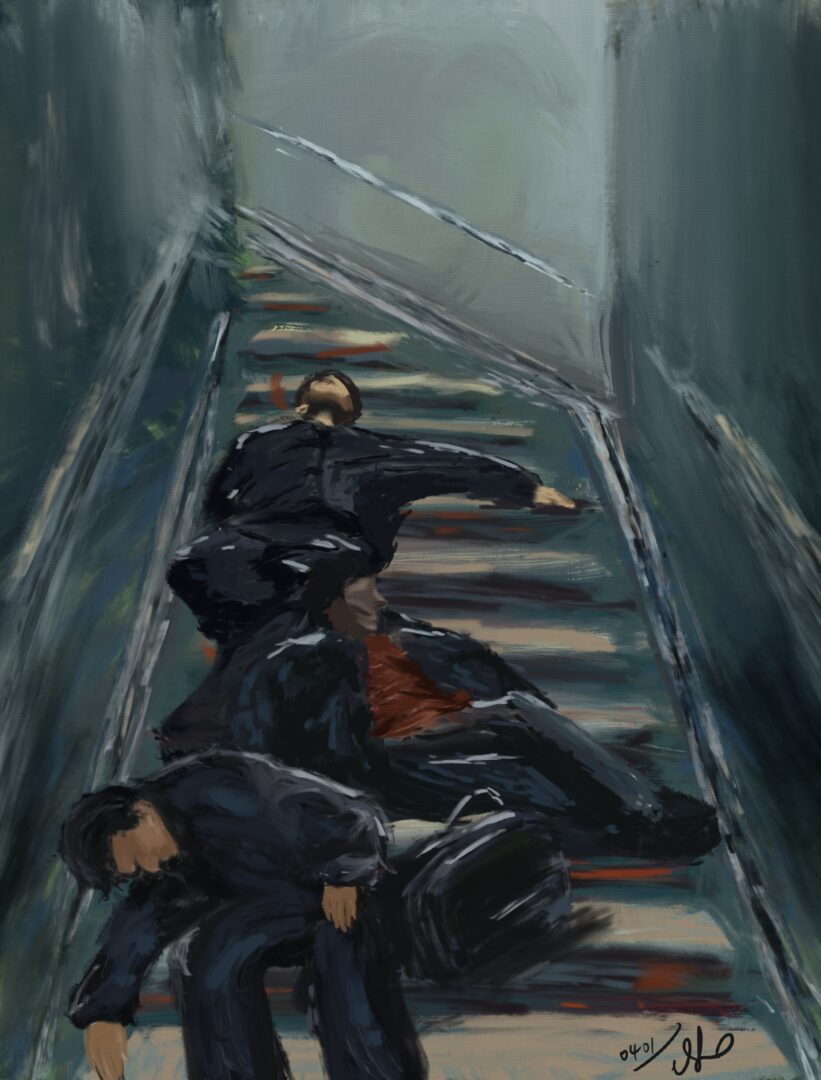
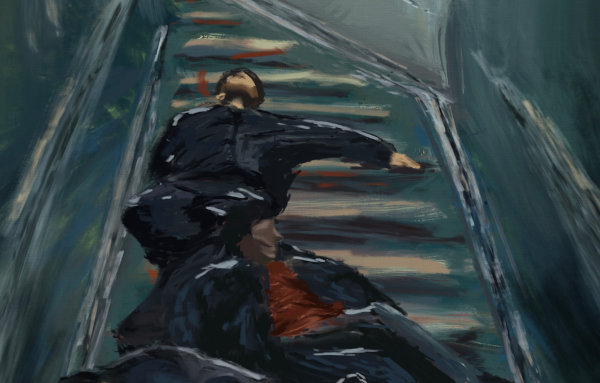
Early Morning on Seven Sisters Rd. Oil painting. 1 April 2024. Painting by author.
It was a pale morning. I slipped into the backseat of the car and left the neighbourhood where I’d stayed for twenty-six days, heading southwest toward the so-called “safe zone”.
“Welcome home again,” my landlord, K, stood in the doorway wearing a burgundy loungewear set, arms open.
On the dining table, breakfast and fruit were neatly laid out.
“…I don’t like the smell in that room. It’s a lingering mix of many, many other people’s smells. That’s why I never close the window. Outside, first a nest of pigeons lived there, then a family of blackbirds moved in. After the dead branches began to bud, there was always the same squirrel staring at me from the branch closest to the window. Not far away was the railway. Sometimes I’d wake up at night and feel my spine vibrating with the bed.”
I popped a slice of blood orange into my mouth with a fork.
“But I liked that neighbourhood and the people there. I didn’t like the room, so I kept running out of it.”
K turned his back to me to press milk foam with a French press.
“I’m surprised you grew fond of that area. I told you before it might be a bit…” he searched for the word, “…noisy.” It is, after all, much closer to the city centre. He added, “Many years ago, a lot of artists gathered there—so many that I couldn’t imagine anyone doing anything but art.”
“Do you mean artists, or decent artists?” I bit into buttered toast in small bites.
Looking out from the dining room window, light spilled from the edges of cumulus clouds, painting half the bench in gold. The eaves and rooftops blocked the other half of the sky. This was my first impression of London. Pale streets, pale skies, pale tones, pale expressions. The politeness here is as bleached as the light. No street-side guitar jams with strangers. No shopkeepers who know my face but still mock my age at 1am. No shadowy figure shadowing me into the dark for cash turned roadside confessors, awkwardly keep assuring me everything will be okay.
[Re-sampling 8:58 AM]
It is him. I see the water stain on his trousers, the dampness clinging to the fabric. I stand at the corner of the stairs, looking down at the crown of his head four steps below mine. I see myself walking down, descending until I am on the step just above him, squatting there to place a hand lightly on his shoulder. He opened his eyes, apologised. The tightening of his brow, the trembling of his jaw. With every shift of his expression, the deep-set wrinkles in his face breathe out the dark soil.
Several hours ago in Islington, I stared down at my hands, watching as dark soil grew from the gaps between my fingers. Now I stand before the mirror in my room in Putney with the dark, defiant tangles of natural curls of my hair, expressionless, inspecting my clean face and nails. The white cement has dried into the pores, rendering my skin as impenetrable as the walls of an Edwardian red-brick townhouse. A person like me —shattered from a misread ‘我们(we)’, having fled into ‘their’ vibrant neighbourhood only to be gradually grafted, drawing sustenance, yet eventually severing those roots to be folded back into the ready-made ‘we’ that had been waiting to accommodate me all along.
A month has passed since I tripped on the paving stones in front of this house, scraping a frost-bloom on my inner wrist.The scar is still there. My friend says it’s pigmentation from deep trauma. “It’ll fade,” she comforted me.
That ‘we’ fail to wash away the thousand-pound shame from my face; the mottled gypsum refuses to flake off.
[Re-sampling 8:58 AM]
Below the first man I see another figure remaining curled in a puffer-jacket resonance, tone muted. He stretches his left arm—a slow, unconscious extension, limbs loosely claimed by sleep. A prominent white scuff marks the right elbow of his jacket. His head rests upon a flattened duffle bag; a tattoo is tangled across his exposed left ankle. When the first man nudges him, a rhythmic buzzing ricocheting through the narrow space is abruptly cut off. For a split second, I wonder if a bee might actually fly out from his nostrils. It doesn’t. He simply drifts toward the wall with heavy, half-opened eyes, creating just enough space for me to pass. He doesn’t look up. I never know the colour of his eyes.
Moving furniture, sorting luggage, shoving all machine-washable clothes into the laudry. Politely declining my friend’s offer to chase sunsets at the beach, lying in a hollowed suit immersed in Ludovico Einaudi’s liquid piano resonance, half-dozing. No other scent in this room. Not anymore. I stretch my right arm.
Since the day I first landed in London, I’ve stepped into countless rooms: solving puzzles alone in the apartment rented for a ‘we’; reading Hatred of Music in a tiny but delicate suite; watching cooking from the messy kitchen doorway, the air thick with lighter gas; dissecting space and time in a modernist minimalist townhouse; deconstructing facial tyranny in a studio piled with faceless canvases; trying to coax sound from flutes in a room filled with instruments; skewering nihilism like candied haw on a stick in a cherry-blossom-facing living room; eating fried rice, blowing glass, three or four cups of wine —reflections overlapping with shadows; words multiplying like malignant tissues, metastasising from the walls, then the ceiling, then the floor.
I wandered recklessly through others’ spaces, absorbing the delicate, false, chaotic, indulgent, relaxed, rigid, indifferent, vivid micro-signals, only to reinforce mine with lock upon lock.
[Re-sampling 8:58 AM]
At the very bottom of the stairs closest to the street-side exit, I catch the profile of a startlingly young boy with matted, dark red hair and a face dense with freckles. He was curled in the corner like geological staining. He wears a black bomber jacket and a pair of Carhartt work trousers, the label faded. The soles of his boots turned toward me read Dr. Martens; a blue lighter lays on the floor at his feet. As I walk past him, I stumble over the strap of his massive black travel bag.
I have no way of guessing the relationship between these three men. Luggage, cigarette butts, waste paper—are they also just passing through, intending to stay for only one night?
Light leans heavy upon the dining table. I open the screen. The cursor pulses, tracing the first scratch onto the digital surface, suspended in the honey-hued warmth of timber and wood.
I almost never invited anyone into my house.
Present or absent, seen or unseen, belonging or expelled—I remain forever in between. The binary oppositions press and erode one another; social rhetoric and decency gradually encrust my skin. Every possibility of connection or alignment is severed by a blade of gypsum’s edge. Flowing at the critical point of in-between is my only agency.
What are you thinking?
I’m thinking—every approach, every acceptance, every open door, every pair of welcoming arms is so honest, so undefended—perhaps because no one worries I’d ever stay.
[Re-sampling 8:58 AM]
With a heavy stride, the shopkeeper wedges his body into the space between me and the half-open door, blocking the gap entirely. His flesh becomes a performative border. Over his shoulder, I see three blurred silhouettes deform in an instant. Light strikes his tight, black curls, making them shimmer. As the fissure behind his reddened earlobe splits open, smoky and sour cocoa pods ripen and fall to the ground. In that instinctive shift, the hallway is partitioned. Behind his back, I am forcibly placed on the side of the ‘we’. He acts as a diligent guardian, securing the role the building has already assigned me. Their place is requisitioned as our non-place. We demarcate the territory. We push the boundaries. The parts that formed the neighbouring nation separated from the ‘we’ by a single wall, lose their form in the lightless dark. The unpurified matter out of place is evicted.
I cannot recall our final passage through one another.
I am sorry. Sorry. Sorry. That is all I hear. My heavy eyelids filled with white cement are a camera that can no longer press its shutter.
Dark-toned. Pale-toned. Colourless. Closest to the sky. Floating. Rooted. People like them. People like you. People like me. I understand, and I don’t. In each different ‘someone’s’ eyes, how am I seen?
“We’re too different.”
There, I was the identifiable exception allowed to pass; here, I am the acceptable exception allowed to stay. ‘I’ am severed from every ‘we’. I pass through everywhere yet merge with nothing. Everywhere is a border, everywhere a wall. War is always one spark away. I refuse to be neighbouring nations with anyone again. I topple every wall, nullify my statehood. If you see an ice floe pass by, walk toward me, walk onto me. Rose Island lies below sea level. The mermaid’s legacy is hidden in the coral reef.
[Re-sampling 8:58 AM]
I never saw a face like mine in Islington. At the station across from the apartment, figures always sat lurking in the shadows, as if the light refused to find them. The shopkeeper downstairs would stand at the door with friends, talking in a strange language where I could only catch scattered words; the menus outside the neighbouring restaurants featured lead dishes I couldn’t name; occasionally, a pale face would flicker past a bus window.
I follow the shopkeeper, walking silently through the purified non-place of the staircase. A left turn after the fourth corner. He lifts my black leather suitcase. For the last time, we descend through that purified non-place of the staircase. The taxi is parked at the curb; he helps me move my luggage into the trunk. We bid our farewells, yet neither of us says, “see you around.”
I lie under the ceiling with the amber glow of the Putney pendant light, the residue of Islington begins to ferment. My stomach feels strange. Hunger and sadness are the same physiological response—tight chest, stomach shrinks beneath the ribs, a dull ache under the shoulder blades. I crack open my ribcage and lungs, expose the stomach, and confront it.
How do I tell whether you are hungry or sad?
Look at the muscles, the body replies. They are tensing as if shrugging. And you will find out that hunger is desire; sadness is desire out of sync with ability.
The landlady, J, knocks. “Would you like to join us for some fish tonight?”
My face began to itch. The layers of gypsum are fissuring, thousand blades losing their sharp edges as they softened, and begin to liquefy into a chalky, white heat.
“Wait a moment,” I say, buttoning my chest shut.
“I’ve always liked seeing how each tenant uses this space,” She glances in from the doorway, “How many days will you be staying this time?”
This is the sixteenth-to-last night. I walk with her toward the dining room, dragging a pale, liquid trace behind me.
Dusk settles. The broken piano sound fractures from the living room. Two months have passed since I first moved into this house; my flatmate is still playing the same étude, over and over. I turn my desk toward the window, falling sleeves and trouser legs whisper sometimes. The mechanical keyboard sparkles like a handheld firework stick. Every so often, a pair of legs passes in front of me.
What are you thinking now?
I’m thinking—is fleeting connection a gift, or a theft?