


Yuliya Grinberg. 2025. Ethnography of an Interface: Self-Tracking, Quantified Self, and the Work of Digital Connections. Cambridge: Cambridge University Press.
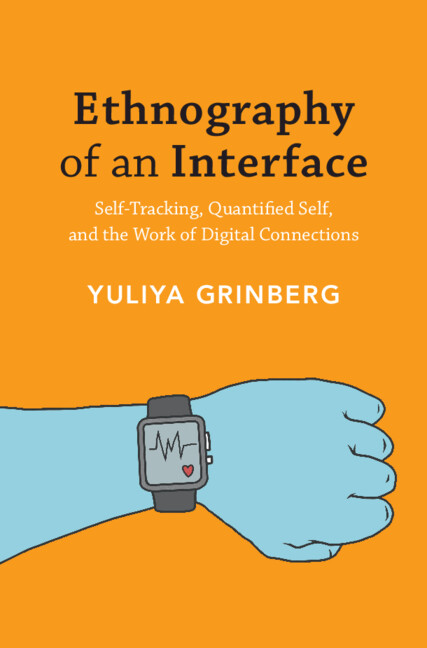
Based on five years of ethnographic research, Yuliya Grinberg’s monograph Ethnography of an Interface: Self-Tracking, Quantified Self, and the Work of Digital Connections offers an engaging analysis of the broader tech movement in the United States. Specifically, it introduces us to the lifeworlds of techno enthusiasts, digital entrepreneurs, and start-up founders who are connected through the shared passion for personal data, self-tracking, and the “deep knowledge of the self,” made possible through commercial wearable devices. Grinberg builds on prior research about these digital practices, exploring the social effects and consequences of these practices. While never losing sight of this critical line of inquiry, her book, nevertheless, departs from the already existing work by focusing on the actual material and affective contexts under which these technophiles operate. With that, the book demonstrates how these conditions shape the field and discourse around these technologies and the data they record.
The text opens with an ethnographic vignette describing a promotional video for Chris Dancy, a self-tracking hobbyist and an early pioneer of this phenomenon. While his video anticipates a supposed future saturated with digital connections enabled by wearable sensors, Grinberg draws our attention to the commercial context of the video. This wry observation gestures to the central tension in her ethnography: these self-tracking devices, presented to consumers as objective, seamless, and empowering tools to optimize the self, are anything but such tools. Rather, they are the products of a messy assemblage of shifting market conditions, commercial pressures, and entrepreneurial ambition that create them.
This wry observation gestures to the central tension in her ethnography: these self-tracking devices, presented to consumers as objective, seamless, and empowering tools to optimize the self, are anything but such tools. Rather, they are the products of a messy assemblage of shifting market conditions, commercial pressures, and entrepreneurial ambition that create them.
The book is organized into six substantive chapters, with an introduction and a conclusion. Gringberg opens the introduction by describing QS (Quantified Self), a forum for those interested in self-tracking technology and her primary field site. Rather than taking QS as a social gathering of self-tracking enthusiasts, Grinberg reframes it as an interface where a diverse set of participants come together to negotiate the meanings of personal data, professional aspirations, and personal identities. She undertakes such reframing because of the methodological difficulties of studying digital professionals in restricted workplaces, as she pragmatically notes (4). In her conceptual move, the interface becomes an ethnographic backdrop for studying her subjects and illuminates the links between seemingly disparate entities such as business cycles, labor conditions, and passionate affects that make possible the self-tracking economy. From a data collection perspective, this leads Grinberg to participate in “halfway” events, such as conferences, meetups, speaking engagements, and talks, “where the technology industry presents itself to the public” (5).
The first chapter begins by historically and conceptually situating the QS forum as an idea, going back to Gary Wolf and Kevin Kelly, the former editors of Wired magazine who coined the term. In the late 2000s, Wolf and Kelly were putting a descriptive label on an already existing social phenomenon, namely the propagation/diffusion of individuals interested in the digital practices of self-tracking. The act of naming this “culturally found object” helped form the community of hobbyists that later became known as QS. Grinberg, however, emphasizes that Wolf and Kelly were doing more than just describing what they saw. They were active participants in shaping the self-understanding of the QS community. The subsequent terms they coined, such as the “quantified self” and the “culture of personal data,” set the tone for how individuals and business actors came to relate QS forum to the larger self-tracking market, shaped largely in personal and passionate terms.
The second chapter builds on the idea that the “Quantified Self” is more than an idea or a community. Based on ethnographic interviews with start-up founders and on the examination of corporate marketing materials, Grinberg shows that the idea of QS becomes a powerful rhetorical strategy for entrepreneurs and market actors. She demonstrates how the way they talk about data reveals more about their professional interests and industry pressures than about objective measurement itself. In this reading, inventors present the data their devices collect as clear, precise, and reliable. Yet, in actuality, conversations with these inventors reveal the ambiguities that surround data collection and generation. Hence, the deployment of digital ambiguity and claims of data objectivity suggest a far more malleable definition of data. This linguistic malleability is used to advance corporate objectives, such as mitigating legal risk and appealing to a mass audience. With that, inventors can be seen as performing narratives about data and self-tracking that serve their entrepreneurial goals.
The third chapter shifts the focus from discussions about self-tracking and QS to the examination of how tech professionals and executives engage with the QS community not only as observers but also as commercial actors. The core argument of the chapter is that participants in QS events often present themselves as community members interested in the ethos of self-tracking but are, in fact, thinking as vendors that try to ascertain consumer desire. Such dual positionality blurs the line between community and the marketplace. With that, rather than being an organic community, QS can be viewed as a corporate mechanism designed to “instrumentalize passion” through the unpaid, affective, and often obscured labor of these tech professionals (68).
In chapter 4, Grinberg accounts for the affective labor performed by digital professionals who see themselves as part of the QS community. Their participation in the forum is indexed by the amount of passion and desire, displayed as free labor, which takes the form of attending and organizing meetings and delivering presentations in their free time. This labor is made bearable because personal interests and work commitments are seen not only as reconcilable but also as something one must undertake, as it signals one’s “professional credibility and value” to the broader community of technology professionals (110). This reflects the normalization of hustle culture in the economic sphere and the tech sector more specifically.
In chapters 5 and 6, Grinberg lays out the techno-fantasies of knowledge professionals and their desire for a “frictionless world mediated by seamlessly connected digital tools” (132). There, she highlights the modes of masculinized privilege that continue to dominate and structure the tech sector, including the market for self-tracking technologies. In chapter 5, the digital dreams of tech professionals can be seen as a stand-in for productivity and as a way to liberate the privileged work from the excesses of personal commitments. In chapter 6, Gringberg notes the lack of gender diversity in the QS forum, which continues to be the norm despite corporate attempts at inclusivity. This is the case because of the deeply ingrained biases within the tech sector: men embrace “masculinized notions of scientific rationality,” while women are seen as “vital conduits of emotions” (168) and a model of accretive difference that recodes and reproduces rigid gender binaries and inadvertently sharpens them.
As is common in many fields beyond tech, workers are pressured and expected to perform unremunerated, affective labor in hopes of entrepreneurial self-advancement, without any guarantees of job security, success, and financial stability.
Yuliya Gringberg’s Ethnography of an Interface is an ethnographically rich and theoretically sophisticated text. First, her approach to interface as a method calls attention to the importance of analyzing QS as a product both embedded in and separate from the tech sector. In other words, the forum is not a self-given community. It is a space that brings together disparate elements – from business logics to entrepreneurial self-crafting – and interfaces with the larger system of tech capitalism to extract value. Second, Grinberg demonstrates how (labor) market instability (i.e., disruption) materially shapes and molds the beliefs, practices, and discourse of tech workers. As part of this process, special attention is given to the affective dimension, where workers are expected to “hustle with a passion” (101). As is common in many fields beyond tech, workers are pressured and expected to perform unremunerated, affective labor in hopes of entrepreneurial self-advancement, without any guarantees of job security, success, and financial stability. The third important aspect of this ethnography is how Grinberg problematizes the production and creation of digital knowledge. Rather than being a neutral category, knowledge is an unstable outcome of material and affective forces, as Grinberg’s ethnographic encounters repeatedly show. Her critical monograph demonstrates why there is a need for more ethnographic explorations that question the self-representation of tech, demystify the inner workings of the field, and demonstrate the importance of “studying up” in anthropological accounts of tech capitalism.
Featured Image: Wearable Technology by theglobalpanorama. Source: openverse.org.