


“We are the only people in the world who feel very happy when a typhoon comes. Do you know why? It’s because we don’t need to organize protests. I hope the next one comes on Wednesday so I can rest for a whole week.” With his cheerful laugh, one of the protesters joked with his friend about their excitement for the typhoon, as it practically disrupts the construction of a U.S. military base in Henoko and gives protesters a precious opportunity to rest.
Located in the northern area of Okinawa, Japan, Henoko is a small town inhabited by 1637 residents. Due to its proximity to the Camp Schwab, it used to be a vibrant city until around the 80s, as the masses of the U.S. military personnel roamed around the city to generously spend their salaries. Yet, the end of the Vietnam War and the subsequent downsizing of military personnel at Camp Schwab ushered in a continuing decrease in the town’s population. This created the very economic and social vacuum that the construction of a new military base is allegedly intended to refill. For this construction, 150 hectares in Henoko Bay are planned to be landfilled to accommodate a V-shaped runway for the U.S. military aircraft.
The conversation above took place in the hostel that cater to those from outside Okinawa who participate in protests against the construction of a new military base. The hostel serves not only as a dormitory for those coming from outside Okinawa but also as a social space for all protesters. On that day, not much was different from usual. Around 10 protesters living in Okinawa stopped by to read the local newspapers with instant coffees in hand. All of them completely covered their bodies with arm warmers, hats, towels around their necks, and masks and sunglasses shielding their faces. Their colorful bodily coverings are cut through by the shared color and texture of their skin—dark brown, rough, and scaly in patches—evidence of prolonged exposure to the sun’s radiance. The damage on their faces signified the commitment they made to the protest in their everyday lives. After a while, one of them folded down the newspaper and announced, “Okay, it’s time to go to the protest,” after which they left together to the protest site. This marked the beginning of another protest that had built upon the previous 10 years of their everyday struggles against the construction of a new military base at Henoko, a continuation of much longer history of strenuous wrestling with the U.S. military since its occupation of Okinawa in 1945.
The protestor’s joke in the hostel reflects the two sides of the same coin in the everyday life of protesters: the physical and emotional burden, and the obdurate will to continue their resistance. Certainly, his humor carries traces of accumulated fatigue and distress from an endless struggle. Yet, alongside the despair and exasperation, it also expresses a deep determination to fight until the day the military bases are finally removed from Okinawa. Despite more than a decade of persistent protests, the protesters’ core goal of the removal of U.S. military bases remains largely unrealized, while the U.S. military perpetuates environmental degradation, sexual violence against women, and other atrocities. His joke made me wonder what still drives them to remain committed to the protest amidst this political dormancy. This leads to the main question that I would like to explore in this essay: What kinds of collective feelings are produced by protesters to sustain their political mobilization? Answering this question allows for a more nuanced understanding of how protesters make sense of their political actions and translate that understanding into further mobilization.
Since the construction of a new military base in Henoko was forcibly initiated by the Japanese government without the consent of local residents in 2014, protesters in Okinawa have been staging daily sit-ins at the gate in front of Camp Schwab to block the hundreds of trucks transporting construction materials. Several interlocutors told me that 10 years ago, more than 100 people showed up and sometimes succeeded in turning the trucks away or, if not, significantly delayed their entry. Nevertheless, after experiencing a decrease in the number of the participants, particularly accelerated by COVID-19, the recent protests were able to delay the trucks only by at most around 40 minutes.
The seeming diminishment of immediate material outcomes made me wonder how the participants make sense of the political efficacy of this protest. One day, I was sitting with a protester, Masaru. In his mid 60s, he wore a hand-knitted apron, decorated with some colorful patches of animals and fish on the margins and the white letters in the middle that displayed a message: “Dawn will eventually come”. Though a veteran protester with a decade-long involvement and an esteemed social position in the protest, he treated a complete newcomer from the mainland Japan like me, with incredible kindness, putting his efforts to incorporate me into their community. Squinting his eyes with a smile, he always asked me to buy him a drink from the vending machine due to his difficulty walking, and that day was no different. With both of us holding the fizzy soda I had bought for us, we rested under the small trees. His walking stick rests on the verdant bush under a tree. The scorching midday sun is interrupted by the foliage, casting a small shadow over our spot. “This is so refreshing,” he grinned and grimaced, coping with the tingly sensation in his throat.
With great hesitation, I could not stop myself from asking him how he understood the purpose of the protests. I asked, “What are the objectives of the protests if we cannot materially stop the entry of trucks into the military base?” He stared into the air for a few seconds in complete silence, with his smiling face turning into a blank face, which immediately made me fear that the question had been too intrusive. Nevertheless, he slowly opened his mouth, as if still arranging his thoughts in his mind.
“I understand that people feel the protests have dwindled due to the lack of physical conflicts
between protesters and the police, which used to happen very often until about 5 or 6 years
ago.”
“Oh, so how did the protests look back then?”
“The police were much more violent compared to now. I also broke my ribs twice, and the last instance of violence made it hard for me to walk on my own without a stick. The recent
relative peace in the protests has been established through long negotiations with the police to mitigate their violence.”
“But how do you view the political importance of stopping the trucks for 15-20 minutes
Lately?”
“No one knows about the other protests that take place in Awa and Shiokawa [these are also
places where the stoppages of dump trucks carrying materials occur], but everyone knows
about Henoko and visits here. So, it is imperative to continue the sit-in protests even with this small size because this is a symbol of the historical struggles of Okinawans that can expand the political movement.” He trailed off before his voice intensified, saying, “We just do what we can do.”
In his account, Masaru claims that protester’s consistent negotiation with the police has contributed to reducing the police violence and to maintaining retention of the public representation despite the shrinkage of political movement. In fact, this negotiation turns out to produce the systematized routine in their protests. Protestors gather in front of a gate at the U.S. military base at Camp Schwab three times every day: at 8:30 AM, 11:30 AM, and 2:30 PM, 30 minutes before dump trucks carrying sand and rocks for reclamation enter the base. Upon arrival, they stage a sit-in in front of the gate to convey political speeches and practice cultural performances such as singing and dancing to enunciate their opposition to the construction. This political expression is tolerated by the riot police for only approximately 30 minutes; the police stand nearby, using a megaphone to instruct the sitting-in protesters to move on their own. Refusing this call, protestors end up being indisputably dragged out by the police due to the power imbalance in terms of numbers and physical strengths between protestors and the riot police. A decade-long engagement between the two sides has resulted in a shared understanding of this series of actions.
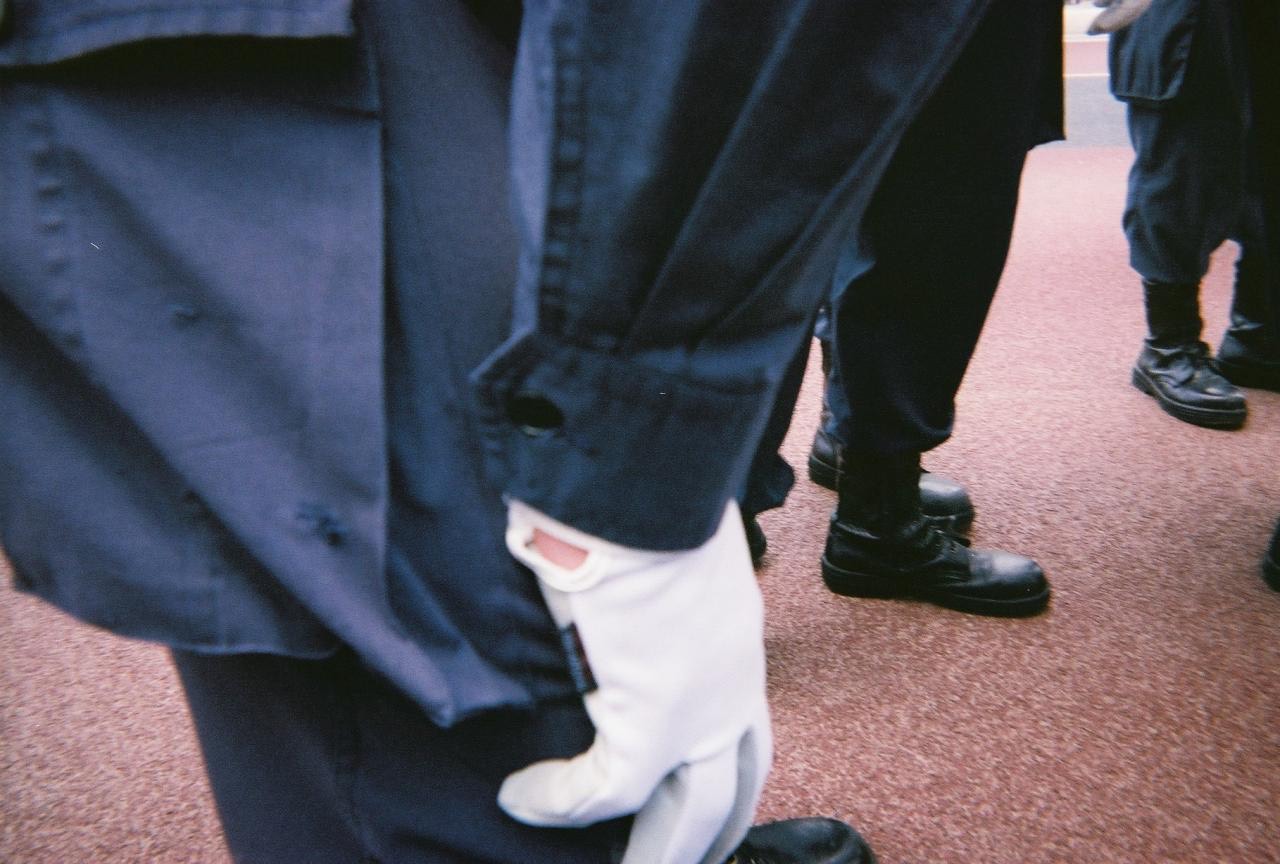
Image1: The police instructing the sit-in protesters to move, Henoko, 12. August 2024. © the author.
This systematized protest provides protesters with chances to express and disseminate their political opposition while avoiding ferocious physical damages and potential arrests. In this protest, protesters place their political goals not so much on stopping trucks per se as on embodying their refusal to capitulate to the Japanese government and disseminating their everyday efforts. This is illuminated by Masaru’s remark; as he described their protests in Henoko as a “symbol of historical struggle” recognized by outsiders, he emphasized the political functions of this protest to reproduce and circulate representations of the protests to those both within and beyond Okinawa. Often, the protests are scooped by journalists of the local newspaper companies, featured as the main theme by photographers and documentary filmmakers, and also researched by social scientists. These actors are welcomed and even encouraged to do their jobs because they are considered essential players to spread their struggles to the broader population.
In addition, newcomers who participate almost every day are welcomed by protesters and urged to play a role in disseminating the cause in mainland Japan. They are gently given the chance by protesters to ask any questions they have, and also sometimes provided with small presents. Before they leave, they are always urged by protesters to discuss what they learn with their family and friends. I was also one of those who was compelled by them to act to spread awareness on this issue in mainland Japan. One man asked me how I plan to keep engaged in the protests outside Okinawa and explain its importance, his calm voice reflecting his deep-seated conviction: “If Yamatonchu (those from mainland Japan) do not take any action, this militarization will not end. I always ask newcomers how they keep engaged in our causes in mainland Japan. I embrace immense respect for those who create the space to voice up for Okinawa on the mainland.” Protesters consider their everyday struggles as focal points that engender new connections, either through media or encounters in presence, with those unfamiliar with their struggles, and invite them to become their political allies. These encounters are understood by protesters as moments that could contribute to disseminating their causes and expanding national and international solidarity.
My interlocutor’s stories make it clear that they understand everyday practices of sharing their tribulation with those unfamiliar with their struggles as holding unforeseeable, yet immense potential to expand their political mobilization. They collectively make sense of these encounters as acts of planting what Massumi (2003, 222) describes as “seeds of change, connections in the making that might not be actuated or obvious at the moment”, yet that could generate future changes, repeatedly reminding themselves that “Dawn will eventually come”.
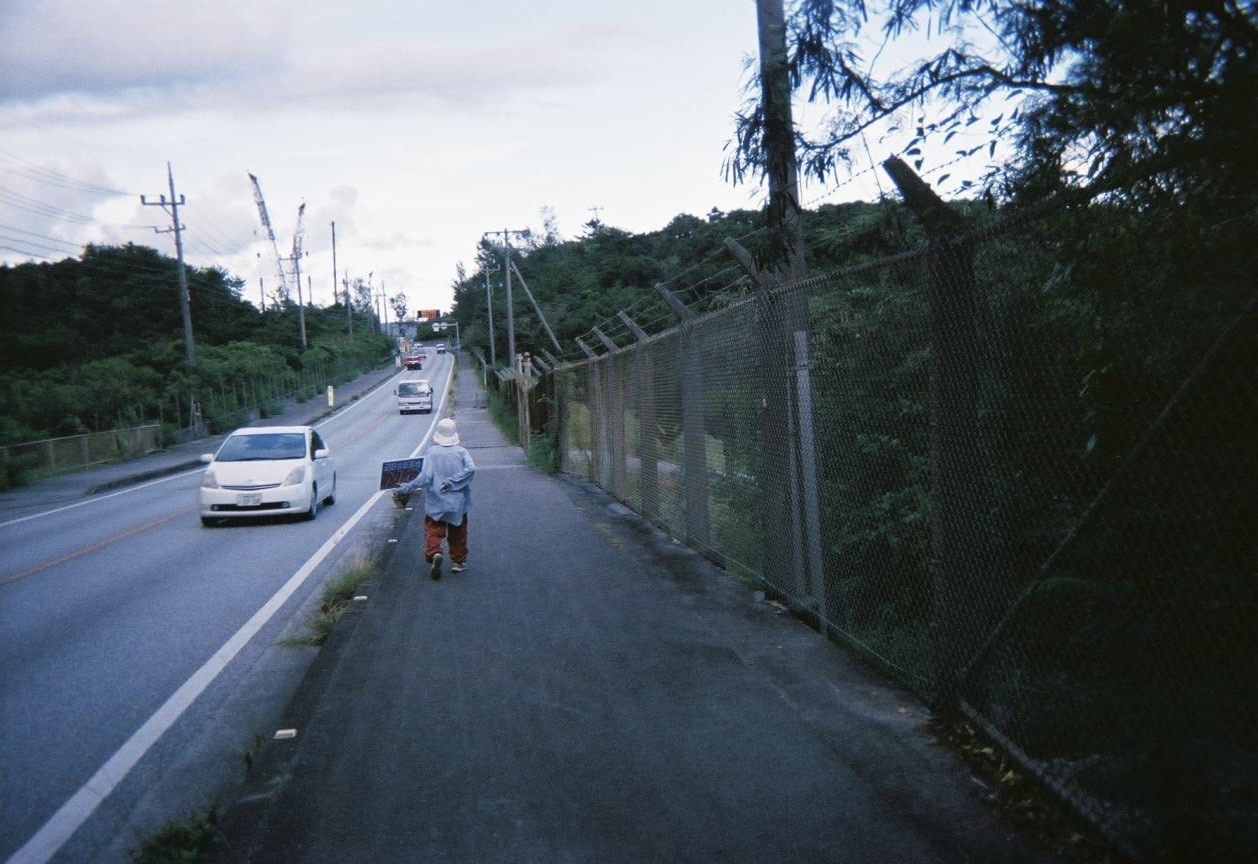
Image 2: A protester walks to the site of the sit-in protest, displaying a political banner to passing cars, Henoko, 15. August 2024. © the author.
Bibliography
Massumi, Brian, and Mary Zournazi. 2003. Navigating movements: an interview with Brian Massoumi. In Hope: New Philosophies for Change. Routledge.
Nago City Official Website. 2025. “Population and the number of households”. Last modified March 31, 2025. https://www.city.nago.okinawa.jp/about/population/